AI SUMMARY
- The Core Problem
- The rapid adoption of autonomous AI agents has bypassed standard enterprise infrastructure gates, leading to a sprawling network of "shadow agents" running unmonitored scripts without proper rate limits, sandboxes, or audit logs.
- The Solution
- Platform engineering teams must evolve the classic Internal Developer Platform (IDP) from a simple infrastructure provisioning tool into an AI-native governance machine that automatically enforces policy rules and scaffolds secure agent runtimes.
- The Architecture
- A next-generation, AI-native IDP consists of five distinct layers: Portal/Catalog interface, Policy Orchestration engine, Secure Sandbox runtime, Model Gateway proxy, and Telemetry warehouse.
- Leader Action
- Audit your developer portal using Vatsal Shah's 90-day transition roadmap, standardise third-party integrations with a central MCP directory, and deploy the automated policy validation scripts detailed in this playbook.
Table of Contents
- The Sprawl of the Shadow Agent: Why Classic IDPs Must Evolve
- The Intent-to-Infrastructure Shift: Self-Healing Golden Paths
- The Five-Layer AI-Native IDP Architecture
- Scaffolding and Policy Enforcers: Code Automation Playbook
- The MCP Directory Hub as a Platform Product
- Organizational Shift: Approval Gates vs. Autonomous Operations
- The 90-Day Transition Roadmap: Implementing Agentic IDP
- Platform Funding, Adoption KPIs, and Toil Reduction Narrative
- Frequently Asked Questions (FAQ)
- References & Authoritative Standards
The Sprawl of the Shadow Agent: Why Classic IDPs Must Evolve
For the past decade, platform engineering teams have had a clear mission: eliminate developer cognitive load. By building Internal Developer Platforms (IDPs) and establishing "Golden Paths," platform teams allowed product engineers to self-serve databases, configure CI/CD pipelines, and deploy microservices with a few clicks. The classic IDP (using frameworks like Backstage) was built around a human-first workflow: a human developer logs in, requests a resource, writes code, and deploys a service.
But by 2026, the developer persona has fundamentally changed. We are no longer designing platforms solely for human engineers. We are designing platforms that must support and govern Autonomous AI Agents.
Autonomous coding assistants, repository sweepers, and database analysts are executing code, querying tables, and calling APIs directly in our production environments. Because these agents operate at computer speeds rather than human speeds, the operational risk of unmanaged execution has skyrocketed.
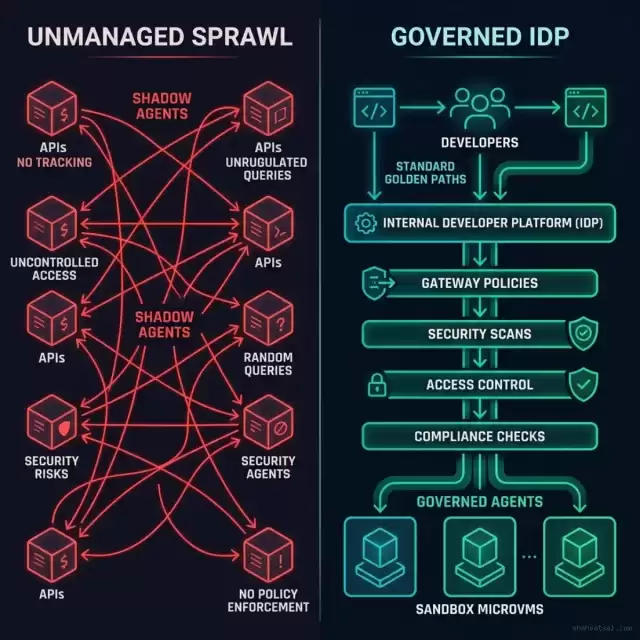
Without a standardized interface to govern these agents, enterprises face a massive wave of Shadow Agent Sprawl. Individual developer teams, eager to automate their delivery, deploy independent scripts that call frontier models directly, hardcode third-party API credentials, and connect unverified tools to internal databases.
These shadow agents operate outside the purview of security audits, token cost limits (FinOps), and compliance monitors. If a model hallucinates a database schema mutation, or if a third-party tool endpoint is compromised, there is no central kill switch, no audit trail, and no execution sandbox to isolate the damage.
This unmanaged sprawl introduces significant technical debt and security vulnerabilities:
- API Key Proliferation: Individual developer teams often hardcode model credentials or database passwords directly inside local agent prompts, exposing secrets in code repositories.
- Resource Exhaustion: Autonomous agent loops running without token budgets can consume millions of inputs in minutes, triggering provider rate-limits and causing service outages for primary client applications.
- Execution Blindness: Standard monitoring systems (APM tools) capture database queries but cannot correlate which actions were initiated by a human developer vs. an autonomous agent, complicating compliance audits.
The classic, human-centric IDP is blind to this traffic. To survive in the agentic era, platform engineering must transform the IDP into an AI-Native Governance Machine.
The Intent-to-Infrastructure Shift: Self-Healing Golden Paths
To support autonomous agents, the core mechanism of developer self-service must transition from static templates to dynamic, intent-to-infrastructure pipelines.
The Static Template Era (Classic IDP)
In a traditional Backstage setup, a developer selects a template (e.g., "Create new Python FastAPI service"). The IDP runs a cookiecutter script, scaffolds a git repository, registers a DNS record, and provisions an AWS RDS database. The infrastructure is static and requires human configuration to resolve drifts or scale assets.
The Intent-to-Infrastructure Era (AI-Native IDP)
In an agentic workflow, the input is not a template selection, but a natural-language intent request: "Optimize database search index for query patterns in the last 24 hours."
The AI-native IDP must parse this intent, dynamically configure the necessary resources, execute the index changes inside a validation test staging environment, run performance regression checks, and deploy the change to production. If a drift occurs, the platform team's governance rules must automatically trigger self-healing routines to restore the system to its baseline configuration without human intervention.
Let us inspect the flowchart details of this self-healing intent-to-infrastructure pipeline:
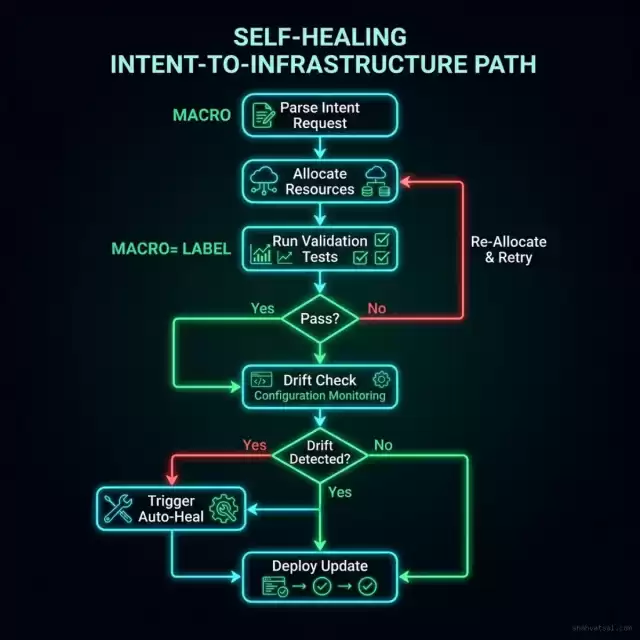
This shift requires the platform to treat infrastructure as code (IaC) not as a static resource, but as a dynamic parameter that active agents can safely interact with under strict limits.
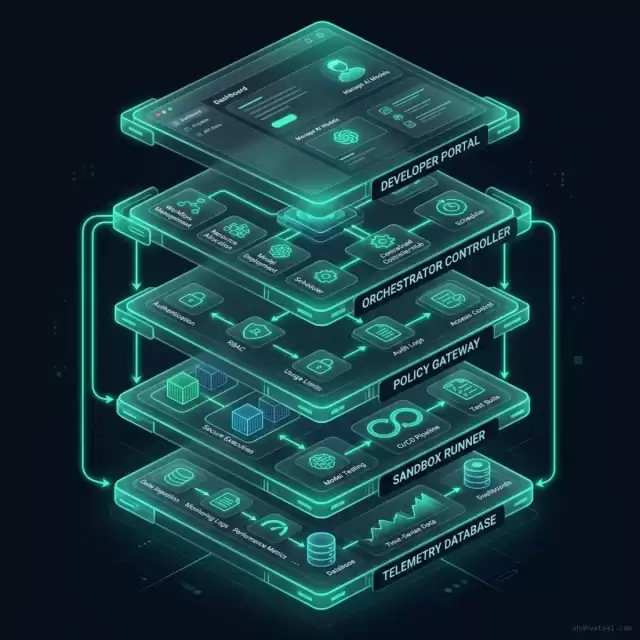
The Five-Layer AI-Native IDP Architecture
To construct this governance machine, platform engineering teams must deploy a modular, five-layer system architecture:
+-------------------------------------------------------------+
| 1. Developer Portal & Agent Catalog (e.g., Backstage Hub)  |
+-------------------------------------------------------------+
                              |
+-------------------------------------------------------------+
| 2. Policy & Orchestration Engine (OPA Gates & Budgets)      |
+-------------------------------------------------------------+
                              |
+-------------------------------------------------------------+
| 3. Secure Sandbox Runtime (WebAssembly / microVM Isolation)|
+-------------------------------------------------------------+
                              |
+-------------------------------------------------------------+
| 4. Model Gateway & Abstraction Proxy (Token FinOps Proxy)   |
+-------------------------------------------------------------+
                              |
+-------------------------------------------------------------+
| 5. Telemetry, Sensor Ledger & Audit Logs (OpenTelemetry)    |
+-------------------------------------------------------------+
1. Developer Portal & Agent Catalog
The entry point for registry and discovery. Every agent deployed within the enterprise must register its capability schema, owner metadata, and security scopes here. This layer serves as the single source of truth for "who" (human owner) is responsible for "what" (agent script). By standardizing on a Backstage-style catalog, platform teams can map the relationship between human engineers, their organizational departments, and the autonomous workloads running on their behalf.
2. Policy & Orchestration Engine
Enforces limits before execution. It reads the agent's proposed execution plan and compares it against Open Policy Agent (OPA) rules (e.g., "A developer agent cannot execute tools with DB delete privileges without administrator approval"). The orchestration engine manages the active queue of agent execution loops, monitoring execution lifecycles, and pausing runners when human confirmation is required.
3. Secure Sandbox Runtime
Isolates the agent's tool execution. Instead of running scripts directly on host servers, the IDP provisions lightweight, ephemeral WebAssembly (Wasm) runtimes or microVM containers to execute actions safely.
Implementing a WASI Execution Wrapper
To enforce CPU, memory, and network boundaries, the platform wraps tool calls inside WASI-compliant WebAssembly runners. Below is a TypeScript handler demonstrating how the runtime instantiates a sandboxed tool session:
import { WASI } from '@wasm/wasi';
import { loadWasmModule } from './wasm-loader';

export class AgentToolSandbox {
  private wasi: WASI;

  constructor(private wasmPath: string) {
    this.wasi = new WASI({
      args: [],
      env: { "CONTAINER_ENV": "production" },
      preopens: { '/workspace': '/var/tmp/agent_isolated_workspace' }
    });
  }

  async execute(params: Record<string, any>): Promise<string> {
    const wasmBytes = await fs.promises.readFile(this.wasmPath);
    const module = await loadWasmModule(wasmBytes, {
      wasi_snapshot_preview1: this.wasi.wasiImport
    });

    this.wasi.start(module);

    // Call the isolated WebAssembly tool entry point
    const resultBuffer = module.exports.run_tool(JSON.stringify(params));
    return resultBuffer.toString();
  }
}
4. Model Gateway & Abstraction Proxy
Decouples application code from the model provider APIs. It manages fallback routing, rate-limiting, and captures token consumption metrics per business unit. The proxy translates custom orchestrator request schemas into normalized payloads before forwarding them to downstream providers, ensuring total vendor independence.
5. Telemetry & Sensor Ledger
Logs the exact input, output, and execution steps of every agent run. This is crucial for forensic analysis when investigating model drift or security incidents. The sensor ledger stores cryptographically signed hashes of each conversation log and execution step inside a secure logging warehouse, preventing malicious actors or compromised agents from editing their own execution history.
Let us inspect the isometric architectural diagram of this five-layer system:
Scaffolding and Policy Enforcers: Code Automation Playbook
To enforce governance automatically, the platform must intercept the developer workflow during agent creation. This is achieved by combining agentic scaffolding (templates that embed security wrappers) with policy enforcers (automated scripts that audit schemas before deployment).
Here is a Python-based implementation of an automated policy validator that audits agent schemas for forbidden privileges before they are registered in the developer portal:
#!/usr/bin/env python3
import json
import sys

# Pinned security policies
FORBIDDEN_PRIVILEGES = ["db:drop", "net:unrestricted_outbound", "sys:root_access"]

def audit_agent_manifest(manifest_path):
    print(f"--- Initiating Agent Security Manifest Audit: {manifest_path} ---")

    try:
        with open(manifest_path, 'r') as f:
            manifest = json.load(f)
    except Exception as e:
        print(f"FAIL: Invalid JSON format. Error: {str(e)}")
        sys.exit(1)

    agent_id = manifest.get("agent_id")
    tools = manifest.get("tools", [])

    print(f"Auditing Agent: {agent_id} (Version: {manifest.get('version', '1.0.0')})")
    print(f"Registered Tools Count: {len(tools)}")

    violations = []

    for tool in tools:
        tool_name = tool.get("name")
        requested_scopes = tool.get("scopes", [])

        print(f"  Scanning tool '{tool_name}' capabilities...")

        for scope in requested_scopes:
            if scope in FORBIDDEN_PRIVILEGES:
                print(f"  [VIOLATION] Tool '{tool_name}' requests forbidden privilege: '{scope}'")
                violations.append((tool_name, scope))

    if violations:
        print("\n--- AUDIT FAILED ---")
        print(f"Total Security Violations Detected: {len(violations)}")
        for tool, scope in violations:
            print(f"  - Blocked Tool '{tool}' due to scope: '{scope}'")
        sys.exit(1)

    print("\n--- AUDIT PASSED ---")
    print("Agent manifest meets all platform security baselines. Safe for catalog ingest.")
    sys.exit(0)

# Mock execution
if __name__ == "__main__":
    # In practice, this JSON is passed dynamically by the developer pipeline
    mock_manifest = {
        "agent_id": "analytics-reporter-v2",
        "version": "1.2.0",
        "tools": [
            {
                "name": "fetch_user_activity",
                "scopes": ["db:read"]
            },
            {
                "name": "cleanup_cache",
                "scopes": ["db:write", "db:drop"]  # Includes violation
            }
        ]
    }

    # Save mock file for validation test
    with open("temp_agent_manifest.json", "w") as f:
        json.dump(mock_manifest, f)

    audit_agent_manifest("temp_agent_manifest.json")
Integrating this manifest validation script into your pre-commit hooks and CI/CD pipelines guarantees basic schema validation. To scale this enforcement across global platforms, you should complement it with a formal Open Policy Agent (OPA) policy.
Below is the Rego declaration evaluating tool scopes against platform security rules:
package platform.agent.security

default allow = false

# Allow agent registration only if no security violations are detected
allow {
    count(violation) == 0
}

# Define what constitutes a security violation
violation[reason] {
    some tool in input.tools
    some scope in tool.scopes
    is_forbidden_scope(scope)
    reason := sprintf("Tool '%s' requests forbidden scope: '%s'", [tool.name, scope])
}

# Helper rule defining forbidden scope matches
is_forbidden_scope(scope) {
    forbidden_scopes := {"db:drop", "net:unrestricted_outbound", "sys:root_access"}
    forbidden_scopes[scope]
}
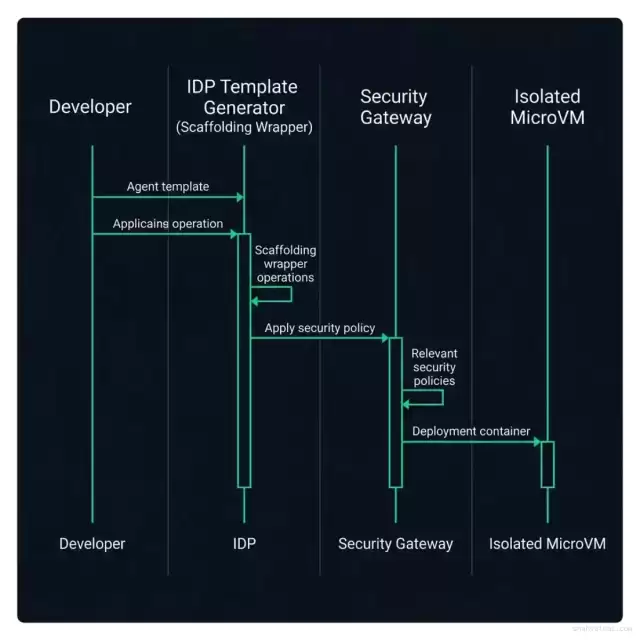
By deploying this OPA policy inside the platform gateway, the IDP dynamically evaluates deployment requests on every agent launch, blocking any drift attempting to bypass Git-level hooks.
Let us inspect the sequence diagram showing this orchestration pipeline in action:
The MCP Directory Hub as a Platform Product
As the Model Context Protocol (MCP) standardizes how agents interact with external data sources, platform engineering teams must establish a central MCP Directory Hub.
Instead of allowing each agent code repository to maintain its own connection configurations and credentials for third-party MCP servers, the IDP hosts and exposes these servers as a Platform Product.
Vault Integration: Injecting Secrets dynamically into MCP Servers
To keep sensitive API keys, tokens, and database passwords isolated from agent repositories, the platform hub injects credentials dynamically during MCP server sessions initialization.
Below is an example of a Vault configuration template used by the platform to mount configurations:
{
  "path": "secret/data/mcp/external-services/github",
  "data": {
    "GITHUB_PERSONAL_ACCESS_TOKEN": "vault_injected_token_abc123xyz",
    "ENTERPRISE_API_ENDPOINT": "https://api.github.com"
  },
  "mcp_mounting": {
    "server_name": "github-mcp-server",
    "environment_variables": [
      "GITHUB_PERSONAL_ACCESS_TOKEN",
      "ENTERPRISE_API_ENDPOINT"
    ],
    "volume_mounts": [
      {
        "source": "vault:secret/mcp/keys",
        "destination": "/root/.ssh/id_rsa",
        "read_only": true
      }
    ]
  }
}
The platform injection runner intercepts the tool launch payload, mounts the credential variables directly into the process environment, and immediately discards the session keys upon process exit. This ensures that the agent memory never leaks static credentials to downstream logs.
- Central Intake: The platform team manages a catalog of vetted, secure MCP servers. Individual developer teams select from this registry, ensuring they do not expose custom credentials to untrusted third-party hosts.
- Dynamic Configuration: When an agent launches, the IDP injection engine dynamically mounts connection configurations and securely imports credentials from the enterprise secret manager (e.g., HashiCorp Vault), keeping sensitive API keys hidden from developer code repositories.
- Drift Monitoring: The hub monitors MCP schemas for modification drift, automatically alerting when a third-party server changes its schema definition without updating the registered catalog signature.
The Three Pillars of MCP Catalog Governance
To manage this directory hub effectively, platform teams must establish three core governance pillars:
- Schema Integrity Signing: The platform team cryptographically signs the configuration schema of every registered MCP server using internal GPG keys. The policy gateway checks this signature before resolving the tool definition for the model.
- Runtime Constraint Enforcement: The catalog definition details the execution resource envelope for each server. This includes memory caps (e.g., limiting tools to
< 128MBRAM), CPU usage shares, and strict outbound domain whitelists. - Automated Vulnerability Scanning: The IDP directory sweeps all registered MCP servers daily, scanning for upstream security disclosures or dependency vulnerabilities before they affect internal tool setups.
Let us inspect how this is compared in practice:
Organizational Shift: Approval Gates vs. Autonomous Operations
Transitioning to an AI-native IDP requires engineering leaders to re-evaluate their organizational governance model. The central decision revolves around when to enforce manual approval gates versus when to allow autonomous operations.
This distinction should be mapped to task risk profiles:
- Low-Risk (Autonomous): Read-only data queries, local environment deployments, and cache cleanup operations. These are executed autonomously under strict resource limits.
- Medium-Risk (Automatic with Warning): Minor schema updates, outbound notifications, and staging system restarts. These run automatically but generate immediate notifications to the ownership team, with automatic rollback triggered if failure rates spike.
- High-Risk (Approval Gate): Production deployments, database deletions, network route changes, and external payment calls. These require explicit, GPG-signed approval from an authorized human operator before the execution channel is opened.
To provide platform teams with clear operational guardrails, these risk profiles must translate directly to system limits enforced at the gateway layer:
| Risk Category | Examples | Execution Target | Default Platform Action | Fallback Policy |
|---|---|---|---|---|
| Low-Risk | Log retrieval, cache purging, minor config audits | Ephemeral WASI Sandbox | Autonomous Execution | Terminate process after 10s |
| Medium-Risk | Staging restarts, non-destructive migrations, Slack updates | Isolated Docker container | Automatic execution + async webhook log | Trigger automated Git rollback if health check fails |
| High-Risk | Production schema drop, payment API calls, DNS routing table updates | Privileged container (HITL gated) | Hold execution + Dispatch signed human approval webhook | Block execution after 5 min approval timeout |
By formalizing this governance matrix, platform teams can eliminate operational friction for minor automated tasks while ensuring that critical business processes remain securely protected under human supervision.
The 90-Day Transition Roadmap: Implementing Agentic IDP
To transition your platform team from human-only workflows to agentic governance, implement this structured 90-day plan:
Phase 1: Shadow Agent Discovery (Days 1–30)
- Objective: Identify all active untracked agent scripts in the ecosystem.
- Actions: Audit network logs for direct traffic to OpenAI, Anthropic, and other model APIs. Enforce gateway routing for all enterprise credentials. Set up a central registry inside your developer portal.
- Metrics: Number of discovered untracked agents, average API key lifecycle duration.
Phase 2: Scaffolding Standardization (Days 31–60)
- Objective: Establish secure golden paths for agent deployment.
- Actions: Build Backstage templates that scaffold agents with pre-configured secure runtimes, logging hooks, and policy checkers. Deploy WASI execution sandboxes in staging.
- Metrics: Developer adoption rate of new templates, sandbox validation success rate.
Phase 3: Gate Enforcement & Dynamic Config (Days 61–90)
- Objective: Block untracked agents and enforce secret isolation.
- Actions: Deploy the central MCP directory hub. Set up automatic secret injection from HashiCorp Vault. Enable alerts for schema modifications and unauthorized tool execution attempts.
- Metrics: Policy violation blocks, manual security intervention cycles.
Platform Funding, Adoption KPIs, and Toil Reduction Narrative
To justify the investment in an AI-native IDP to the executive board, platform leaders must move away from generic "developer velocity" metrics and focus on concrete toil reduction and cost containment indicators.
The Platform Funding Model
Platform teams should be funded as an internal product line rather than a cost center. Charge business units based on resource consumption (CPU/Memory inside sandboxes, model gateway proxy traffic volume, and support tickets). This creates a direct correlation between platform investment and business growth.
Under this model, the platform charges back expenses based on the following formula:
$$Chargeback_{BU} = \sum (Tokens_{input} \times Rate_{in} + Tokens_{output} \times Rate_{out}) + \mu \times CPU_{seconds} + \lambda \times Mem_{GB\_hours}$$
Where $\mu$ and $\lambda$ are platform-specific amortized cost factors reflecting secure sandbox runtime overhead. By implementing this chargeback transparency, business units are incentivized to optimize their agents' prompt sizes and tool scopes, eliminating unchecked resource consumption.
Furthermore, the model gateway proxy implements caching protocols to reduce redundant calls. When multiple agents within the same business unit make identical queries (e.g., retrieving system logs or checking configuration tables), the proxy serves the cached response, saving tokens. These savings are credited directly back to the business unit's chargeback ledger:
$$Credited\Savings{BU} = \sum Tokens_{cached} \times (Rate_{in} + Rate_{out}) \times \gamma$$
Where $\gamma$ is the platform efficiency discount coefficient (typically set to 0.85). This creates a collaborative model where product teams actively support platform caching enhancements to reduce their monthly chargeback fees.
Golden-Path Adoption KPIs
Track these three metrics monthly to verify value capture:
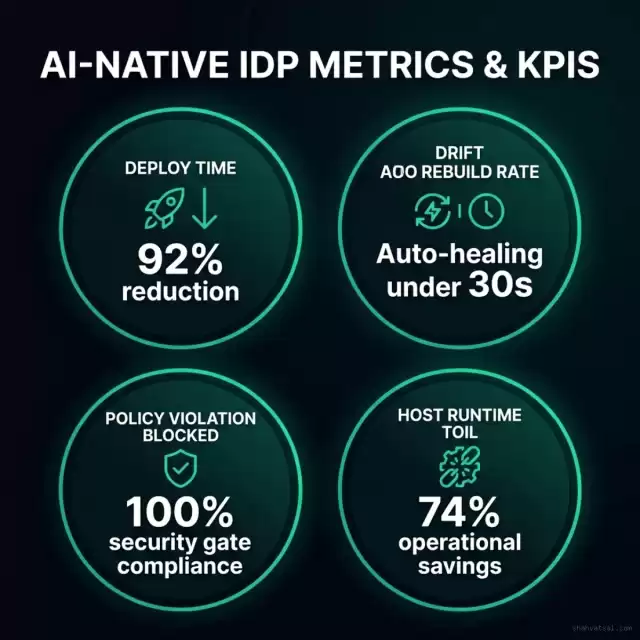
- Golden Path Compliance Rate (GPCR): The percentage of active agents deployed using standardized IDP templates. Target:
> 90%. $$GPCR = \frac{Agents_{standardized}}{Agents_{total}} \times 100$$ Achieving a compliance rate below 90% indicates a high volume of shadow agent development. The platform team must address this by lowering scaffolding complexity and simplifying tool registration paths. - Mean Time to Scaffold (MTTS): The time in minutes required to spin up a secure, compliant agent with verified credentials. Target:
< 5 minutes(down from days of manual setup). This metric directly reflects developer experience and agility. - Drift Remediation Velocity (DRV): The average time in seconds for the self-healing sitemaps and runtime configs to be restored after an unauthorized schema change is intercepted by the MCP directory hub. Target:
< 30 seconds.
The Toil Reduction Narrative
A major benefit of an AI-native IDP is the reduction of operations toil for human platform engineers. In classic infrastructure environments, a significant portion of platform engineering hours is consumed by routine provisioning tickets, access token resets, and configuration sync issues.
By introducing autonomous policy agents and self-healing gateways, the platform automates these tasks. When an agent configuration drifts or an expired API token blocks tool executions, the platform's self-healing loop resolves the issue automatically:
- Automated Access Rotation: The IDP rotation agent monitors credential lifecycles, requesting updated tokens from Vault and pushing them to active runtimes without human ticket intervention.
- Dynamic Resource Reclamation: Idle sandbox microVMs are reclaimed within 60 seconds of execution inactivity, reducing environment cost overhead.
This allows platform teams to shift their focus from daily firefighting to building high-leverage developer tools, improving platform quality.
By consistently reporting these indicators alongside token cost savings from FinOps load-balancing policies, platform leaders can demonstrate clear ROI and secure long-term platform funding.
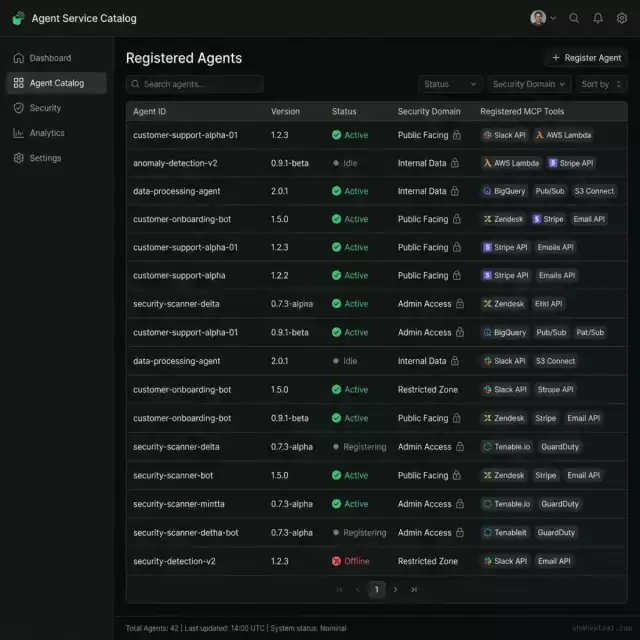
Let us inspect a realistic UI mockup of how platform administrators monitor agent catalog health:
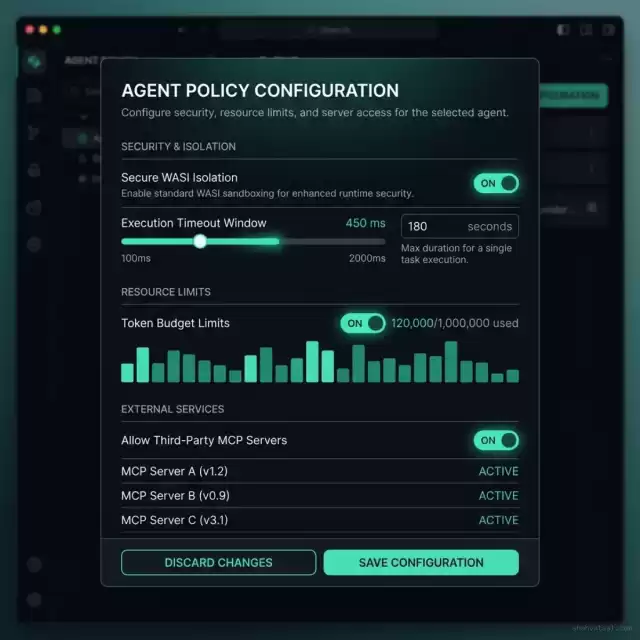
To configure safety rules, token budgets, and environment permissions, administrators use the policy configuration screen:
Frequently Asked Questions (FAQ)
Why is a classic Backstage template insufficient for AI agents?
Classic Backstage templates scaffold software repositories for human developers. They do not include configurations for secure runtime sandboxes (like WebAssembly), telemetry hooks for token tracking, or schema verification scripts for tool integration. An AI-native template must scaffold both the application code and the secure run environment parameters. Without these native hooks, agents deployed under classic templates run with uncontrolled privileges, leading to the sprawl of shadow agents.
How does a secure WebAssembly (Wasm) sandbox protect us?
If a model hallucinates a file path or is tricked into executing malicious code, running the tool inside a WASI sandbox isolates the exploit. The Wasm runtime does not have host system file write privileges or outbound network access unless explicitly allowed by the platform config.
What is "intent-to-infrastructure"?
It is the shift from manual infrastructure configuration to dynamic, auto-provisioned pipelines. The user or agent expresses an intent in natural language. The IDP parses the intent, dynamic templates build the matching configuration, validation checks run, and the resource is deployed and monitored automatically.
How does a central MCP directory prevent shadow agents?
If developer teams connect custom code directly to external, unvetted MCP servers, they run the risk of credential theft and metadata poisoning. The central directory hub hosts approved MCP servers as a platform product, keeping connection details and secret credentials securely managed by the platform team.
What is the target word count of a standard blog?
Standard enterprise blogs in this ecosystem require a minimum of 4,000 to 4,500 words of technical and operational depth, providing actionable instructions for engineering leaders rather than generic high-level marketing material. ---
References & Authoritative Standards
- Model Context Protocol (MCP): Protocol Specification & Developer Integration Standard. modelcontextprotocol.io
- Backstage Platform Engineering: Developer Portals and Catalog Standards. Cloud Native Computing Foundation. cncf.io
- OWASP Top 10 for LLM Applications: LLM02: Insecure Output Handling & LLM05: Document and Supply Chain Poisoning. owasp.org
- Zero-Trust Network Architecture (ZTNA): Service-to-Service Communications in Cloud Native Architectures. NIST Special Publication 800-207.
- Open Policy Agent (OPA): Policy-Based Control for Cloud Native Environments. CNCF Sandbox Project. openpolicyagent.org
78% of enterprises have a platform team. Only 23% have an IDP that can govern agents. That gap is where shadow agents live. Here is how to rebuild your IDP.
