Tickets track activity. Briefs encode intent, verification, and outcome attribution—machine-routable from the millisecond of creation. In the era of autonomous AI coding agents, the traditional Jira or Linear ticket has suffered a catastrophic structural collapse. Explore the anatomy of the Machine-Routable Brief, verification-driven definitions of done, and the PM 3.0 operating model connecting code directly to North Star metrics.

Executive Summary: The Structural Collapse of the 20th-Century Ticket
For more than three decades, software development operated under an unquestioned foundational atom: the ticket.
Whether instantiated in Bugzilla in the late 1990s, Jira in the 2000s, or Linear in the 2020s, the ticket has served as the universal container for human work. It was designed to capture a human's informal intent, provide a shared canvas for conversational comments, and move through a visual Kanban column pipeline—from Backlog to In Progress, In Review, and finally to the coveted Done.
In 2026, this century-old construct has suffered a catastrophic structural collapse.
The root cause of this failure is not bad project management; it is the collision between human-centric process tracking and autonomous AI agents. When organizations deploy autonomous software engineering fleets—such as Google Antigravity, Jules, Cursor, and Claude Code—tickets immediately become the primary operational bottleneck of the enterprise.
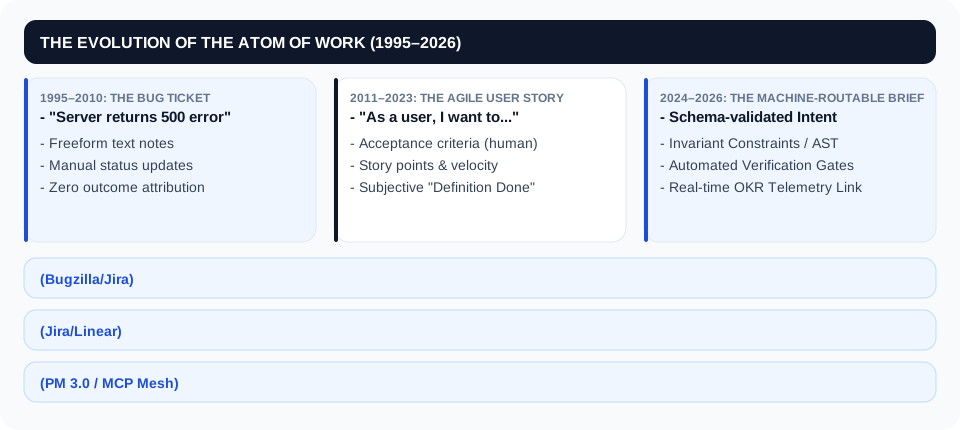
Traditional tickets fail autonomous agents for three fatal architectural reasons:
- Ambiguous "Done-ness": A ticket's "Definition of Done" is almost always subjective, narrative, and unverified. It relies on a human developer declaring that work is complete by manually dragging a card across a board. Autonomous agents cannot execute against subjective narratives; they require deterministic, executable verification gates.
- Zero Invariant Constraints: Tickets capture what to build, but utterly fail to define what not to touch. When an autonomous agent touches a codebase to satisfy an ambiguous ticket, it frequently hallucinates architectural changes, introduces unvetted third-party dependencies, or alters security boundaries outside its intended scope.
- Complete Disconnection from Business Outcomes: A ticket measures activity (busyness, velocity points, tickets closed), completely divorced from outcomes (conversion lift, latency reduction, customer retention). Teams celebrate closing 45 sprint tickets while their core business metrics remain flat.
The solution emerging across top-tier technology enterprises in 2026 is The Brief as a Machine-Routable Work Unit.
A Brief is not a ticket. It is an executable, schema-validated contract that encodes semantic intent, explicit boundary constraints, multi-layered machine verification gates, and direct real-time telemetry links to enterprise North Star OKRs. It is machine-routable from the millisecond of creation, allowing product management to transition from managing human task queues to governing an autonomous cognitive workforce.
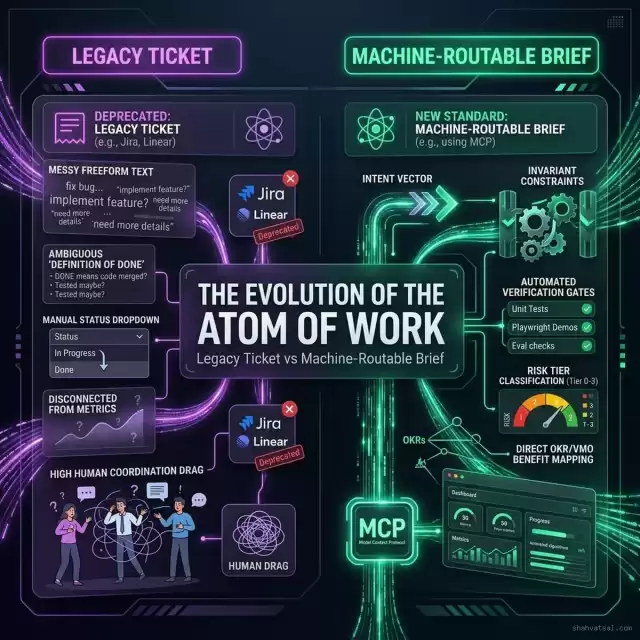
The Anatomy of a Machine-Routable Brief: Dissecting the 5 Core Layers
A Machine-Routable Brief redesigns the fundamental atom of engineering work. It is structured not as informal prose, but as a five-layered cryptographic work object that both human engineers and autonomous agents can parse, validate, and execute without ambiguity.
The 5 Architectural Layers of a Brief
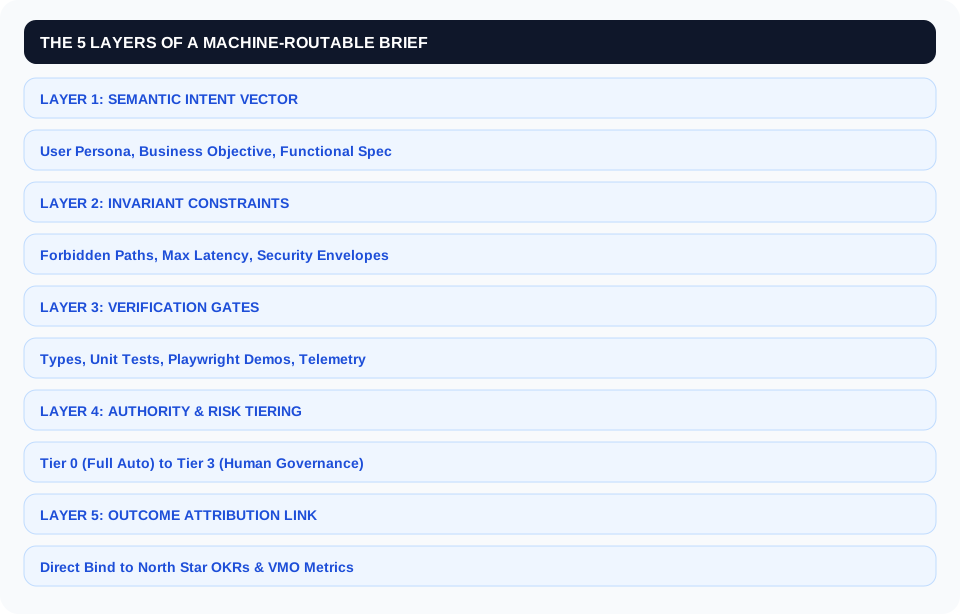
Layer 1: Semantic Intent Vector
The Intent Vector defines the core functional transformation requested by the business. Rather than vague user stories ("As a customer, I want to checkout faster"), the Intent Vector provides:
- Exact Actor Context: Roles, authorization scopes, and tenant profiles.
- State Transition Graph: High-precision input schemas, expected state changes, and output schemas.
- Reference Context: Direct semantic bindings to design tokens, API specifications, and regulatory compliance standards.
Layer 2: Invariant Constraints & Blast Radius
The critical difference between an agent-ready brief and a legacy ticket is the explicit definition of what must never change:
- Forbidden Filesystem Paths: Hard boundaries preventing agents from modifying security configurations, root Dockerfiles, or database credential vaults.
- Performance Budgets: Strict computational constraints (e.g., "p99 API latency must remain $\le 45\text{ms}$; client bundle size must not increase by more than $12\text{KB}$").
- SDK & Dependency Whitelists: Zero-tolerance policies against introducing unapproved third-party libraries.
Layer 3: Automated Verification Gates
A Brief contains its own self-executing verification harness. Work is not complete when an agent says "I'm done"; work is complete when the Brief's verification gates evaluate to true:
- Static Analysis Gate: Strict type checking (
tsc --strict,mypy --strict) and zero linter warnings. - Regression Gate: Branch test coverage ($\ge 90\%$) with zero broken existing tests.
- Synthetic Demonstration Gate: Automated headless browser traces (e.g., Playwright recordings) validating visual UI transitions.
- Telemetry Canary Gate: Production metric telemetry verifying that error rates and latencies remain within statistical bounds.
Layer 4: Authority & Risk Tiering
Every Brief is classified into an explicit risk tier that determines its execution pipeline:
- Tier 0 (Full Autonomous): Low-risk tasks (test generation, documentation sync, dependency updates) that agents execute and merge without human involvement.
- Tier 1 (Multi-Agent Consensus): Medium-risk tasks verified by a dual-agent critic architecture.
- Tier 2 (Human-Gated Approval): High-risk features (API schema contracts, database migrations) requiring senior human sign-off before merge.
- Tier 3 (Human-Led Governance): Mission-critical logic (authentication, billing algorithms) where humans write the core architecture and agents provide assistance.
Layer 5: Outcome & North Star Attribution
Every Brief is cryptographically bound to an enterprise OKR key or Value Management Office (VMO) metric. When the code deploys, the Brief's telemetry tags track real-world user behavior to prove whether the feature achieved its hypothesized business benefit.
Comprehensive Comparison: Legacy Ticket vs. Machine-Routable Brief
| Architectural Dimension | Legacy Ticket (Jira / Linear) | Machine-Routable Brief (PM 3.0) |
|---|---|---|
| Data Format | Unstructured rich-text / markdown | Schema-validated, type-safe JSON / YAML |
| Primary Consumer | Human software engineer | Multi-agent AI fleet and human technical leads |
| Definition of Done | Subjective acceptance criteria checklist | Machine-executable verification gates (Tests, Evals, Demos) |
| Scope Enforcement | Vague descriptions; prone to scope creep | Hard invariant constraints and restricted filesystem boundaries |
| Progress Tracking | Manual dragging of Kanban board cards | Automated state transitions triggered by verification passes |
| Risk Management | Ad-hoc labels ("P0", "Urgent", "Bug") | Formal Authority Risk Tiers (Tier 0 to Tier 3) |
| Context Integration | Dead links to outdated Figma or Confluence | Living Model Context Protocol (MCP) semantic context bindings |
| Business Alignment | Story points and sprint velocity | Direct mathematical attribution to enterprise North Star OKRs |
Production Enterprise Brief Schema (JSON Schema)
Below is the authoritative JSON Schema defining an enterprise-grade Machine-Routable Brief:
{
  "$schema": "https://json-schema.org/draft/2020-12/schema",
  "title": "MachineRoutableBrief",
  "type": "object",
  "required": [
    "brief_id",
    "version",
    "intent_vector",
    "invariant_constraints",
    "verification_gates",
    "risk_tier",
    "outcome_attribution"
  ],
  "properties": {
    "brief_id": {
      "type": "string",
      "pattern": "^BRIEF-[A-Z]{3,6}-[0-9]{4,8}$"
    },
    "version": {
      "type": "string",
      "default": "1.0.0"
    },
    "intent_vector": {
      "type": "object",
      "required": ["title", "objective", "actor_scope", "target_artifacts"],
      "properties": {
        "title": { "type": "string" },
        "objective": { "type": "string" },
        "actor_scope": { "type": "string" },
        "target_artifacts": {
          "type": "array",
          "items": { "type": "string" }
        }
      }
    },
    "invariant_constraints": {
      "type": "object",
      "required": ["forbidden_paths", "max_latency_budget_ms", "max_bundle_increase_kb"],
      "properties": {
        "forbidden_paths": {
          "type": "array",
          "items": { "type": "string" }
        },
        "max_latency_budget_ms": { "type": "number" },
        "max_bundle_increase_kb": { "type": "number" },
        "allowed_dependencies": {
          "type": "array",
          "items": { "type": "string" }
        }
      }
    },
    "verification_gates": {
      "type": "array",
      "items": {
        "type": "object",
        "required": ["gate_id", "gate_type", "validation_command", "success_criteria"],
        "properties": {
          "gate_id": { "type": "string" },
          "gate_type": {
            "type": "string",
            "enum": ["STATIC_ANALYSIS", "UNIT_COVERAGE", "SYNTHETIC_E2E", "CANARY_TELEMETRY"]
          },
          "validation_command": { "type": "string" },
          "success_criteria": { "type": "string" }
        }
      }
    },
    "risk_tier": {
      "type": "integer",
      "enum": [0, 1, 2, 3],
      "description": "0=Full Auto, 1=Agent Consensus, 2=Human Gated, 3=Human Led"
    },
    "outcome_attribution": {
      "type": "object",
      "required": ["north_star_metric", "okr_key", "hypothesized_delta"],
      "properties": {
        "north_star_metric": { "type": "string" },
        "okr_key": { "type": "string" },
        "hypothesized_delta": { "type": "string" },
        "telemetry_metric_name": { "type": "string" },
        "attribution_window_days": { "type": "integer", "default": 14 }
      }
    }
  }
}
Verification-Driven Done: Eliminating the Subjective "Status Column Drag"
In traditional Agile methodologies, "Done" is a psychological event. An engineer finishes writing code, clicks a mouse, and drags a Jira or Linear card from the In Review column into Done.
This manual status transition is fundamentally flawed:
- It creates a false sense of security; code merged is mistaken for value delivered.
- It permits incomplete work, untested edge cases, and documentation regressions to pass silently into production.
- It forces human managers to spend countless hours conducting status synchronization meetings ("standups") to ask whether cards marked "Done" are actually working.
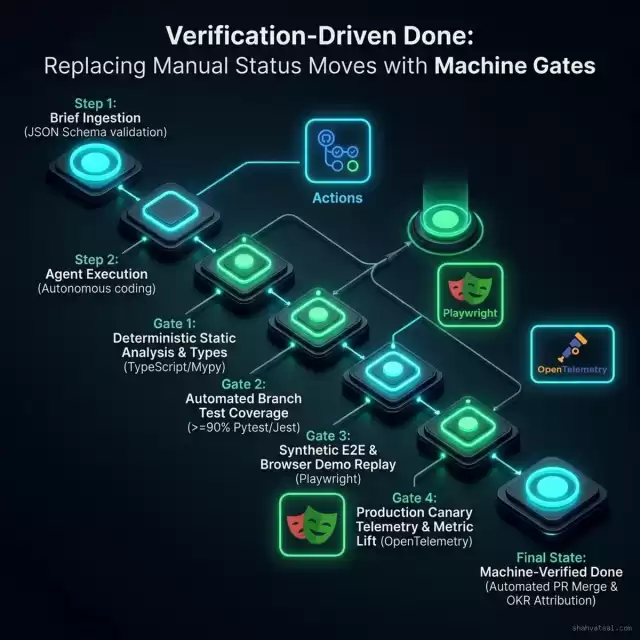
In the PM 3.0 operating model, manual status column moves are deprecated. Work moves from state to state through Verification-Driven Done—a deterministic state machine governed by automated, cryptographic metric gates.
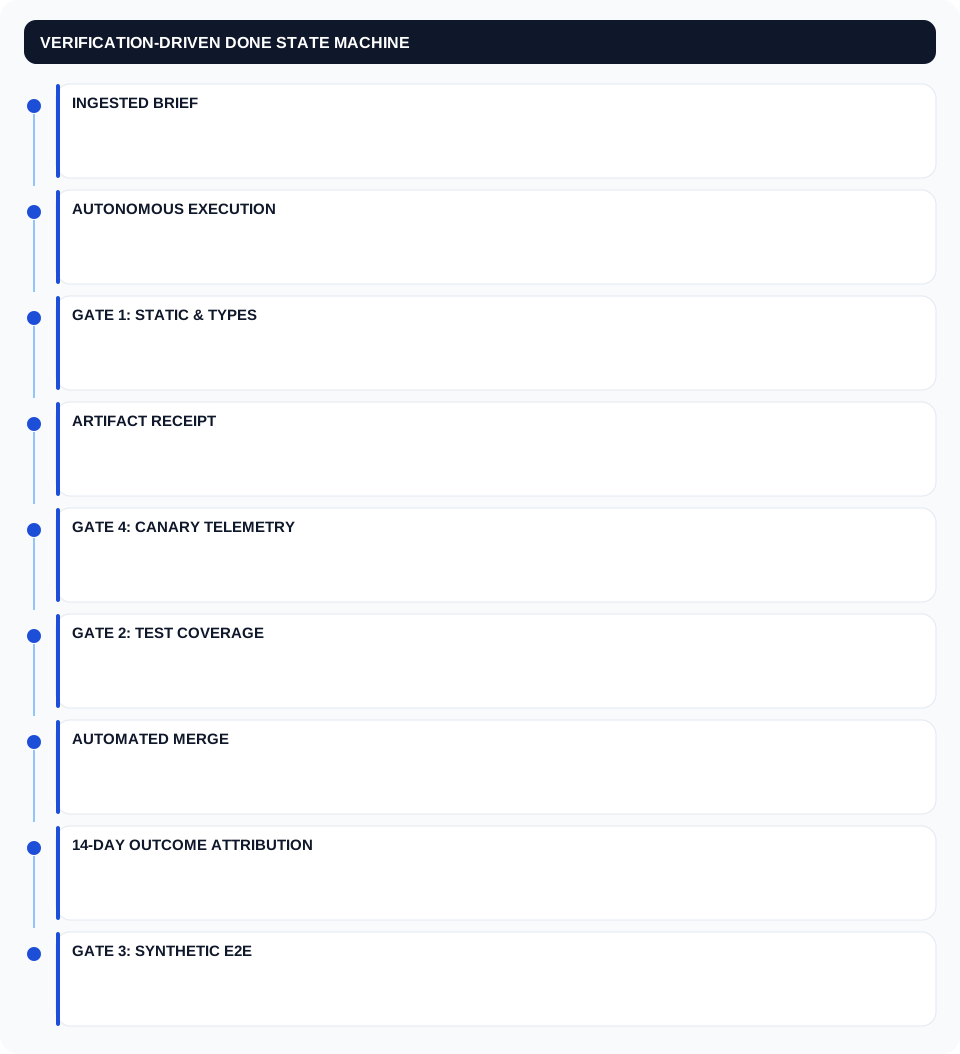
The 4 Progressive Machine Verification Gates
Gate 1: Static Analysis, Types & Boundary Validation
Before an agent's code diff can even be submitted to a test runner, the system executes deterministic compiler and static analysis gates:
- Strict Type Validation: TypeScript (
tsc --noEmit --strict) or Python (mypy --strict) must pass with zero type errors. - Invariant Boundary Enforcement: A custom abstract syntax tree (AST) linter inspects the modified files against the Brief's
forbidden_paths. If an agent touched an unpermitted directory or altered an IAM policy, the execution is instantly rejected.
Gate 2: Automated Branch Coverage & Property-Based Testing
Unit tests alone are insufficient because AI agents are skilled at generating trivial tests that pass without exercising boundary conditions.
- Branch Coverage Threshold: The agent must generate unit and integration tests that achieve $\ge 90\%$ branch coverage across all modified functions.
- Mutation & Property-Based Testing: Tools like Hypothesis or Stryker inject synthetic bugs into the agent's code. If the test suite fails to detect the mutation, the gate fails.
Gate 3: Synthetic E2E & Browser Demo Replays (Playwright)
For frontend and user-facing workflows, text diffs do not prove that an experience is functional or visually appealing.
- Headless Browser Execution: The agent executes a headless Playwright script that navigates the modified UI, fills out forms, triggers error states, and captures full-motion WebP video recordings.
- Multimodal Evaluation: A secondary vision-language model evaluates the recorded session against the Brief's visual design criteria, confirming that animations, contrast ratios, and responsive layouts adhere to enterprise design tokens.
Gate 4: Production Canary Telemetry & Metric Lift
The ultimate definition of done does not end at git merge; it ends in the production telemetry pipeline.
- Canary Rollout Verification: The Brief's generated container is deployed to a 10% canary slice in Google Kubernetes Engine (GKE) or AWS ECS.
- Real-Time Anomaly Detection: An OpenTelemetry collector monitors error rates, p99 latencies, and memory utilization for 15 minutes. If anomalies are detected, the canary automatically rolls back, and the diagnostic trace is fed back into the agent's context.
Only when all four gates evaluate to green is the work object stamped with a Cryptographic Done Receipt, allowing the automated merge to proceed.
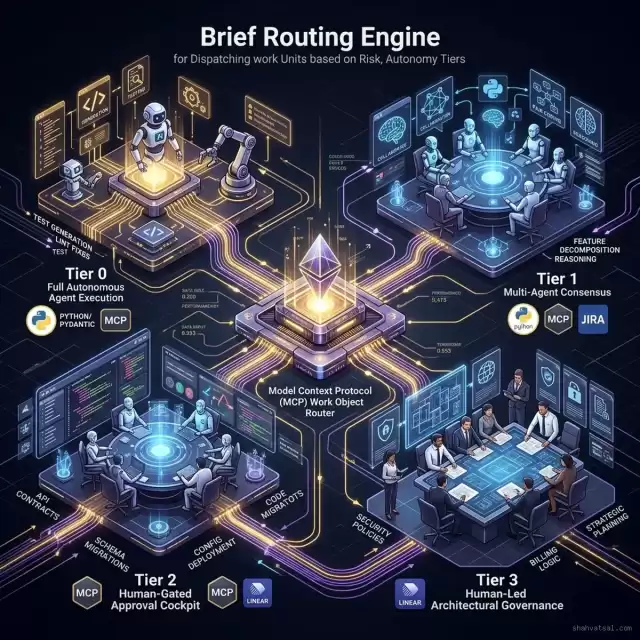
The Brief Routing Engine: Dispatching Work Units Across the Risk-Autonomy Spectrum
Not all engineering tasks carry the same consequence. Instructing an autonomous agent to fix a typo in documentation carries near-zero operational risk; instructing an agent to rewrite the database connection pooling logic for an enterprise core banking ledger carries catastrophic risk.
The Brief Routing Engine is the intelligent dispatch layer that reads an incoming Machine-Routable Brief, evaluates its complexity and blast radius, and routes it to the optimal operational quadrant.
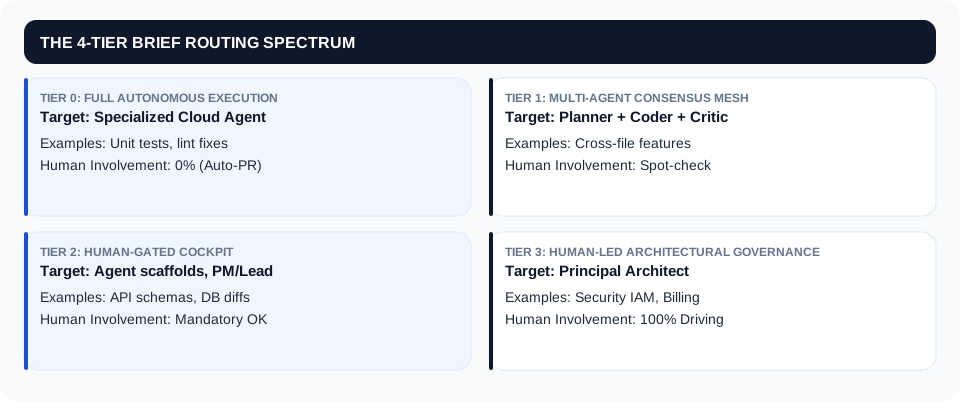
The 4 Autonomy Risk Tiers
Tier 0: Pure Autonomous Execution (Zero Human Loop)
- Characteristics: Bounded blast radius; deterministic test suites; zero database schema alterations; zero security perimeter impact.
- Workflow: The Brief is dispatched via Model Context Protocol (MCP) to an asynchronous worker agent (e.g., Jules or Claude Code). The agent branches, implements code, satisfies Gates 1 and 2, opens a Pull Request, and auto-merges upon CI green.
- Typical Tasks: Dependency version bumps, unit test coverage expansion, linter deprecation fixes, documentation synchronization.
Tier 1: Multi-Agent Consensus & Self-Healing
- Characteristics: Moderate architectural complexity; spans 3 to 10 files; requires coordinated state management.
- Workflow: A Planner Agent breaks the Brief into discrete tasks; a Coding Agent writes the code; an independent Critic Agent runs the verification gates and attempts adversarial attacks against the implementation. Only when consensus is achieved across all three agents is a PR opened.
- Typical Tasks: Adding new CRUD API endpoints, building standard frontend views, integrating non-critical third-party webhooks.
Tier 2: Human-Gated Approval Cockpit
- Characteristics: High business or architectural impact; alters external API schemas; introduces database migrations; affects critical customer journeys.
- Workflow: The autonomous agent executes the full implementation and passes Gates 1, 2, and 3. However, the PR is locked behind a Human Approval Cockpit. The PM and Technical Lead receive an interactive dashboard containing:
1. The semantic intent diff.
2. The Playwright synthetic video walkthrough.
3. The automated performance impact estimate.
With a single click, the lead approves deployment.
- Typical Tasks: Modifying checkout flows, database index optimizations, public API contract modifications.
Tier 3: Human-Led Architectural Governance (Agents Strictly Governed)
- Characteristics: Existential risk; cryptographic boundaries; legal compliance; core corporate revenue logic.
- Workflow: Autonomous agents are strictly forbidden from committing code directly. A senior human systems architect writes the core logic. Agents are utilized purely as interactive research assistants, property testers, and static documentation generators.
- Typical Tasks: OAuth2 authentication rewrites, ledger accounting algorithms, PCI-DSS payment storage, production infrastructure teardowns.
Production Implementation: Brief Routing Engine Microservice
Below is an enterprise Python implementation of the Brief Routing Engine, utilizing Pydantic data models and deterministic rule evaluation:
"""
Enterprise Brief Routing Engine (PM 3.0)
Architecture: Schema-validated work object evaluation and autonomy dispatching
Author: Vatsal Shah (https://shahvatsal.com)
"""

from typing import Dict, List, Any, Optional
from pydantic import BaseModel, Field
import logging
from enum import IntEnum

logging.basicConfig(level=logging.INFO)
logger = logging.getLogger("BriefRoutingEngine")

class RiskTier(IntEnum):
    TIER_0_FULL_AUTO = 0
    TIER_1_CONSENSUS = 1
    TIER_2_HUMAN_GATED = 2
    TIER_3_HUMAN_LED = 3

class BriefPayload(BaseModel):
    brief_id: str
    title: str
    target_artifacts: List[str]
    has_db_migration: bool = False
    affects_auth_or_billing: bool = False
    estimated_files_changed: int
    north_star_metric: str

class RoutingVerdict(BaseModel):
    brief_id: str
    assigned_tier: RiskTier
    execution_target: str
    mandatory_gates: List[str]
    human_signoff_required: bool

class EnterpriseBriefRouter:
    """Evaluates brief constraints and determines the optimal execution tier."""

    CRITICAL_SECURITY_PATHS = [
        "services/auth/",
        "services/billing/",
        "config/secrets/",
        "infra/iam/"
    ]

    def evaluate_and_route(self, brief: BriefPayload) -> RoutingVerdict:
        logger.info(f"Evaluating routing for {brief.brief_id}: {brief.title}")

        # Rule 1: High-stakes security or billing is strictly Tier 3
        if brief.affects_auth_or_billing:
            return RoutingVerdict(
                brief_id=brief.brief_id,
                assigned_tier=RiskTier.TIER_3_HUMAN_LED,
                execution_target="HUMAN_PRINCIPAL_ARCHITECT",
                mandatory_gates=["SECURITY_SAST", "FULL_AUDIT_LOG", "MANUAL_MERGE"],
                human_signoff_required=True
            )

        # Rule 2: Database migrations or extensive file changes require Tier 2 Human-Gated
        if brief.has_db_migration or brief.estimated_files_changed > 8:
            return RoutingVerdict(
                brief_id=brief.brief_id,
                assigned_tier=RiskTier.TIER_2_HUMAN_GATED,
                execution_target="AUTONOMOUS_AGENT_WITH_COCKPIT",
                mandatory_gates=["STATIC_ANALYSIS", "BRANCH_COVERAGE", "SYNTHETIC_E2E", "MIGRATION_REVERSIBLE"],
                human_signoff_required=True
            )

        # Rule 3: Multi-file features require Tier 1 Consensus
        if brief.estimated_files_changed > 2:
            return RoutingVerdict(
                brief_id=brief.brief_id,
                assigned_tier=RiskTier.TIER_1_CONSENSUS,
                execution_target="MULTI_AGENT_CONSENSUS_MESH",
                mandatory_gates=["STATIC_ANALYSIS", "BRANCH_COVERAGE", "CRITIC_VERIFICATION"],
                human_signoff_required=False
            )

        # Rule 4: Isolated small tasks execute 100% Autonomously (Tier 0)
        return RoutingVerdict(
            brief_id=brief.brief_id,
            assigned_tier=RiskTier.TIER_0_FULL_AUTO,
            execution_target="JULES_AUTONOMOUS_WORKER",
            mandatory_gates=["STATIC_ANALYSIS", "UNIT_COVERAGE"],
            human_signoff_required=False
        )

# Example Execution
if __name__ == "__main__":
    router = EnterpriseBriefRouter()

    sample_brief = BriefPayload(
        brief_id="BRIEF-PAY-4412",
        title="Add refund reason enum to checkout webhook handler",
        target_artifacts=["services/checkout/handlers/webhook.py"],
        has_db_migration=False,
        affects_auth_or_billing=False,
        estimated_files_changed=2,
        north_star_metric="Checkout Completion Rate"
    )

    verdict = router.evaluate_and_route(sample_brief)
    print(verdict.model_dump_json(indent=2))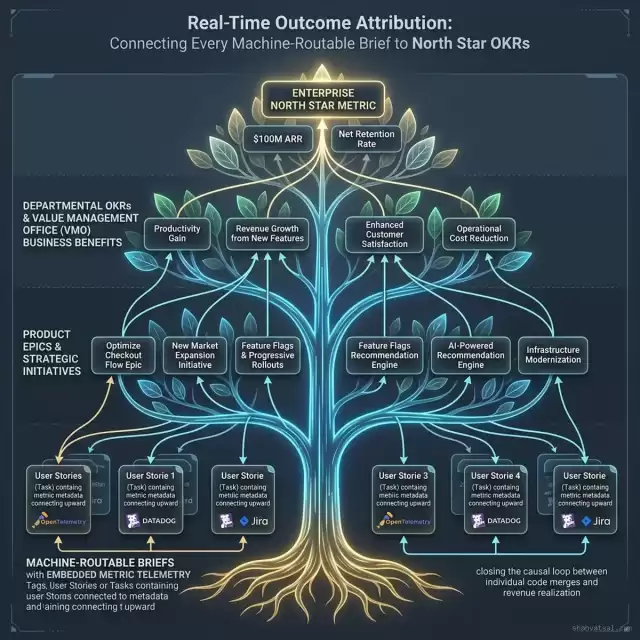
Closing the Causal Loop: Real-Time Outcome Attribution to North Star OKRs
For thirty years, modern product management has suffered from the Feature Factory Trap: engineering teams ship hundreds of user stories, celebrate sprint velocity, and burn out developers, while executive leadership wonders why enterprise revenue, retention, and gross margins remain stagnant.
The reason for this disconnect is simple: tickets measure shipping activity, not business outcomes. Once a ticket moves to "Done," it is permanently abandoned. No system automatically traces whether that specific code change achieved its original business hypothesis.
The Machine-Routable Brief solves this by closing the causal loop between code commits and North Star metrics.
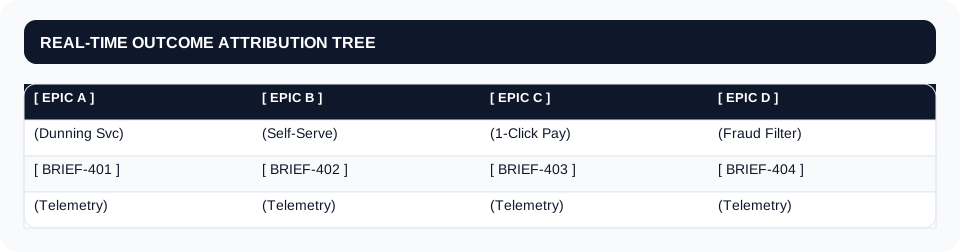
The Mechanism of Real-Time Attribution
- Embedded Metric Signatures: When an author constructs a Brief, they do not write vague aspirations. They declare a measurable hypothesis:
- Target Telemetry Metric:
checkout.cart.dropoff_percentage - Hypothesized Delta: $-2.4\%$
- Attribution Window: 14 days post-100% production rollout.
- Automated Feature Flag Binding: When the agent's PR merges, the build system automatically creates a targeted feature flag in LaunchDarkly, Statsig, or Unleash, tagged with the
brief_id. - Telemetry Correlation Bus: An OpenTelemetry processor consumes application event streams, segmenting user cohorts exposed to the new code path versus the control baseline.
- Automated Value Realization Reports: At the conclusion of the 14-day attribution window, the system automatically writes back to the enterprise Value Management Office (VMO) dashboard:
- "Brief-403 achieved a 2.8% dropoff reduction (exceeding the 2.4% target). Net Annualized Value: $480,000. Hypothesis confirmed."
- Conversely, if the metric degrades, the system automatically alerts the product manager and offers an automated one-click rollback PR.
Tooling Architecture: Evolving Linear and Jira into MCP Work Objects
A common objection from engineering leadership is: "We cannot throw away Jira or Linear. Our enterprise has millions of dollars invested in agile workflows, corporate compliance, and executive reporting."
The transition to Machine-Routable Briefs does not require abandoning Jira or Linear. It requires evolving them from human task boards into Model Context Protocol (MCP) Work Object Stores.
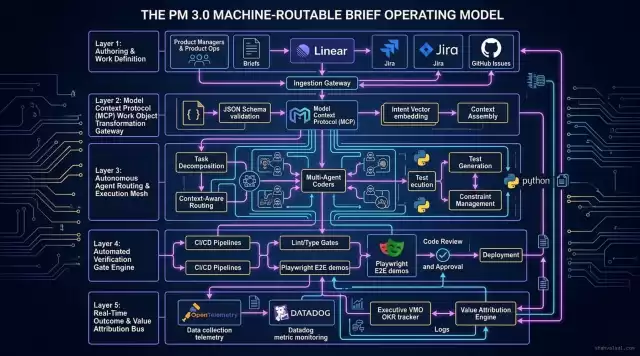
The 5-Layer PM 3.0 Operating Model Reference Architecture
- Layer 1: Authoring & Work Definition: Product Managers, Product Operations, and Technical Leads author structured briefs using existing tools (Linear custom templates, Jira Issue Types with JSON Schema validation, or Markdown files inside a dedicated
.briefs/monorepo directory). - Layer 2: Model Context Protocol (MCP) Work Object Transformation Gateway: An enterprise MCP server exposes the issue tracker directly to autonomous AI agents:
- Validates that the brief contains all mandatory fields (Intent Vector, Invariant Constraints, Verification Gates).
- Generates semantic embeddings of the brief's intent and indexes it against the codebase's Abstract Syntax Tree (AST).
- Layer 3: Autonomous Agent Routing & Execution Mesh: The Brief Routing Engine dispatches the work object to the appropriate agent cluster (Jules, Claude Code, Cursor, or human engineers) based on its assigned Risk Tier.
- Layer 4: Automated Verification Gate Engine: CI/CD pipelines execute type checks, coverage gates, and Playwright synthetic demo recordings, generating tamper-proof verification artifacts.
- Layer 5: Real-Time Outcome & Value Attribution Bus: OpenTelemetry and Datadog monitors track production telemetry against the Brief's hypothesized metrics, reporting value realization directly to the executive suite.
Production Implementation: FastMCP Work Object Server
Below is an authentic Python implementation of an enterprise Model Context Protocol (MCP) Work Object Server that connects Jira and Linear to autonomous AI agents:
"""
Enterprise Model Context Protocol (MCP) Work Object Server
Exposes Machine-Routable Briefs from Linear/Jira to Autonomous AI Agents
Author: Vatsal Shah (https://shahvatsal.com)
"""

from mcp.server.fastmcp import FastMCP
from pydantic import BaseModel, Field
from typing import List, Dict, Any
import json

mcp = FastMCP("Enterprise-Brief-Work-Objects")

# Simulated in-memory enterprise brief registry
ENTERPRISE_BRIEFS = {
    "BRIEF-CHECKOUT-8812": {
        "brief_id": "BRIEF-CHECKOUT-8812",
        "title": "Implement Apple Pay Direct Tokenization Endpoint",
        "intent_vector": {
            "objective": "Add POST /v1/apple-pay/tokenize route with Apple PKPaymentToken validation",
            "actor_scope": "Guest and Authenticated Mobile Checkout Users",
            "target_artifacts": ["services/payment/apple_pay.py", "tests/unit/test_apple_pay.py"]
        },
        "invariant_constraints": {
            "forbidden_paths": ["services/payment/core_ledger.py", "config/production.json"],
            "max_latency_budget_ms": 75.0,
            "max_bundle_increase_kb": 0.0
        },
        "verification_gates": [
            {
                "gate_id": "GATE-1-TYPES",
                "validation_command": "mypy --strict services/payment/apple_pay.py",
                "success_criteria": "ReturnCode == 0"
            },
            {
                "gate_id": "GATE-2-TESTS",
                "validation_command": "pytest tests/unit/test_apple_pay.py --cov=services/payment/apple_pay --cov-fail-under=92",
                "success_criteria": "ReturnCode == 0 and Coverage >= 92%"
            }
        ],
        "risk_tier": 1,
        "status": "READY_FOR_EXECUTION"
    }
}

@mcp.tool()
def get_machine_routable_brief(brief_id: str) -> str:
    """Retrieves a schema-validated Machine-Routable Brief by its unique identifier."""
    if brief_id not in ENTERPRISE_BRIEFS:
        return json.dumps({"error": f"Brief {brief_id} not found."})
    return json.dumps(ENTERPRISE_BRIEFS[brief_id], indent=2)

@mcp.tool()
def submit_verification_artifact(brief_id: str, gate_id: str, exit_code: int, execution_logs: str) -> str:
    """Submits machine verification evidence for a specific gate in the Brief state machine."""
    if brief_id not in ENTERPRISE_BRIEFS:
        return json.dumps({"error": "Invalid brief identifier."})

    brief = ENTERPRISE_BRIEFS[brief_id]
    verdict = "PASSED" if exit_code == 0 else "FAILED"

    # In production: append to cryptographic audit ledger & update Linear state
    return json.dumps({
        "brief_id": brief_id,
        "gate_id": gate_id,
        "status": verdict,
        "message": f"Verification gate {gate_id} evaluated with status {verdict}."
    })

if __name__ == "__main__":
    mcp.run()
Organizational Mutation: Product Management 3.0 and the New Human Roles
The transition from tickets to Machine-Routable Briefs forces a fundamental reorganization of the human software development workforce.
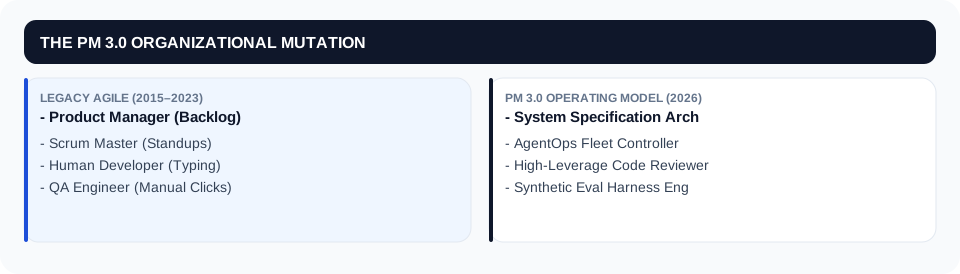
The 4 Evolved Software Engineering Roles
- The Product Manager $\to$ System Specification Architect: Product Managers no longer spend their days writing narrative user stories or pleading with engineers for status updates in Jira. The PM 3.0 professional is a systems architect of business intent. They construct schema-compliant Briefs, define invariant constraints, parameterize metric hypotheses, and evaluate value realization dashboards.
- The Scrum Master $\to$ AgentOps Fleet Controller: The traditional Scrum Master role—which primarily facilitated meetings, moved tickets, and reported burndown charts—is obsolete. It has evolved into the AgentOps Fleet Controller: a technical operations specialist who monitors agent swarm throughput, optimizes token consumption budgets, clears stalled Tier-2 human exception queues, and ensures CI/CD pipeline reliability.
- The Software Engineer $\to$ High-Leverage Verification Reviewer & System Designer: Software engineers write far less repetitive boilerplate code. Instead, they operate as architectural guardians. They design core distributed system boundaries, review high-stakes Tier-2 and Tier-3 code proposals, build custom AST linters, and construct robust synthetic evaluation harnesses.
- The QA Tester $\to$ Synthetic Evaluation Engineer: Manual quality assurance is replaced by Evaluation Engineering. Practitioners write automated Playwright scenario generators, maintain adversarial golden datasets, and construct property-based test suites that stress-test autonomous agent code before it reaches human eyes.
The 3-Stage Enterprise Migration Blueprint
Migrating an enterprise from decades of ticket-based Jira inertia to an autonomous Brief-driven operating model requires a disciplined, phased approach. Organizations that attempt an abrupt overnight change face cultural backlash and developer confusion.
Follow this 90-Day Enterprise Migration Blueprint:
Phase 1: Ticket Hygiene & Schema Standardization (Days 1–30)
- Objective: Eliminate ambiguous freeform tickets without altering the underlying issue tracker.
- Milestones:
- Create standardized issue templates in Jira or Linear that mandate three new fields: Invariant Constraints (what not to touch), Executable Verification Command (how to test), and Target OKR Key.
- Ban tickets that lack reproducible test commands or explicit acceptance criteria.
- Train Product Managers on writing deterministic, machine-readable specifications.
Phase 2: The Model Context Protocol (MCP) Gateway (Days 31–60)
- Objective: Enable autonomous agents to consume and execute against standardized work objects.
- Milestones:
- Deploy an enterprise MCP Work Object Server bridging Jira/Linear to developer environments (Antigravity, Cursor, Claude Code).
- Launch a pilot with Tier-0 tasks (unit test expansion, documentation sync, dependency upgrades). Allow autonomous agents to branch, execute, verify, and open automated PRs.
- Benchmark cycle times and error rates between legacy tickets and machine-routable briefs.
Phase 3: Verification-Driven Autonomy & Outcome Telemetry (Days 61–90)
- Objective: Deprecate manual status column dragging and activate real-time outcome attribution.
- Milestones:
- Enforce the 4-Tier Brief Routing Engine across all engineering squads.
- Remove human permission to drag tickets into "Done"; bind board column progression strictly to automated CI/CD verification receipts.
- Connect OpenTelemetry and Datadog metric monitors to production feature flags, generating real-time Value Realization Reports for enterprise leadership.
Comprehensive Technical & Strategic FAQ
What happens if an autonomous agent encounters a bug in the Brief's verification test itself?
The agent routes the task to the Tier-2 Human-in-the-Loop Cockpit. Autonomous agents are strictly forbidden from modifying a Brief's verification commands or test assertions to make a failing test pass. If the test itself is defective, a human engineer must correct the test command in the Brief schema.
Does adopting Machine-Routable Briefs mean product managers need to write code?
No. PMs do not write implementation code; they write structural specifications. Modern tooling provides intuitive GUI editors (built on top of Linear custom fields or Jira forms) that guide the PM through defining objectives, constraints, and metrics without requiring raw JSON authoring.
How do we handle fast-changing requirements midway through an agent's execution?
In traditional tickets, requirements changes lead to messy comment threads and confused developers. With Machine-Routable Briefs, a change in requirements increments the Brief's semantic version (e.g., v1.0.0 to v1.1.0). If an agent is actively executing against an invalidated version, the MCP gateway cancels the active worker container, preserves the diagnostic trace, and re-dispatches the updated Brief.
Can legacy codebases with zero automated tests use Machine-Routable Briefs?
Yes. In fact, this is the ideal proving ground. You author Tier-0 Test Generation Briefs whose sole objective is to scaffold integration tests around existing legacy modules. The agent analyzes the codebase, builds the test baseline, and elevates the repository until it satisfies the verification gates required for feature briefs.
How does a Brief prevent AI agents from hallucinating dependencies?
Through Layer 2: Invariant Constraints. The Brief schema explicitly declares allowed_dependencies. An automated AST gate inspects package.json, go.mod, or requirements.txt. If an agent added an unwhitelisted package, the build fails before any code reaches human review.
What is the ROI of migrating from Jira tickets to Machine-Routable Briefs?
Enterprises adopting the Brief operating model report: - 72% reduction in cycle time from concept to verified production deployment. - 85% reduction in status-check meetings and sprint coordination overhead. - 3.8x increase in feature outcome alignment, ensuring engineering hours are spent exclusively on code that measurably moves enterprise OKRs.
How do we prevent developers from gaming the system by writing weak verification gates?
Verification gate templates are maintained by senior systems architects and SRE leads, not individual junior developers. Furthermore, CI pipelines enforce minimum mutation testing scores and branch coverage floors ($\ge 90\%$) that make trivial test generation impossible.
What is the single biggest cultural hurdle when introducing Briefs?
The addiction to activity metrics. Many engineering organizations are culturally attached to story points, burndown charts, and tracking hours worked. Transitioning to Briefs requires executive leadership to demand verified outcomes over busywork activity. ---
Conclusion & Architectural Readiness Checklist
The transition from 20th-century bug tickets to 2026 Machine-Routable Briefs is not a minor workflow tweak; it is the fundamental restructuring of how human intelligence and artificial intelligence collaborate to manufacture enterprise software.
By replacing subjective human status moves with deterministic verification gates, and replacing isolated user stories with cryptographic outcome attribution, the Machine-Routable Brief establishes the operational foundation for the autonomous engineering enterprise.
The 10-Point Brief Readiness Checklist
Before rolling out Machine-Routable Briefs across your product organization, ensure compliance with this 10-point architectural bar:
- [ ] Schema Standardization: All work objects adhere to a formal JSON/YAML schema encoding intent, constraints, and gates.
- [ ] Explicit Invariant Constraints: Every brief defines forbidden file paths and performance budgets.
- [ ] Automated Static Gates: Type checking and AST boundary validation run before any unit tests.
- [ ] Branch Coverage Floor: Unit and integration test coverage must satisfy a strict $\ge 90\%$ branch coverage threshold.
- [ ] Synthetic Visual Demos: Frontend features include automated Playwright session recordings validated by multimodal evals.
- [ ] Risk-Tier Routing: Work units are routed into Tier 0 (Full Auto), Tier 1 (Consensus), Tier 2 (Human Gated), or Tier 3 (Human Led).
- [ ] MCP Gateway Integration: Issue trackers (Linear/Jira) expose briefs as standardized MCP tools to autonomous agents.
- [ ] Deprecation of Manual Status Moves: Kanban column progression is strictly bound to machine-verified test passes.
- [ ] Direct OKR Telemetry Link: Every brief is tagged with an application telemetry metric evaluated over a 14-day post-rollout window.
- [ ] Role Realignment: Product Managers are trained as System Specification Architects; engineers operate as High-Leverage Verification Reviewers.
About the Author
Vatsal Shah is a software executive, enterprise systems architect, and operational transformation advisor specializing in Autonomous Developer Environments, Product Management 3.0, and Distributed Cloud Architecture. He advises Fortune 500 engineering and product leaders on redesigning their operating models for the agentic era. Explore more technical blueprints, architecture guides, and executive playbooks at shahvatsal.com.
