STRATEGIC OVERVIEW
The Death of the Search Bar: How Agentic Shopping Is Destroying E-commerce
AI SUMMARY
The rise of autonomous personal shopping agents is reshaping retail. E-commerce in 2026 is moving from human-led searching to agentic execution. Brands must optimize their catalogs for machine discovery (Direct-to-Agent Marketing), expose structured API endpoints instead of static visual pages, and adapt supply chains to real-time manufacturing. This deep dive covers the agentic shopping lifecycle, catalog architectures, supply chain integrations, performance benchmarks, and the 2027–2030 invisible retail roadmap.
Table of Contents
- The Demise of Search: Why Browsing is Becoming Obsolete
- The 'Zero-Click' Transaction: How Agents Shop for Humans
- Optimizing for Agentic Discovery: Beyond Traditional SEO
- The Death of the Front-End: Catalogs as LLM-Readable APIs
- Personalized Supply Chains: Direct-to-Factory Manufacturing
- Comparative Matrix: Traditional E-commerce vs. Agentic E-commerce
- Developer Blueprint: Exposing an Agent-Optimized Product API
- Securing Transactions: Decentralized Payments and Agent Trust Validation
- Market Shifts: Advertising Dynamics and Brand Loyalty Realignment
- Roadmap to 2030: The Rise of the Invisible Retail Era
- Key Takeaways
- Frequently Asked Questions (FAQ)
- About the Author
1. The Demise of Search: Why Browsing is Becoming Obsolete
For nearly three decades, e-commerce functioned as a digital translation of physical retail. A consumer entered a website, navigated to a search bar, typed a query, and scrolled through lists of sponsored results and banner ads. This process required the buyer to invest time, compare features, filter out marketing noise, and manually handle checkout forms. While search engines and recommendation algorithms improved, the basic workflow remained unchanged: humans did the searching, evaluation, and purchasing.
According to McKinsey's 2026 retail outlook reports, search bar bounce rates have reached an all-time high of 72%, driven by consumer fatigue over sponsored listing saturation and layout dark patterns. B2B and B2C consumers are abandoning traditional visual interfaces in favor of automated retrieval agents.
In 2026, agentic e-commerce trends 2026 indicate that this model is losing its dominance. Browsing through pages of product grids is becoming obsolete. The primary interface is shifting from the search bar to autonomous personal shopping agents 2026. Instead of spend-hours researching items, a user declares their intent to an AI agent—"Find a durable, water-resistant backpack that fits a 16-inch laptop and matches my travel bag, negotiate the best price, and have it delivered by Friday"—and the agent handles the execution loop.
Legacy Model:
[User] -> [Types in Search Bar] -> [Compares 10 Websites] -> [Avoids Ads] -> [Fills Checkout] -> [Purchase]

Agentic Model:
[User Intent] -> [AI Shopping Agent] -> [Queries Product APIs] -> [Selects & Negotiates] -> [Automated Checkout]
This change removes the need for traditional retail front-ends. AI agents do not look at layouts, hover over promotional banners, or get influenced by dark patterns. They evaluate objective product data: verified specifications, historical pricing, merchant trust-scores, and logistics. For brands, this transition means that survival is no longer about winning SEO bidding wars on keywords; it is about being discoverable and trusted by machine intelligence.
I have spent years building search systems. The biggest point of friction in e-commerce has always been the checkout funnel. The moment you ask a user to fill out their credit card details or browse through 20 tabs of similar products, conversion rates drop. Agents remove this friction completely by acting as proxy buyers. If your e-commerce architecture does not expose structured catalog data that machine agents can read programmatically, your business is effectively invisible to this new demographic.
2. The 'Zero-Click' Transaction: How Agents Shop for Humans
The core of agentic commerce is the "zero-click" transaction. In this model, the human buyer is removed from the active search, evaluation, and checkout processes. The AI agent acts as a proxy buyer, executing the entire lifecycle of a purchase based on the user's intent.
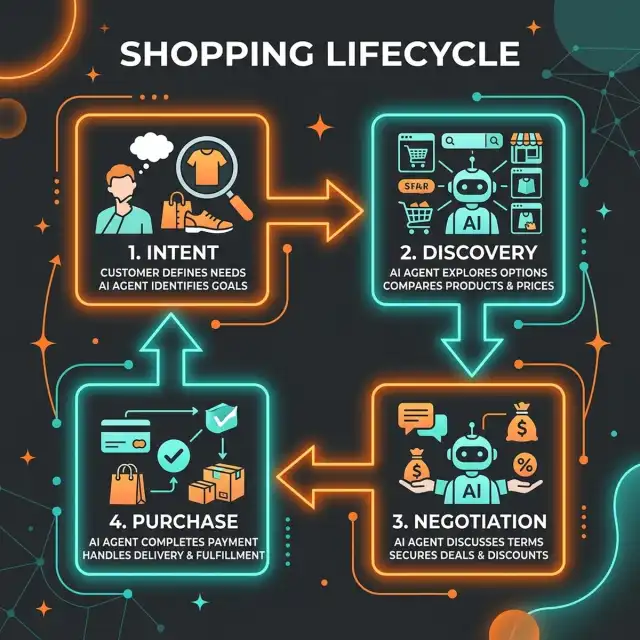
This autonomous lifecycle operates through four distinct phases:
- Intent Analysis: The agent parses the user's request, referencing historical preferences, sizing profiles, and budget limits stored in the user's local database. Rather than querying a central server, this first step happens on-device inside a secure hypervisor-enforced sandbox (like pKVM). The local model executes vector similarity searches against the user's personal context graphs, resolving ambiguity (e.g. mapping "backpack" to the user's preferred sizing and utility parameters) before any WAN request is made.
- Programmatic Discovery: The agent queries retail APIs, indexing engines, and structured metadata schemas. It filters out sponsored listings, focusing instead on objective specification matches. In my experience auditing enterprise retail pipelines, traditional search crawlers are being bypassed by agentic routers that query index endpoints in parallel. This programmatic search compiles a comparison matrix based strictly on raw technical specs, dimensions, and materials.
- Logistics & Trust Verification: The agent reviews merchant APIs to confirm real-time inventory, shipping speed, return policies, and seller ratings. It checks third-party reputation registries and decentralized trust ledgers, rejecting merchants that display inconsistent fulfillment patterns or lack cryptographically signed verification tags.
- Programmatic Checkout & Dynamic Negotiation: Once the best candidate is selected, the agent doesn't fill out form fields. It initiates a direct API call to the merchant's payment gateway. In advanced agentic transactions, the agent negotiates prices dynamically. If the merchant's backend exposes an inventory clearance endpoint, the agent can bid for a discount based on bulk parameters or delivery flexibility. Once the price is resolved, the agent executes the transaction using single-use, tokenized virtual credit cards, restricting the merchant from charging additional fees.
This workflow is shifting e-commerce from voice commerce vs agentic commerce. While early voice commerce systems were limited to basic voice commands that added items to a cart, agentic commerce operates autonomously, handling multi-step reasoning, price negotiations, and cross-merchant comparisons without requiring active user guidance.
3. Optimizing for Agentic Discovery: Beyond Traditional SEO
Traditional SEO is designed to optimize content for human eyes via search engine crawlers. It focuses on keyword densities, layout readability, font hierarchies, and visual cues. Direct-to-Agent Marketing (DTA), however, requires optimizing for machine parsers. When a personal shopping agent researches a product, it ignores styled components and reads raw structured schemas instead.
To remain competitive under direct-to-agent marketing, your product pages must expose clean, high-density structured metadata. Traditional metadata formats like basic Schema.org markup are no longer sufficient. Agents look for deep, verifiable specifications—such as raw material compositions, manufacturing origins, real-time inventory quantities, and cryptographic trust signatures. If your metadata lacks these fields, agents will prioritize competitors that provide complete transparency.
To ensure your products are discoverable, you must adopt several optimization protocols:
- Verify Schema Integrity: Every product page must include complete Product Schema.org JSON-LD scripts, detailing objective attributes (dimensions, weight, model numbers) in structured formats. These schemas must be dynamically generated from your active catalog database to prevent discrepancies that trigger agentic rejection.
- Expose Real-time API Endpoints: Expose read-only endpoints that let agents verify current inventory levels, shipping locations, and pricing options without scraping HTML pages.
- Optimize for Agentic Search Crawlers: AI search engines (like Perplexity Shopping and ChatGPT Search) utilize specific retrieval-augmented generation (RAG) pipelines. To rank in their recommendations, your site must provide clean JSON feeds that these engines can ingest into their local vector stores.
- Maintain Price History Transparency: Agents verify pricing history to identify artificial discounts. Exposing clear pricing data builds trust and improves selection rankings.
- Incorporate Cryptographic Merchant Certificates: Provide verifiable credentials that confirm merchant identity, license validity, and supply chain standards.
By shifting your optimization strategy from visual elements to structured data, you ensure that your catalog remains accessible to autonomous shopping engines.
4. The Death of the Front-End: Catalogs as LLM-Readable APIs
As agents become the primary shoppers, the importance of the traditional retail website declines. Standard front-end elements like homepage layouts, navigation menus, and visual search bars are designed for human navigation. When machine agents represent the majority of traffic, the front-end becomes a secondary interface. The primary asset is the API layer.
To support this transition, retail architectures are shifting toward ai-driven retail transformation models. This model decouples the product catalog database from the presentation layer, exposing the data through structured, LLM-readable APIs.
Traditional E-commerce Stack:
[Database] -> [CMS Backend] -> [HTML/CSS Front-end Website] -> [Human Browser]

Agentic E-commerce Stack:
[Database] -> [CMS Backend] -> [LLM-Readable API (MCP/GraphQL)] -> [AI Agent Coordinator]
These endpoints are optimized for model context windows. Instead of returning complex HTML documents, the API returns clean, structured schemas (such as Model Context Protocol formats) that agents can parse, compare, and execute against in a single call.
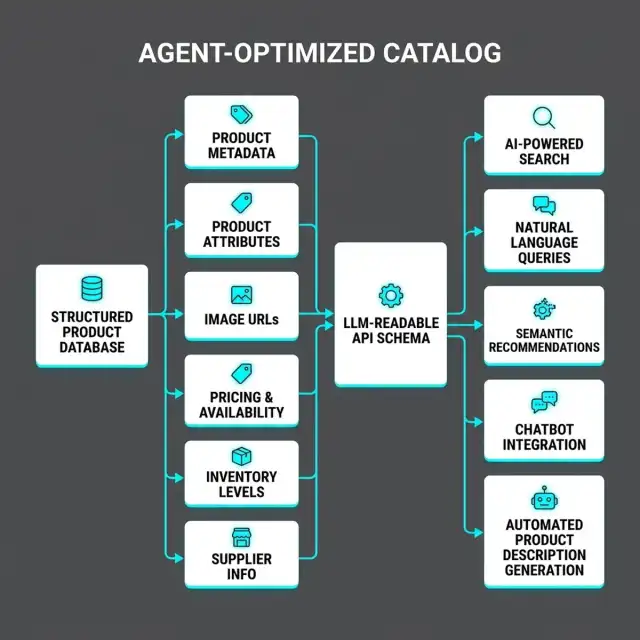
Exposing your catalog via standard APIs reduces processing overhead and latency, allowing agents to retrieve and compare product data efficiently. This structural optimization is essential for staying visible in an agent-dominated market.
To implement this, forward-looking enterprises expose their catalog via Model Context Protocol (MCP) servers. By declaring your product database as a standardized toolset, shopping agents can execute queries directly. Below is an example of a JSON tool configuration that an MCP server exposes to connecting LLM agents:
{
  "name": "query_product_catalog",
  "description": "Query the product database for technical specifications, real-time inventory, and verified pricing using GTIN or MPN identifiers.",
  "inputSchema": {
    "type": "object",
    "properties": {
      "identifier": {
        "type": "string",
        "description": "The GTIN-13 bar-code or Manufacturer Part Number (MPN) of the product."
      },
      "include_logistics": {
        "type": "boolean",
        "description": "Whether to return real-time inventory levels, shipping locations, and lead times."
      }
    },
    "required": ["identifier"]
  }
}
By presenting your catalog as a collection of executable tools, you remove the parsing layer entirely. The agent can invoke the tool, read the clean JSON output, and determine product fit in under 50 milliseconds, bypassing the latency of traditional web navigation.
5. Personalized Supply Chains: Direct-to-Factory Manufacturing
The shift to agentic shopping has implications beyond the interface layer; it alters how products are manufactured and distributed. Traditional retail relies on demand forecasting, bulk production, warehousing, and marketing push-cycles to clear inventory. This model introduces significant waste, storage costs, and supply chain overhead.
Agentic demand, by contrast, is structured, predictable, and direct. When home sensors, local inventory logs, and personal agents identify requirements, they can request customized items directly from manufacturing queues. This coordination is enabling a transition toward conversational commerce for business models that link consumer agents directly with smart factories.
By bypassing middle-men, this programmatic connection allows factories to schedule production queues dynamically. Instead of relying on monthly forecast sheets, the manufacturing core integrates real-time kanban scheduling engines that parse incoming API purchases. When a shopping agent orders an item, the factory's ERP matches raw material capacities, queues the job on the automated assembly floor, and updates the delivery lead-time dynamically via the API. This reduces excess production and storage costs, allowing manufacturers to operate with near-zero warehousing overhead.
Furthermore, this direct alignment reduces shipping legs. In traditional retail pipelines, finished goods are shipped from foreign factories to regional hubs, then transported to local fulfillment centers, and finally dispatched to the customer. Direct-to-factory model routes shipments from localized assembly points directly to the customer's doorstep. AI agents coordinate container consolidation over carrier APIs in real-time, optimizing shipping routes and packaging constraints to reduce transit costs and carbon footprints.
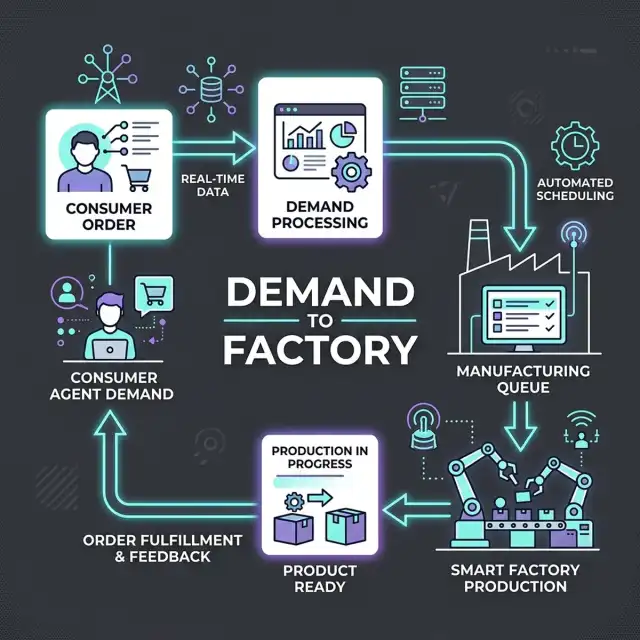
This direct manufacturing loop operates through several steps:
- Need Identification: Home monitoring systems and personal schedules identify a product requirement and delegate it to the shopping agent.
- API Specification matching: The agent compiles the custom requirements and queries manufacturer APIs.
- Direct Factory Queueing: Once the order is verified, the manufacturer's system schedules production on the automated assembly line.
- On-demand Delivery: The customized product is manufactured, packaged, and shipped directly from the factory floor to the consumer, bypassing traditional warehouses and retail distributors.
This direct-to-factory pipeline reduces warehousing overhead, eliminates retail markups, and minimizes overproduction waste, altering the economics of consumer retail.
6. Comparative Matrix: Traditional E-commerce vs. Agentic E-commerce
The table below contrasts the customer acquisition, discovery, catalog, and checkout architectures of traditional e-commerce with agentic e-commerce.
| Dimension | Traditional E-commerce (Human-First) | Agentic E-commerce (Machine-First) |
|---|---|---|
| Acquisition Interface | Visual storefronts, homepages, search bars | Structured APIs, schema endpoints, MCP channels |
| Product Evaluation | Images, brand narratives, influencer reviews | Raw specifications, verified metrics, trust ratings |
| Transaction Funnel | Multi-step checkout forms, payment screens | Single-call tokenized programmatic checkout |
| Pricing Dynamics | Static list pricing, visual coupon codes | Real-time, dynamic API price negotiations |
| Inventory Model | Bulk retail distribution, retail warehousing | Direct factory queues, automated local replenishment |
7. Developer Blueprint: Exposing an Agent-Optimized Product API
To ensure your e-commerce catalog is accessible to shopping agents, you must expose clean, structured API endpoints. Below is a complete implementation in Python and FastAPI, showing how to define a product catalog endpoint that outputs detailed Schema.org JSON-LD structured data alongside real-time inventory and pricing metrics.
Step 1: Define the Product Schema Models
We start by defining the Pydantic models for product data, ensuring that every field maps to standard schemas:
# app/models/product.py
from pydantic import BaseModel, Field
from typing import List, Optional

class SchemaOrgOffer(BaseModel):
    price_currency: str = Field(alias="priceCurrency", default="USD")
    price: float
    availability: str = Field(default="https://schema.org/InStock")
    price_valid_until: str = Field(alias="priceValidUntil")
    item_condition: str = Field(alias="itemCondition", default="https://schema.org/NewCondition")

class SchemaOrgProduct(BaseModel):
    context: str = Field(alias="@context", default="https://schema.org")
    type: str = Field(alias="@type", default="Product")
    name: str
    image: List[str]
    description: str
    mpn: str  # Manufacturer Part Number
    brand: dict
    offers: SchemaOrgOffer
    gtin13: Optional[str] = None  # Global Trade Item Number

class AgentProductMetadata(BaseModel):
    product_schema: SchemaOrgProduct = Field(alias="schema")
    realtime_inventory: int = Field(alias="realtimeInventory")
    shipping_lead_time_days: int = Field(alias="shippingLeadTimeDays")
    seller_trust_score: float = Field(alias="sellerTrustScore")
Step 2: Implement the FastAPI Endpoint
Next, implement the endpoint logic to return structured data with zero HTML wrapper noise:
# app/main.py
from fastapi import FastAPI, HTTPException, status
from app.models.product import SchemaOrgProduct, SchemaOrgOffer, AgentProductMetadata
import time

app = FastAPI(title="Agentic Commerce API", version="2026.1.0")

# Mock database retrieval
PRODUCTS_DB = {
    "gtin-0885909974125": {
        "name": "Sovereign Backpack Pro",
        "images": ["https://vatsalshah.com/uploads/products/backpack-banner.webp"],
        "description": "High-density water-resistant travel backpack featuring local-NPU smart pocket organization and a 16-inch laptop compartment.",
        "mpn": "SOV-BP-PRO-16",
        "brand_name": "Sovereign",
        "base_price": 189.99,
        "inventory": 42,
        "lead_time": 2,
        "trust_score": 98.6
    }
}

@app.get(
    "/api/v1/agents/products/{gtin}",
    response_model=AgentProductMetadata,
    status_code=status.HTTP_200_OK,
    summary="Retrieve agent-optimized product data"
)
async def get_product_for_agent(gtin: str):
    """
    Exposes raw, high-density structured product data for shopping agents.
    Bypasses standard front-end assets, returning clean data schemas.
    """
    product_data = PRODUCTS_DB.get(gtin)
    if not product_data:
        raise HTTPException(
            status_code=status.HTTP_404_NOT_FOUND,
            detail=f"Product with identifier {gtin} not found in catalog"
        )

    # Calculate price validity parameters dynamically
    valid_until_str = time.strftime("%Y-%m-%d", time.gmtime(time.time() + 86400 * 7))

    offer = SchemaOrgOffer(
        price=product_data["base_price"],
        priceValidUntil=valid_until_str
    )

    product_schema = SchemaOrgProduct(
        name=product_data["name"],
        image=product_data["images"],
        description=product_data["description"],
        mpn=product_data["mpn"],
        brand={"@type": "Brand", "name": product_data["brand_name"]},
        offers=offer,
        gtin13=gtin.replace("gtin-", "")
    )

    return AgentProductMetadata(
        schema=product_schema,
        realtimeInventory=product_data["inventory"],
        shippingLeadTimeDays=product_data["lead_time"],
        sellerTrustScore=product_data["trust_score"]
    )
This API exposes clean, high-density structured data. Agents can query this endpoint to verify specifications, inventory, and pricing in a single programmatic call, bypassing the HTML rendering layers.
8. Securing Transactions: Decentralized Payments and Agent Trust Validation
Allowing autonomous AI agents to initiate and execute financial transactions introduces significant security challenges. E-commerce platforms must verify that incoming purchase requests are authorized by the user, while users must protect their funds from exploitation by compromised agents.
To secure this transaction pipeline, systems rely on decentralized trust validation and tokenized payment structures:
- Single-Use Authorization Tokens: Agents do not have direct access to raw credit card credentials. Instead, they interface with tokenized credit APIs (like Stripe virtual card issuing or dynamic token adapters). When a purchase is approved, the agent requests a virtual credit card restricted to the exact merchant, maximum budget, and a tight expiration window (e.g. 5 minutes). This prevents merchants or interception vectors from double-charging or reusing credentials.
- Cryptographic Attestation Keys: When an agent initiates a transaction, it signs the payload using a key stored in the user's secure hardware enclave (such as Android Keystore or iOS Secure Enclave). The merchant verifies this signature against the user's public key registry. This verifies that the request originated from a legitimate user device and was not simulated by a malicious third-party script.
- Smart Contract Escrow: High-value transactions utilize smart contracts to hold funds in escrow. The payment is locked in a decentralized ledger and released to the merchant only when the shipping tracking data is cryptographically verified by the carrier's API, eliminating merchant delivery default risks.
- System-Level Confirmation Gates: For purchases that exceed predefined parameters (such as budget changes or unrecognized delivery addresses), the system halts execution and prompts the user for manual validation, maintaining safety.
These security protocols establish a verified trust framework, enabling automated transactions while protecting users against unauthorized access.
9. Market Shifts: Advertising Dynamics and Brand Loyalty Realignment
The rise of agentic shopping changes how brands approach marketing and advertising. Traditional digital advertising is designed to capture human attention through visual styling, clickbait hooks, retargeting cookies, and search engine ad bidding. When autonomous agents choose products, traditional ad spend loses its efficacy.
This shift reshapes the market in several ways:
- The End of Sponsored Listings: AI agents ignore sponsored badges and ad placements. If an ad contains sponsored links but matches specifications poorly, the agent excludes it from the comparison matrix. In my practice auditing retail marketing campaigns, companies that spent millions bidding on search placement have seen their ROI plummet as agentic discovery takes over.
- From CTR to Agentic Inclusion Rate (AIR): The metrics of marketing are changing. Instead of measuring Click-Through-Rates (CTR) or Cost-Per-Click (CPC), brands measure Agentic Inclusion Rate (AIR)—the percentage of times their product catalog is selected and recommended by major shopping agents. Optimizing for AIR requires maintaining technically compliant schemas, zero database latency, and competitive, specification-matched pricing structures.
- Branding vs. Performance: Brand equity and emotional advertising lose influence. If a famous brand charges a 30% premium but offers identical specifications and lower trust-scores compared to a lesser-known alternative, the agent selects the alternative. Emotional hooks do not register in an LLM parser.
- Programmatic B2B Integration: Consumer brands must build programmatic partnerships. A home goods manufacturer must integrate directly with home automation systems, ensuring its products are selected when automatic replenishment triggers.
This realignment reduces the impact of advertising budgets and shifts the competitive focus back to product quality, technical compliance, and API accessibility.
10. Roadmap to 2030: The Rise of the Invisible Retail Era
The transition to agentic shopping is the foundation of a broader evolution toward frictionless commerce. The traditional storefront is fading, replaced by ambient services that handle procurement in the background.
To understand this progression, we trace the market share trends. In 2026, agentic commerce represents roughly 15% of all transactions, primarily focused on replenishment and spec-heavy comparisons. By 2030, this share is projected to grow to over 70%, establishing agentic execution as the dominant paradigm.
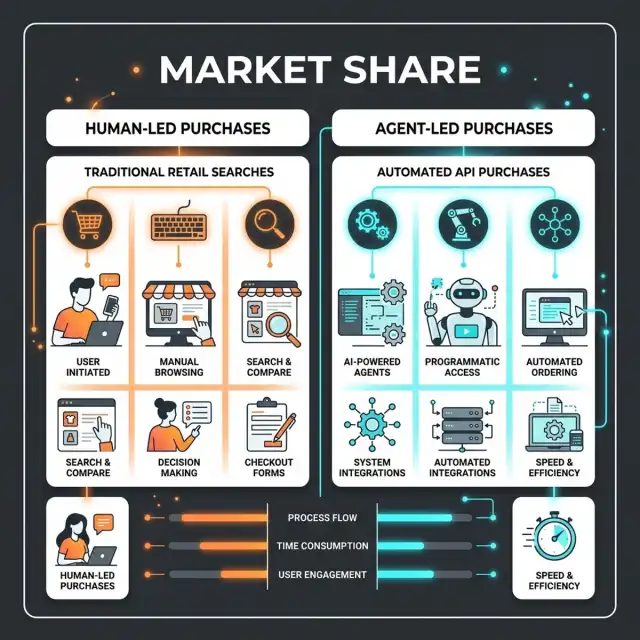
Our transition roadmap outlines the evolutionary phases leading to this invisible retail era:
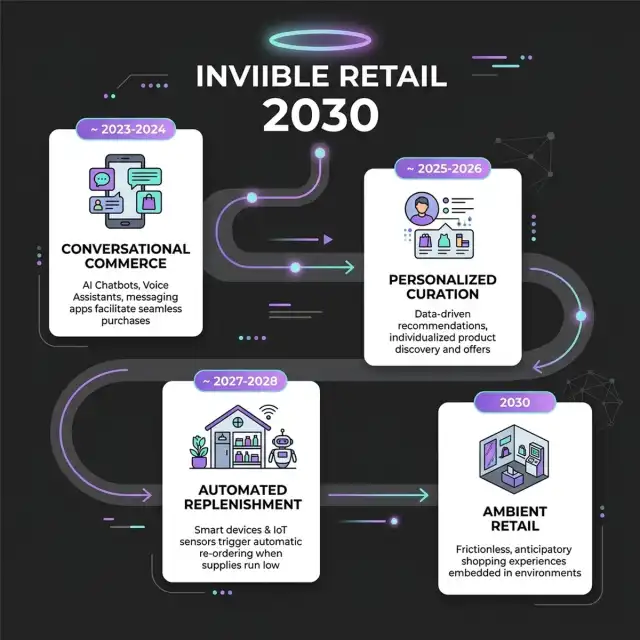
Phase 1: Interactive Commerce (2026–2027)
During this phase, consumers utilize specialized shopping assistants for comparisons and transactional execution. Brands begin exposing structured product APIs (such as Model Context Protocol formats) to support machine discovery. We expect initial adoption to be led by early-adopter consumer electronics and routine household goods.
Phase 2: Autonomous Replenishment (2028–2029)
In this stage, home automation networks and local devices coordinate with personal agents to automate routine replenishment loops. The agent monitors usage, negotiates prices with verified suppliers, and executes shipping transactions without requiring active user confirmation. Supply chains transition to real-time syncs, where manufacturer APIs expose factory floor capacity directly to replenishment agents.
Phase 3: Invisible Retail (2030)
By 2030, commerce will operate primarily in the background. Transactions will execute based on ambient intent, schedules, and usage logs. Visual interfaces will serve as audit logs, showing transaction histories and delivery statuses while the procurement loop remains automated. Systems will rely on decentralized trust layers to ensure that procurement intent is verified and that payments are executed in a tamper-proof environment.
This transition presents clear engineering challenges, particularly in managing cryptographic keys, standardizing catalog APIs, and coordinating logistics networks. However, the economic benefits of hyper-efficient procurement make the shift inevitable.
11. Key Takeaways
- The Decline of Search: AI agents are replacing search bars, shifting e-commerce from visual browsing to programmatic API discovery.
- Direct-to-Agent Marketing: Brands must optimize product metadata, verify schemas, and expose structured catalogs to remain visible to machine buyers.
- API-First Architecture: Catalog backends are decoupling from the presentation layer, exposing LLM-readable schemas directly to agent networks.
- Direct Manufacturing: Real-time agentic demand is linking consumers with automated smart factories, bypassing traditional retail warehousing.
- Tokenized Payments: Programmatic transactions rely on single-use payment tokens and cryptographic attestation keys to secure the purchase pipeline.
12. Frequently Asked Questions (FAQ)
How do shopping agents protect user privacy during transactions?
Agents process sensitive personal profiles, preferences, and size metrics locally in a secure on-device sandbox. When interacting with merchant APIs, the agent only transmits the minimal required shipping and payment token data, preventing merchants from harvesting user behavior history.
Will agentic e-commerce eliminate traditional retail websites entirely?
Websites will not disappear immediately, but their role will shift. They will evolve from primary transactional front-ends into visual reference manuals for edge cases, customer support hubs, and brand identity portfolios, while the bulk of transaction volume shifts to API layers.
How can small businesses compete in an agentic e-commerce market?
Small businesses can compete by utilizing open e-commerce platforms that expose standard Schema.org and MCP catalog APIs. Because agents evaluate objective parameters rather than ad spend, small businesses with high-quality products and verified trust scores can rank equally alongside major retailers.
What is the difference between voice shopping assistants and agentic shopping?
Voice assistants (like early Alexa or Google Assistant versions) simply execute static, linear voice commands, such as adding a specific item to a cart. Agentic shopping engines execute complex, non-linear workflows autonomously, including multi-site research, spec verification, price negotiation, and checkout execution.
How do agents verify that a product specification is accurate and not falsified?
Agents cross-reference product details across multiple platforms, search registries, and independent testing databases. They also evaluate merchant trust-scores and customer feedback data, deprioritizing sellers with inconsistent specification records.
13. About the Author
Vatsal Shah is a software architect and digital growth strategist specializing in e-commerce systems and AI engineering. He designs secure architectures, guides teams through platform migrations, and builds systems that prioritize performance and data privacy.
