STRATEGIC OVERVIEW
MCP vs REST vs GraphQL: The 2026 API War Every Developer Must Understand
AI SUMMARY
APIs reached an inflection point in 2026. While REST remains the backbone for stateless CRUD and GraphQL dominates complex UI data fetching, neither is optimized for autonomous AI agents. The Model Context Protocol (MCP) has emerged as the standard for connecting LLMs to external tools and data safely. This intelligence node provides a technical comparison of REST, GraphQL, and MCP, detailing when to use each in the modern Sovereign Stack.
Table of Contents
- Why APIs Are at an Inflection Point in 2026
- REST: The Undisputed Backbone
- GraphQL: Composability and The Enterprise UI
- MCP: The AI-Native Standard
- The Security Surface of MCP: Hardening the Agentic Link
- Real-World Adoption: How Cursor and Claude Reshaped Integration
- The Decision Matrix
- Migration Playbook: REST to MCP for Agents
- Developer Tooling: Debugging the MCP Lifecycle
- Anti-Patterns: When MCP Becomes a Liability
- 2027–2030 Roadmap: The Protocol Convergence
- Expert Insight: The Sovereign View on Connectivity
1. Why APIs Are at an Inflection Point in 2026
For over a decade, API design was a binary choice: build a REST API for simplicity and cacheability, or build a GraphQL API for client-driven data fetching. By 2026, the primary consumer of APIs is no longer just front-end applications—it is autonomous AI agents.
Agentic systems require a different integration paradigm. They need to understand the shape of the data, the exact tool schemas, and the state of the system without hardcoded integration logic. This shift exposed the limitations of traditional API architectures. LLMs struggle to correctly format deeply nested GraphQL mutations, and they often lack the orchestration logic to piece together 15 sequential REST calls. The API war of 2026 is fought on a new axis: Contextual Readiness.
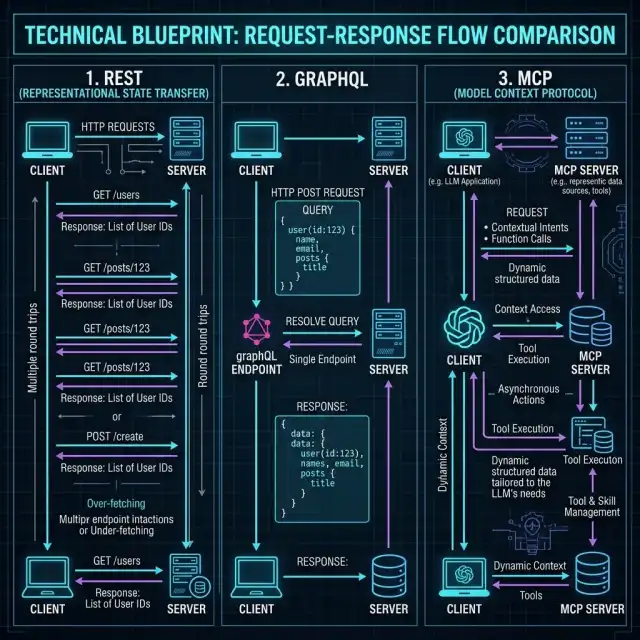
Traditional APIs were designed for determinism. A human developer writes a line of code that calls a specific endpoint with a specific payload. If the payload changes, the code breaks. In the agentic era, we deal with probabilistic consumption. An LLM decides which tool to call based on a natural language goal. If the tool description is vague, the agent fails. This requires a protocol that doesn't just transport data, but transports intent and capability.
2. REST: The Undisputed Backbone
REST (Representational State Transfer) is not dead. It is the concrete foundation of the web. In 2026, REST dominates stateless, cache-heavy, and high-throughput microservices. The architectural simplicity of REST—using standard HTTP verbs and status codes—makes it the most reliable choice for horizontal scaling.
Where REST Wins:
- Cacheability: HTTP caching semantics (ETags, Cache-Control) are perfectly aligned with REST endpoints. This is vital for CDNs and edge computing where sub-millisecond response times are mandatory.
- Simplicity: Standard HTTP methods (GET, POST, PUT, DELETE) map cleanly to CRUD operations. Every developer knows how to debug a 404 or a 500 error.
- Durability: Event-driven architectures and webhook receivers rely almost exclusively on RESTful endpoints. It is the lingua franca of system-to-system messaging.
However, REST fails when building complex, data-rich UIs. Over-fetching and under-fetching plague mobile clients, leading to the infamous "N+1 request" problem. For an AI agent, REST can be "chatty." If an agent needs to "summarize the last 5 invoices," a RESTful system might require the agent to fetch the user ID, then the list of invoice IDs, and then each invoice individually. This consumes tokens, increases latency, and introduces multiple points of failure.
3. GraphQL: Composability and The Enterprise UI
GraphQL solved the N+1 problem by allowing clients to query exactly what they need. It remains the gold standard for enterprise user interfaces and mobile applications in 2026. By providing a single endpoint that can resolve complex graphs of data, it reduced the number of round-trips required for a page load.
Where GraphQL Wins:
- Client-Driven Data: Front-end teams can build rich views without waiting for backend engineers to deploy new endpoints. This "Schema-First" development accelerated UI iteration cycles.
- Strong Typing: The schema provides a rigid contract, enabling excellent tooling and code generation. Typed systems reduce the runtime error surface significantly.
- Aggregation: A single GraphQL query can aggregate data from multiple microservices via a federated gateway, providing a unified view of the business domain.
The downside? GraphQL is exceptionally difficult to cache at the network edge because most queries use POST requests with dynamic bodies. It also introduces significant complexity in query parsing, cost analysis, and DDoS protection. For AI agents, GraphQL is a "double-edged sword." While it allows fetching all context in one go, the sheer complexity of writing a valid, optimized GraphQL query is often too high for smaller or more specialized LLMs, leading to hallucinated field names or broken syntax.
4. MCP: The AI-Native Standard
The Model Context Protocol (MCP) is the defining architectural shift of 2026. Pioneered initially by Anthropic and rapidly adopted across the industry, MCP standardizes how AI models access data sources, tools, and prompts. It isn't just an API; it's a Contextual Interface.
Where MCP Wins:
- Agentic Tool Use: MCP defines exactly how tools are exposed to LLMs, standardizing parameter extraction and state feedback. The model receives a list of "Capabilities" it can invoke.
- Secure Context Injection: It allows agents to securely request context (like local file system data or database schemas) without exposing raw API keys to the model itself. The "Host" application handles the auth, while the "Server" provides the data.
- Zero-Config Integrations: Instead of writing custom API wrappers for every LLM, developers expose an MCP Server. Any compliant agent (from a local Cursor instance to a cloud-based Claude) can immediately understand and use the tools.
MCP operates primarily through two transports: stdio (for local tools) and SSE (Server-Sent Events) for remote tools. This allows for a unique "Local-First" development experience where your IDE can talk directly to your database or local files without ever sending that data to a third-party API gateway.
5. The Security Surface of MCP: Hardening the Agentic Link
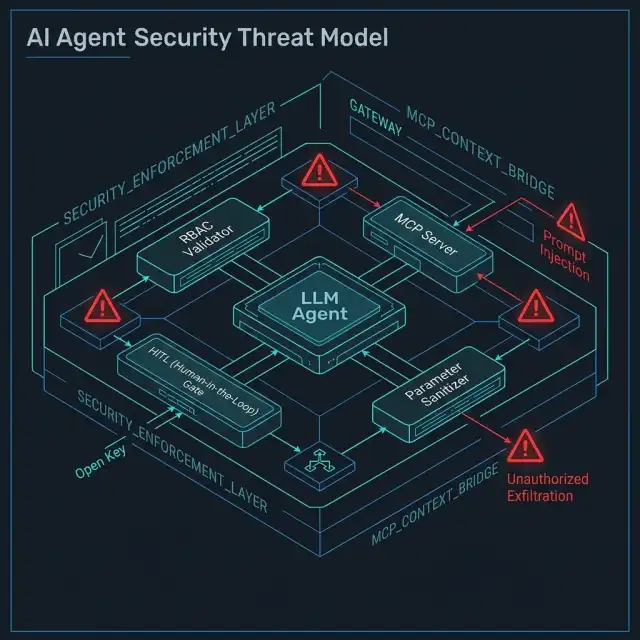
As we move from human-triggered actions to agent-triggered actions, the security model must evolve. In a REST/GraphQL world, we trust the code. In an MCP world, we are trusting an autonomous decision-maker.
Key Security Vectors in 2026:
- Prompt Injection to Tool Execution: If an attacker can inject a prompt that instructs the agent to call an MCP tool with malicious parameters (e.g.,
delete_user(id="all")), the system is compromised. - Data Exfiltration via Context: An agent might be instructed to "read the last 100 emails and summarize them," but a malicious prompt could redirect that summary to an external endpoint controlled by the attacker.
- Privilege Escalation: MCP servers often run with broader permissions than the agent needs. Implementing "Least Privilege" for MCP tools is the most critical hardening step.
Security Surface Warning
Exposing internal systems via MCP requires strict Role-Based Access Control (RBAC). A hijacked LLM prompt could theoretically instruct an MCP server to execute destructive actions if permissions are not hardened. Always implement "Human-in-the-Loop" (HITL) validations for state-mutating MCP tools.
6. Real-World Adoption: How Cursor and Claude Reshaped Integration
By early 2026, the adoption of MCP followed a "Bottom-Up" trajectory. It started with developer tools.
Cursor and VS Code (Local Dominance):
Developers began shipping "MCP Configs" with their repositories. When you open a project in Cursor, it automatically connects to the local MCP servers defined in the .cursor/mcp.json. This allowed the AI to "know" the database schema, "read" the documentation files, and "run" the test suite without the developer having to paste context manually.
Claude and Enterprise Agents (Cloud Scale):
Anthropic's native support for MCP meant that Claude.ai could suddenly "reach into" a company's internal Slack, Jira, or AWS console via secure SSE tunnels. This wasn't a "plugin" in the 2023 sense; it was a standardized protocol that allowed for multi-step reasoning loops. The agent could check a Jira ticket, look up the code in GitHub via MCP, propose a fix, and run the CI/CD pipeline—all through a unified interface.
7. The Decision Matrix
Choosing the right protocol is critical. The modern "Sovereign Stack" utilizes all three in harmony.
| Protocol | Primary Consumer | Strengths | Weaknesses | Best For |
|---|---|---|---|---|
| REST | System-to-System | HTTP Caching, Simplicity, Scale | Over-fetching, Rigid payloads | Microservices, Webhooks, CRUD |
| GraphQL | Front-end Clients | Exact fetching, Type Safety, Federation | Complex caching, Query parsing overhead | Mobile Apps, Complex Dashboards |
| MCP | AI Agents & LLMs | Standardized tool calling, Secure context | Not for high-throughput UI data | AI integrations, Agentic Orchestration |
8. Migration Playbook: REST to MCP for Agents
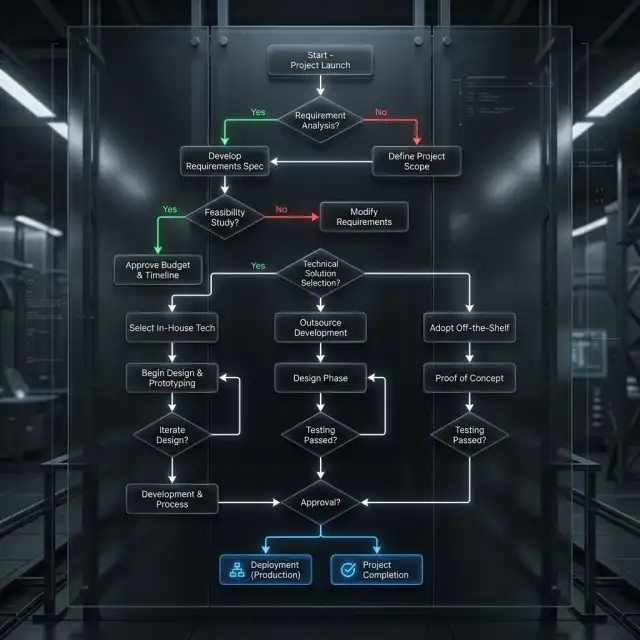
If you have a legacy REST API that needs to be consumed by an AI agent, you don't need to rewrite it. Instead, build an MCP Gateway. This acts as an "Intelligence Adapter" for your existing infrastructure.
The 4-Step Adapter Pattern:
- Initialize the Server: Use the MCP TypeScript or Python SDK to create a server instance. This server lives inside your firewall or alongside your microservices.
- Define Tools: Wrap your existing REST endpoints in MCP tool definitions. Crucial: Provide rich, descriptive JSON Schema descriptions. LLMs do not use the code; they use the description to decide when to trigger the tool.
- Handle Authentication: Implement OAuth or API key pass-through at the MCP gateway level. Ensure the agent operates under the specific user's context, not a global "Admin" key.
- Deploy: Run the MCP server via an SSE (Server-Sent Events) or stdio transport layer. Register the server URL in your Agentic Host (e.g., Claude Enterprise or a custom CrewAI agent).
9. MCP Transport Layers: stdio vs. SSE
The Model Context Protocol supports two primary transport mechanisms, each suited for different deployment architectures. Understanding the trade-offs is essential for a secure, high-performance integration.
1. stdio Transport (Local-First):
This is the transport used for local tools and IDE integrations (like Cursor). The host application starts the MCP server as a child process and communicates via standard input/output streams.
- Use Case: Local file system access, local database queries, running shell commands.
- Benefits: Extremely low latency, no network overhead, inherits the host's security context.
- Limitations: Limited to the machine where the host is running.
2. SSE Transport (Remote/Cloud):
Server-Sent Events allow for a persistent, unidirectional stream from the server to the client, while the client sends commands via standard HTTP POST requests.
- Use Case: Connecting cloud-based LLMs (like Claude.ai) to internal company data or third-party SaaS tools.
- Benefits: Works across the internet, supports standard web security (CORS, OAuth), and scales like a traditional web service.
- Limitations: Higher latency than stdio, requires a publicly accessible or tunneled endpoint.
10. MCP vs. OpenAPI: The Schema War
A common question in 2026 is: "If I already have a Swagger/OpenAPI spec, why do I need MCP?"
The answer lies in Consumption Logic. OpenAPI was designed for Human-Readable API Documentation and Machine-Generated Clients. It describes how to call an endpoint (parameters, types, headers).
MCP, however, is a Runtime Protocol. It doesn't just describe the endpoint; it manages the Negotiation of Context. An MCP server can proactively suggest prompts, provide resources (like a raw documentation file), and maintain a stateful connection with the LLM. While you can convert an OpenAPI spec into an MCP server, the MCP server provides the "Agentic Glue" that OpenAPI lacks. In the Sovereign Stack, we use OpenAPI to define the data structure and MCP to define the Cognitive Capability.
11. Developer Tooling: Debugging the MCP Lifecycle
Debugging an MCP interaction is fundamentally different from debugging a REST call. You aren't just checking if the server returned a 200 OK; you are checking if the Model called the tool correctly and if the Result was useful for the next reasoning step.
The 2026 Tooling Suite:
- MCP Inspector: A specialized CLI tool that allows you to manually trigger MCP tools and see exactly what the model sees. It's the "Postman for MCP."
- Trace Observability: Tools like LangSmith or custom OpenTelemetry exporters now include "MCP spans." You can see the prompt, the model's decision to call a tool, the MCP server response, and the final completion in a single trace.
- Mock Context Servers: For local development, engineers use mock MCP servers that simulate large database schemas or complex file systems to test how an agent handles context overflow.
10. Anti-Patterns: When MCP Becomes a Liability
Despite its power, MCP is often misapplied. Avoid these "Agentic Debt" traps:
- The "God Tool" Anti-pattern: Creating a single MCP tool called
execute_sql(query: string). This gives the agent too much power and zero guardrails. Instead, create specific tools likefetch_user_by_emailorget_recent_orders. - Ignoring Token Limits: Sending a 50MB database schema via MCP context. The agent will either crash or lose focus (Needle in a Haystack problem). Use Semantic Search (RAG) within the MCP server to provide only the relevant snippets of context.
- Stateless Tool Loops: Expecting the agent to remember state between different MCP server instances. State should be managed by the Host Application, not the individual MCP server.
11. 2027–2030 Roadmap: The Protocol Convergence
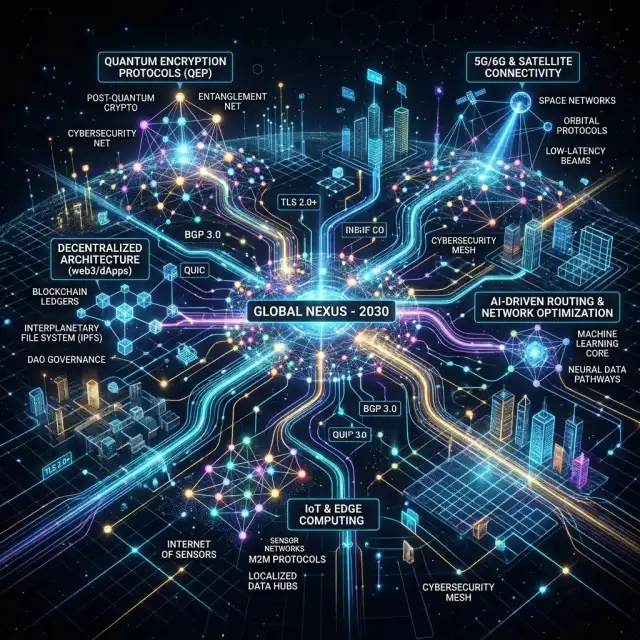
Looking ahead, APIs will evolve from data providers to capability providers. The distinction between "calling an API" and "asking an agent" will blur.
- 2027: Universal MCP adoption. Every major SaaS provider ships an official MCP server alongside their REST API. "Built with MCP" becomes the new "Powered by AI."
- 2028: GraphQL + MCP hybrids. GraphQL schemas auto-generate MCP tool definitions. The "Query" becomes the "Context Request."
- 2030: Contextual Protocols dominate. APIs negotiate capabilities autonomously based on the calling agent's intelligence level and authorization scope. We move from "API Keys" to "Agentic Identity Certificates."
12. Expert Insight: The Sovereign View on Connectivity
By Vatsal Shah
"Connectivity is the lifeblood of intelligence. In the industrial era of AI (2026+), we cannot afford 'siloed intelligence.' If your data is trapped behind a rigid REST endpoint that an agent can't understand, that data is functionally invisible. The transition to MCP isn't just a technical upgrade; it's an Accessibility Upgrade for Artificial Intelligence. My advice to CTOs is simple: Audit your API surface today. If you aren't describing your capabilities in a way an LLM can consume, you are building a legacy system in real-time."
Frequently Asked Questions (FAQ)
Can I use GraphQL instead of MCP for my AI agent?
While possible, it is highly inefficient. LLMs struggle to generate syntactically perfect, deeply nested GraphQL mutations consistently. MCP abstracts this by providing standardized tool calling schemas that models are fine-tuned to understand.
Is REST dead in 2026?
Absolutely not. REST is the most robust, scalable, and cacheable protocol for standard backend-to-backend communication and webhook delivery.
How does MCP handle authentication?
MCP is transport-agnostic. When running over SSE (HTTP), standard authentication headers (Bearer tokens, API keys) apply. The server enforces access control before executing the tool.
Will MCP replace OpenAPI/Swagger?
No. OpenAPI is a specification for HTTP APIs. MCP is a distinct protocol designed specifically for injecting context and executing tools in an LLM-driven environment. However, OpenAPI specs can be used to auto-generate MCP tool definitions.
What is the best language to build an MCP Server?
In 2026, TypeScript and Python possess the most mature MCP SDKs, backed directly by Anthropic and the open-source community.
Does MCP work with local LLMs?
Yes. Many local runners like Ollama and LM Studio have adopted MCP support, allowing you to connect local data to local models with zero cloud dependency.
