STRATEGIC OVERVIEW
Practitioner breakdown of Re-Engineering the Project Manager: Moving from Tactical Task-Tracking to Strategic Design — written for CTOs, VP Engineering, and India GCC leads shipping production AI with measurable ROI.
By Vatsal Shah | 2026-07-13 | 25 min read
Table of Contents
- Introduction
- The Ticket-Clerk Obsoletion: Why Automated Status Tracking Kills Basic PM Tasks
- Re-Defining the Role: PMs as Strategic Value Chain System Designers
- Systems Orchestration: Managing Integrations Across Engineering and Operations
- The Technical Bridge: Critical Architectural Skills for Modern Project Managers
- Legacy PM vs. Strategic Value Chain Designer
- Pitfalls and Modern Anti-Patterns
- Anti-Pattern 1: Relabeling Status Updates as 'AI Prompts' Without Structural Redesign
- Anti-Pattern 2: Decoupling PMs from Technical Architectural Conversations
- Anti-Pattern 3: Hardcoding Rigid Agile Frameworks in Flexible AI Environments
- Anti-Pattern 4: Balance Sheet Pooling Without Inter-Company Entity Segregation
- Futuristic Horizon: 2027–2030 Roadmap
- Key Takeaways
- What to Do Monday Morning
- FAQ
- About the Author
Introduction
The software development industry is undergoing a structural realignment. For decades, the project manager (PM) has functioned as the administrative heartbeat of delivery teams. Armed with spreadsheets, Kanban boards, and burndown charts, these professionals spend their days gathering updates, moving tickets, scheduling sync meetings, and reporting metrics. However, entering 2026, the rise of autonomous development environments, automated coding pipelines, and agentic workflows has rendered this tactical status-tracking role completely obsolete.
When code generation, deployment, unit testing, and progress tracking are managed directly by stateful AI agents and integrated systems, the need for a human intermediary to ask "What is the status of this ticket?" drops to zero. Enterprises that continue to employ project managers in purely administrative roles find themselves burdened with high overhead, slowed delivery cycles, and communication friction.
The survival of the project management profession depends on a complete re-engineering of the role. PMs must transition from tactical "ticket clerks" into strategic value chain system designers and organizational architects. This article details the transition to this new operational model, outlining the core technical competencies, systems orchestration skills, and strategic frameworks required to design high-throughput product delivery pipelines in 2026.
We will analyze why traditional agile tracking methods fail in AI-native engineering environments, how to build robust integration pipelines that coordinate work across human builders and autonomous agents, and the specific system design skills PMs must master to remain indispensable technology leaders.
In this deep dive, we will explore the structural shifts driving the reengineering of the project manager role. We examine how early industrial models shape today's coordination tools, how the transition to automated SDLC ingestion is executed technically, and why the metrics of organizational velocity must change from qualitative estimates to quantitative, telemetry-based flow logs.
Furthermore, we will outline the concrete architectural competencies required to bridge the gap between business strategies and complex engineering implementations. This includes reading system topography diagrams, verifying API schema validation contracts programmatically, managing data compliance boundaries (such as GDPR, CCPA, and HIPAA), and avoiding the common organizational pitfalls and anti-patterns that delay AI-native transformation initiatives. Technology teams that adopt these practices eliminate coordination bottlenecks and accelerate release cycles, securing their position at the forefront of the software delivery landscape.
Historically, the project manager was created to manage communication latency. When information had to move via physical paper, weekly status reports were a necessary evil to keep executives updated on project statuses. When teams moved to digital tracking systems in the 1990s and early 2000s, the role evolved but the core function remained: translating raw developer activity into structured business updates. Managers held long meetings, created complex Gantt charts, and continually chased engineers for status updates.
This manual status gathering introduced massive friction. Developers were pulled away from deep building focus to explain what they did yesterday, what they plan to do today, and what blockers they face. In an era where software teams must ship daily to remain competitive, these legacy communication patterns act as a massive drag on organizational velocity.
By automating status retrieval, resource planning, and quality gates, the modern enterprise frees its engineers to focus on building while project managers step up to a much higher leverage function. They design the systems, metrics, and workflows that allow the entire software factory to run autonomously, maximizing engineering yield and business outcomes.
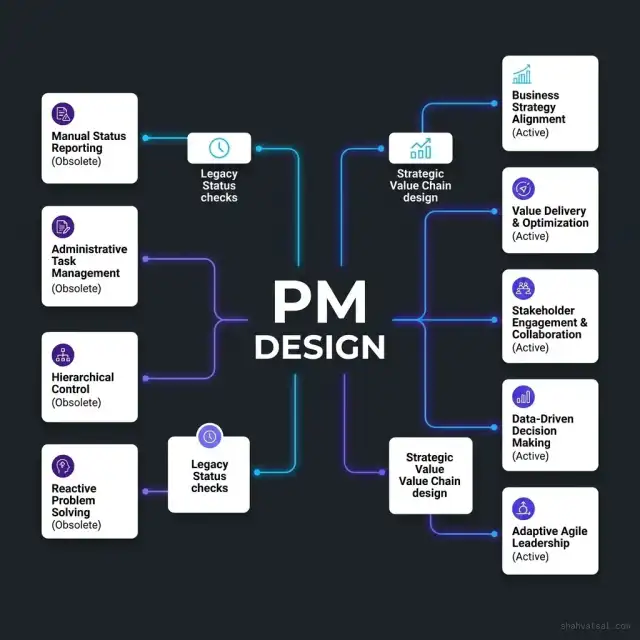
The Ticket-Clerk Obsoletion: Why Automated Status Tracking Kills Basic PM Tasks
The traditional project management model is built on status gathering. Daily stand-ups, backlog grooming sessions, and weekly status reviews are designed to extract information from engineers and write it into tracking tools like Jira or Linear. This structure is inherently inefficient, introducing context-switching costs for engineers and creating communication delays.
To understand why this model is failing today, we must trace its historical roots. Traditional project management is a direct descendant of Frederick Winslow Taylor's scientific management principles, also known as Taylorism, developed in the early 20th century for industrial manufacturing. Taylorism separated work into two distinct categories: 'planning' (managed by specialized administrators) and 'execution' (done by manual laborers). This command-and-control paradigm was carried into the software industry through Gantt charts, work breakdown structures, and rigid project phases.
However, software engineering is not a repetitive manufacturing process. It is a highly creative, iterative design discipline. When organizations separate planning from execution, they create a communication barrier. Project managers, lacking technical context, build schedules based on arbitrary business deadlines, while developers focus on solving technical constraints. This separation results in artificial deadlines, high developer stress, and poor software quality. In an AI-native development environment, where automated coding pipelines can generate and deploy software in real time, this legacy Taylorist model is completely obsolete.
In 2026, this status-gathering layer is completely automated. Modern IDEs, CI/CD pipelines, and agentic systems update project states automatically as code is written and committed. When a developer works on a feature, the underlying development tool analyzes the changes, updates the task description, links the pull request, and moves the ticket through the pipeline without human intervention.
The legacy approach to project management treats status as a qualitative narrative. Managers rely on developers to explain their progress, introducing human biases like optimism bias (where tasks are reported as "90% complete" for weeks) or sandbagging (where developers inflate estimates to avoid pressure). These subjective narratives prevent managers from obtaining a clear, objective view of operational capacity.
When status updates are linked directly to actual repository commits, the subjectivity is removed. The system knows exactly what code files have been edited, what tests are passing, and what deployment environments are active. This telemetry-based tracking provides a real-time, high-fidelity view of development progress, allowing the organization to coordinate its release plans with total precision.
SDLC Ingestion: Automating State Synchronization Directly from Git Trees
Modern software engineering teams do not write updates; they write code. The transition to automated state tracking relies on direct Software Development Lifecycle (SDLC) ingestion pipelines. When an engineer branches from a main repository, commits code, or opens a pull request, the events are captured by system webhooks.
An ingestion pipeline processes these events:
- Context Parsing: Parsing commit messages and code diffs using lightweight natural language parsers to understand what changes were made.
- Ticket Linking: Identifying task references (e.g. task keys or issue IDs) embedded in the branch names or commits, linking them directly to project records.
- Status Transitions: Moving the corresponding ticket through work states (from Backlog to In Progress to Code Review) based on actual development actions rather than manual dashboard drags.
Furthermore, technical project managers must establish cryptographic trust chains for all incoming status updates. In modern enterprise environments, development actions are performed by a combination of human engineers and autonomous AI agents. To prevent malicious spoofing of commit records, all commits must be signed using GPG or SSH keys. The ingestion pipeline verifies these signatures against registered developer public keys before updating the project database.
This cryptographic verification ensures:
- Non-Repudiation: Proving that a commit was indeed written by the specified developer or authorized agent, preventing unauthorized changes.
- Audit Integrity: Creating an unalterable audit log of every system change, satisfying compliance frameworks like SOC 2 and ISO 27001.
- Secure Work Routing: Ensuring that automated agents only execute operations when triggered by verified, signed requests from authorized project administrators.
By implementing this security boundary, the technical PM protects the integrity of the delivery pipeline, ensuring that all status updates are based on verified, trusted development actions.
Consider a developer who creates a branch named feature/usr-901-oauth-flow and commits a change to a login controller. The ingestion system instantly parses the branch prefix, associates the commit with the outstanding OAuth task, changes the status to "In Progress," and records the active development time. When the engineer opens a pull request to merge the branch, the ingestion service links the PR, changes the status to "In Review," and assigns the code review to the designated team lead.
This automation completely eliminates the administrative burden on the engineer. They write code, merge PRs, and deploy services without ever having to log into a project management dashboard to drag a ticket. The status of the work is a natural, real-time byproduct of their actual development activity.
The Death of Estimation Poker and the Rise of Raw Historical Cycle Averages
For years, project managers have facilitated "estimation poker" sessions, where teams assign story points to tasks based on perceived complexity. This manual estimation is highly subjective, influenced by group dynamics, and frequently inaccurate, leading to missed deadlines and poor planning.
In 2026, systems-driven project management replaces manual estimates with raw historical cycle averages. By analyzing actual time-to-deliver data across hundreds of previous commits, the system builds a probabilistic model of future task delivery.
This probabilistic estimation uses historical latency data:
- Code Complexity Analysis: The system reads the code files impacted by a task and estimates complexity based on dependency counts and structural changes.
- Historical matching: Matching the current task profile against past deliverables to identify typical cycle times.
- Probabilistic Projections: Generating a probability curve (e.g. "85% probability of delivery within 4 days") rather than a single, static estimation number.
For example, when a new ticket is added to the backlog, the system performs a static analysis of the target repository area, noting dependencies, codebase age, and historical churn rates. It then runs a Monte Carlo simulation against the team's historical delivery latency for similar profiles, producing a probability distribution of delivery dates.
This data-driven approach removes the negotiation from project planning. Instead of debating whether a task is a "3-point" or "5-point" ticket, the team relies on historical performance data. This allows the product team to plan marketing campaigns, customer updates, and partner integrations with realistic, data-backed confidence.
Administrative Fatigue: The Real Context-Switching Cost Exposed
When developers are forced to participate in frequent status meetings, write manual progress descriptions, and manage administrative details, they suffer from context-switching fatigue. Cognitive science research demonstrates that after an interruption, a developer requires an average of 23 minutes to return to their original state of deep focus.
Forcing builders to manage administrative databases directly reduces their productive engineering time. The strategic PM recognizes that engineer attention is the primary constraint of the technology organization. By automating all administrative tracking tasks, they eliminate context switching, allowing builders to maintain deep focus and accelerate actual feature delivery.
Let us calculate the financial impact of administrative meetings. In a 50-person engineering organization, if every developer attends one 15-minute stand-up and spends 10 minutes updating tickets daily, the organization loses 1,250 minutes of focus time every single day. Over a standard working year, this administrative tax consumes thousands of engineering hours, representing a significant waste of capital.
By replacing these meetings with automated ingestion feeds, the enterprise recovers this lost capacity. Engineers remain in their flow states, writing clean code and shipping features, while the system records their progress silently and accurately in the background.
Citation Anchor: Project Management Automation Metrics
A 2025 global technology study by PMI indicates that organizations adopting automated project tracking and AI-driven resource allocation experience a 35% reduction in administrative overhead and a 22% improvement in on-time delivery metrics. This data demonstrates that offloading status tracking to automated systems directly correlates with improved delivery performance.
Re-Defining the Role: PMs as Strategic Value Chain System Designers
To remain relevant, the project manager must move from tracking tasks to designing the systems that deliver value. This transition requires a shift in focus from "how a single task is moving" to "how the entire organizational pipeline is structured."
The modern project manager functions as a Value Chain System Designer. Their primary responsibility is to analyze the flow of ideas from conception to production, identify operational bottlenecks, design automation paths, and ensure that the organization's resources are aligned with strategic objectives.
To optimize these delivery pipelines, the modern PM applies Eliyahu M. Goldratt's Theory of Constraints (TOC) to organizational workflows. TOC states that every manageable system is limited by a very small number of constraints, and global throughput can only be improved by optimizing the system's primary constraint. In a software organization, local optimization (such as ensuring that every developer is writing code 100% of the time) often reduces overall throughput by flooding downstream queues with incomplete features and bugs.
The strategic project manager manages this constraint by applying Goldratt's five focusing steps:
- Identify the Constraint: Locating the primary bottleneck (e.g. testing capacity, design approvals, or data synchronization latencies) that limits delivery speed.
- Exploit the Constraint: Ensuring that the bottleneck node operates at maximum efficiency (e.g. automating routine QA checks so QA engineers focus only on complex edge cases).
- Subordinate Everything Else: Aligning all upstream and downstream workflows to the pace of the bottleneck, preventing work-in-progress inventory from building up.
- Elevate the Constraint: Investing in additional resources, tools, or automation to increase the bottleneck's capacity.
- Repeat: Once the constraint is resolved, identifying the new system bottleneck and repeating the optimization loop.
By focusing on system constraints rather than local resource utilization, the PM builds a balanced, high-throughput delivery pipeline that delivers value consistently.
[ Strategic Business Inputs ]
             |
             v
[ Value Chain Design Layer (PM) ] ---> [ Resource Optimization ] ---> [ Automated Output Delivery ]
Instead of asking "Is this task done?", the designer asks:
- "What are the specific process delays between code complete and production release?"
- "How can we automate the verification of security compliance for external API integrations?"
- "Where is resource queue wait-time accumulating in our cross-functional delivery streams?"
By focusing on these structural questions, the PM optimizes the organization's delivery capabilities, creating sustainable competitive advantages.
To design efficient delivery pipelines, project managers must adopt a systems engineering mindset. They view the technology organization as a factory system composed of queues, servers, routing pathways, and feedback loops. Their goal is to maximize the throughput of this system while minimizing lead times and operational costs.
This transition requires a fundamental shift in daily activities. Instead of writing status updates and chasing developers, the PM spends their time modeling workflows, designing automation integrations, auditing queue latencies, and aligning team topologies to minimize cross-team dependencies.
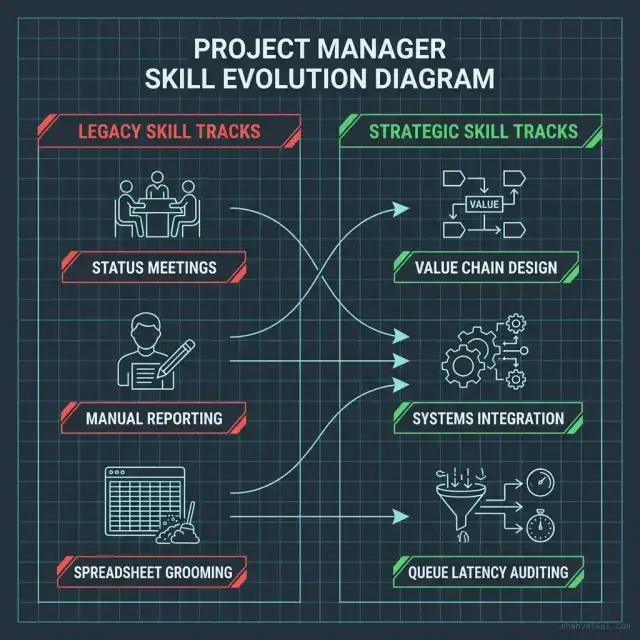
Value Chain Engineering: Structuring Operational Pipelines for Systemic Yield
Value chain engineering represents the application of systems engineering principles to organizational workflows. The project manager maps every stage of product delivery as a data transformation node:
[ Concept Draft ] -> [ Technical Design ] -> [ Agent Code Generation ] -> [ Human Validation ] -> [ Production Release ]For each node, the PM defines:
- Input Quality Requirements: The specific documentation and context templates needed before work can begin at that node.
- Processing Automation: The script integrations, code-generators, and testing suites that accelerate processing within the node.
- Output Quality Gates: The automated testing and verification steps that check deliverables before passing them to the next node.
By structuring these pipelines, the PM ensures that work moves smoothly between stages, minimizing manual handoffs and maximizing throughput.
To apply value chain engineering principles to software development, project managers use value stream mapping to identify and eliminate waste. They track two primary metrics for every operational pipeline: Value-Added Time (the time developers spend actively writing code, designing interfaces, or writing tests) and Non-Value-Added Time (the time tasks spend waiting in queues for reviews, approvals, or builds). The ratio of these two metrics defines the team's Process Cycle Efficiency (PCE):
$$PCE = \frac{Value\text{-}Added\text{ }Time}{Total\text{ }Lead\text{ }Time} \times 100$$
In traditional technology organizations, the PCE is often below 15%. This means that for a feature that takes 10 days to deliver, the developer spent only 1.5 days actively working on the code, while the remaining 8.5 days were spent waiting in various queues. The strategic PM acts as a value stream designer, focusing on reducing this non-value-added queue time.
They automate manual handoffs using API-driven triggers. For instance, when a designer marks a user interface mockup as 'Approved' in Figma, the integration system automatically extracts the design tokens, exports the layout assets to a shared directory, creates the implementation ticket in the engineering backlog, and notifies the development team. By replacing manual email notifications and status reviews with automated triggers, the PM reduces handoff delays, keeping the delivery pipeline moving smoothly and efficiently.
For example, when design files are handed off from the product team to engineering, a legacy PM manually notifies the developers and schedules a handoff meeting. A strategic value chain designer structures this transition as an automated API trigger. When the design file status changes to "Ready for Development" in the design tool, the system automatically parses the layout elements, generates boilerplate CSS variables, updates the project backlog, and assigns the initial component generation task to an available development agent.
This systematic approach removes manual friction from handoffs. By defining clear, programmatic inputs and outputs for each step, the PM ensures that work progresses without coordination delays or human oversight errors.
Cycle Latency Audits: Uncovering Blocker Dependencies Across Organizational Nodes
To optimize value streams, project managers conduct regular cycle latency audits. Instead of looking at individual resource utilization (how busy each developer is), they measure queue latency (how long a task sits waiting for processing).
These audits typically reveal that tasks spend 80% of their lifecycle waiting in queues (e.g. waiting for pull request reviews, waiting for database migrations, or waiting for business approvals). The strategic PM targets these queues for optimization.
Consider an audit that tracks a new user registration feature from backlog to deployment. While the actual active coding time was only 4 hours, the total calendar time to deliver the feature was 14 days. A detailed latency breakdown reveals the following:
- Backlog Queue: 5 days waiting for product manager clarification.
- Technical Design Review: 3 days waiting for senior architect availability.
- Active Coding: 4 hours of builder building.
- PR Review Queue: 4 days waiting for a review from the engineering lead.
- Staging Deployment Verification: 2 days waiting for manual QA sign-off.
The strategic PM focuses their efforts on reducing these queue delays. They implement automated QA verification suites, establish code review SLAs, and design clearer product specification templates to streamline handoffs. By addressing these operational bottlenecks, they reduce cycle times and accelerate delivery across the organization.
Systems Orchestration: Managing Integrations Across Engineering and Operations
A primary challenge for modern enterprises is orchestrating work across diverse, distributed teams. The re-engineered project manager acts as a systems orchestrator, bridging the gap between engineering, product, marketing, and operations.
Rather than managing these integrations through weekly meetings and manual email status updates, PMs design automated orchestration pipelines. They establish API-driven triggers that align workflows across departments, ensuring that the organization moves in sync.
When designing these automated orchestration systems across distributed microservices, project managers must understand how to manage distributed transactions. In a microservices architecture, a single business transaction (such as a customer order checkout) may require updates across multiple independent database nodes (e.g. inventory database, billing gateway, and shipping registry). Enforcing traditional database transactions (ACID properties) across these services is difficult because it locks resources and slows down system performance.
To solve this, the systems orchestrator designs workflows using the Saga Pattern. A Saga is a sequence of local transactions across services. Each local transaction updates the database and publishes an event that triggers the next service in the sequence. If a step fails, the Saga orchestrator executes compensating transactions that undo the changes made by the previous steps, restoring data consistency.
For example, if a billing charge succeeds but the shipping registry fails to reserve a package, the orchestrator automatically executes a compensating transaction to refund the charge and update the order state. By understanding these transaction flows, the PM designs integration paths that protect data integrity and prevent system errors.
The modern PM's role is similar to that of a systems integration architect. They design the data schemas, webhook events, and integration paths that connect tools across the company (such as CRM systems, marketing automation platforms, and ERP databases). By linking these systems, the PM ensures that customer feedback, sales pipelines, and engineering priorities flow smoothly.
For instance, when a customer success agent registers a critical system bug in the CRM, the systems orchestrator designs a pipeline that parses the request, checks the error logs, routes the bug to the correct engineering team, and notifies the marketing team to prepare an update notification. This orchestration happens automatically, removing the delay associated with manual triage.
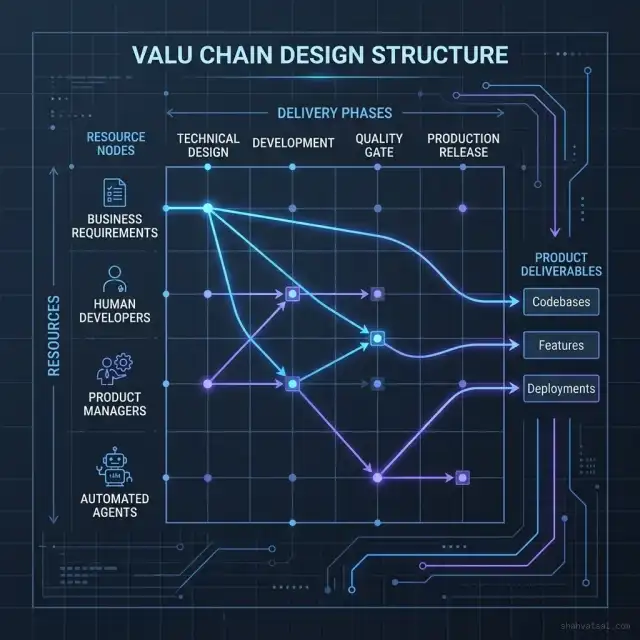
Human-Agent Orchestration Patterns: Task Partitioning and Hand-Offs in Hybrid Teams
In 2026, development teams are hybrid networks of human engineers and autonomous AI agents. Human engineers focus on complex architectural decisions and design tasks, while AI agents handle routine code generation, refactoring, test writing, and dependency upgrades.
Project managers design the delivery lifecycles that govern these hybrid networks. They establish task partitioning rules that route assignments based on complexity profiles:
[ Incoming Task ]
       |
       +---> Low Complexity / High Detail ---> [ Route to AI Agent Engine ]
       |
       +---> High Complexity / Architectural ---> [ Route to Senior Engineer ]
Additionally, they define hand-off protocols that manage transition points. For instance, when an AI agent completes a code generation task, the system automatically runs the test suites, creates a pull request, and assigns a human engineer to review the changes. If the validation tests fail, the system routes the failure logs back to the agent for correction, minimizing human review overhead.
Managing this hybrid workforce requires a deep understanding of resource optimization. The strategic PM treats development agents as scalable compute resources, spinning up agent instances to handle routine maintenance tasks, documentation updates, and test additions.
By offloading this manual work to automated agents, the PM ensures that human engineers can focus on creative problem solving, architectural design, and strategic feature building. This hybrid structure maximizes organization efficiency while reducing overall delivery costs.
Orchestrating a hybrid team of human developers and autonomous AI agents requires the project manager to design clear task routing and verification protocols. Not all software tasks are suited for agentic automation. The PM defines complexity thresholds that separate assignments: routine tasks (like writing unit tests, adding API endpoints, or updating dependency libraries) are routed to AI agents, while complex tasks (like architectural design, database optimization, or security reviews) are reserved for human developers.
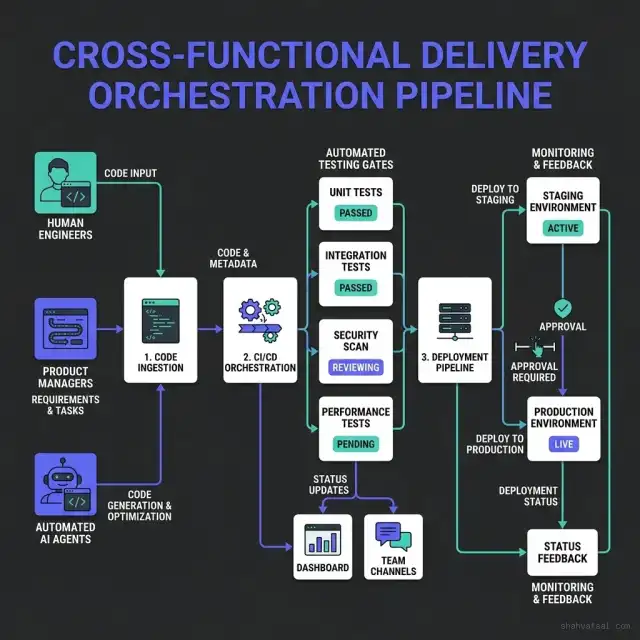
To govern these workflows, the project manager designs state machines that manage the lifecycle of agent-generated code. When a task is routed to an AI agent, the automation system spawns a containerized development environment, checkouts the code branch, and passes the task instructions to the agent API. The agent writes the code and opens a pull request.
At this point, the validation system executes automated checks:
- Static Code Analysis: Verifying code style and checking for common security vulnerabilities (using tools like SonarQube or Semgrep).
- Unit and Integration Testing: Running the test suites to ensure the agent-generated code does not introduce regressions.
- Review Assignment: If the automated checks pass, the system assigns the pull request to a human developer for final architectural review. If the checks fail, the error logs are routed back to the agent for correction, preventing human review overhead.
By implementing this automated review loop, the project manager ensures that agent-generated code meets quality standards before human review, maximizing overall team productivity and delivery speed.
Automating Gateways: Standardizing Release-Ready Checklist Criteria via Git Triggers
In traditional organizations, releasing software requires a series of manual check-off meetings where managers verify release readiness. This manual gatekeeping introduces delays and increases the risk of compliance errors.
The strategic PM automates these gateways using Git-driven release triggers. They write declarative release-readiness configurations that specify the criteria a project must satisfy before deployment:
release_gate_criteria:
  unit_test_coverage: ">= 92%"
  security_vulnerability_scan: "0 CRITICAL, 0 HIGH"
  architectural_review_signoff: true
  product_owner_verification: true
  performance_benchmark_regression: "<= 2%"
When a release branch is merged, the system checks these criteria automatically. If all checks pass, the deployment pipeline executes the release. If any check fails, the deployment is blocked, and the system notifies the appropriate team members, ensuring that release gates are both fast and secure.
This automated gatekeeping ensures that compliance and quality checks are applied consistently to every release. It removes human bias from the release process, protecting system stability while allowing the team to deliver updates rapidly.
Citation Anchor: Hybrid Workforce Productivity Benchmarks
Recent software engineering audits from McKinsey show that organizations deploying structured human-agent collaboration workflows experience a 45% increase in developer productivity and a 50% reduction in time-to-market metrics for standard features. This highlights the strategic value of designing efficient orchestration loops.
The Technical Bridge: Critical Architectural Skills for Modern Project Managers
To design effective delivery pipelines, project managers must possess strong technical literacy. A PM who does not understand basic system design cannot design a software delivery system.
A key technical skill for project managers is understanding the design patterns used to protect systems from overload. When linking applications to external APIs or open public networks, the system can get overwhelmed by sudden traffic spikes, causing service failures. PMs must understand:
- Rate Limiting: Restricting the number of API requests a client can make in a given timeframe (using algorithms like Token Bucket or Leaky Bucket). This protects services from traffic spikes and ensures fair resource distribution.
- Circuit Breakers: An architectural pattern that prevents an application from repeatedly calling a failing downstream service. The circuit breaker operates in three states: Closed (requests flow normally), Open (requests fail immediately without calling the service), and Half-Open (a limited number of requests are allowed through to check if the service has recovered).
- Fallback Strategies: Defining the alternative workflow when a service call fails (such as displaying cached data or placing the request onto a retry queue).
By incorporating these patterns into their project designs, the technical PM ensures that system integrations are resilient, maintaining platform stability under heavy load.
While they do not need to write production code, modern PMs must be able to understand architectural diagrams, analyze system topographies, identify database constraints, and discuss API integrations with senior engineers.
This technical bridge allows the PM to translate business requirements into structured engineering designs, ensuring that project goals are aligned with technical realities.
A PM who lacks technical literacy often builds unrealistic delivery timelines. They may treat a simple CSS change and a complex database migration as equivalent tasks, or schedule integration reviews without accounting for API rate limits and network latency. To avoid these errors, the modern project manager must invest time in developing their technical skills.
By understanding the underlying technology stack, the PM can facilitate better collaboration between business and engineering teams. They translate complex technical constraints into clear business trade-offs, helping the company make realistic, strategic decisions.
Deep-Dive: Resolving API Integration Points and Understanding Relational Integrity Constraints
To participate productively in technical discussions, project managers must understand how database structures and interface systems impact development timelines. They should know:
- API Schema Definitions: How data structures are validated and transmitted between microservices (e.g. using JSON Schema or Protocol Buffers).
- Relational Database Constraints: How foreign keys, unique indices, and database transaction locks affect operational speed and data integrity.
- Asynchronous Processing Patterns: The trade-offs between synchronous REST calls and event-driven, queue-based messaging.
Furthermore, technical project managers must understand database transaction isolation levels and how they balance data integrity against processing performance. In high-throughput transaction systems, multiple database operations run concurrently. To prevent data corruption, database engines support four main isolation levels:
- Read Uncommitted: The lowest isolation level, where transactions can read data that has been modified by other transactions but not yet committed. This level offers the highest read performance but is prone to 'dirty reads' (where a transaction reads data that is later rolled back by the original writer).
- Read Committed: Prevents dirty reads by ensuring a transaction can only read data that has been committed. However, it is subject to 'non-repeatable reads' (where reading the same row twice within a transaction returns different values because another transaction modified and committed changes in between).
- Repeatable Read: Ensures that any data read during a transaction remains unchanged for the duration of the transaction, preventing non-repeatable reads. However, it can still suffer from 'phantom reads' (where new rows inserted by another transaction during the query become visible in subsequent reads).
- Serializable: The highest isolation level, which locks resources to run transactions sequentially. This level prevents all database anomalies (dirty reads, non-repeatable reads, and phantom reads) but significantly reduces write performance and increases the risk of database deadlocks.
By understanding these database isolation levels, the technical project manager can work with database administrators and engineers to select the appropriate level for different features. For example, a financial ledger module requires Serializable isolation to prevent double-spending anomalies, whereas a user analytics log module can operate under Read Committed isolation to maximize processing speed, ensuring the system balancer remains optimized.
For example, when planning a new features integration, a technical PM can identify that a proposed design relies on synchronous API calls to an external service that lacks high availability. By spotting this dependency risk early, they can guide the team to design an asynchronous queue-based fallback, preventing runtime failures.
Below is a Python validation check template that a technical project manager can use to audit system topographies and verify API integration schemas programmatically.
import json
from typing import Dict, Any, List

class APISchemaValidator:
    def __init__(self, expected_schema: Dict[str, Any]):
        self.expected_schema = expected_

    def validate_payload(self, payload: Dict[str, Any]) -> List[str]:
        errors = []
        for key, expected_type in self.expected_schema.items():
            if key not in payload:
                errors.append(f"Missing required field: '{key}'")
                continue

            actual_value = payload[key]
            # Handle standard type validations
            if expected_type == "int" and not isinstance(actual_value, int):
                errors.append(f"Field '{key}' must be of type integer. Got {type(actual_value).__name__}.")
            elif expected_type == "str" and not isinstance(actual_value, str):
                errors.append(f"Field '{key}' must be of type string. Got {type(actual_value).__name__}.")
            elif expected_type == "float" and not isinstance(actual_value, (float, int)):
                errors.append(f"Field '{key}' must be of type float. Got {type(actual_value).__name__}.")
            elif expected_type == "bool" and not isinstance(actual_value, bool):
                errors.append(f"Field '{key}' must be of type boolean. Got {type(actual_value).__name__}.")
        return errors

class SystemIntegrityAuditor:
    def __init__(self, system_nodes: Dict[str, List[str]]):
        self.system_nodes = system_nodes  # Maps nodes to their downstream dependencies

    def detect_circular_dependencies(self) -> List[List[str]]:
        visited = set()
        path = []
        cycles = []

        def dfs(node: str):
            if node in path:
                # Cycle found, extract circular path
                cycle_start = path.index(node)
                cycles.append(path[cycle_start:] + [node])
                return
            if node in visited:
                return

            visited.add(node)
            path.append(node)
            for neighbor in self.system_nodes.get(node, []):
                dfs(neighbor)
            path.pop()

        for current_node in self.system_nodes.keys():
            dfs(current_node)

        return cycles

# Example execution dataset
if __name__ == "__main__":
    # Define an expected API integration payload schema
    required_user_schema = {
        "user_id": "int",
        "email": "str",
        "is_active": "bool",
        "billing_limit": "float"
    }

    validator = APISchemaValidator(required_user_schema)

    # Audit an incoming payload from an external gateway integration
    test_payload = {
        "user_id": 90812,
        "email": "[email protected]",
        "is_active": "ACTIVE",  # Invalid type: should be boolean
        # Missing billing_limit
    }

    schema_errors = validator.validate_payload(test_payload)
    if schema_errors:
        print("[AUDIT ERROR] API Schema Validation failed:")
        for error in schema_errors:
            print(f"  - {error}")
    else:
        print("[SUCCESS] API Payload matches required integration schema.")

    # Audit a system topography mapping for circular dependencies
    topography_map = {
        "AuthService": ["UserLedgerService"],
        "UserLedgerService": ["BillingGateway"],
        "BillingGateway": ["AuthService"],  # Circular dependency risk detected
        "NotificationQueue": []
    }

    auditor = SystemIntegrityAuditor(topography_map)
    detected_cycles = auditor.detect_circular_dependencies()

    if detected_cycles:
        print("\n[AUDIT WARNING] Detected circular system dependencies that threaten stability:")
        for cycle in detected_cycles:
            print(f"  - Path: {' -> '.join(cycle)}")
    else:
        print("\n[SUCCESS] System topography matches hierarchical design rules.")
Risk Mitigation: Structuring Compliance Boundaries Under GDPR, CCPA, and HIPAA Protocols
Data privacy regulation requires technology organizations to enforce strict access controls. Project managers must design compliance boundaries directly into project topographies:
- Data Residency Rules: Ensuring that user data from specific jurisdictions (like the EU under GDPR) is stored on local servers and not processed on overseas systems.
- Personally Identifiable Information (PII) Isolation: Designing systems that separate user identification details from operational processing logs, protecting user privacy.
- Audit Logging: Integrating logging systems that capture every read and write access to protected data tables, satisfying regulatory audits.
By incorporating these compliance guardrails into the project designs, the PM mitigates regulatory risks and prevents expensive system redesigns.
To build reliable delivery pipelines, the strategic project manager must understand how system architecture and database designs impact project schedules. One of the most common causes of project delays is database schema migrations. When a new feature requires changes to a database table (such as adding columns, renaming fields, or modifying data types), the project manager must coordinate the migration to prevent system downtime.
The PM must understand the difference between backward-compatible and breaking migrations:
- Backward-Compatible Migrations: Changes that do not break the existing application code (such as adding a nullable column). These migrations can be deployed ahead of time without system downtime.
- Breaking Migrations: Changes that break older application versions (such as renaming or deleting a column). These require a multi-step migration process (like the Expand and Contract pattern) to update the database schema and application code safely.
Additionally, when designing systems that integrate with external APIs, the PM must account for API rate limits and data sync schedules. If an integration relies on real-time data sync but is limited by low API rate limits, the PM must guide the team to design a queue-based, asynchronous sync pattern. By understanding these technical constraints early, the project manager helps the team build robust, scalable architectures, avoiding costly rework and delivery delays.
For example, when working with healthcare systems under HIPAA, a technical PM designs the workflow so that all protected health information (PHI) is processed within a secure, encrypted database layer. Any diagnostic or debugging data exported to development environments must be anonymized before export.
By understanding these compliance rules, the PM designs workflows that protect user data and maintain regulatory standards, ensuring that security is built in from the start.
Legacy PM vs. Strategic Value Chain Designer
Transitioning to a systems design model requires replacing old administrative habits with strategic activities.
| Dimension | Legacy Project Manager | Strategic Value Chain Designer |
|---|---|---|
| Primary Focus | Tactical task tracking, status gathering, and meeting coordination. | Systems design, pipeline optimization, and resource alignment. |
| Workflow Metric | Manual velocity points and retrospective sprint reports. | Automated flow efficiency, lead times, and capacity forecasts. |
| Integration Strategy | Scheduled status meetings, email check-ins, and manual ticket updates. | API-driven trigger workflows and real-time automated updates. |
| Team Model | Siloed human teams working on manual task assignments. | Hybrid human-agent delivery networks with automated task routing. |
| Technical Literacy | Minimal; focused on tracking delivery dates rather than design. | Moderate-to-high; able to read architecture diagrams and discuss API contracts. |
Pitfalls and Modern Anti-Patterns
Organizations trying to modernize their project management practices often fall into several common traps:
Anti-Pattern 1: Relabeling Status Updates as 'AI Prompts' Without Structural Redesign
A common mistake is using AI tools to summarize manual status reports without changing the underlying administrative process:
- The Trap: Project managers use AI to compile status updates from developers and email summaries to leadership, while keeping stand-ups and manual tracking tasks unchanged.
- The Reality: This approach simply automates the creation of administrative reports without removing the friction of status gathering, missing the opportunity to build direct tool integrations.
Instead, companies must integrate their development tools directly with tracking platforms, allowing data to flow automatically without human intermediaries.
For example, a manager might use an AI model to write summaries of pull requests and email them to the leadership team, while still requiring developers to attend daily stand-ups and write manually compiled sprint reports. This approach fails to address the underlying issue: developers are still distracted from writing code to fulfill reporting requests. True optimization requires removing the reporting meetings and using direct tool integrations to automatically update project databases.
This anti-pattern is particularly common in legacy organizations attempting to show 'AI adoption' to executives. Managers focus on using generative AI as an administrative drafting assistant rather than redesigning the work system itself. The developers' primary constraint—cognitive distraction—remains unaddressed. Instead of writing code, engineers continue to spend hours explaining their progress. To break this pattern, project managers must eliminate manual status inputs entirely, allowing project databases to be updated dynamically based on repository activity logs.
Anti-Pattern 2: Decoupling PMs from Technical Architectural Conversations
Some organizations believe that because project management is a business-focused role, PMs should be kept away from technical discussions:
- The Trap: Project managers are excluded from system architecture reviews, leaving them to build timelines without understanding the underlying technical dependencies.
- The Reality: Excluding PMs from these reviews results in unrealistic schedules and misaligned project plans, as the PM cannot identify integration risks or resource bottlenecks.
PMs must participate in technical reviews to understand system dependencies and align delivery pipelines with actual technical constraints.
When PMs are kept away from architectural reviews, they cannot identify dependency risks or resource bottlenecks. For instance, a PM might schedule a feature launch without knowing that the engineering team must first complete a database migration. By including the PM in the technical design phase, they can align the release plan with the actual technical sequence of work, avoiding launch delays.
Excluding project managers from architectural discussions creates a misalignment between business goals and technical feasibility. The PM builds delivery timelines without understanding the underlying technical dependencies. When unforeseen technical constraints arise, the project misses its deadline, causing frustration. To prevent this, the PM must develop their technical literacy, actively join architectural grooming sessions, and work with engineers to translate technical dependencies into realistic, strategic schedules.
Anti-Pattern 3: Hardcoding Rigid Agile Frameworks in Flexible AI Environments
Many project managers are trained in rigid Agile methodologies (such as Scrum or SAFe) and try to enforce these frameworks in AI-native development environments:
- The Trap: Enforcing two-week sprint structures, estimation poker, and manual backlog grooming sessions when working with hybrid human-agent teams.
- The Reality: AI-native environments operate with high velocity and dynamic task routing. Enforcing rigid sprint cycles creates unnecessary bottlenecks and limits the speed advantages of automation.
Organizations must shift from rigid time-boxed sprints to continuous flow models (like Kanban or Shape Up), optimizing for throughput and flow efficiency.
AI-native development environments require flexible, continuous-flow workflows. Enforcing two-week sprints and story point estimation poker limits the velocity advantages of automation. Because AI agents can generate code and run test suites in minutes, development cycles are much shorter. Strategic PMs use continuous flow systems (like Kanban or Shape Up) to manage work dynamically, focusing on flow metrics and throughput rather than time-boxed sprint completions.
When teams are coupled to two-week sprints, they build artificial bottlenecks. Tasks that are completed on day three of a sprint sit idle waiting for the sprint review on day ten before they can be released to production. In high-speed, automated environments, this delay represents a massive waste of capacity. Strategic project managers replace rigid sprints with continuous delivery flows. They establish automated verification checks that validate code immediately, allowing features to be released as soon as they are ready, maximizing delivery speed.
Anti-Pattern 4: Balance Sheet Pooling Without Inter-Company Entity Segregation
In multi-entity corporate structures, managing resource allocation across subsidiaries is complex. PMs who try to manage shared project resources without tracking entity lines create significant tax and legal liabilities. Shared development resources must have clear project time tracking to ensure accurate cross-charging, preserving financial compliance.
In multi-entity corporate structures, project managers must track resource allocation across separate legal entities to avoid tax and compliance liabilities. When developers work on projects for a subsidiary, their time and costs must be tracked and charged back to that specific entity. Pooling resources without clear cross-charging records violates international tax regulations (such as transfer pricing rules). Technical PMs ensure that time and resource tracking systems are designed to support entity-level tracking, preserving compliance across the organization.
When a company operates with shared development resources across different subsidiaries, managing resource costs without tracking entity lines creates significant tax audit risks. Tax authorities require that all transactions between related entities be conducted at arm's length, meaning that the parent company must charge its subsidiaries for the actual developer time spent on their projects. The strategic PM builds precise project tracking codes directly into the task routing system. This ensures that every developer commit is associated with the correct legal entity, providing tax teams with clear records for cross-entity charging.
Futuristic Horizon: 2027–2030 Roadmap
Over the next few years, the software delivery lifecycle will become almost completely automated, shifting the PM role further toward strategic orchestration.
2026: Automated Status Tracking & Hybrid Triage -> 2028: Multi-Agent Autonomous Delivery Networks -> 2030: Zero-Day Delivery & Strategic Portfolio Design- 2026–2027: Widespread adoption of direct bank-to-ledger integrations and webhook-driven project tracking. PMs transition from administrators to value chain designers.
- 2028–2029: Rise of autonomous multi-agent networks that manage software development lifecycle (SDLC) steps (from requirements gathering to deployment) without human intervention. PMs focus on designing the policy guardrails and quality gates that govern these networks.
- 2030 and Beyond: Zero-day delivery. Strategic portfolio decisions are written as declarative configurations, and automated systems generate, test, deploy, and monitor the required applications, transforming the PM role into a strategic portfolio designer.
As software development tools continue to evolve, the distinction between product management, project management, and systems engineering will blur. Technology leaders will become pure systems architects, configuring automated delivery networks and adjusting resource allocation inputs to align software output directly with company business strategies.
Key Takeaways
- Obsolete Status Tracking: Gathering updates manually through status meetings is inefficient and slows down engineering teams in modern AI-native environments.
- Value Chain Design: Modern PMs must focus on designing the systems that deliver value, optimizing flow efficiency and eliminating manual bottlenecks.
- Orchestrating Hybrid Networks: PMs design the delivery lifecycles that govern hybrid networks of human developers and autonomous AI agents.
- Technical Literacy: Effective project design requires PMs to understand system topographies, API dependencies, and data compliance rules.
- Dynamic Flow Models: Traditional time-boxed sprint cycles must be replaced with continuous flow models to capture the speed advantages of automation.
What to Do Monday Morning
To start re-engineering the project management role in your organization:
- Catalog Administrative Tasks: Audit your PMs' daily calendars and identify manual status gathering, reporting, and meeting tasks that can be automated with direct tool integrations.
- Integrate Ingestion Feeds: Link your code repositories directly to your tracking platforms (e.g. GitHub to Linear) to automate status updates based on actual development actions.
- Include PMs in Architecture Reviews: Invite your project managers to join technical architecture reviews, helping them understand system topographies and identify integration risks early.
To ensure a smooth transition from legacy project management to systems design:
- Establish Baseline Flow Metrics: Before automating integrations, measure your team's current Process Cycle Efficiency (PCE) and cycle lead times. This establishes a baseline against which you can verify the productivity gains of automation.
- Deploy Ingestion Webook Handlers: Configure custom webhook receivers on your repositories to capture git commits and pull request state changes, updating your project management database dynamically.
- Standardize Release Gate Configurations: Write declarative release criteria (such as test coverage minima and security vulnerability limits) directly in your repository configs. Integrate these configurations with your deployment pipeline to automate quality checks and remove release-readiness meeting delays.
- Conduct Technical Grooming Sessions: Schedule regular, technical walkthroughs where engineers explain API schemas, database topographies, and transaction flows to project managers, helping them build the critical architectural skills required to identify integration risks early.
By taking these steps, you eliminate coordination overhead, recovered lost engineering focus time, and build a resilient, high-velocity delivery pipeline that keeps your technology organization moving in sync.
FAQ
Does re-engineering the PM role mean we need fewer project managers?
Yes. By automating administrative status tracking and reporting tasks, organizations can achieve higher delivery throughput with smaller, more strategic project management teams, reducing coordination overhead.
How can non-technical PMs build the necessary architectural skills?
Non-technical PMs can start by studying basic system design concepts, learning how APIs work, reading database schemas, and actively participating in technical grooming sessions with senior engineers.
What tools are essential for a Strategic Value Chain Designer?
Strategic PMs use integrated project systems that offer automated metrics tracking (like Linear, Jira with advanced automation, or ClickUp), combined with CI/CD dashboards and data analysis tools to track flow efficiency.
How do AI agents change project estimation and timelines?
AI agents eliminate the need for manual estimation poker by analyzing historical code changes and pull request cycle times, providing more accurate, probabilistic delivery projections.
Does this model apply to non-software project management domains?
Yes. The principles of value chain design, systems orchestration, and automated status tracking apply to operations, marketing, finance, and other business sectors that utilize digital workflows.
About the Author
Vatsal Shah is a technology executive and systems architect specializing in enterprise AI integrations, FinOps infrastructure, and data platforms. He helps global enterprises modernize legacy systems, automate complex financial processes, and optimize unit economics through strategic technology deployments.
