The average enterprise is paying for over 1,000 SaaS applications—with over 30% completely redundant or unmonitored. In this definitive 2026 playbook, explore how enterprise leaders cut 7-figure software bloat, eliminate shadow IT, and build a unified, high-velocity tech stack.

Executive Summary: The Seven-Figure SaaS Hangover
Over the last decade, corporate technology procurement underwent a radical democratization. Department heads, engineering managers, and individual contributors were empowered to swipe corporate credit cards for point solutions that solved immediate tactical bottlenecks. The initial promise was intoxicating: decentralized agility, zero IT ticketing delays, and best-of-breed software adoption.
By 2026, however, this unconstrained decentralization has triggered an unprecedented operational and financial crisis. According to global enterprise IT benchmarks:
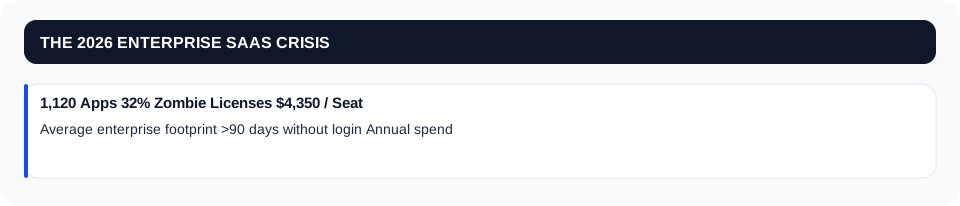
- The average enterprise with over 2,000 employees now maintains 1,120 discrete SaaS applications.
- 32% of all active SaaS licenses have not been logged into for more than 90 consecutive days ("Zombie Licenses").
- Enterprises spend an average of $4,350 per employee annually on software licenses—a 45% increase since 2022.
- Over 40% of the software portfolio constitutes Shadow IT—applications procured without security review, Single Sign-On (SSO) integration, or data governance oversight.
- Data fragmentation across dozens of point tools has degraded cross-functional velocity, creating isolated information silos that cost the average enterprise 4.2 hours per employee per week in manual context switching and reconciliation.
SaaS consolidation is no longer merely a CFO-driven cost-cutting exercise; it is the #1 strategic mandate for CIOs, CTOs, and Chief Product Officers. Rationalizing the tech stack eliminates security attack surfaces, restores data integrity for enterprise AI agents, and frees up seven figures in capital to reinvest in core competitive moats.
This playbook provides a battle-tested, end-to-end framework for evaluating, cutting, and rebuilding your enterprise SaaS portfolio without destroying developer productivity or triggering organizational mutiny.

The Anatomy of SaaS Sprawl: How We Got to 1,000 Apps
SaaS sprawl does not happen through malicious intent; it is the natural byproduct of organizational scaling without centralized guardrails. Four distinct vectors drive portfolio bloat:
1. The Point-Solution Proliferation Trap
Between 2020 and 2024, venture capital funded hundreds of single-feature micro-SaaS companies. An organization would buy one tool for screen recording (Loom), another for asynchronous standups, a third for visual whiteboarding (Miro), a fourth for sprint planning (Linear), and a fifth for documentation (Notion)—despite already paying for an enterprise suite (Microsoft 365, Google Workspace, or Atlassian) that provided 85% of those capabilities out of the box.
2. Departmental Duplication & Tool Silos
Without centralized portfolio visibility, different business units independently solve identical problems:
- Project Management: Engineering runs on Jira and Linear; Marketing uses Asana; Sales Operations uses Monday.com; Customer Success tracks work in Smartsheet.
- Customer Feedback: Product uses Productboard; Customer Support uses Zendesk; Marketing runs Qualtrics; Sales logs notes in Gong.
- Analytics: Data Engineering maintains Snowflake and Looker; Growth Marketing subscribes to Mixpanel and Amplitude; Finance builds models in Pigment.
The direct license cost is substantial, but the indirect cost of cross-tool API integration maintenance, data desynchronization, and redundant vendor management is often 3x the licensing spend.
3. The "AI Point-Solution" Gold Rush
In 2024–2025, every vendor rebranded around "AI capabilities," slapping a $20–$40/seat/month surcharge on existing subscriptions or launching AI-native point solutions (meeting summarizers, copywriting assistants, AI code generators, slide builders). Enterprise employees rapidly adopted overlapping AI wrappers, creating massive cost inflation and severe data exfiltration risks.
4. Expired Contracts and Auto-Renewals
Vendor contracts routinely include auto-renewal clauses with 30-to-60-day notification windows and 5–8% annual price escalators. Without an active SaaS management platform (SMP) or centralized contract calendar, IT teams miss cancellation windows, locking the company into multi-year commitments for software that teams have already abandoned.
The 4-Quadrant SaaS Landscape Audit Matrix
Before making a single cancellation or contract renegotiation, you must conduct a rigorous, data-driven discovery audit. Categorizing every active subscription across two core vectors—Business Criticality (Y-axis) versus Monthly Active Usage (MAU / Seat Ratio) (X-axis)—reveals the exact rationalization path for each application:

Quadrant 1: Mission Critical (Retain & Optimize)
- Profile: High daily active usage (>75% assigned seats), deep bidirectional data integrations, core revenue generation (e.g., Salesforce CRM, AWS Cloud Infrastructure, GitHub Enterprise, Snowflake).
- Consolidation Strategy: Do not displace. Negotiate 3-year enterprise agreements with volume tier discounts, uncap API rate limits, and enforce strict identity lifecycle provisioning (SCIM).
Quadrant 2: Redundant Overlaps (Consolidate to Core Platform)
- Profile: Valuable capabilities used by small sub-teams, but directly redundant with existing enterprise platforms (e.g., paying for 200 Miro licenses when the company has full Microsoft 365 / Whiteboard access; paying for Calendly when Google Calendar / Outlook native scheduling exists).
- Consolidation Strategy: Standardize on the enterprise suite. Provide structured migration paths, export existing assets, and terminate the point solution at renewal.
Quadrant 3: Underutilized Niche Tools (Downgrade or Reallocate)
- Profile: Frequently used by a very small specialized group, but the company purchased an enterprise-wide tier or 500 excess seats (e.g., paying for 100 Figma Enterprise seats when only 15 designers build components and 85 product managers only need view/comment access).
- Consolidation Strategy: Downgrade from enterprise-wide licenses to role-based tiers (View-Only / Contributor) or renegotiate true-up thresholds.
Quadrant 4: Shadow IT & Zombie Subscriptions (Immediate Sunset & Cut)
- Profile: Unmanaged tools procured via corporate credit cards, forgotten trial conversions, tools with <15% monthly active usage, or tools abandoned after an employee departure.
- Consolidation Strategy: Immediate expense block at the corporate card level, revoke SSO permissions, extract any proprietary data, and formally terminate the account.

The 4-Tier Rationalization Decision Framework
To remove emotional bias from software consolidation, enterprise IT and Product steering committees must evaluate every application through a deterministic, four-step decision tree:
graph TD
    Start[Software Subscription Under Audit] --> Q1{Is 90-Day Active Usage >50% of Licensed Seats?}
    Q1 -- No --> Action1[Action: Immediate Seat Downgrade or Contract Termination]
    Q1 -- Yes --> Q2{Does Existing Core Platform Provide >=80% Feature Parity?}

    Q2 -- Yes --> Q3{Is There a Valid Technical Moat or Regulatory Requirement?}
    Q3 -- No --> Action2[Action: Migrate to Core Platform & Sunset Point Tool]
    Q3 -- Yes --> Action3[Action: Retain as Exception with CPO/CIO Sign-Off]

    Q2 -- No --> Q4{Can Commercial Terms Be Renegotiated with >25% Savings?}
    Q4 -- Yes --> Action4[Action: Renegotiate Multi-Year Contract with Volume Tiers]
    Q4 -- No --> Action5[Action: Issue RFP for Competitive Replacement]
The "80/20 Rule" for Software Parity
The most common blocker to SaaS consolidation is the "Edge Case Fallacy": “We cannot switch from Tool A to Platform B because Tool A has a specific transition animation or tagging filter that 3 people use once a quarter.”
The 2026 standard for enterprise rationalization is the 80% Parity Threshold: If the enterprise platform (e.g., Microsoft 365, Atlassian, Salesforce) delivers 80% or more of the core functional requirements needed by 80% of daily users, the specialized point solution is scheduled for consolidation. Customized workflows are rebuilt using platform native capabilities (e.g., Power Automate, Jira Automation, Slack Workflows) rather than funding standalone point solutions.

The Enterprise Vendor Scoring Rubric
When choosing which vendor to consolidate around (e.g., selecting between Jira vs. Linear, Slack vs. Teams, or Salesforce vs. HubSpot), emotional opinions must be replaced with a weighted architectural scoring rubric:
| Evaluation Pillar | Weight | Key Architectural Criteria | Scoring Scale (1–10) |
|---|---|---|---|
| 1. API Openness & Integration Depth | 25% | OpenAPI 3.1 specs, robust Webhook support, bi-directional sync, SCIM 2.0 provisioning, rate-limit predictability | 1 = Walled garden / No API 10 = Full REST/GraphQL & Event Stream |
| 2. Data Portability & Moat | 20% | Zero-lock-in export (JSON/Parquet/CSV), automated database replication, compliance with open standards | 1 = Proprietary binary lock-in 10 = Real-time CDC / S3 lake export |
| 3. Security & Compliance | 20% | SOC 2 Type II, ISO 27001, HIPAA BAA, FedRAMP, granular RBAC/ABAC, audit log streaming via SIEM | 1 = Basic username/password 10 = FIPS 140-3, SAML SSO, SIEM push |
| 4. AI Feature Velocity & Roadmap | 20% | Native foundation model integration, MCP server support, RAG compatibility, no data training on customer prompts | 1 = No AI / Vaporware 10 = Production GenAI & MCP agent hub |
| 5. Commercial Flexibility | 15% | Transparent seat-based or consumption pricing, no aggressive auto-renewal penalties, rollover allowances | 1 = Hidden fees & 90-day locks 10 = Elastic billing & fair true-ups |

The 4-Wave Phased Migration Roadmap
Attempting to consolidate your entire software estate in a single quarter causes catastrophic operational friction. Successful enterprise transformations execute across four disciplined waves over a 12-month horizon:
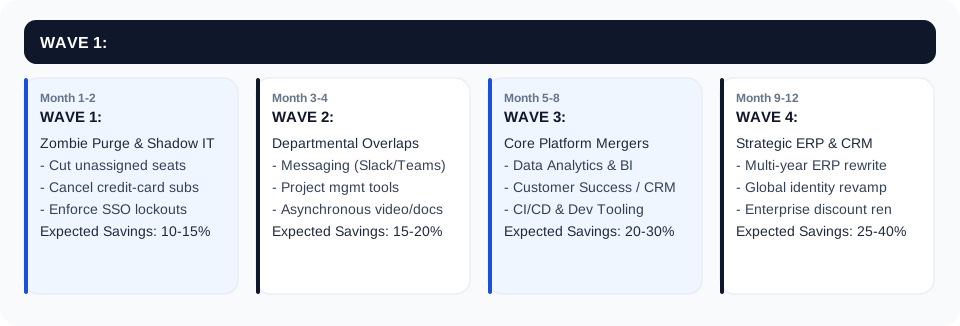
Wave 1: The Zombie Purge & Shadow IT Quarantine (Months 1–2)
- Goal: Harvest immediate, frictionless cash savings without impacting any active production workflow.
- Action Items:
1. Pull Single Sign-On (Okta / Entra ID) audit logs and identify all active accounts with zero logins in the preceding 60 days.
2. Deprovision zombie seats across tier-1 software (Salesforce, Google Workspace, GitHub, Zoom, Figma).
3. Audit corporate credit card statements via Brex / Ramp / Concur; immediately quarantine non-approved recurring subscriptions.
- Financial Impact: 10%–15% immediate reduction in monthly SaaS burn.
Wave 2: Departmental Redundancy Consolidation (Months 3–4)
- Goal: Eliminate overlapping horizontal collaboration and productivity tools.
- Action Items:
1. Standardize company-wide communication on a single platform (e.g., migrating from Slack + Teams dual-stack to a single standard).
2. Consolidate asynchronous documentation (e.g., sunsetting Coda, Confluence, and Notion fragmentation into a single unified knowledge base).
3. Replace standalone scheduling tools (Calendly, Doodle) with native calendar integration features.
- Financial Impact: 15%–20% additional software spend reduction; eliminates cross-departmental communication barriers.
Wave 3: Core Platform Mergers (Months 5–8)
- Goal: Consolidate domain-specific vertical stacks (Engineering, Marketing, Support).
- Action Items:
1. Engineering & DevOps: Consolidate fragmented issue tracking, CI/CD runners, and artifact registries onto GitHub Enterprise or GitLab Ultimate.
2. Marketing & Customer Experience: Merge fragmented email marketing, landing page builders, and analytics tools into HubSpot Enterprise or Salesforce Marketing Cloud.
3. Product & Design: Standardize on Figma for design and FigJam for whiteboarding, sunsetting standalone whiteboard subscriptions (Miro / Mural).
- Financial Impact: 20%–30% net savings; massive reduction in custom webhook and integration maintenance.
Wave 4: Strategic ERP, Data, and Vendor Contract Restructuring (Months 9–12)
- Goal: Renegotiate core multi-year enterprise contracts backed by aggregated purchasing power.
- Action Items:
1. Consolidate database and data warehouse infrastructure (e.g., unifying fragmented Redshift, BigQuery, and Snowflake deployments).
2. Leverage the unified portfolio footprint to negotiate 35%+ enterprise volume discounts with mega-vendors (Microsoft, AWS, Salesforce, Google).
3. Implement automated SaaS management software (SMP) to continuously monitor license utilization and prevent future sprawl.
Navigating Internal Politics & Change Management
The primary reason SaaS consolidation initiatives fail is not technical; it is political. Software tools are deeply intertwined with professional identity, habit, and perceived autonomy. When IT announces that a beloved point solution is being retired, employees react with visceral resistance.
To overcome the "You'll have to pry this tool from my cold, dead hands" syndrome, enterprise leaders must deploy three proven change management strategies:
1. The "Software Amnesty & Reinvestment" Pact
If employees believe that software consolidation is purely an austerity measure to pad executive bonuses, they will actively subvert it by creating new shadow IT workarounds.
The Solution: The CIO and CFO must publicly commit to the Reinvestment Ratio:
"For every $1.00 saved through tech stack rationalization, $0.30 will be directly allocated back to engineering and product teams for advanced tooling, AI infrastructure, training budgets, and high-spec hardware."
This aligns employee incentives with cost discipline.
2. Departmental Tool Champions (The "Build-With, Not Dictate-To" Model)
Never impose a tool migration purely through top-down IT edicts. Identify influential power users within each department (e.g., the lead designer, the principal DevOps engineer, the top sales performer) and appoint them as Migration Champions:
- Involve them directly in the Vendor Scoring Rubric evaluation.
- Give them early beta access to the target consolidated platform.
- Task them with co-designing the training curriculum for their peers.
3. Grace Periods and Automated Data Migration Bridges
The fear of losing historical documentation or custom configurations causes immense anxiety. IT must provide automated migration scripts and a mandatory 45-day read-only grace period where old tools remain accessible for historical reference before permanent decommissioning.
Enterprise SaaS Audit & Automated Discovery Tool
To automate the discovery of zombie licenses and calculate redundant seat waste, enterprise engineering teams can deploy this production-grade Python audit script. It parses SCIM/SaaS user telemetry and outputs a structured rationalization action report:
"""
Enterprise SaaS License Utilization & Sprawl Audit Engine (2026).
Analyzes user activity telemetry across enterprise SaaS vendors,
identifies zombie licenses (>60 days inactive), detects redundant seats,
and calculates net annual cost savings.
"""

import json
from dataclasses import dataclass
from datetime import datetime, timezone, timedelta
from typing import List, Dict, Any


@dataclass
class SaaSUser:
    email: str
    department: str
    last_login: datetime
    role: str
    license_cost_monthly: float


class SaaSRationalizationEngine:
    def __init__(self, application_name: str, annual_seat_cost: float) -> None:
        self.app_name = application_name
        self.annual_cost = annual_seat_cost
        self.monthly_cost = annual_seat_cost / 12.0
        self.users: List[SaaSUser] = []

    def ingest_user_telemetry(self, user_records: List[Dict[str, Any]]) -> None:
        """Ingests SCIM or SMP telemetry data."""
        now = datetime.now(timezone.utc)
        for record in user_records:
            last_login_dt = datetime.fromisoformat(record["last_login_iso"]).replace(tzinfo=timezone.utc)
            self.users.append(
                SaaSUser(
                    email=record["email"],
                    department=record["department"],
                    last_login=last_login_dt,
                    role=record.get("role", "Standard"),
                    license_cost_monthly=self.monthly_cost
                )
            )

    def execute_audit(self, inactivity_threshold_days: int = 60) -> Dict[str, Any]:
        """Categorizes licenses into Active, Underutilized, and Zombie tiers."""
        now = datetime.now(timezone.utc)
        threshold_dt = now - timedelta(days=inactivity_threshold_days)

        active_users = []
        zombie_users = []
        dept_breakdown: Dict[str, Dict[str, int]] = {}

        for user in self.users:
            dept = user.department
            if dept not in dept_breakdown:
                dept_breakdown[dept] = {"total": 0, "zombie": 0, "active": 0}

            dept_breakdown[dept]["total"] += 1

            if user.last_login < threshold_dt:
                zombie_users.append(user)
                dept_breakdown[dept]["zombie"] += 1
            else:
                active_users.append(user)
                dept_breakdown[dept]["active"] += 1

        total_seats = len(self.users)
        zombie_seats = len(zombie_users)
        utilization_rate = (len(active_users) / total_seats * 100.0) if total_seats > 0 else 0.0

        annual_zombie_waste = zombie_seats * self.annual_cost

        return {
            "application": self.app_name,
            "total_licensed_seats": total_seats,
            "active_seats": len(active_users),
            "zombie_seats": zombie_seats,
            "utilization_percentage": round(utilization_rate, 2),
            "annual_seat_cost_per_user": self.annual_cost,
            "gross_annual_spend": total_seats * self.annual_cost,
            "potential_annual_savings": annual_zombie_waste,
            "departmental_summary": dept_breakdown,
            "recommended_action": (
                "IMMEDIATE_DEPROVISION_AND_DOWNGRADE"
                if utilization_rate < 60.0
                else "RIGHT_SIZE_SEATS_AT_RENEWAL"
            )
        }


# Example Demonstration Run
if __name__ == "__main__":
    audit_engine = SaaSRationalizationEngine(
        application_name="Figma Enterprise",
        annual_seat_cost=900.00  # $75/seat/month
    )

    # Simulated SCIM Telemetry Feed
    telemetry_data = [
        {"email": "[email protected]", "department": "Engineering", "last_login_iso": "2026-06-01T10:00:00"},
        {"email": "[email protected]", "department": "Design", "last_login_iso": "2026-06-07T14:30:00"},
        {"email": "[email protected]", "department": "Product", "last_login_iso": "2026-01-15T09:12:00"},
        {"email": "[email protected]", "department": "Marketing", "last_login_iso": "2025-11-20T11:00:00"},
        {"email": "[email protected]", "department": "Sales", "last_login_iso": "2026-02-10T16:45:00"},
        {"email": "[email protected]", "department": "Design", "last_login_iso": "2026-06-06T18:20:00"},
    ]

    audit_engine.ingest_user_telemetry(telemetry_data)
    audit_report = audit_engine.execute_audit(inactivity_threshold_days=60)
    print(json.dumps(audit_report, indent=2))
The SaaS FinOps ROI Calculation Model
To secure executive and board approval for a comprehensive rationalization program, you must present a rigorous financial model that accounts for both gross savings and transition overhead:
$$\text{Net 3-Year Savings} = \sum_{t=1}^{3} \Big( \mathcal{S}{\text{license}}(t) + \mathcal{S}{\text{admin}}(t) + \mathcal{S}{\text{security}}(t) \Big) - \Big( \mathcal{C}{\text{migration}} + \mathcal{C}{\text{training}} + \mathcal{C}{\text{overlap}} \Big)$$
Where:
- $\mathcal{S}_{\text{license}}$ = Direct reduction in recurring SaaS subscription fees.
- $\mathcal{S}_{\text{admin}}$ = IT engineering hours saved from managing fewer identity integrations, SCIM connectors, and vendor renewals.
- $\mathcal{S}_{\text{security}}$ = Reduced cyber insurance premiums and lowered risk of data breaches from unmanaged shadow IT.
- $\mathcal{C}_{\text{migration}}$ = Professional services, data export scripts, and schema transformation costs.
- $\mathcal{C}_{\text{training}}$ = Internal employee onboarding and enablement time.
- $\mathcal{C}_{\text{overlap}}$ = Double-bubble licensing costs during active migration phases.
A Representative 2,500-Employee Enterprise Financial Model
Gross Annual SaaS Spend Prior to Consolidation:          $10,875,000  ($4,350/seat)
Consolidated Applications Targeted:                      320 of 1,120 apps (28.5%)

YEAR 1 SAVINGS WATERFALL:
  + Direct License Reductions (Wave 1-3):                $2,450,000
  + IT Admin & Integration Maintenance Elimination:        $420,000
  - Data Migration & Professional Services:              -$380,000
  - Dual-License Overlap Buffer:                         -$250,000
  - Employee Training & Enablement:                      -$120,000
  -----------------------------------------------------------------
  NET YEAR 1 REALIZED CASH SAVINGS:                       $2,120,000

YEAR 2 & YEAR 3 NET SAVINGS (Steady State):               $3,100,000 / year

TOTAL 3-YEAR NET CASH BENEFIT:                            $8,320,000  (76.5% ROI)
The 3-Step Monday Morning Action Plan: Launching Your SaaS Rationalization
Ready to begin consolidating your enterprise technology stack? Execute this practical, 3-step action plan starting next Monday:
Step 1: Export Your SSO Identity Directory (Week 1)
Pull active user login records from your Identity Provider (Okta, Microsoft Entra ID, Ping Identity) for all assigned SaaS applications. Run the Python audit script provided in this guide to flag all accounts inactive for $>60$ days. Present the immediate zombie license savings to your CFO.
Step 2: Establish the Software Procurement Gate (Week 2)
Implement a zero-trust procurement policy:
- Require architectural review for any new software subscription exceeding $5,000/year.
- Mandate that all applications support SAML SSO and SCIM 2.0 provisioning.
- Issue virtual corporate credit cards with vendor-locked merchant controls, instantly eliminating unauthorized auto-renewals.
Step 3: Launch the Wave 1 & Wave 2 Steering Committee (Weeks 3–4)
Form a cross-functional Tech Stack Rationalization Committee comprising IT, Product, Engineering, and Finance. Target the top three departmental overlaps (e.g., whiteboarding, project management, asynchronous video), select the consolidation standard using the Vendor Scoring Rubric, and initiate the migration roadmap.
Frequently Asked Questions (FAQ)
1. What is SaaS consolidation and why is it critical in 2026?
SaaS consolidation is the strategic process of auditing, reducing, and unifying an organization's software applications. In 2026, the average enterprise maintains over 1,000 SaaS apps, with 30%+ redundant or underutilized. Consolidation eliminates multi-million-dollar software waste, closes shadow IT security vulnerabilities, and breaks down data silos to enable autonomous AI workflows.
2. How much money can an enterprise realistically save through tech stack rationalization?
Most mid-to-large enterprises achieve between 20% and 35% net savings on their annual software licensing budget. For an enterprise with 2,500 employees spending $10M+ annually on SaaS, a disciplined rationalization program delivers $2M to $3.5M in recurring annual cash savings after accounting for migration costs.
3. How do we handle employees who refuse to give up their favorite point solutions?
Overcoming internal resistance requires a combination of clear data, incentive alignment, and champion involvement. Implement the 80% parity threshold, appoint influential team members as Migration Champions, provide automated data migration bridges, and establish a "Reinvestment Pact" where a portion of software savings is returned to departmental budgets for advanced tooling and AI infrastructure.
4. What are "Zombie Licenses" and how do we detect them?
Zombie licenses are active, paid software seats assigned to users who have not logged in or interacted with the application for 60 to 90+ days. They are detected by integrating your Identity Provider (Okta, Microsoft Entra ID) or SaaS Management Platform (SMP) with usage audit scripts that cross-reference seat assignments against actual timestamped activity telemetry.
5. Should we consolidate onto mega-suites (Microsoft 365 / Google Workspace) or best-of-breed platforms?
The modern enterprise standard uses a "Core + Specialized Moat" strategy. Standardize broad horizontal productivity capabilities (chat, email, documents, basic whiteboarding) on mega-suites to eliminate dozens of micro-SaaS subscriptions. Reserve specialized best-of-breed tools exclusively for core competitive domains (e.g., GitHub for software engineering, Figma for UI/UX product design, Salesforce for complex enterprise sales) where specialized tooling directly drives revenue.
6. What is the impact of SaaS consolidation on enterprise AI and agentic workflows?
SaaS consolidation is a prerequisite for enterprise AI agent adoption. When company data is scattered across 1,000 isolated SaaS tools, AI agents cannot access unified context, leading to high error rates and security breaches. Consolidating into centralized data lakes and standard platforms with open APIs allows AI agents to securely query and automate end-to-end business processes.
Structural Schema Markup (JSON-LD)
LINKEDIN_HOOK: The definitive 2026 enterprise guide to SaaS consolidation.
