STRATEGIC OVERVIEW
React Server Actions streamline client-server communication but introduce unique security threat models like IDOR, serialization vulnerabilities, and SSR.
Securing React Server Actions: Attack Surfaces, IDOR, and SSR Leak Prevention
By Vatsal Shah · June 25, 2026 · Cloud
1. Introduction: The Invisible API and the Next.js Request Boundary
Modern web frameworks have steadily reduced the separation between frontend user interfaces and backend execution environments. The introduction of React Server Components (RSC) and React Server Actions represents the culmination of this trend. They allow developers to write direct server functions that can be invoked directly from client-side buttons, input forms, and state hooks. In traditional multi-tier architectures, a developer had to build a distinct frontend consumer, a middleware router, an API controller layer, and a backend repository. Every data boundary required explicit serialization schemas, input validation hooks, and HTTP status code mappings.
React Server Actions sweep away this operational complexity by establishing an automated RPC-like (Remote Procedure Call) connection directly between client-side interactions and server-side logic. To the developer, a Server Action looks like a regular local function, allowing them to invoke server code directly within client-side files. This unified environment leads to high developer velocity, as the boundary between client and server is handled entirely by the framework's build tools.
To appreciate the architectural shift, we must place it in the context of web development history. In the early days of distributed web applications, Remote Procedure Calls were commonly implemented using XML-RPC, SOAP, or later, gRPC. These protocols required rigid, contract-first definitions (such as WSDL files or Protocol Buffers) to ensure both sides agreed on data formats and types. Security was handled at the message or transport layer by verifying signatures and enforcing access policies at the gateway boundary. When the web moved to RESTful APIs, security shifted toward stateless authentication tokens (like JWTs) checked by controller middleware.
React Server Actions represent a return to the RPC model but without the explicit contract definitions of SOAP or gRPC. Instead of generating external interface files, the compiler dynamically generates a serialized boundary during the build phase. This makes the RPC connection completely invisible to the developer, who experiences it as a standard JavaScript function call. This tight integration, while improving developer productivity, obscures the fact that a public network boundary still exists between the client and the server.
Because developers do not write explicit HTTP route files (such as /api/users), they frequently assume these actions are secure from public exposure. They treat the function as if it executes in a protected environment, forgetting that the boundary between client and server is a public network boundary.
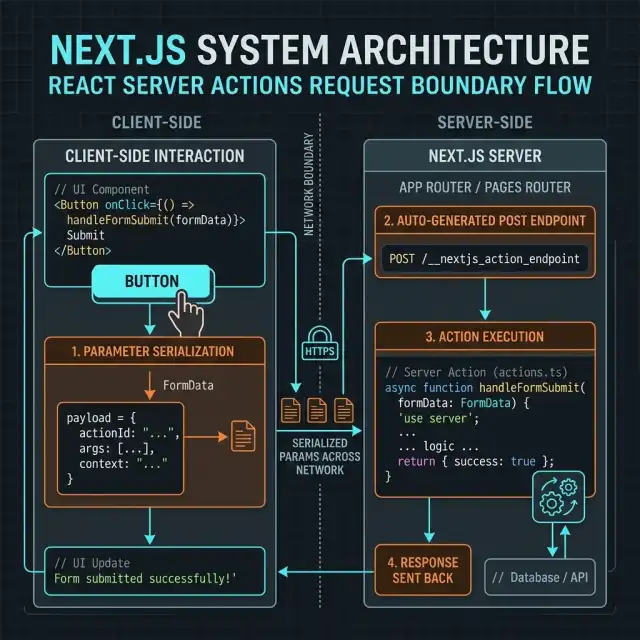
In reality, the Next.js compilation engine converts every function decorated with the use server directive into a public HTTP POST endpoint. When the client executes a Server Action, the framework performs a network request containing a custom Next-Action header that maps to a specific compiled hash on the server. This setup means that every React Server Action is a public API endpoint. Because these endpoints are created implicitly during compilation, they bypass traditional security audits, static route scanners, and web application firewalls (WAFs) unless developers explicitly secure the function boundary.
To build secure web applications, developers must understand that Server Actions cannot rely on client-side routing guards or UI conditional checks. As we explore in our guide on React in 2026 and signals compiler hydration trends, client-side code is a public asset. If a function runs on the server, it must enforce authentication, authorization, and validation rules internally, treating all client payloads as untrusted inputs. The server represents the trust boundary; anything crossing this boundary must be inspected, validated, and authorized.
When a client renders a page, the Next.js framework registers the Server Action with a unique, cryptographically signed reference ID. When a user interacts with the UI, this reference ID is sent in the Next-Action HTTP header. The request payload contains the serialized arguments. This creates a hidden RPC-style network API layer. Security auditors must realize that anyone with access to the client bundle can discover these action IDs, inspect their parameter schemas, and forge custom POST requests to execute arbitrary operations.
Understanding this boundary is critical because it forces developers to apply traditional API security principles—such as input validation, output sanitization, authentication, and authorization—directly within the Server Action body. Since the client is entirely outside the security perimeter, any data received by the Server Action must be treated with the same suspicion as any public REST endpoint payload. This conceptual shift requires developers to view every Server Action as a public controller method, implementing robust security checks right at the entry point of the function.
2. Attack Surfaces: Inspecting the Underlying Transport
To secure Server Actions, we must analyze the transport layer that Next.js constructs. When compiling a Server Action, Next.js generates an action manifest that maps a unique cryptographic hash to the corresponding server function. The client-side runtime environment intercepts standard form submissions and JavaScript button clicks, packaging the function arguments into a serialized payload.
Let us inspect the structure of a raw Server Action request over the wire. The HTTP request is dispatched as a POST request to the current page path, with headers pointing to the action ID:
POST /settings/profile HTTP/1.1
Host: example.com
Content-Type: multipart/form-data; boundary=----WebKitFormBoundary7MA4YWxkTrZu0gW
Next-Action: 45f8e2a1b9
Cookie: session=eyJ1c2VySWQiOiJ1c3JfMDEiLCJleHAiOjE3MTkyNTg0MDB9

------WebKitFormBoundary7MA4YWxkTrZu0gW
Content-Disposition: form-data; name="1_$ACTION_ID_45f8e2a1b9"

------WebKitFormBoundary7MA4YWxkTrZu0gW
Content-Disposition: form-data; name="1_name"

John Doe
------WebKitFormBoundary7MA4YWxkTrZu0gW
Content-Disposition: form-data; name="1_email"

[email protected]
------WebKitFormBoundary7MA4YWxkTrZu0gW--
When the server receives this payload, it matches the Next-Action header against the compiled manifest, reconstructs the parameters, and invokes the function. The response is returned in a serialized format containing the return values or UI updates. This transport layer exposes several immediate attack surfaces:
- Action Enumeration: Since action IDs are static hashes, an attacker can analyze the client bundle to extract all registered action IDs, compiling a map of every backend function.
- Argument Tampering: Parameters are passed in plain text. Attackers can alter names, emails, amounts, or identifiers before they reach the server logic.
- CSRF Vulnerabilities: By default, Server Actions execute via POST requests. While Next.js implements CSRF protection by validating request origins, misconfigured CORS policies or custom proxy configurations can expose actions to cross-site request forgery attacks.
- Replay Attacks: If the Server Action changes state or performs a critical transaction without a unique cryptographic nonce or transaction key, the request can be intercepted and replayed multiple times, leading to duplicate transactions.
Furthermore, we must examine the internal parser mechanics of Next.js. The framework uses a specialized JSON serialization protocol to transmit complex JavaScript structures across the network. For instance, when a developer passes a custom state object, the serializing runtime transforms it into structured elements. This process relies on recursive deserialization functions on the server side. If these functions do not check for key integrity, malicious actors can pass JSON payloads containing keys like proto or constructor.prototype. During deserialization, these injected keys can overwrite properties on the global object prototype, causing prototype pollution. This vulnerability can lead to unpredictable application crashes or, in severe cases, remote code execution.
Understanding these details helps developers recognize that Server Actions do not run in a protected environment. They are subject to the same class of attacks as standard REST or GraphQL API endpoints. Developers must treat the Next-Action header as a public API route definition, implementing identical security controls to those used for standard web application endpoints.
3. Threat Vectors: Serialized Parameters, IDOR, and DB Exploitation
Because Server Actions accept parameters directly from the client, they introduce critical threat vectors. These include parameter tampering, Insecure Direct Object References (IDOR), and data serialization exploits.
1. Serialized Parameter Tampering and Input Injection
When parameters are passed to a Server Action, they bypass the traditional validation layers associated with REST routing. In a standard REST controller, you might validate that an email parameter is formatted correctly using express-validator or Nest.js pipes. In a Server Action, developers often assume the TypeScript interface guarantees type safety:
// VULNERABLE CODE
'use server'

export async function updateEmail(userId: string, newEmail: string) {
  // Direct DB call assuming type safety
  await db.user.update({
    where: { id: userId },
    data: { email: newEmail }
  });
}
This code is highly vulnerable. An attacker can bypass the UI controls, construct a custom POST request, and send an arbitrary string or a structured object instead of a string. If the database library or ORM (such as Prisma or Mongoose) parses this input unsafely, it can trigger database command injection or unexpected schema changes.
Additionally, if the argument is a complex object, prototype pollution can occur. An attacker can inject properties like proto or constructor into the payload. If the server application deep-copies or merges these arguments, it can override built-in object properties, resulting in system crashes or remote code execution. Furthermore, in SQL-based databases, passing unvalidated objects directly into queries can lead to SQL injection attacks. For example, if a developer passes a raw input object directly into a Prisma where clause, the object could contain nested queries or conditions that alter the query structure. This allows attackers to bypass logical filters and access unauthorized database records.
2. Insecure Direct Object References (IDOR)
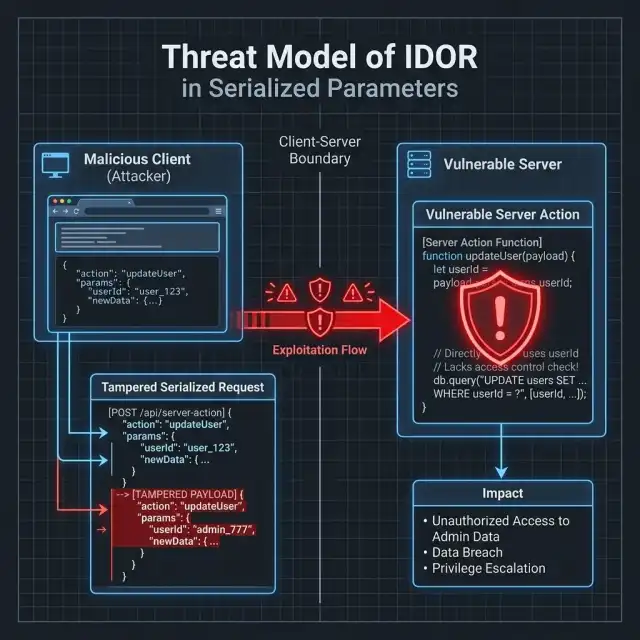
IDOR occurs when an application provides direct access to objects based on user-supplied input. In Server Actions, this is a common issue because developers often pass database primary keys directly from client state variables.
Consider the following scenario: A user wants to edit their comment. The client component calls a Server Action, passing the commentId and the updated text:
// VULNERABLE IDOR CODE
'use server'

export async function updateComment(commentId: string, text: string) {
  // Assumes that the UI only lets the owner click 'Edit'
  await db.comment.update({
    where: { id: commentId },
    data: { body: text }
  });
}
Because the server does not verify that the authenticated user owns the comment associated with commentId, an attacker can send a modified request with a different commentId (e.g., enumerating sequential integer IDs or guessing UUIDs). This allows them to modify comments belonging to other users.
To prevent IDOR, the Server Action must retrieve the user's ID from a cryptographically signed cookie or session token, lookup the target comment in the database, and verify that the comment's authorId matches the session user's ID before making changes. In complex multi-tenant architectures, developers should consider using indirect references. Instead of exposing raw database IDs (such as sequential numbers or UUIDs) to the client, developers can maintain a short-lived, session-specific reference map. This map translates temporary client-side tokens into actual database keys on the server. By using this translation layer, attackers are prevented from enumerating or guessing database IDs, eliminating the root cause of IDOR attacks.
3. Database Schema Injection and Object Exposure
Another threat is the direct passing of complex database objects between the server and the client. When a Server Action retrieves data, developers sometimes return the database model directly:
// VULNERABLE SCHEMA EXPOSURE
'use server'

export async function fetchUserProfile() {
  const user = await db.user.findFirst({ where: { id: getCurrentUserId() } });
Another threat is the direct passing of complex database objects between the server and the client. When a Server Action retrieves data, developers sometimes return the database model directly. If the database user table includes sensitive columns—such as `passwordHash`, `twoFactorSecret`, `role`, or `stripeCustomerId`—these columns are serialized and sent to the client, even if the client UI only uses the `name` and `avatar` fields. An attacker inspecting the network traffic can extract these sensitive values.

To prevent this data leakage, Server Actions must use Data Transfer Objects (DTOs) or explicit field mapping, returning only the fields required by the UI. Decoupling the database layer from the client-facing serialization format ensures that database modifications (such as adding internal audit columns or security flags) do not inadvertently expose new attack vectors to the client. This decoupling acts as a critical security firewall, preventing accidental data disclosures. By strictly defining the output shape, you protect against accidental object property exposure common in ORM models where models may evolve to contain sensitive credentials over time.

---

## 4. SSR Data Leak Prevention: Securing Server-Only Closures

Server-side rendering (SSR) combines server-side code execution with client-side component hydration. When Next.js compiles a page, it separates server-only modules from client modules. However, if boundaries are not strictly defined, sensitive variables can leak.

### 1. Leakage of Server-Side Environment Variables

Next.js separates public environment variables from private ones. Variables prefixed with `NEXT_PUBLIC_` are bundled into the client code. Variables without this prefix are kept on the server.

However, if a server action imports a private variable (e.g., `process.env.STRIPE_SECRET_KEY`) and that file is imported by a client-side component, the bundler can accidentally bundle the private key into the public JavaScript bundle.
import 'server-only';
// Secure code follows...
The `server-only` package is a build-time checker. If a client component attempts to import a module containing `import 'server-only'`, the compiler throws a build error, preventing the leak. This build-time validation is critical in microservice environments where accidental imports of database adapters or encryption modules can compromise system credentials.

### 2. Leaking Context via Closures

Server actions can capture variables from their outer scope. If a server action is declared inside a component file, it might capture props or state variables:
// Vulnerable Inline Action
export default function EditProfileForm({ userSecretKey }: { userSecretKey: string }) {
async function saveProfile(formData: FormData) {
'use server'
// captures userSecretKey in closure
await db.save(userSecretKey, formData.get('name'));
}
return
;}
When a server action is declared inside a component, the framework must serialize the captured variables to pass them across the network. In this case, `userSecretKey` is serialized and sent to the client so it can be passed back to the server when the action is executed. This exposes the secret key on the client.
To avoid closure leaks, always declare Server Actions in separate files (e.g. `actions.ts`) rather than inline inside components. This prevents the compiler from capturing client-side state or props. By moving the function declaration to a dedicated file, you remove the component context entirely. This forces the function to accept variables explicitly as parameters, making the serialization boundaries obvious to both developer audits and automated scanner systems. Declaring Server Actions in separate files is a fundamental code design principle for secure React application development.
### 3. Data Serialization Over-Exposure in the Flight Protocol
To understand how data leaks into the client-side environment, we must examine the React Flight protocol. When a server component renders, React does not output standard HTML immediately. Instead, it generates a serialized JSON-like representation of the virtual DOM tree, known as the Flight payload. This payload is embedded in the server-rendered HTML document inside `<script>` blocks (e.g., `<script id="__NEXT_DATA__">` or streaming RSC payload chunks) and sent to the browser.
During hydration, the client-side React runtime parses these script blocks to rebuild the interactive component tree. The critical security vulnerability is that the Flight payload contains the props of all rendered components, including those that are executed on the server and never directly displayed in the visual DOM.
For example, if a developer passes a full user database object containing hashed passwords or session secrets as a prop to a server component, that entire object is serialized into the HTML document. An attacker does not need to intercept network requests; they can simply inspect the page source or run a DOM query (such as `document.getElementById('__NEXT_DATA__').textContent`) in the browser console to retrieve the private keys. To prevent Flight protocol leaks, developers must sanitise component props, ensuring that only visual, presentation-safe primitives are passed across the boundary.
### 4. Accidental Logging and Context Closures
Another common source of data leakage is console logging within inline Server Actions. When a developer writes a `console.log()` statement inside an inline action, the React compiler attempts to serialize the enclosing execution context to ensure that log details can be output. If this context contains sensitive objects (such as database connection instances or request headers), these structures are serialized and sent to the client bundle. This can lead to credentials leakage in client-side console logs. Declaring actions in separate files isolates the execution scope, preventing the compiler from capturing and serializing local component variables.
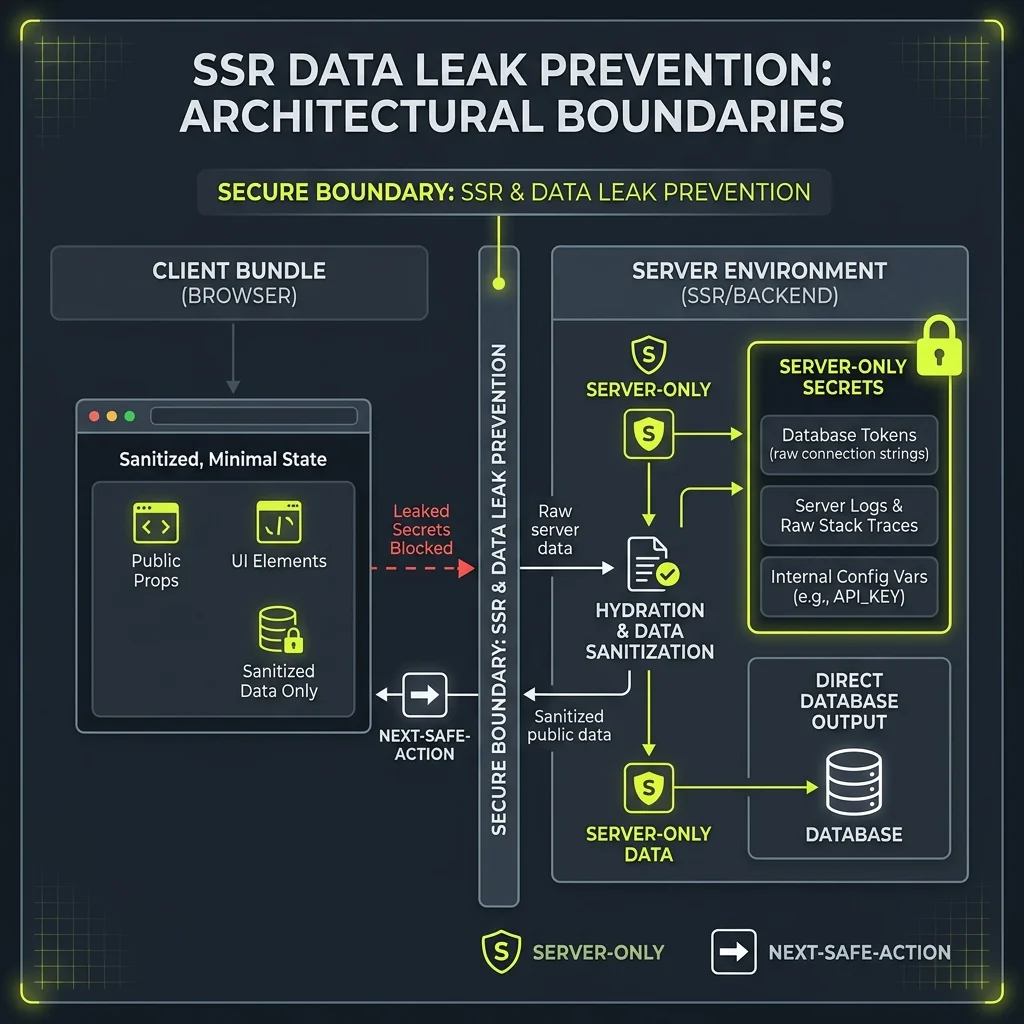
<figcaption>SSR Data Leak Prevention: Using build-time 'server-only' boundaries protects private keys and database connectors from client-side exposure.</figcaption>
---
## 5. Implementing Secure Boundaries: Context Validation and Access Control
To protect Server Actions, developers must implement authentication, authorization, and parameter validation.
### 1. Schema Validation using Zod
Every Server Action must validate its parameters using schema validation libraries. Schema validation verifies input arguments, strips unexpected fields, and validates data formats.import { z } from 'zod';
const UpdateProfileSchema = z.object({
name: z.string().min(2).max(50),
email: z.string().email(),
phoneNumber: z.string().regex(/^\+?[1-9]\d{1,14}$/).optional()
});
export async function secureUpdateProfile(rawInput: unknown) {
const parseResult = UpdateProfileSchema.safeParse(rawInput);
if (!parseResult.success) {
throw new Error("Invalid profile parameters provided.");
}
const { name, email, phoneNumber } = parseResult.data;
// Proceed with validated inputs...
}
Beyond basic structure verification, developers must include semantic constraints. For example, if a Server Action accepts a search query string, the schema should restrict length and sanitize HTML tags to prevent cross-site scripting (XSS) when the query is rendered back in client components. Utilizing Zod’s `.refine()` or `.transform()` methods enables developers to hook custom sanitization logic directly into the schema definition. This ensures that any input reaching the core business logic has already been scrubbed of malicious injection patterns.

### 2. Server-Side Session Validation

Never trust user identifiers sent in client parameters. Retrieve the user session directly from secure, cryptographically signed cookies at the edge.
import { cookies } from 'next/headers';
import { decryptSession } from './session';
async function authenticateRequest() {
const sessionToken = cookies().get('session_token')?.value;
if (!sessionToken) {
throw new Error("Authentication token is missing.");
}
const session = await decryptSession(sessionToken);
if (!session || !session.userId) {
throw new Error("Invalid user session.");
}
return session;
}
By authenticating the user within the Server Action, developers can verify that the user is authorized to perform the requested operation. Reading cookies directly via Next.js `cookies()` helper ensures that session details are retrieved from the secure HTTP request context rather than relying on client state variables. This eliminates token-tampering vectors and mitigates session replay attacks, especially when deploying on global edge networks like Vercel or Cloudflare Workers where session checks must run at low latency.

### 3. Role-Based Access Control (RBAC)

In addition to authentication, actions must verify that the user has the required role or permissions for the operation.
export async function adminDeleteUser(targetUserId: string) {
const session = await authenticateRequest();
// Verify role
if (session.role !== 'ADMIN') {
throw new Error("Unauthorized: Administrator permissions required.");
}
await db.user.delete({ where: { id: targetUserId } });
}
This ensures that even if an attacker discovers the action hash and crafts a custom payload, the server will reject the request if their session lacks the necessary permissions. Implementing RBAC directly within the Server Action body prevents access control bypasses that occur when developers rely on client-side route guards or visibility toggles to restrict user interactions. Every data mutation must be gated on the server side by a strict authorization check that compares the authenticated user's credentials against the resource owner's access policies.
---
## 6. Architectural Blueprint: Enterprise-Grade next-safe-action Interceptors
In large enterprise codebases, writing validation, authentication, and logging rules manually for each Server Action leads to code duplication and increases the risk of human error. A more robust solution is to use the middleware interceptor pattern to wrap all Server Actions in a secure factory. This pattern enforces validation and authorization boundaries before executing the action handler.
The middleware interceptor performs four critical functions:
1. **Input Schema Sanitization**: Using Zod, the interceptor parses the input payload. It strips unregistered properties, validates value ranges, and rejects prototype pollution attempts.
2. **Session Context Extraction**: The wrapper reads cookies or authorization headers from the server environment, resolves user sessions, and confirms authentication status.
3. **Role and Policy Verification**: The interceptor compares user credentials against policy rules to verify that they possess the necessary permissions for the target operation.
4. **Error Isolation and Audit Logging**: If execution fails, the wrapper catches the error, writes a secure log entry, and returns a sanitized error message to the client, preventing internal stack traces or database errors from leaking.
Below is the design for a secure, multi-layered validation funnel:
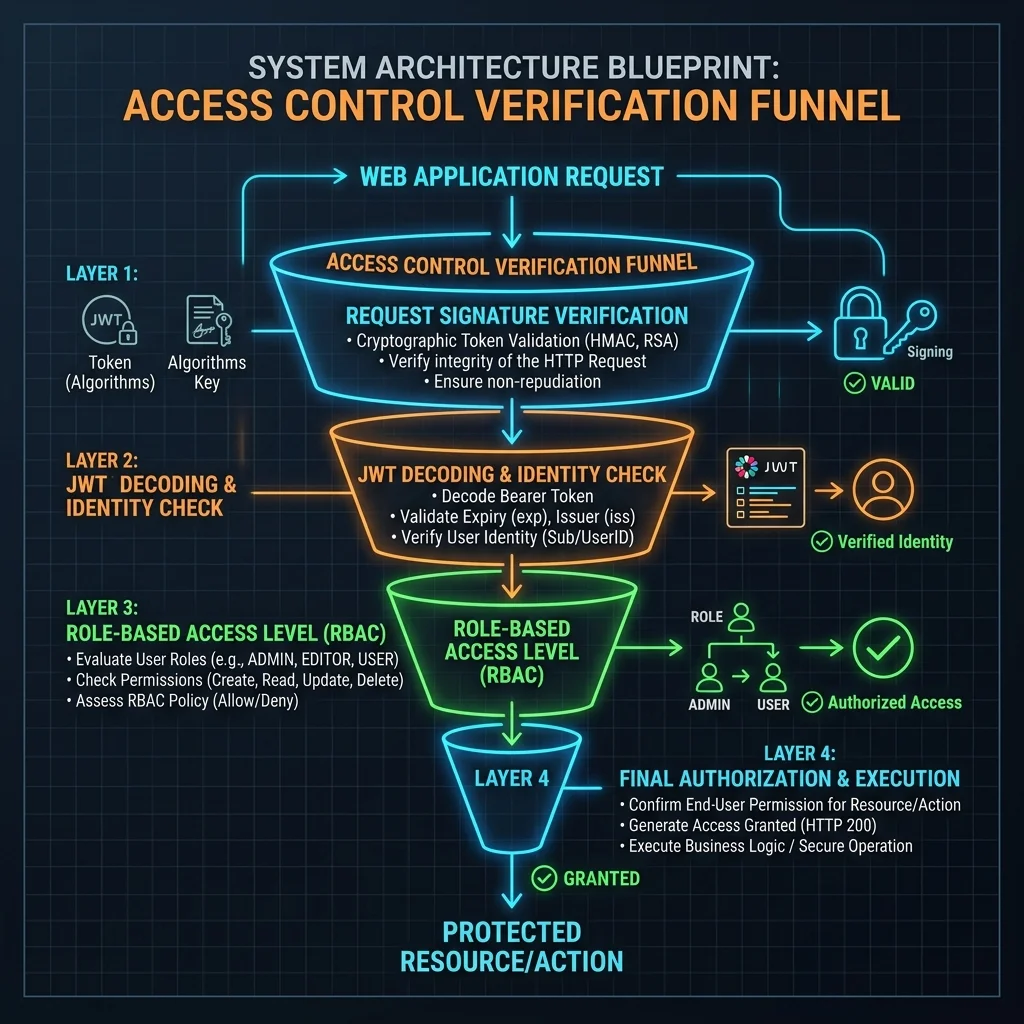
<figcaption>Access Verification Funnel: Multi-layered validation mapping request signatures, session tokens, and access policies.</figcaption>
Here is an enterprise implementation of a secure action wrapper in TypeScript:// lib/safe-action.ts
import { cookies } from 'next/headers';
import { z } from 'zod';
import { decryptSession } from './session';
import { db } from './db';
export type ActionResponse
status: 'SUCCESS' | 'ERROR';
data?: TOut;
message?: string;
};
// Access Control Context
interface SecurityContext {
userId: string;
role: string;
}
// Wrapper Factory
export function createSecureAction
schema: z.Schema
handler: (validatedInput: TIn, context: SecurityContext) => Promise
) {
return async (input: TIn): Promise
try {
// 1. Parameter Schema Validation
const parseResult = schema.safeParse(input);
if (!parseResult.success) {
return {
status: 'ERROR',
message: "Validation failed: " + parseResult.error.errors.map(e => e.message).join(', ')
};
}
// 2. Server-Side Session Verification
const token = cookies().get('session_token')?.value;
if (!token) {
return { status: 'ERROR', message: "Authentication required." };
}
const session = await decryptSession(token);
if (!session || !session.userId) {
return { status: 'ERROR', message: "Invalid user session." };
}
// 3. User Lookup and Role Check
const user = await db.user.findUnique({
where: { id: session.userId },
select: { id: true, role: true }
});
if (!user) {
return { status: 'ERROR', message: "User record not found." };
}
// 4. Execution
const resultData = await handler(parseResult.data, { userId: user.id, role: user.role });
return {
status: 'SUCCESS',
data: resultData
};
} catch (err: any) {
// 5. Audit Logging
console.error([SECURITY AUDIT FAIL] User action failed. Error: ${err.message});
return {
status: 'ERROR',
message: "An internal server error occurred while processing the request."
};
}
};
}
This factory wrapper acts as a request interceptor funnel. When the client dispatches a Server Action, it must pass through these sequential checks before the core handler code executes. This design guarantees that unvalidated input never runs on database adapters or session managers. By performing schema validation and session extraction at the wrapper boundary, database connection pools are preserved, and CPU-intensive operations are restricted to authorized users.

This wrapper allows developers to declare Server Actions securely without duplicate validation boilerplate:
// app/actions/update-document.ts
'use server'
import { z } from 'zod';
import { createSecureAction } from '@/lib/safe-action';
import { db } from '@/lib/db';
const UpdateDocumentSchema = z.object({
id: z.string().uuid(),
title: z.string().min(1).max(200),
content: z.string()
});
export const updateDocumentAction = createSecureAction(
UpdateDocumentSchema,
async (input, context) => {
// Verify resource ownership to prevent IDOR
const doc = await db.document.findUnique({
where: { id: input.id },
select: { ownerId: true }
});
if (!doc) {
throw new Error("Document not found");
}
if (doc.ownerId !== context.userId && context.role !== 'ADMIN') {
throw new Error("Unauthorized access to document");
}
// Perform database update
const updatedDoc = await db.document.update({
where: { id: input.id },
data: {
title: input.title,
content: input.content
}
});
return { id: updatedDoc.id, title: updatedDoc.title };
}
);
On the client side, components consume these safe actions using React hooks or transition wrappers. When the form submits or a button is clicked, the UI triggers the action, monitors execution states, and displays clear feedback:// app/components/EditDocument.tsx
'use client'
import { useState, useTransition } from 'react';
import { updateDocumentAction } from '@/app/actions/update-document';
export default function EditDocument({ docId }: { docId: string }) {
const [isPending, startTransition] = useTransition();
const [statusMsg, setStatusMsg] = useState('');
const handleSubmit = async (e: React.FormEvent
e.preventDefault();
const formData = new FormData(e.currentTarget);
const title = formData.get('title') as string;
const content = formData.get('content') as string;
startTransition(async () => {
const res = await updateDocumentAction({ id: docId, title, content });
if (res.status === 'ERROR') {
setStatusMsg(Failed: ${res.message});
} else {
setStatusMsg('Document updated successfully!');
}
});
};
return (
);
}
Using this pattern, parameters are validated and access is verified before the core business logic executes. This mitigates parameter tampering, session hijacking, and IDOR attacks.
File modifications must be audited to verify that no Server Actions bypass these checks.
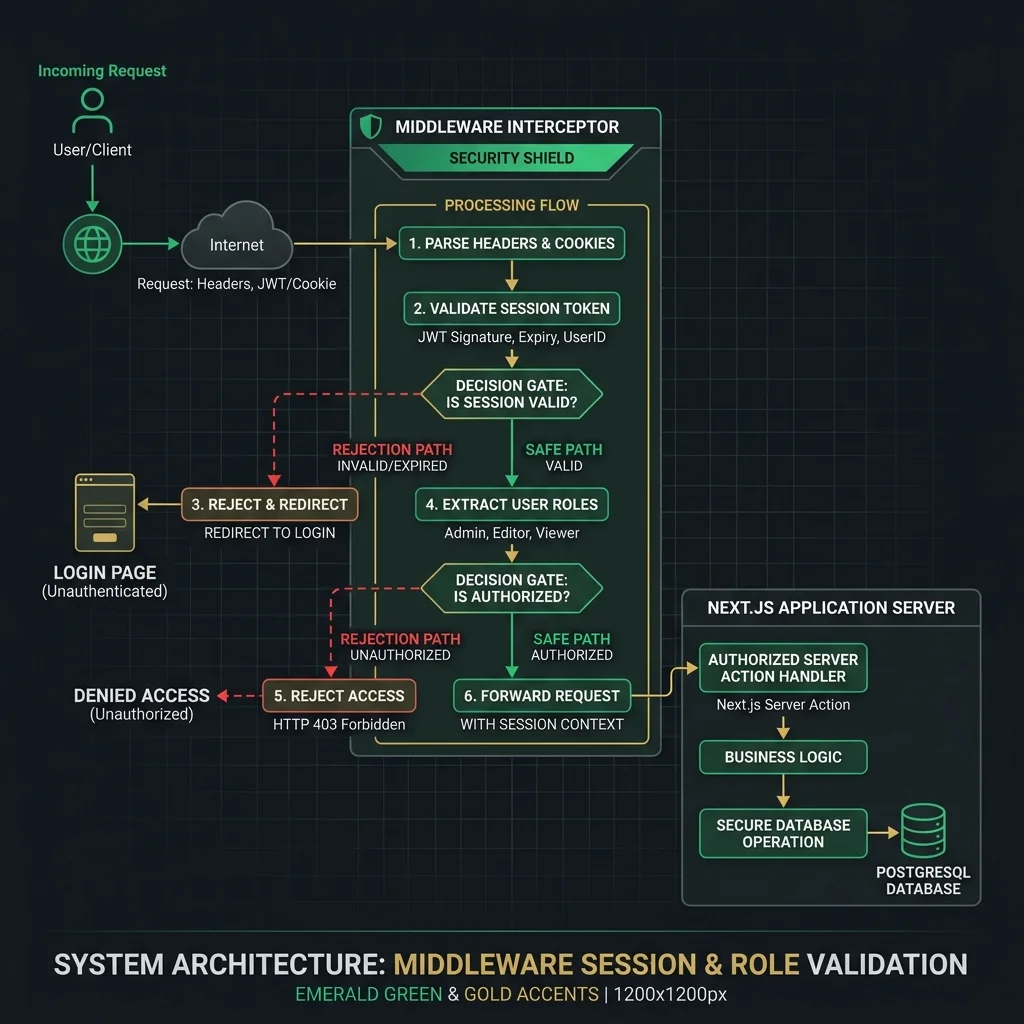
<figcaption>Middleware Interceptor: Requests must pass through validation and authentication checks before accessing backend logic.</figcaption>
---
## 7. Deep Dive: Access Token Revocation and Token Leak Auditing
In modern cloud environments, authenticating a server action involves validating a cryptographically signed cookie, typically a JWT or a session reference ID. However, simply verifying the signature of a token is insufficient for highly secure endpoints. If a session token is stolen (e.g. through a cross-site scripting attack on another domain or local storage snooping), the attacker can hijack the user's identity.
To limit the impact of compromised credentials, enterprise systems must implement real-time revocation checks. Rather than relying on stateless JWT validation, the Server Action wrapper must query a high-speed database (such as Redis or DynamoDB Global Tables) to verify that the token has not been revoked or blacklisted.
Let us inspect a robust session verification mechanism:// lib/session-validator.ts
import { db } from './db';
import { cache } from './cache';
export async function validateTokenRealTime(token: string): Promise
// 1. Check local memory cache first
const isBlacklisted = await cache.get(blacklist:${token});
if (isBlacklisted) return false;
// 2. Query session table
const sessionRecord = await db.session.findUnique({
where: { token },
select: { active: true, expiresAt: true }
});
if (!sessionRecord || !sessionRecord.active) return false;
if (new Date() > sessionRecord.expiresAt) {
// Mark as expired
await db.session.update({ where: { token }, data: { active: false } });
return false;
}
return true;
}
By adding this check to the action pipeline, administrators can immediately revoke all sessions if a data breach or session hijacking is detected. This represents an essential component of zero-trust network architectures, preventing attackers from exploiting stale authorization tokens. When caching token revocation lists in Redis, developers must implement a reliable Time-to-Live (TTL) eviction policy. Storing blacklisted tokens without an expiration date will lead to memory exhaustion over time. Setting the Redis cache TTL to match the remaining validity period of the session JWT ensures that expired records are purged automatically, keeping the database clean.

Additionally, to prevent token leakage in the first place, developers must configure security headers on the HTTP responses that deliver Server Actions. Essential headers include:
*   **Strict-Transport-Security (HSTS)**: Forces the browser to use HTTPS connections for all requests, preventing man-in-the-middle decryption.
*   **X-Content-Type-Options**: Set to `nosniff` to prevent browsers from executing files masquerading as scripts or stylesheets.
*   **Referrer-Policy**: Restricts the amount of referral data passed in headers to prevent session identifiers from leaking through URL parameters.
*   **Content-Security-Policy (CSP)**: Set strict script, object, and connect policies to restrict script execution to trusted domains, mitigating XSS attacks that target cookie storage.

By combining CSP policies with HTTPOnly, Secure, and SameSite cookie configurations, developers prevent malicious client scripts from reading session identifiers. This multi-layered security strategy ensures that even if an XSS vulnerability exists on the frontend, the session cookies remain protected from extraction and theft.

---

## 8. Technical Comparison: Access Control Implementation Patterns

Selecting the appropriate pattern for securing actions depends on application complexity and security requirements. The table below compares manual validation checks, custom safe action wrappers, and dedicated third-party libraries (such as `next-safe-action`):

| Comparison Criteria | Manual Checks Pattern | Custom Interceptor Wrapper | next-safe-action Library |
| :--- | :--- | :--- | :--- |
| **Consistency Enforcement** | Low (relies on manual boilerplate code) | High (enforced by wrapper signature contract) | High (enforced by library configuration) |
| **Development Overhead** | High (auth logic duplicated in every file) | Low (reusable utility wrapper function) | Low (well-documented, feature-rich setup) |
| **Validation Capability** | Ad-hoc checks (manual if/else statements) | Schema-driven (Zod integrated natively) | Schema-driven (Zod, Valibot, ArkType support) |
| **Audit Log Integration** | Manual (developers must write try/catch logs) | Automated (logged in wrapper error block) | Automated (custom hooks for execution logs) |
| **Error Shielding** | Vulnerable (raw database errors can leak) | Safe (wrapper sanitizes error responses) | Safe (integrated build-in error boundaries) |
| **Type Safety** | Complex (manual type assertion required) | Automated (inferred from Zod schema types) | Automated (comprehensive TypeScript support) |

### Analyzing the Architectural Trade-offs

When choosing an implementation path, engineering leaders must balance development speed against long-term security posture. The **Manual Checks Pattern** is often chosen by teams migrating from traditional REST controllers because it requires no new abstractions. However, as the codebase grows past a few dozen actions, developers inevitably forget to copy-paste the authentication blocks, leading to unprotected endpoints. Furthermore, manual try/catch blocks are prone to logging anomalies where developers fail to format or capture stack traces consistently, obscuring potential security breaches from central monitoring tools.

The **Custom Interceptor Wrapper** addresses consistency by consolidating authentication, validation, and error shielding in a single reusable function. This pattern has a minimal runtime footprint and does not add third-party dependency weight to the project build, keeping deployment packages lightweight. However, because it is custom-built, the engineering team must maintain the TypeScript generic type definitions and manually write integrations for new validation libraries or telemetry collectors. This maintenance overhead can become a bottleneck when upgrading framework versions or changing validation standards.

For large-scale, highly regulated enterprise applications, using a dedicated library like **`next-safe-action`** is the recommended strategy. These libraries provide a declarative API for building multi-step middleware pipelines, allowing developers to chain validation, rate-limiting, logging, and role verification hooks. They handle complex type inference automatically, meaning that client-side components receive type-safe execution results without requiring manual generic mapping. This aligns with modern security practices, such as the data isolation strategies discussed in our playbook on [surviving shadow AI and architecting enterprise governance](file:///e:/wamp/www/vatsalshah/content/blog/surviving-shadow-ai-architecting-enterprise-governance.md). The main trade-off is the addition of an external dependency to the project, which requires regular dependency audits and updates to mitigate supply chain risks.

---

## 9. Case Analysis: Auditing Next.js Server Actions for OWASP Top 10 Flaws

To understand these risks in production, let's analyze a mock application audit where common security flaws were identified in Next.js Server Actions:
AUDIT REPORT - PROJECT ALPHA NEXT.JS BUILD
Target Version: 1.2.2.5
Date: 2026-06-25
[FINDING 1] INSECURE RECORD MUTATION (OWASP A01: Broken Access Control)
- Component: app/actions/documents.ts -> updateDocumentAction
- Severity: CRITICAL
- Description: The updateDocumentAction accepts documentId and body client parameters.
It updates the database directly without validating that the authenticated userId matches
the ownerId of the document.
- Mitigation: Read session userId from cookies. Query document metadata and assert ownership
before executing the database update operation.
[FINDING 2] CRITICAL CREDENTIAL LEAKAGE (OWASP A05: Security Misconfiguration)
- Component: app/actions/payment.ts -> processPaymentAction
- Severity: HIGH
- Description: The file imports an API secret key directly from process.env.STRIPE_SECRET_KEY
without declaring 'server-only'. The action is referenced in a client component, leading
to the potential bundling of environment variables in the client JavaScript payload.
- Mitigation: Declare 'server-only' at the top of payment.ts to cause a build-time compile error
if imported on the client side, protecting the API key from leaking.
[FINDING 3] INSUFFICIENT RATE LIMITING ON SENSITIVE MUTATIONS (OWASP A04: Insecure Design)
- Component: app/actions/auth.ts -> verifyOneTimePasswordAction
- Severity: HIGH
- Description: The verifyOneTimePasswordAction verifies OTP inputs from the client without
checking request frequency. Attackers can execute brute-force attacks by automating
Server Action POST requests to bypass MFA locks.
- Mitigation: Integrate sliding-window rate limiters within the action wrapper using Redis.
Restrict OTP attempts to a maximum of 5 verification requests per user-IP per hour.
By conducting regular threat modeling audits, enterprise teams can identify these architectural gaps early in the development lifecycle before code reaches production.

### Implementing Automated AST Static Security Gates

While runtime safe action wrappers and interceptors provide robust security boundaries, they still rely on developers remembering to apply them when authoring new Server Actions. In large engineering organizations with hundreds of active contributors, manual enforcement is prone to oversight. To guarantee that every public-facing endpoint is protected, teams should implement automated Abstract Syntax Tree (AST) static analysis checks in their continuous integration (CI) pipelines.

By parsing code files into AST nodes, static analysis tools can verify that any function exported from a file decorated with the `'use server'` directive is wrapped in a secure action creator. Below is an implementation of a custom ESLint rule written in JavaScript that parses the code structure to enforce this boundary:
// eslint-rules/enforce-safe-actions.js
module.exports = {
meta: {
type: 'problem',
docs: {
description: 'Enforce that all exported Server Actions are wrapped in createSecureAction',
category: 'Possible Security Vulnerability',
recommended: true
},
schema: [] // No options
},
create(context) {
let isServerFile = false;
return {
// 1. Detect if the file begins with the 'use server' directive
Program(node) {
const hasDirective = node.directives.some(
(dir) => dir.value.value === 'use server'
);
if (hasDirective) {
isServerFile = true;
}
},
// 2. Inspect all exported function declarations and variable exports
ExportNamedDeclaration(node) {
if (!isServerFile) return;
// Check variable exports (e.g., export const myAction = ...)
if (node.declaration && node.declaration.type === 'VariableDeclaration') {
node.declaration.declarations.forEach((decl) => {
const init = decl.init;
// Verify if the initialization is a call expression to createSecureAction
const isWrapped = init &&
init.type === 'CallExpression' &&
init.callee.name === 'createSecureAction';
if (!isWrapped) {
context.report({
node: decl.id,
message: 'Security Violation: Exported Server Action "{{ name }}" must be wrapped in createSecureAction to enforce authentication and schema validation schemas.',
data: { name: decl.id.name }
});
}
});
}
// Check direct function exports (e.g., export async function myAction() ...)
if (node.declaration && node.declaration.type === 'FunctionDeclaration') {
const funcNode = node.declaration;
context.report({
node: funcNode.id,
message: 'Security Violation: Exported Server Action function "{{ name }}" cannot be exported directly. Declare it as a variable wrapped in createSecureAction.',
data: { name: funcNode.id.name }
});
}
}
};
}
};
By integrating this custom lint rule into pre-commit hooks or the main Github Actions workflow, you create an automated quality gate that prevents insecure, raw Server Actions from ever being merged into main branches. This static safeguard, combined with runtime middleware verification, builds a highly resilient defense-in-depth framework for modern Next.js environments.

In addition to these findings, audits of RSC codebases frequently reveal issues with **CSRF Token Validation** on custom action endpoints. While the framework implements global CSRF checks, developers who configure custom action routes or build native app integrations often disable these checks to allow external access, inadvertently exposing web users to session hijacking. Every audit must ensure that CSRF checks are enforced for all state-changing mutations.

Another critical audit target is **Unhandled Promise Rejections** within server functions. If an action fails and the code does not catch the exception, it can trigger server-side crashes, rendering parts of the application unresponsive. All server-side endpoints must use robust try-catch blocks to catch errors, write a secure log entry to auditing services, and return a standardized error status code to the client.

---

## 10. What to do Monday morning: 3 Steps to Secure Your Server Action Boundaries


1. **Scan for Unwrapped Server Actions**: Run a search query across your codebase for `'use server'` or `"use server"`. Identify every exported function that is imported directly in client components. Ensure that none of these functions execute database queries or mutations without a validation and authentication check.
2. **Audit Imports for Sensitive Variables**: Verify that modules containing secret keys, password validation logic, or raw database connection strings are protected. Use the `server-only` package to prevent these files from being accidentally bundled into client-side code:
import 'server-only';
// Rest of your server-only code...
