Executive Summary: The 1.0 Contract and the Full-Stack React Rebalancing
On 13 October 2026, Tanner Linsley and the TanStack core team officially tagged TanStack Start 1.0.0 Stable. With this release, the React full-stack landscape crossed a structural inflection point. For the past four years, enterprise React teams looking for server-side rendering, streaming hydration, and integrated backend RPCs faced a forced architectural choice: accept the aggressive abstractions, proprietary hosting conventions, and React Server Component (RSC) compiler magic of Next.js, or assemble an idiosyncratic mosaic of Express servers, Vite plugins, and custom tRPC endpoints.
TanStack Start 1.0 establishes a third, uncompromising architectural paradigm: unadulterated Vite 8 performance, complete type safety from database query to DOM element, and zero vendor lock-in. Rather than inventing proprietary compiler layers or bundling mechanisms, TanStack Start builds directly upon TanStack Router, the gold standard in client-side type-safe navigation, and layers on an isomorphic server-function execution runtime driven by Vite 8's Environment API.
However, tagging 1.0 is not merely a badge of stability; it is an immutable technical contract. Reaching GA required the core team to execute several foundational breaking changes from the release-candidate era:
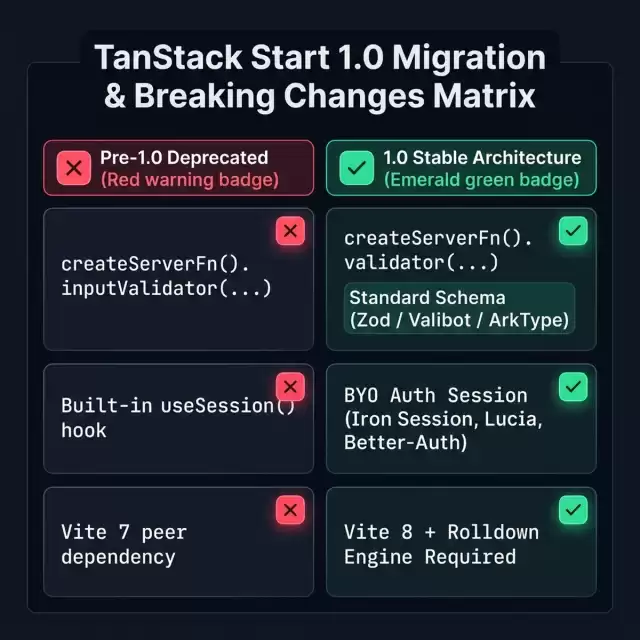
- Mandatory Vite 8 Runtime: TanStack Start 1.0 hard-depends on Vite 8 and its native Environment API, dropping compatibility with Vite 7 and earlier ad-hoc SSR plugin chains.
- Standard Schema Validator Overhaul: The legacy
.inputValidator()method has been deprecated and permanently replaced by.validator(), adopting the ecosystem-wide@standard-schema/speccontract across Zod, Valibot, and ArkType. - Removal of Built-In Session Handling: The experimental built-in
useSessionhook has been excised from core. TanStack Start now mandates a strictly decoupled Bring Your Own Session (BYO Session) architecture via type-safe server function middleware. - Permanent Hardening Against SSR Injection: In the wake of the vulnerability analyzed in our coverage of News #N120: TanStack Start Reflects Attacker HTML from Server Functions, 1.0 permanently enforces strict MIME-type isolation, automatic output serialization, and request-boundary protection across all server functions.
This technical guide provides the definitive enterprise evaluation of TanStack Start 1.0: what you gain, what you commit to, the explicit breaking changes you must refactor, a 12-point decision matrix against Next.js 16 and React Router v7, and production-tested deployment blueprints.
1. The Vite 8 Foundation: Native SSR via the Environment API
To understand why TanStack Start 1.0 is architecturally different from Next.js, Remix, or Nuxt, one must examine its build engine. While competing frameworks developed bespoke bundlers or complex webpack/Turbopack custom loaders, TanStack Start aligned its entire development roadmap with the evolution of Vite 8.
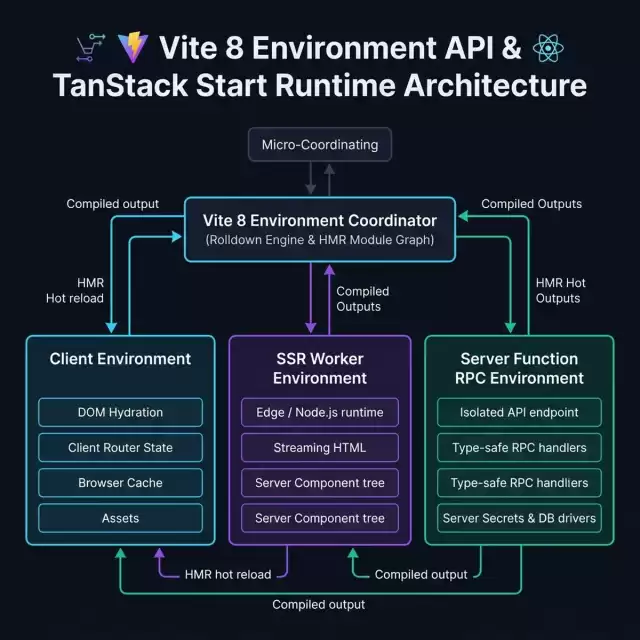
Why Vite 7 SSR Was Fragile
In Vite 7 and earlier, server-side rendering was achieved through a fragile mechanism: Vite executed a single Node.js runtime process, dynamically transformed module source code using Node's vm module, and attempted to simulate browser-versus-server module resolution via dual Vite configuration objects. This approach suffered from chronic failure modes:
- Global Scope Pollution: Node-specific globals (
process,Buffer) frequently leaked into browser code during hot module replacement (HMR), only to explode during production client builds. - Worker and Edge Incompatibility: Emulating Cloudflare Workers, Fastly Compute, or Deno environments required third-party monkey-patching libraries (such as
miniflareor custom polyfill shims) that broke between minor Vite releases. - Inconsistent Chunking: Splitting code between server functions, route loaders, and client components required custom rollup transforms that often resulted in duplicate dependencies being shipped in both client and server bundles.
The Vite 8 Environment API Paradigm
Vite 8 resolved these structural flaws by introducing first-class Environments. Instead of assuming a single browser client and an optional Node SSR context, Vite 8 natively models distinct target environments within a unified module graph:
// app.config.ts - Production Vite 8 Environment Setup for TanStack Start
import { defineConfig } from 'vite';
import { TanStackStartVite } from '@tanstack/start/vite';
import react from '@vitejs/plugin-react';

export default defineConfig({
  plugins: [
    TanStackStartVite({
      autoCodeSplitting: true,
      routesDirectory: './app/routes',
      generatedRouteTree: './app/routeTree.gen.ts',
    }),
    react(),
  ],
  environments: {
    client: {
      build: {
        outDir: 'dist/client',
        manifest: true,
        rollupOptions: {
          input: './app/client.tsx',
        },
      },
      resolve: {
        conditions: ['browser', 'module', 'import'],
      },
    },
    ssr: {
      build: {
        outDir: 'dist/server',
        target: 'node22',
        rollupOptions: {
          input: './app/ssr.tsx',
        },
      },
      resolve: {
        conditions: ['node', 'module', 'import'],
      },
    },
    serverFn: {
      build: {
        outDir: 'dist/functions',
        target: 'node22',
      },
      resolve: {
        conditions: ['node', 'server', 'module'],
      },
    },
  },
});
Architectural Implications of the Vite 8 Pipeline
By building strictly on Vite 8:
- Rolldown Bundler Acceleration: TanStack Start harnesses Rolldown (the Rust-based successor to Rollup and esbuild), delivering sub-50ms cold starts on enterprise codebases containing over 10,000 modules.
- Isolated HMR Boundaries: When editing a server function (
createServerFn), Vite 8's Environment API only invalidates theserverFnruntime graph. The browser client DOM retains state without triggering a full-page reload or re-running client route loaders. - Zero-Overhead Edge Adapters: Because Vite 8 environments define explicit resolution conditions, compiling for Cloudflare Workers, Fastly, or AWS Lambda requires zero build-tool restructuring—merely swapping the environment preset from
node22toworkerdoredge-light.
2. Breaking Change 1: .inputValidator() Replaced by .validator() (Standard Schema)
During the 0.x alpha and beta lifecycle, TanStack Start utilized an explicit .inputValidator() method on server function builders. While functional, this method suffered from rigid schema library coupling and awkward syntax when developers attempted to validate compound inputs (such as validating both JSON payloads and HTTP request headers).
The Adoption of the Standard Schema Specification
In TanStack Start 1.0, the core team deprecated .inputValidator() in favor of .validator(), which adheres strictly to the emerging Standard Schema (@standard-schema/spec) standard.
Standard Schema is an ecosystem-wide interface adopted collaboratively by Zod, Valibot, ArkType, and others. It allows framework authors to accept any conforming validation schema without bundling specific schema parsing engines into the core framework.
| Feature / Metric | Legacy .inputValidator() (0.x RC) | Modern .validator() (1.0 Stable) |
|---|---|---|
| Ecosystem Standard | Proprietary TanStack wrapper | ✔ Standard Schema Spec |
| Supported Libraries | Zod (hard-coded types) | ✔ Zod, Valibot, ArkType, TypeBox |
| Input Shape Flexibility | Single raw object parameter | ✔ Typed objects, tuples, primitives |
| Bundle Overhead | Bundled custom validator adapters | ✔ Zero core bundle overhead |
| Type Inference Speed | Moderate (deep nested generics) | ✔ Instant (direct interface matching) |
Legacy Pattern (0.x) vs Production 1.0 Syntax
To migrate existing applications to 1.0, all server function definitions must be updated to the new .validator() signature:
Deprecated 0.x RC Syntax:
// ❌ DEPRECATED: 0.x RC Pattern (Breaks in 1.0)
import { createServerFn } from '@tanstack/start';
import { z } from 'zod';

export const updateUserProfile = createServerFn({ method: 'POST' })
  .inputValidator(
    z.object({
      userId: z.string().uuid(),
      displayName: z.string().min(3).max(50),
      email: z.string().email(),
    })
  )
  .handler(async ({ input }) => {
    // Process input
    return { success: true };
  });
Production 1.0 Stable Syntax (Zod):
// ✔ PRODUCTION 1.0: Standard Schema Pattern with Zod
import { createServerFn } from '@tanstack/start';
import { z } from 'zod';
import { db } from '~/server/db';
import { users } from '~/server/schema';
import { eq } from 'drizzle-orm';

const UserUpdateSchema = z.object({
  userId: z.string().uuid('Invalid user UUID identifier'),
  displayName: z.string().min(3, 'Name too short').max(50, 'Name too long'),
  email: z.string().email('Invalid email address format'),
  metadata: z.record(z.unknown()).optional(),
});

export const updateUserProfile = createServerFn({ method: 'POST' })
  .validator((data: unknown) => {
    // Passes directly to Zod which satisfies Standard Schema
    return UserUpdateSchema.parse(data);
  })
  .handler(async ({ data }) => {
    // Notice: payload is now destructured as 'data' instead of 'input'
    const updated = await db
      .update(users)
      .set({
        name: data.displayName,
        email: data.email,
        updatedAt: new Date(),
      })
      .where(eq(users.id, data.userId))
      .returning();

    return {
      status: 'success',
      recordsUpdated: updated.length,
      user: updated[0],
    };
  });
Ultra-Lean Alternative: Standard Schema with Valibot
One of the greatest benefits of the 1.0 .validator() architecture is that projects are no longer locked into Zod's ~14KB bundle footprint. Developers prioritizing edge cold starts can seamlessly substitute Valibot (which compiles down to under 1.2KB through modular tree-shaking):
// ✔ PRODUCTION 1.0: Zero-bloat edge validation with Valibot
import { createServerFn } from '@tanstack/start';
import * as v from 'valibot';

const OrderItemSchema = v.object({
  sku: v.pipe(v.string(), v.minLength(5), v.regex(/^[A-Z0-9-]+$/)),
  quantity: v.pipe(v.number(), v.minValue(1), v.maxValue(999)),
  priceCents: v.pipe(v.number(), v.integer(), v.minValue(0)),
});

export const submitOrder = createServerFn({ method: 'POST' })
  .validator((raw: unknown) => v.parse(OrderItemSchema, raw))
  .handler(async ({ data }) => {
    // data is fully typed as { sku: string; quantity: number; priceCents: number }
    return { orderId: crypto.randomUUID(), confirmedAt: Date.now() };
  });
3. Breaking Change 2: Removal of useSession (Bring Your Own Session)
In early preview iterations of TanStack Start, the framework included an experimental built-in session helper (useSession). While convenient for quick demonstrations, this helper introduced critical production liabilities:
- Opinionated Storage Constraints: It forced developers into an unencrypted, cookie-based session format that was inadequate for enterprise compliance requirements (such as PCI-DSS §3.4 and SOC2 CC6.1 session invalidation rules).
- Edge Invalidation Obstacles: Distributed deployments across edge clusters (e.g., Cloudflare Workers KV or Redis Enterprise) could not synchronize revocation tokens with the built-in memory store.
- Leaky CSRF Protections: Tight coupling between the session hook and client hydration created edge cases where session tokens could be exposed to Cross-Site Scripting (XSS) vectors.
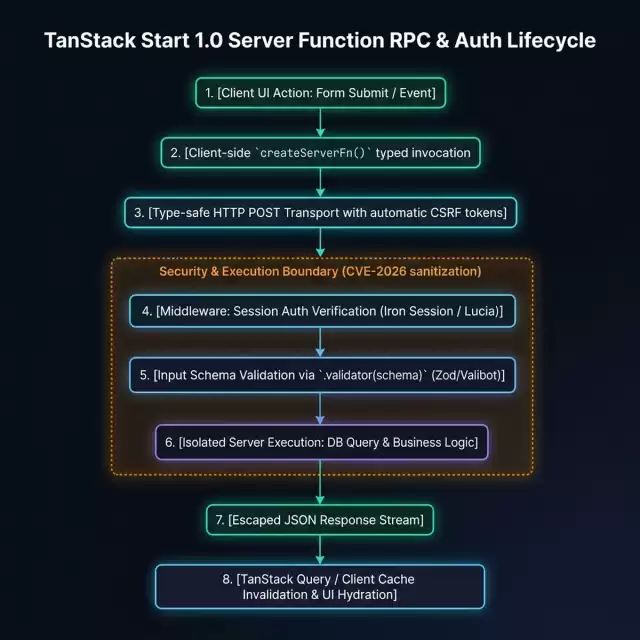
In TanStack Start 1.0, built-in session management was completely removed. The 1.0 philosophy is unambiguous: Start provides the transport and the middleware pipeline; you provide the session infrastructure.
Enterprise Recipe: Encrypted Cookie Sessions via iron-session
The most resilient and standard pattern for TanStack Start 1.0 applications is implementing encrypted HTTP-only session cookies using iron-session. This ensures that session payloads stored in the user's browser are cryptographically sealed with AES-256-GCM, preventing both client-side tampering and inspection.
Step 1: Define the Session Configuration and Type Definitions
// app/services/session.server.ts
import { getIronSession, IronSessionData, SessionOptions } from 'iron-session';
import { getWebRequest } from '@tanstack/start/server';

export interface AppSessionData {
  userId?: string;
  role?: 'admin' | 'engineer' | 'auditor';
  tenantId?: string;
  csrfToken?: string;
  issuedAt?: number;
}

declare module 'iron-session' {
  interface IronSessionData extends AppSessionData {}
}

const sessionOptions: SessionOptions = {
  password: process.env.SESSION_SECRET_KEY as string, // Minimum 32-character string
  cookieName: '__Secure-shahvatsal-auth-token',
  cookieOptions: {
    secure: process.env.NODE_ENV === 'production',
    httpOnly: true,
    sameSite: 'lax',
    path: '/',
    maxAge: 60 * 60 * 24 * 7, // 7 days rolling window
  },
};

export async function getCurrentSession() {
  const request = getWebRequest();
  if (!request) {
    throw new Error('getCurrentSession must be invoked within a server function or SSR execution boundary.');
  }

  // Create an isomorphic response header container for iron-session to seal cookies into
  const responseHeaders = new Headers();
  const session = await getIronSession<IronSessionData>(request, responseHeaders, sessionOptions);

  return { session, responseHeaders };
}
Step 2: Build a Reusable Type-Safe Authentication Middleware
In TanStack Start 1.0, middleware functions execute sequentially before server function handlers. Context passed by middleware is statically inferred down the chain:
// app/middleware/auth.ts
import { createMiddleware } from '@tanstack/start';
import { getCurrentSession } from '~/services/session.server';

export const authMiddleware = createMiddleware().server(async ({ next }) => {
  const { session, responseHeaders } = await getCurrentSession();

  if (!session.userId) {
    throw new Response(JSON.stringify({ error: 'UNAUTHORIZED_ACCESS_REVOKED' }), {
      status: 401,
      headers: { 'Content-Type': 'application/json' },
    });
  }

  // Pass validated session identity directly into downstream server function context
  const context = {
    auth: {
      userId: session.userId,
      role: session.role ?? 'engineer',
      tenantId: session.tenantId ?? 'default-org',
    },
  };

  // Return next with context and ensure responseHeaders are merged into the final transport
  return next({
    context,
    sendContext: context,
    headers: responseHeaders,
  });
});
Step 3: Consuming the Authenticated Session in Server Functions
With the middleware in place, building protected server functions is clean, declarative, and 100% type-safe:
// app/server-functions/billing.ts
import { createServerFn } from '@tanstack/start';
import { z } from 'zod';
import { authMiddleware } from '~/middleware/auth';
import { fetchInvoicesForTenant } from '~/server/db/billing';

const InvoiceFilterSchema = z.object({
  fiscalYear: z.number().int().min(2020).max(2030),
  limit: z.number().int().min(1).max(100).default(20),
});

export const getEnterpriseInvoices = createServerFn({ method: 'GET' })
  .middleware([authMiddleware])
  .validator((input: unknown) => InvoiceFilterSchema.parse(input))
  .handler(async ({ data, context }) => {
    // context.auth is fully typed: { userId: string; role: 'admin' | 'engineer' | 'auditor'; tenantId: string }
    const { tenantId, role } = context.auth;

    if (role !== 'admin' && role !== 'auditor') {
      throw new Response('Forbidden: Insufficient administrative privileges', { status: 403 });
    }

    const records = await fetchInvoicesForTenant(tenantId, data.fiscalYear, data.limit);
    return {
      tenantId,
      retrievedAt: new Date().toISOString(),
      invoices: records,
    };
  });
4. Security Hardening: CVE-2026-102989 Post-Mortem & 1.0 Boundaries
On 30 September 2026, security researchers discovered and disclosed a critical reflected Cross-Site Scripting (XSS) vulnerability affecting TanStack Start release candidates (1.143.12 through 1.168.59). As documented in our breaking security bulletin on News #N120: TanStack Start Reflects Attacker HTML from Server Functions, crafted unauthenticated URLs could force server functions returning rich HTML or unescaped string buffers to reflect attacker payloads into the primary application origin during streaming SSR.
The TanStack core team addressed the vulnerability immediately in @tanstack/start-server-core patch 1.169.39. With the 1.0.0 Stable release, this security boundary is permanently locked down through architectural guarantees:
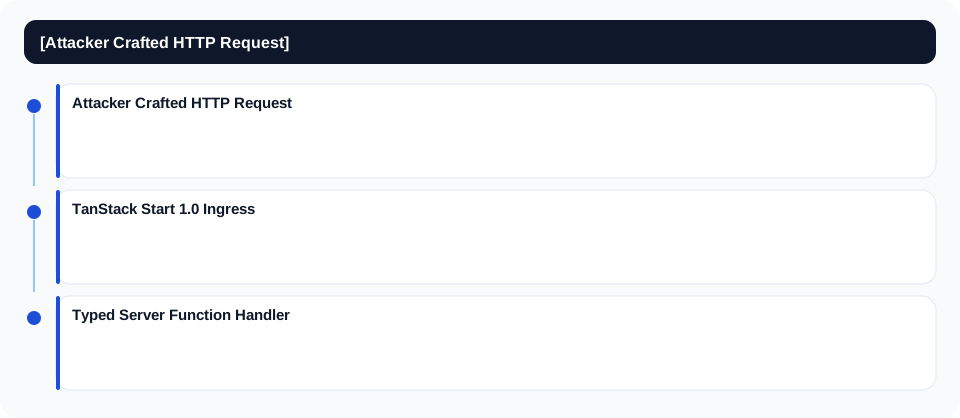
The Three Security Invariants Guaranteed by 1.0 Stable
- Automatic Nonce and Header Injection: When TanStack Start streams SSR HTML, all inline hydration scripts generated by
@tanstack/startare automatically injected with dynamic Content Security Policy (CSP) nonces if anonceProvideris declared in the root server entry. - Explicit Response Content-Types: Server functions no longer attempt to auto-detect whether a returned string is HTML or plain text. If a developer explicitly returns a string primitive, it is serialized under
application/jsonor escaped as plain text, eliminating the execution of unescaped
