STRATEGIC OVERVIEW
How digital twins, edge AI, and autonomous agent loops orchestrate self-healing supply chains and lights-out production in Industry 5.0 factories.
The Autonomous Factory: Orchestrating Industry 5.0 with Digital Twins
By Vatsal Shah | June 23, 2026 | 22 min read
Table of Contents
- Industry 5.0: Bringing Human Intent to the Robot-Centric Floor
- What is the Autonomous Factory?
- Real-Time Digital Twins: Syncing Physical Sensors with Agentic Logic
- Procedural Logic: Closed-Loop Telemetry and Edge Control
- Self-Healing Supply Chains: Agents that Reorder Parts Before They Break
- Step-by-Step: Implementing an Edge Telemetry Receiver and Dispatcher
- The 'Lights-Out' Factory: 100% Autonomous Production Cycles
- Comparative Analysis: Industry 4.0 vs Industry 5.0 (AI-Native)
- Pitfalls & Industrial Anti-Patterns in AI-Native Factories
- Futuristic Horizon: The 'Reshoring' Revolution 2026–2030
- What to Do Monday Morning
- Frequently Asked Questions
- About the Author
- Industry 5.0
- The industrial wave prioritizing collaboration between human intelligence and cognitive computing systems to deliver customized, resilient production.
- Digital Twin
- A dynamic virtual replica of a physical asset, process, or system that mirrors its operational state and environmental conditions in real time.
- PLC (Programmable Logic Controller)
- Industrial solid-state computers that monitor sensor inputs and make logical decisions to control physical actuators.
- Edge AI
- The deployment of machine learning algorithms directly on local hardware appliances near the data source rather than in centralized cloud instances.
- Closed-Loop System
- A control system that automatically adjusts its execution state based on feedback data from its outputs.
Industry 5.0: Bringing Human Intent to the Robot-Centric Floor
The transition from Industry 4.0 to Industry 5.0 represents a shift in how we think about automation. Industry 4.0 was about connectivity. It was the era of the Internet of Things (IoT), where factories were instrumented with thousands of sensors to stream temperature, vibration, and throughput data into centralized cloud lakes. The goal was visibility—creating dashboards so human managers could see what was happening on the factory floor.
However, Industry 4.0 left a significant gap: the Action Gap. While systems collected massive amounts of data, taking action still required human analysis, consensus meetings, and manual programming overrides. If a cooling pump on a refinery line began vibrating abnormally, a dashboard turned red, an email alert went out, and a human operator had to manually schedule a maintenance window, diagnose the failure, and order a replacement part.
Industry 5.0 closes this action gap by integrating cognitive agent orchestration and real-time digital twins. In this new model, machines are not merely connected; they are wrapped in an autonomous software loop.
Rather than sending raw alerts to human inboxes, edge-based agents continuously read the digital twin state, reason about anomalies, run simulations in virtual environments, negotiate tool access via protocols like Model Context Protocol (MCP), and execute corrective actions directly. The human's role shifts from a tactical responder to a policy director, establishing safety envelopes and production goals while the system manages execution.
What is the Autonomous Factory?
An autonomous factory is a manufacturing facility where production lines, material transport, energy consumption, and supply chain logistics are managed dynamically by a synchronized network of local AI agents. The physical machines (robotic arms, CNC mills, conveyors) are coordinated by a software abstraction layer that mirrors the factory state in real time.
This model is built on three core capabilities:
- Bidirectional Synchronization: Sensors on physical machines continually update the virtual replica (digital twin), while the digital twin feeds control commands back to physical PLCs to adjust operational parameters on the fly.
- Dynamic Scheduling: If a machine fails or a vendor delivery is delayed, local agents recalculate the production schedule across the entire floor, routing parts to alternative lines to minimize throughput degradation.
- Automated Procurement: The factory's software stack connects directly to supplier APIs. When predictive models indicate a part is near its failure limit, the system orders a replacement, books a maintenance slot, and coordinates the delivery with automated guided vehicles (AGVs) on the floor.
By moving execution to the edge and automating the planning loop, the autonomous factory operates with unprecedented resilience, adapting to hardware failures and supply chain shocks in real time.
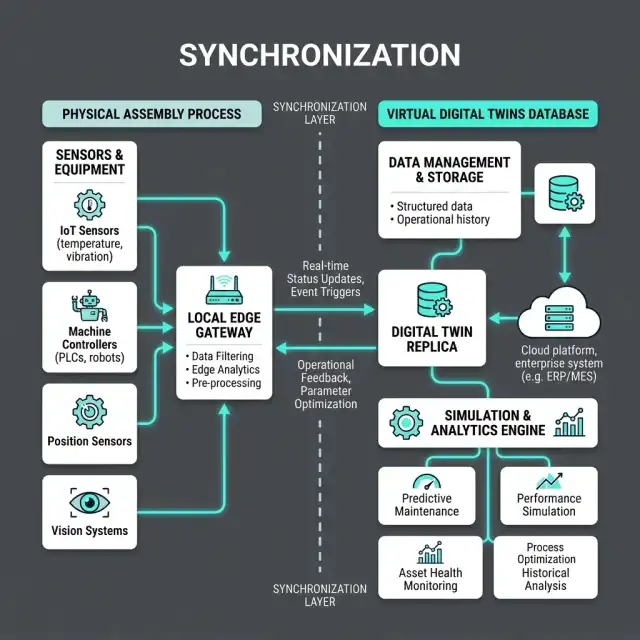
Real-Time Digital Twins: Syncing Physical Sensors with Agentic Logic
The foundation of the autonomous factory is the real-time digital twin. The digital twin is not a static 3D CAD model; it is a live computational state machine that tracks the exact speed, temperature, pressure, electrical draw, and degradation level of every component on the floor.
Synchronization is achieved using high-frequency telemetry pipelines:
- Telemetry Capture: Sensors on the physical machines stream telemetry data to local gateway appliances via industrial protocols like Modbus, OPC-UA, or MQTT.
- State Processing: The edge gateway parses the telemetry streams, normalizes the data formats, and updates the digital twin database.
- Agent Integration: The digital twin exposes its schema via standard Model Context Protocol (MCP) tools. This allows cognitive agents to query machine health, request historical run charts, and execute control commands.
The following architecture diagram details the bidirectional pipeline connecting physical sensors on the assembly floor with the virtual digital twin database and the cognitive agent execution tier:
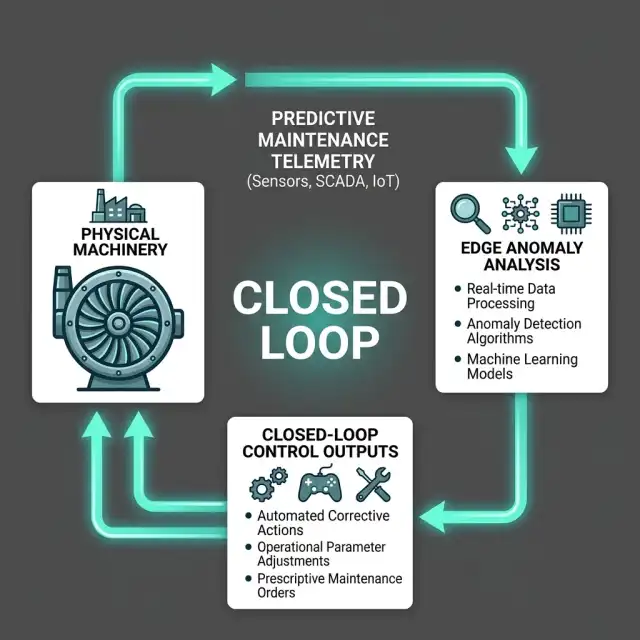
Procedural Logic: Closed-Loop Telemetry and Edge Control
The operational efficiency of the autonomous factory is driven by closed-loop control. In a closed-loop system, the output of a process is continually monitored and used to adjust the inputs in real time.
Consider a high-speed metal milling machine. As the drill bit cuts through hard alloys, it generates heat and undergoes mechanical friction:
- Telemetry Feedback: Temperature and vibration sensors stream high-frequency data to the edge gateway.
- Anomaly Detection: An edge AI model detects a subtle vibration pattern that indicates drill bit fatigue.
- Action Selection: The orchestration agent queries the digital twin to check alternative feed rates. It runs a local simulation to calculate if reducing the spindle speed by 15% will cool the bit and extend its lifecycle until the end of the current production run.
- Actuation: The agent sends a control command to the physical PLC, dynamically adjusting the machine speed without stopping production.
This closed-loop loop happens in milliseconds, preventing tool breakage and protecting expensive industrial hardware from catastrophic wear.
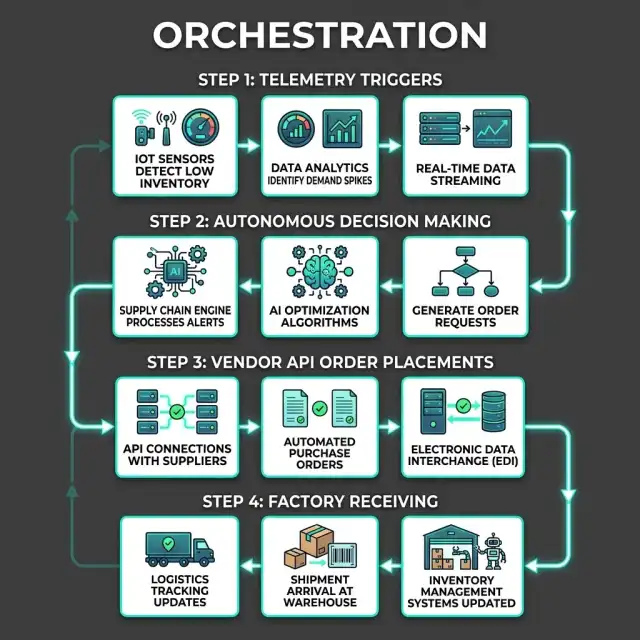
Self-Healing Supply Chains: Agents that Reorder Parts Before They Break
The automation of the factory floor is only half the battle. If a machine breaks down and sits idle for three days waiting for a replacement bearing to arrive from an overseas warehouse, the entire facility's throughput collapses. True autonomy requires connecting the factory floor directly to the broader supply chain.
In Industry 5.0, this is achieved through self-healing supply chain loops:
- Telemetry Forecast: Edge models track pump wear and calculate that a specific critical bearing has 120 operational hours remaining before it reaches its safety threshold.
- Inventory Query: A procurement agent queries the local warehouse database. Finding no replacement bearing in stock, it queries vendor APIs.
- Automated Procurement: The agent compares lead times, shipping costs, and vendor ratings. It places an order for the bearing, schedules the delivery to arrive in exactly 72 hours, and books a maintenance window on the production schedule.
- Autonomous Receiving: When the delivery truck arrives, RFID readers log the part, and an AGV transports the bearing directly to the target machine's service zone.
By automating the logistics loop, the factory coordinates maintenance windows with part arrivals, minimizing downtime and maintaining optimal inventory levels.
Step-by-Step: Implementing an Edge Telemetry Receiver and Dispatcher
Let's write a lightweight, production-ready edge telemetry receiver and agent dispatcher in Python. This system listens for sensor telemetry, evaluates the values against safety envelopes, and invokes local tools via a simulated MCP schema to adjust machine states on the fly.
import asyncio
import json
import logging
import random
from typing import Dict, Any

logging.basicConfig(level=logging.INFO)
logger = logging.getLogger("EdgeTelemetry")

class EdgeMCPGateway:
    """Simulates local industrial MCP gateway tools."""
    def __init__(self):
        self.plc_states = {"pump_01": {"speed_rpm": 1800, "temp_c": 45, "vibration_mm_s": 1.2}}

    def register_tools(self, client):
        pass

    async def get_machine_telemetry(self, machine_id: str) -> Dict[str, Any]:
        # Simulate reading physical sensors
        state = self.plc_states.get(machine_id)
        if state:
            # Introduce small sensor noise
            state["temp_c"] += random.uniform(-0.5, 0.5)
            state["vibration_mm_s"] += random.uniform(-0.1, 0.1)
        return state

    async def adjust_plc_parameters(self, machine_id: str, speed_rpm: int) -> bool:
        if machine_id in self.plc_states:
            self.plc_states[machine_id]["speed_rpm"] = speed_rpm
            logger.info(f"[PLC-Gateway] Successfully adjusted {machine_id} spindle speed to {speed_rpm} RPM")
            return True
        return False

class TelemetryAnalyzer:
    def __init__(self, gateway: EdgeMCPGateway, temp_limit: float, vibration_limit: float):
        self.gateway = gateway
        self.temp_limit = temp_limit
        self.vibration_limit = vibration_limit
        self.running = False

    async def monitor_loop(self, machine_id: str):
        self.running = True
        logger.info(f"[Analyzer] Initiating real-time telemetry monitoring for {machine_id}...")

        while self.running:
            telemetry = await self.gateway.get_machine_telemetry(machine_id)
            if not telemetry:
                logger.error(f"[Analyzer] Failed to read sensors for {machine_id}")
                await asyncio.sleep(2.0)
                continue

            temp = telemetry["temp_c"]
            vibration = telemetry["vibration_mm_s"]
            speed = telemetry["speed_rpm"]

            logger.info(f"[Telemetry Feed] {machine_id} - Temp: {temp:.2f}°C, Vib: {vibration:.2f}mm/s, Speed: {speed} RPM")

            # Check safety thresholds
            if temp > self.temp_limit or vibration > self.vibration_limit:
                logger.warning(f"[THRESHOLD EXCEEDED] Pump {machine_id} showing signs of mechanical friction!")
                await self.remediate_machine_state(machine_id, telemetry)

            await asyncio.sleep(1.0) # High-frequency polling cycle

    async def remediate_machine_state(self, machine_id: str, current_state: Dict[str, Any]):
        logger.info(f"[Remediation Agent] Initiating closed-loop optimization sequence...")
        current_speed = current_state["speed_rpm"]

        if current_speed > 1000:
            target_speed = current_speed - 300
            logger.info(f"[Remediation Agent] Scaling back operational load. Slowing pump to {target_speed} RPM...")
            success = await self.gateway.adjust_plc_parameters(machine_id, target_speed)
            if success:
                # Reset sensor states in gateway to simulate cooling
                self.gateway.plc_states[machine_id]["temp_c"] = 40.0
                self.gateway.plc_states[machine_id]["vibration_mm_s"] = 1.0
                logger.info(f"[Remediation Agent] Closed-loop adjustments applied successfully. Monitoring recovery.")
        else:
            logger.critical(f"[CRITICAL OUTAGE] Remediations exhausted. Triggering emergency safety shutdown!")
            await self.gateway.adjust_plc_parameters(machine_id, 0)
            self.running = False

async def main():
    gateway = EdgeMCPGateway()
    # Configure safety limits: Max Temp 55°C, Max Vibration 2.0 mm/s
    analyzer = TelemetryAnalyzer(gateway, temp_limit=50.0, vibration_limit=1.8)

    # Simulate anomalous sensor spike after 3 seconds of runtime
    async def simulate_fault():
        await asyncio.sleep(3.0)
        logger.info("[Fault Injector] Simulating high load on pump_01...")
        gateway.plc_states["pump_01"]["temp_c"] = 52.5
        gateway.plc_states["pump_01"]["vibration_mm_s"] = 1.95

    # Run monitoring and fault simulation concurrently
    await asyncio.gather(
        analyzer.monitor_loop("pump_01"),
        simulate_fault()
    )

if __name__ == "__main__":
    asyncio.run(main())
This dispatcher pattern allows local gateways to intercept anomalous readings and take immediate, policy-driven corrections at the edge, protecting physical assets without relying on slow round-trip cloud connections.
The 'Lights-Out' Factory: 100% Autonomous Production Cycles
A 'lights-out' factory is the logical conclusion of the Industry 5.0 paradigm. These are manufacturing facilities that operate continuously with zero human workers present on the factory floor. The lights can literally be turned off because robots do not require visual illumination to execute their programmed paths.
The key features of a lights-out operation include:
- Robotic Assembly Networks: Robotic arms equipped with force-feedback sensors execute precise pick-and-place, welding, and assembly tasks.
- Autonomous Material Flow: Automated Guided Vehicles (AGVs) and autonomous mobile robots (AMRs) navigate the floor using LiDAR, transporting raw materials from the receiving dock to assembly lines and moving finished goods to warehouses.
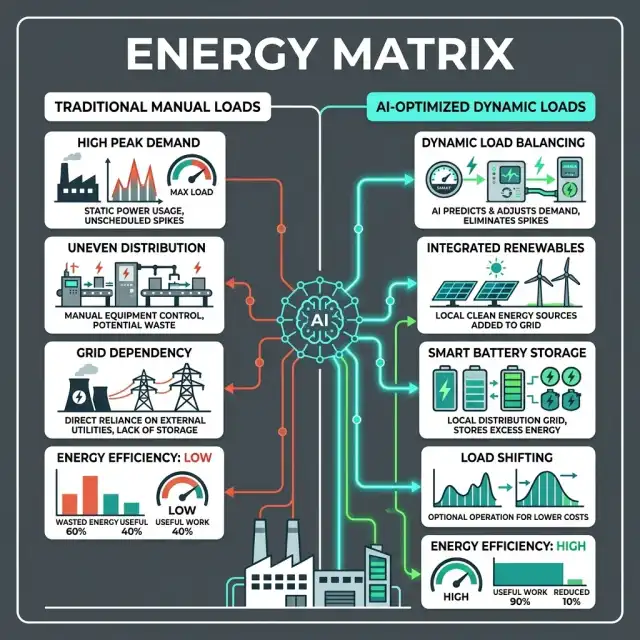
- Self-Optimizing Grids: Smart electrical grids track machine activity and dynamically distribute power, scaling down consumption during peak tariff hours and using battery reserves to balance the load.
In this model, human engineering is performed entirely upstream. A team of systems engineers, product designers, and AI specialists manage the factory configuration virtually, pushing updates to the local orchestrators via secure deployment containers. The physical factory executes these instructions autonomously, achieving maximum capital efficiency.
Comparative Analysis: Industry 4.0 vs Industry 5.0 (AI-Native)
To understand the core differences between connected and autonomous manufacturing systems, let's analyze how they compare across key operational domains:
| Operational Dimension | Industry 4.0 (Connected Model) | Industry 5.0 (Autonomous Model) | Industrial Impact & Value Value |
|---|---|---|---|
| Primary Focus Area | Machine connectivity and massive cloud data collection. | Human intent integration, edge intelligence, and autonomous action loops. | Moves systems from passive observation to active self-remediation. |
| Maintenance Strategy | Predictive alerts (send dashboard notifications to humans). | Closed-loop self-healing (agents diagnose and order parts automatically). | Reduces maintenance delays and prevents secondary equipment damage. |
| Supply Chain Integration | Manual procurement (CFO reviews alerts and orders parts). | Autonomous procurement (agents query supplier APIs and place orders). | Minimizes stockouts and coordinates parts deliveries with maintenance slots. |
| Energy Optimization | Static profiling (historical audits of power use). | Dynamic allocation (AI manages peak shaving and local battery storage). | Reduces monthly industrial electricity bills by up to 25%. |
| Factory Floor Operations | Human-heavy assembly lines with basic safety light-curtains. | Collaborative robot networks and fully autonomous lights-out cycles. | Decouples factory throughput from local labor supply shortages. |
The table illustrates that while Industry 4.0 provided the connectivity baseline, Industry 5.0 delivers the execution intelligence needed to run self-optimizing factories at scale.
Pitfalls & Industrial Anti-Patterns in AI-Native Factories
Deploying autonomous agent logic on physical machinery introduces real-world safety risks. Organizations must avoid several critical anti-patterns to ensure safe operations:
- Unbounded Agent Action limits: Allowing an agent to modify critical machine speed limits without hard PLC boundary locks can lead to mechanical over-stress or hardware failure. Safety boundaries must be hard-coded at the controller layer.
- Context Saturation in Telemetry: Feeding raw millisecond-level sensor logs into input contexts leads to high network costs and slow response times. Edge gateways must filter noise and only report summarized anomalies.
- Insecure Industrial Control Nets: Connecting local MCP gateways directly to the public internet risks exposure to remote prompt injection attacks, where malicious actors could manipulate factory states. Gateways must run inside local VLAN structures.
- Lack of Physical Human-in-the-Loop gates: For high-risk procedures (e.g. system restarts or calibration overrides), the orchestrator must require physical confirmation buttons on the factory floor.
By establishing strict safety policies, isolating edge runtimes, and enforcing physical validation gates, manufacturers can deploy autonomous agents safely without risking line outages.
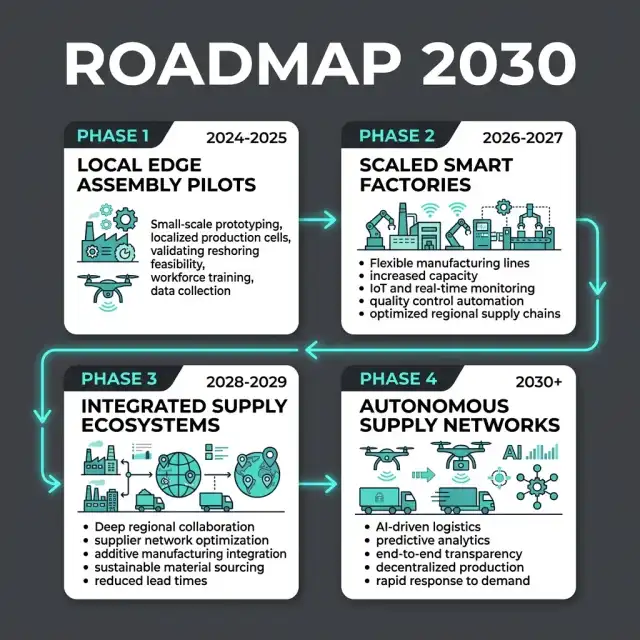
Futuristic Horizon: The 'Reshoring' Revolution 2026–2030
The convergence of autonomous robotics and edge-based intelligence is driving a massive reshoring revolution. Historically, companies moved manufacturing to low-wage countries to optimize costs. However, offshore production introduces long transit times, customs friction, and geopolitical risks.
By deploying autonomous factories, manufacturers change these economics:
- Labor Cost Neutralization: Because autonomous factories require minimal manual labor, local wage differentials are neutralized. The cost of running an automated line in Ohio is comparable to running one in East Asia.
- Proximity to Customers: By building factories close to consumer hubs, companies reduce shipping times from weeks to days, allowing them to adapt to demand shifts instantly.
- Customized Production: Industry 5.0 enables mass customization. A customer can order a product with custom configurations, and the local agent network automatically re-routes the assembly steps, producing a custom unit without stopping the line.
Between 2026 and 2030, we will see a rapid transition of manufacturing back to domestic markets, powered by networks of localized, autonomous, and self-healing micro-factories.
What to Do Monday Morning
To transition your manufacturing operations or industrial software toward an autonomous Industry 5.0 model, focus on these three action steps:
1. Audit Factory Floor Connectivity
Review your current machine interfaces. Ensure that your PLCs and sensors support standard industrial APIs (like OPC-UA or Modbus) so they can be wrapped in local software controllers.
2. Standardize on Edge Gateway Interfaces
Deploy local gateway appliances that parse high-frequency sensor streams, normalize the formats, and expose the values via clean, queryable MCP schemas.
3. Implement Sandbox Remediations
Before deploying agents to production lines, configure virtual digital twin environments where models can test optimization scripts safely without impacting physical machinery.
Frequently Asked Questions
How do edge gateways handle network outages? +
Can an AI agent update physical PLC code? +
How are industrial token costs capitalized on balance sheets? +
Will autonomous factories replace human operators entirely? +
How does the digital twin prevent simulation drift? +
About the Author
Vatsal Shah is a technology executive, system architect, and sovereign founder specializing in enterprise AI adoption, digital business transformation, and stateful agentic system integration. Over his career, he has guided global engineering organizations, scaled enterprise software platforms, and designed high-throughput distributed systems that align business operations with emerging technology trends.
Conclusion + CTA
The transition to Industry 5.0 is redrawing the map of global manufacturing. By combining real-time digital twins with edge-based execution loops, manufacturers decouple production capacity from labor constraints, achieving higher efficiency and reshoring capacity closer to customer markets.
Are you looking to design and scale an autonomous system architecture for your industrial operations? Get in touch today to schedule a technical session.
