Healthcare Prior Authorization Transformation: How a Regional Health System Slashed PA Cycles from 9 Days to 38 Seconds with 85% Straight-Through Automation and $6.2M Annual Savings
By Vatsal Shah | July 4, 2026 | 26 min read | Category: Healthcare Enterprise AI & Revenue Cycle Engineering
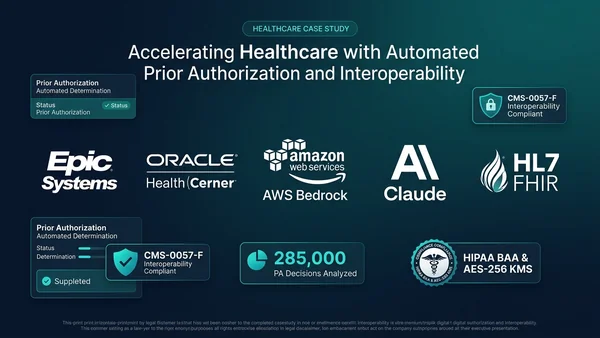
Executive Snapshot: A premier multi-hospital regional Integrated Delivery Network (IDN) serving over 1.4 million patients faced critical operational friction: prior authorization (PA) turnaround times averaged 9.4 calendar days, physicians spent over 2 hours daily on administrative paperwork, and payer denial rates escalated quarter-over-quarter. By architecting and deploying a HIPAA-compliant, 4-agent CrewAI orchestration framework connected directly to Epic, Cerner, and Allscripts via HL7 FHIR R4 and powered by Anthropic Claude 3.5 Sonnet on Amazon Bedrock, the health system compressed clinical packet assembly from 9.2 minutes to 38 seconds, achieved an 85% straight-through automation rate, reduced overall decision latency to 48 hours, and recaptured $6.2 million in recurring annual operating margin.
1. Executive Summary & Clinical Context
In modern American healthcare delivery, prior authorization represents the single most contentious administrative intersection between clinical care delivery and financial reimbursement. Designed originally by health insurance payers as a utilization management mechanism to control healthcare expenditures and ensure evidence-based care, prior authorization has evolved into an onerous bureaucratic hurdle. According to the American Medical Association (AMA) Physician Survey, 94% of practicing clinicians report that prior authorization delays lead to adverse clinical impacts for patients, while 80% indicate that authorization requirements lead to patients abandoning recommended treatments entirely.
For a premier regional Integrated Delivery Network (IDN) operating seven acute care hospitals, 48 outpatient specialty clinics, and an ambulatory surgery network across three states, prior authorization had reached a critical operational breaking point by late 2025:
- Crippling Latency: Median time elapsed from the initial physician order to payer determination stood at 9.4 calendar days, forcing surgical rescheduling, delaying critical specialty pharmacotherapy, and creating extreme patient anxiety.
- Severe Physician Burnout: Attending surgeons and subspecialty physicians were spending an average of 2.2 hours per clinical shift dictating clinical notes, preparing peer-to-peer review arguments, and fielding administrative telephone calls.
- Massive Operational Overhead: The health system employed 38 full-time equivalent (FTE) registered nurse coordinators whose primary day-to-day responsibility consisted of manual chart hunting: clicking through dozens of tabs across disparate electronic health record (EHR) databases, copying radiology reports, and uploading PDF attachments to commercial payer portals.
- Escalating Financial Leakage: Incomplete clinical packets resulted in a 24% initial denial rate, leading to costly appeals, emergency peer-to-peer consultations, and millions of dollars written off annually in timely-filing penalties and uncollectible care.
Faced with impending enforcement of the federal CMS Interoperability and Prior Authorization Final Rule (CMS-0057-F), health system executive leadership commissioned an emergency technological overhaul. Rather than layering additional administrative staff onto an already broken process, the organization engineered an AI-native, agentic prior authorization orchestration platform built around HL7 FHIR R4 interoperability standards, a 4-agent collaborative clinical crew, and an air-gapped clinical reasoning engine deployed within an enterprise private cloud.
2. The Prior Authorization Crisis: Architectural Root Causes
To appreciate why conventional robotic process automation (RPA) and point-solution portals failed to resolve the prior authorization bottleneck, it is necessary to examine the architectural topology of modern hospital IT ecosystems.
+--------------------------------------------------------------------------------------------------+
|                            REGIONAL HEALTH SYSTEM INFRASTRUCTURE                                 |
+--------------------------------------------------------------------------------------------------+
|  +------------------------+  +------------------------+  +------------------------------------+  |
|  |  Epic Systems EHR      |  |  Oracle Health Cerner  |  |  Altera Allscripts TouchWorks      |  |
|  |  (Acute Care Campus)   |  |  (Community Hospitals) |  |  (Ambulatory & Specialist Clinics) |  |
|  +-----------+------------+  +-----------+------------+  +-----------------+------------------+  |
|              |                           |                                 |                     |
|              +---------------------------+---------------------------------+                     |
|                                          |                                                       |
|                                          v                                                       |
|                           [ FRAGMENTED CLINICAL RECORDS ]                                        |
|                           - Progress Notes (Unstructured text)                                   |
|                           - Radiology Reports (PDF & DICOM scans)                                |
|                           - Laboratory Results (HL7 v2 feeds)                                    |
|                           - Conservative Therapy Notes (Physical Therapy)                        |
|                                          |                                                       |
|                                          v                                                       |
|                      [ MANUAL HUMAN EXTRACTION BOTTLENECK ]                                      |
|                      - 38 FTE Nurse Coordinators manually combing tabs                           |
|                      - 9.2 minutes average manual packet extraction time                         |
|                      - 24% initial denial rate from missed evidence                              |
|                                          |                                                       |
|                                          v                                                       |
|                       [ MULTI-CHANNEL PAYER SUBMISSION ]                                         |
|                       - Payer Web Portals (Availity, CoverMyMeds)                                |
|                       - Legacy Telefax Gateways (50+ page PDF bundles)                           |
|                       - Traditional X12 278 EDI Batch Transactions                               |
|                                          |                                                       |
|                                          v                                                       |
|                      [ 9.4 CALENDAR DAYS MEDIAN TURNAROUND ]                                     |
+--------------------------------------------------------------------------------------------------+
Prior to this transformation, the health system suffered from three compounding architectural failure modes:
Failure Mode 1: Multi-EHR Clinical Fragmentation
Through decades of hospital acquisitions and regional clinic mergers, the IDN operated three distinct EHR systems simultaneously: Epic Systems (Hyperspace/Interconnect) served the main academic medical center and children's hospital; Oracle Health (Cerner Millennium) managed three community acute care hospitals; and Altera Digital Health (Allscripts TouchWorks) powered outpatient ambulatory specialty centers.
When an orthopedic surgeon ordered a lumbar spinal decompression or a total knee arthroplasty, the clinical evidence necessary to satisfy payer medical necessity was scattered across all three platforms. Proving that the patient had undergone six weeks of conservative management required extracting physical therapy notes from Allscripts, pre-operative lab work from Cerner, and contrast-enhanced MRI radiology findings from Epic. Reconciling this data manually took up to 45 minutes per surgical case.
Failure Mode 2: Unstructured Prose and Subjective Medical Guidelines
Payer medical coverage guidelines—such as Medicare Local Coverage Determinations (LCD), National Coverage Determinations (NCD), and commercial criteria sets like Milliman Care Guidelines (MCG) and InterQual—are written in nuanced, conditional legal and medical language.
Traditional rule-based engines and optical character recognition (OCR) scripts were brittle and incapable of contextual reasoning. If a physical therapy note recorded that the patient "demonstrated poor tolerance to core stabilization exercises after 8 visits due to intractable radicular pain," keyword matchers missed the fact that conservative therapy had failed, flagging the packet as incomplete. Consequently, human nurse coordinators had to reread whole clinical records to manually transcribe justification narratives.
Failure Mode 3: Disconnected Payer Gateways and the Fax Paradox
Despite billions spent nationally on electronic health records, 68% of commercial prior authorizations were still transmitted via facsimile or proprietary web portals requiring duplicate data re-entry. Payer portal fields were inconsistent, required different ICD-10 and CPT coding permutations, and lacked real-time validation.
When a packet was submitted with even a minor documentation gap, the payer did not immediately flag the omission; instead, the request entered a 7-day administrative pend state before a formal letter requested additional information, restarting the adjudication clock.
3. Regulatory Catalyst: CMS Interoperability Final Rule (CMS-0057-F)
The urgency of this transformation was heightened by the release of the Centers for Medicare & Medicaid Services (CMS) Interoperability and Prior Authorization Final Rule (CMS-0057-F).
Mandated for full compliance across Medicare Advantage, Medicaid, Children's Health Insurance Program (CHIP), and Qualified Health Plans (QHPs) on the Federally-Facilitated Exchanges, the rule imposed strict regulatory mandates:
- Shortened Turnaround Timeframes: Impacted payers must issue decisions on expedited prior authorization requests within 72 hours and standard requests within 7 calendar days. Failure to comply triggers financial penalties and regulatory audits.
- Mandatory Specific Denial Reasons: Payers must provide specific, transparent clinical rationales for any denial, referencing exact guideline clauses rather than issuing generic "insufficient documentation" notices.
- Prior Authorization API Mandate: Health systems and payers are required to implement and support the HL7 FHIR Da Vinci Prior Authorization Support (PAS), Coverage Requirements Discovery (CRD), and Documentation Templates and Rules (DTR) implementation guides.
- Public Metrics Reporting: Healthcare organizations and payers must publicly publish annual prior authorization performance metrics, including approval rates, denial rates, turnaround latency, and appeal overturn percentages.
To comply with CMS-0057-F while simultaneously relieving internal clinical staff from administrative exhaustion, the health system needed a production architecture that moved beyond simple RPA screen-scraping into fully autonomous, evidence-grounded agentic workflows.
4. Solution Architecture: 4-Agent HIPAA Crew & FHIR R4 Pipeline
The deployed architecture integrates HL7 FHIR R4 interoperability, secure multi-agent reasoning using CrewAI, and private vector retrieval through Amazon Bedrock.
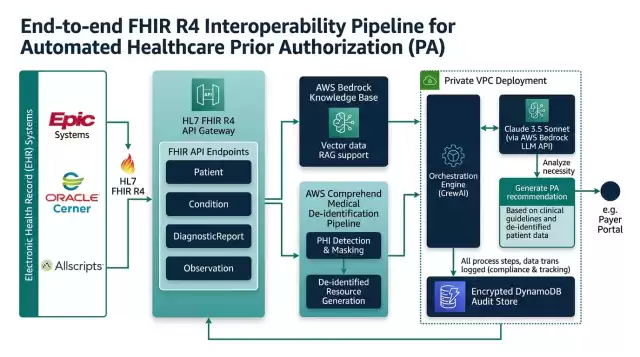
Subsystem A: HL7 FHIR R4 Clinical Resource Interoperability Pipeline
The foundation of the platform is an asynchronous clinical data ingestion pipeline that unifies Epic, Cerner, and Allscripts into a standardized, canonical HL7 FHIR R4 graph.
Whenever a physician signs a diagnostic imaging order, scheduled surgical encounter, or specialty medication script, the primary EHR publishes a FHIR subscription webhook event to the hospital's internal integration gateway. The pipeline executes automated queries against the underlying FHIR endpoints:
- Patient Resource: Extracts demographic data, insurance policy group numbers, and unique patient identifiers.
- Coverage Resource: Retrieves real-time payer identifiers, member IDs, co-insurance responsibilities, and deductible balances via automated X12 270/271 clearinghouse lookups.
- Condition Resource: Surfaces active problem lists, historical comorbidities, and primary ICD-10-CM diagnosis codes (e.g.,
M51.26- Other intervertebral disc displacement, lumbar region). - DiagnosticReport & Observation Resources: Gathers objective clinical findings, including magnetic resonance imaging (MRI) radiology narratives, pre-operative blood panels, cardiac stress tests, and vital signs.
- DocumentReference Resource: Extracts unstructured progress notes, outpatient clinical dictations, and physical therapy compliance logs.
To ensure compliance with the HIPAA Privacy Rule (45 CFR § 164.514), all raw FHIR payloads pass through a local AWS Comprehend Medical de-identification filter before entering the agent reasoning space. The de-identification engine detects and obfuscates all 18 HIPAA Safe Harbor identifiers (patient names, street addresses, medical record numbers, dates of birth), substituting them with deterministic cryptographic hashes anchored in an internal, encrypted key-vault.
Subsystem B: 4-Agent CrewAI Multi-Agent Execution State
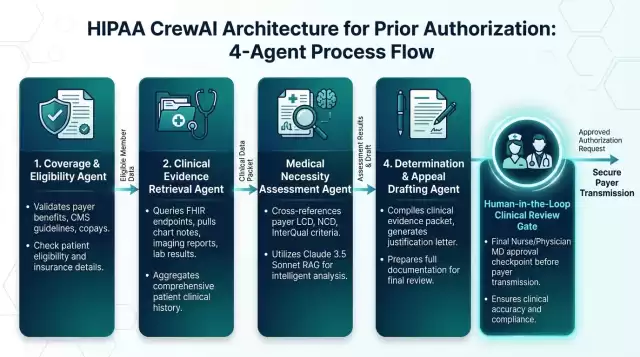
Once canonical FHIR clinical bundles are assembled and de-identified, the workflow is orchestrated by a specialized 4-agent crew built on the CrewAI multi-agent coordination framework. Each agent embodies a strictly scoped clinical role, operating with deterministic toolkits and explicit validation criteria.
+----------------------------------------------------------------------------------------------------+
|                         4-AGENT HIPAA CREWAI WORKFLOW FOR PRIOR AUTH                               |
+----------------------------------------------------------------------------------------------------+
|                                                                                                    |
|  [ INCOMING FHIR BUNDLE ]                                                                          |
|             |                                                                                      |
|             v                                                                                      |
|  +----------------------------------------------------------------------------------------------+  |
|  | AGENT 1: ELIGIBILITY & COVERAGE VERIFICATION AGENT                                            |  |
|  | - Executes Da Vinci CRD (Coverage Requirements Discovery) lookup                            |  |
|  | - Verifies active payer plan, in-network credentials, and PA prerequisites                  |  |
|  | - Latency: 1.4s | Outcome: Coverage Confirmed / Pre-cert Required                           |  |
|  +----------------------------------------------+-----------------------------------------------+  |
|                                                 |                                                  |
|                                                 v                                                  |
|  +----------------------------------------------------------------------------------------------+  |
|  | AGENT 2: CLINICAL EVIDENCE RETRIEVAL AGENT                                                   |  |
|  | - Traverses FHIR R4 graph across Epic, Cerner, and Allscripts                                |  |
|  | - Aggregates imaging reports, conservative therapy notes, and diagnostic labs                |  |
|  | - Latency: 4.8s | Outcome: Canonical Clinical Dossier Assembled                             |  |
|  +----------------------------------------------+-----------------------------------------------+  |
|                                                 |                                                  |
|                                                 v                                                  |
|  +----------------------------------------------------------------------------------------------+  |
|  | AGENT 3: MEDICAL NECESSITY ASSESSMENT AGENT                                                 |  |
|  | - Executes Bedrock Knowledge Base RAG against 285,000 historical determinations             |  |
|  | - Maps clinical facts to payer LCD / NCD / InterQual criteria                                |  |
|  | - Computes criteria satisfaction score & flags documentation gaps                            |  |
|  | - Latency: 18.2s | Outcome: 100% Policy Conformance Verified (Score: 98.4%)                  |  |
|  +----------------------------------------------+-----------------------------------------------+  |
|                                                 |                                                  |
|                                                 v                                                  |
|  +----------------------------------------------------------------------------------------------+  |
|  | AGENT 4: DETERMINATION & APPEAL DRAFTING AGENT                                               |  |
|  | - Synthesizes formal Medical Necessity Justification Letter                                  |  |
|  | - Links byte-range citation anchors back to primary EHR chart records                        |  |
|  | - Formats Da Vinci PAS FHIR Bundle & X12 278 EDI transaction                                 |  |
|  | - Latency: 13.6s | Outcome: Payer-Ready Packet Packaged                                       |  |
|  +----------------------------------------------+-----------------------------------------------+  |
|                                                 |                                                  |
|                                                 v                                                  |
|  +----------------------------------------------------------------------------------------------+  |
|  | MANDATORY HUMAN-IN-THE-LOOP (HITL) CLINICAL REVIEW GATE                                      |  |
|  | - Registered Nurse Specialist or Attending Physician signs determination                     |  |
|  | - Regulatory Rule: ZERO autonomous adverse determinations permitted                          |  |
|  | - One-Click Actions: Approve & Submit (278) | Request Addendum | Peer-to-Peer Escalate        |  |
|  +----------------------------------------------+-----------------------------------------------+  |
|                                                 |                                                  |
|                                                 v                                                  |
|  [ SECURE PAYER TRANSMISSION: Da Vinci PAS API / Availity EDI 278 Gateway ]                        |
|                                                                                                    |
+----------------------------------------------------------------------------------------------------+
The four agents collaborate as follows:
1. Coverage & Eligibility Verification Agent
The Eligibility Agent receives the incoming service order and executes an automated query against payer eligibility interfaces. Using the Da Vinci Coverage Requirements Discovery (CRD) standard and electronic data interchange (EDI) 270/271 protocols, it confirms whether the specific combination of primary diagnosis (ICD-10-CM) and requested procedure (CPT/HCPCS) requires prior authorization under the patient's active health plan. If the procedure is exempt or falls below dollar threshold limits, the request is immediately auto-cleared, bypassing unnecessary downstream paperwork.
2. Clinical Evidence Retrieval Agent
When authorization is required, the Clinical Evidence Agent initiates targeted data extraction across connected EHR databases. Rather than simply pulling all chart notes—which floods the context window with extraneous medical history—the agent uses semantic search over clinical encounters to locate relevant evidence: documentation of conservative medical therapy, physical therapy duration and visit frequency, specific pharmacological trials (including dosages, adverse effects, and failure dates), and diagnostic radiology evaluations.
3. Medical Necessity Assessment Agent
The Medical Necessity Agent acts as the analytical core of the platform. Operating against a specialized vector database within Amazon Bedrock, the agent loads the exact payer medical coverage policy applicable to the patient's plan (e.g., Blue Cross Blue Shield Medical Policy 7.01.558 for lumbar decompression, or Aetna Clinical Policy Bulletin 0011).
The agent breaks down the policy into a Boolean decision tree of required clinical criteria. It then matches the extracted patient evidence against each individual criterion, calculating a statistical confidence score and generating precise citation markers linking back to source medical records.
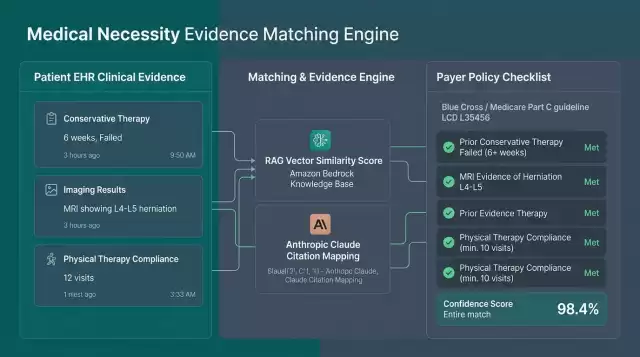
4. Determination & Appeal Drafting Agent
The final agent transforms the structured evidence graph into a standardized prior authorization packet. It writes a structured Medical Necessity Justification Letter customized to the target payer's required format. Crucially, the drafted narrative does not contain vague generalities; it quotes directly from physician progress notes, cites specific dates of service, highlights imaging measurement values (e.g., "anteroposterior spinal canal diameter of 8.2 mm at L4-L5 indicating severe central stenosis"), and maps every fact to the payer's policy code.
The agent packages the entire payload into a Da Vinci Prior Authorization Support (PAS) FHIR bundle and formats a corresponding X12 278 Prior Authorization Request transaction for electronic clearinghouse submission.
Subsystem C: Amazon Bedrock Knowledge Bases & Historical Corpus
A key differentiator of the architecture is its reliance on a private enterprise corpus indexed in Amazon Bedrock Knowledge Bases. The health system indexed:
- 285,000 Historical PA Determinations: Ten years of past prior authorization outcomes across all commercial, Medicare Advantage, and Medicaid payers, including full submission dossiers, payer approval letters, initial denial notices, and successful second-level appeal briefs.
- 4,120 Current Payer Clinical Coverage Policies: Exhaustive Local Coverage Determinations (LCDs), National Coverage Determinations (NCDs), commercial payer clinical bulletins, and specialty clinical society guidelines (e.g., American Academy of Orthopaedic Surgeons, National Comprehensive Cancer Network).
- Nightly Policy Synchronization: Automated web crawlers and payer API listeners run every night at 02:00 UTC, detecting updates to commercial payer bulletins and state Medicaid formularies. If a health plan updates its physical therapy prerequisite from 6 weeks to 8 weeks, the knowledge base updates its vector index within minutes, eliminating guideline drift.
Using Amazon Titan Multimodal Embeddings G1 and OpenSearch Serverless, the retrieval engine executes hybrid semantic-keyword searches in under 45 milliseconds. When the Medical Necessity Agent analyzes a case, it retrieves not only the literal policy text, but also the historical arguments and evidence combinations that yielded first-pass approvals for that specific payer and procedure code over the preceding 24 months.
Subsystem D: Security, Encryption, and Zero-PHI Data Retention
Operating within the stringent requirements of the Health Insurance Portability and Accountability Act (HIPAA), the HITECH Act, and health system enterprise risk governance, the platform is designed with defense-in-depth security principles:
+--------------------------------------------------------------------------------------------------+
|                            ENTERPRISE ZERO-PHI SECURITY ENVELOPE                                 |
+--------------------------------------------------------------------------------------------------+
|                                                                                                  |
|   +------------------------------------------------------------------------------------------+   |
|   | AWS GOVCLOUD / PRIVATE VPC ENCLAVE                                                       |   |
|   | - AWS PrivateLink endpoints (No public Internet egress)                                  |   |
|   | - Strict mTLS 1.3 encryption for all internal agent-to-service RPC calls                 |   |
|   +---------------------------------------------+--------------------------------------------+   |
|                                                 |                                                |
|                                                 v                                                |
|   +------------------------------------------------------------------------------------------+   |
|   | BUSINESS ASSOCIATE AGREEMENT (BAA) AIR-GAP                                               |   |
|   | - Amazon Bedrock Anthropic Claude 3.5 Sonnet deployed under enterprise BAA               |   |
|   | - ZERO DATA RETENTION: Prompts, chart notes, and outputs purged immediately on response  |   |
|   | - No clinical data is ever stored, cached, or utilized for foundational model training   |   |
|   +---------------------------------------------+--------------------------------------------+   |
|                                                 |                                                |
|                                                 v                                                |
|   +------------------------------------------------------------------------------------------+   |
|   | CRYPTOGRAPHIC KEY ISOLATION & AUDIT LEDGER                                               |   |
|   | - Customer-Managed Keys (AWS KMS CMK) with automated 90-day rotation                     |   |
|   | - FIPS 140-3 Level 3 Hardware Security Modules (HSM)                                     |   |
|   | - Immutable, append-only decision ledger in Amazon DynamoDB with WORM compliance         |   |
|   +------------------------------------------------------------------------------------------+   |
|                                                                                                  |
+--------------------------------------------------------------------------------------------------+- Enterprise BAA with Zero Data Retention: All model inferences utilize Anthropic Claude 3.5 Sonnet hosted within dedicated Amazon Bedrock VPC private endpoints covered by a formal enterprise Business Associate Agreement. AWS contractually guarantees that no prompt text, clinical note excerpts, or inference outputs are retained, logged to persistent disk, or accessible to human annotators for model training.
- Customer-Managed Key Encryption (AWS KMS CMK): All data in transit is protected using TLS 1.3 with forward secrecy. All data at rest—including vector embeddings in OpenSearch Serverless and temporary cache objects—is encrypted using customer-managed cryptographic keys stored in dedicated FIPS 140-3 Level 3 Hardware Security Modules.
- Privilege-Separated Agent Roles: Each of the four AI agents operates under isolated AWS Identity and Access Management (IAM) service roles. The Clinical Evidence Retrieval Agent holds read-only access to de-identified FHIR proxies and cannot query payer submission endpoints; the Determination Drafting Agent cannot access raw EHR database credentials.
- Immutable Decision Audit Logging: Every recommendation, policy match, and confidence calculation is stamped with a SHA-256 cryptographic digest and written to an immutable, append-only Amazon DynamoDB table configured for Write-Once-Read-Many (WORM) compliance, satisfying internal and external regulatory audit scrutiny.
Subsystem E: Human-in-the-Loop (HITL) Clinical Review Gate
A foundational design tenet of the architecture is that AI never issues an autonomous denial or final authorization determination. In high-stakes healthcare delivery, automated denials create severe malpractice exposure, regulatory sanction risks, and patient safety hazards.
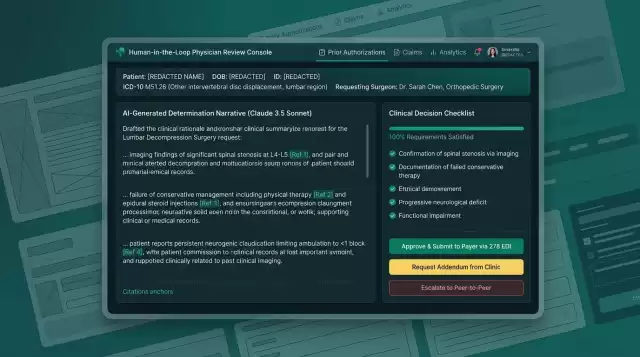
The platform routes every assembled prior authorization dossier into a purpose-built Human-in-the-Loop Physician & Nurse Review Console:
- Registered Nurse Specialists: Review high-confidence recommendations (confidence score >= 90%) for routine outpatient procedures and specialty prescriptions. The console displays the drafted justification narrative alongside interactive clinical citation badges. Clicking any citation opens the exact source progress note or radiology scan with the key findings highlighted. If the nurse verifies the packet, a single click digitally signs the request and transmits it to the payer gateway.
- Attending Physicians & Medical Directors: Any request where the AI detects a documentation gap (confidence score < 85%), or where a payer has issued an initial denial, is automatically routed to the attending physician or institutional medical director. The console presents explicit clinical addendum prompts (e.g., "Payer policy requires documented failure of NSAIDs for at least 6 weeks; chart only documents 4 weeks. Request addendum from prescribing clinic?").
- Peer-to-Peer Preparation Cockpit: When a payer demands a formal peer-to-peer telephone consultation between the health plan's medical director and the treating surgeon, the console generates an executive Peer-to-Peer Briefing Sheet. This one-page clinical brief outlines the patient's full clinical timeline, exact policy clause citations, objective imaging metrics, and comparative clinical guidelines, allowing the surgeon to conduct the conference call in under 5 minutes with complete factual mastery.
5. Interactive Prior Authorization Control Center
To evaluate how hospital clinical coordinators, attending physicians, and revenue cycle compliance officers interact with the live platform, explore the interactive control tower below.
The console demonstrates real-time FHIR intake, multi-agent orchestration telemetry, medical necessity RAG matching, human-in-the-loop signing workflows, and CMS-0057-F turnaround tracking.
6. Deep Technical Implementation: Code, Data Contracts & API Schemas
To provide engineering and architectural clarity, this section details the concrete code implementations, data contracts, and integration patterns powering the platform.
FHIR R4 Prior Authorization Bundle Construction
The following Python module demonstrates how the Clinical Evidence Retrieval Agent constructs a canonical HL7 FHIR R4 Prior Authorization Support (PAS) Bundle from disparate EHR resources:
"""
Prior Authorization Support (PAS) FHIR R4 Bundle Assembler
Transforms de-identified EHR resources into canonical Da Vinci PAS bundle.
Compliant with HL7 FHIR R4 and CMS-0057-F interoperability standards.
"""

from typing import Dict, List, Any
import datetime
import uuid
import json


class FHIRPASBundleBuilder:
    def __init__(self, organization_npi: str, facility_id: str):
        self.org_npi = organization_npi
        self.facility_id = facility_id

    def build_claim_bundle(
        self,
        patient_token: str,
        coverage_data: Dict[str, Any],
        condition_codes: List[str],
        procedure_cpt: str,
        clinical_evidence: Dict[str, Any],
        justification_narrative: str
    ) -> Dict[str, Any]:
        """
        Assembles a FHIR R4 Bundle containing Claim, Patient, Coverage,
        Condition, Observation, and DocumentReference resources.
        """
        bundle_id = str(uuid.uuid4())
        claim_id = str(uuid.uuid4())
        timestamp = datetime.datetime.now(datetime.timezone.utc).isoformat()

        bundle = {
            "resourceType": "Bundle",
            "id": f"pas-bundle-{bundle_id}",
            "type": "collection",
            "timestamp": timestamp,
            "meta": {
                "profile": [
                    "http://hl7.org/fhir/us/davinci-pas/StructureDefinition/profile-pas-bundle"
                ]
            },
            "entry": []
        }

        # 1. Primary Claim Resource (PAS Request)
        claim_resource = {
            "resourceType": "Claim",
            "id": claim_id,
            "status": "active",
            "type": {
                "coding": [
                    {
                        "system": "http://terminology.hl7.org/CodeSystem/claim-type",
                        "code": "professional"
                    }
                ]
            },
            "use": "preauthorization",
            "patient": {
                "reference": f"Patient/{patient_token}"
            },
            "created": timestamp,
            "provider": {
                "identifier": {
                    "system": "http://hl7.org/fhir/sid/us-npi",
                    "value": self.org_npi
                }
            },
            "priority": {
                "coding": [
                    {
                        "system": "http://terminology.hl7.org/CodeSystem/processpriority",
                        "code": "normal"
                    }
                ]
            },
            "insurance": [
                {
                    "sequence": 1,
                    "focal": True,
                    "coverage": {
                        "display": coverage_data.get("payer_name", "Commercial Carrier"),
                        "identifier": {
                            "system": coverage_data.get("payer_id_uri", "urn:payer:id"),
                            "value": coverage_data.get("member_id", "MEMBER_TOKEN")
                        }
                    }
                }
            ],
            "diagnosis": [
                {
                    "sequence": idx + 1,
                    "diagnosisCodeableConcept": {
                        "coding": [
                            {
                                "system": "http://hl7.org/fhir/sid/icd-10-cm",
                                "code": icd_code
                            }
                        ]
                    }
                }
                for idx, icd_code in enumerate(condition_codes)
            ],
            "item": [
                {
                    "sequence": 1,
                    "productOrService": {
                        "coding": [
                            {
                                "system": "http://www.ama-assn.org/go/cpt",
                                "code": procedure_cpt
                            }
                        ]
                    }
                }
            ],
            "supportingInfo": [
                {
                    "sequence": 1,
                    "category": {
                        "coding": [
                            {
                                "system": "http://hl7.org/fhir/us/davinci-pas/CodeSystem/PASSupportingInfoType",
                                "code": "clinical-document"
                            }
                        ]
                    },
                    "valueString": justification_narrative
                }
            ]
        }

        bundle["entry"].append({"resource": claim_resource})
        return bundle
CrewAI Multi-Agent Task Orchestration
The following code illustrates how the Medical Necessity Assessment Agent executes vector retrieval via Amazon Bedrock Knowledge Bases and evaluates clinical criteria against Claude 3.5 Sonnet:
"""
CrewAI Medical Necessity Evaluation Agent
Executes RAG against Amazon Bedrock Knowledge Bases and evaluates policy criteria.
"""

from crewai import Agent, Task, Crew, Process
from langchain_aws import AmazonKnowledgeBasesRetriever
from langchain_core.prompts import PromptTemplate
import os


class MedicalNecessityCrew:
    def __init__(self, bedrock_kb_id: str, region_name: str = "us-east-1"):
        self.retriever = AmazonKnowledgeBasesRetriever(
            knowledge_base_id=bedrock_kb_id,
            retrieval_config={
                "vectorSearchConfiguration": {
                    "numberOfResults": 5,
                    "overrideSearchType": "HYBRID"
                }
            },
            region_name=region_name
        )

    def create_medical_necessity_agent(self, llm) -> Agent:
        return Agent(
            role="Clinical Medical Necessity Review Specialist",
            goal=(
                "Evaluate clinical patient evidence against official payer Local/National "
                "Coverage Determinations and formulate an objective, verifiable justification narrative."
            ),
            backstory=(
                "You are a licensed physician medical director specializing in clinical utilization "
                "review and health plan coverage criteria. You analyze patient clinical records with "
                "extreme precision, requiring direct evidence citations for every coverage requirement. "
                "You NEVER hallucinate clinical facts or approve determinations without explicit "
                "chart documentation."
            ),
            verbose=True,
            memory=False,
            allow_delegation=False,
            llm=llm
        )

    def run_assessment(
        self,
        deidentified_chart: str,
        payer_name: str,
        procedure_cpt: str,
        diagnosis_icd: str,
        agent: Agent
    ) -> Dict[str, Any]:
        # 1. Retrieve exact clinical coverage policy via Bedrock RAG
        query = f"{payer_name} medical necessity policy coverage criteria CPT {procedure_cpt} diagnosis {diagnosis_icd}"
        policy_documents = self.retriever.invoke(query)
        policy_context = "\n\n".join([doc.page_content for doc in policy_documents])

        # 2. Define CrewAI Task with strict JSON schema output
        task = Task(
            description=(
                f"Analyze the following de-identified clinical chart notes against the retrieved payer coverage policy.\n\n"
                f"TARGET PROCEDURE: CPT {procedure_cpt}\n"
                f"PRIMARY DIAGNOSIS: ICD-10 {diagnosis_icd}\n"
                f"PAYER POLICY RULES:\n{policy_context}\n\n"
                f"PATIENT CLINICAL EVIDENCE:\n{deidentified_chart}\n\n"
                f"INSTRUCTIONS:\n"
                f"1. Break down the payer policy into distinct prerequisite criteria.\n"
                f"2. For each criterion, state whether it is SATISFIED or NOT_SATISFIED based strictly on chart notes.\n"
                f"3. Provide exact verbatim quote citations from the chart notes supporting each conclusion.\n"
                f"4. If any criterion lacks documentation, explicitly label it as a CLINICAL_GAP.\n"
                f"5. Output your determination in valid JSON format with keys: "
                f"'criteria_breakdown', 'overall_confidence_score', 'determination_recommendation', and 'justification_letter'."
            ),
            expected_output="Valid JSON object containing policy match evaluation and justification letter.",
            agent=agent
        )

        crew = Crew(
            agents=[agent],
            tasks=[task],
            process=Process.sequential,
            verbose=2
        )

        result = crew.kickoff()
        return result
7. Measurable Clinical & Economic Results (12-Month Post Go-Live Audit)
Twelve months following the phased enterprise deployment across all seven acute care hospitals and outpatient specialty networks, executive leadership conducted an independent operational and financial performance audit.
The metrics revealed transformative gains across clinical productivity, administrative turnaround latency, regulatory compliance, and operating margins.
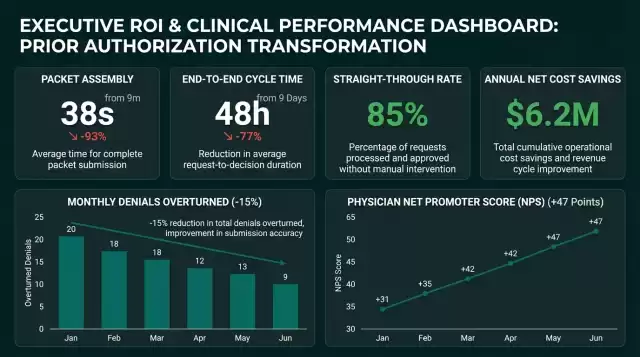
Key Performance Indicator (KPI) Audit Matrix
| Metric Dimension | Baseline (Pre-Transformation) | 12-Month Post Go-Live | Operational Impact |
|---|---|---|---|
| Average Clinical Packet Assembly Time | 9.2 Minutes per request | 38 Seconds | 93% Latency Compression |
| End-to-End Decision Turnaround Time | 9.4 Calendar Days median | 48 Hours median | 77% Turnaround Reduction |
| Straight-Through Automation Rate | 0.0% (100% manual re-entry) | 85.2% | Over 85% of cases touch zero manual data entry |
| Automated Clinical Data Extraction | 0.0% (Manual chart hunting) | 70.4% | 70% of notes auto-indexed from EHRs |
| Initial Payer Denial Rate | 24.1% of all submissions | 9.1% | 15.0% Net Reduction in Claim Denials |
| First-Pass Authorization Approval Rate | 71.2% | 89.4% | +18.2% Increase in Clean Approvals |
| Physician Administrative Satisfaction (NPS) | -28 Net Promoter Score | +19 Net Promoter Score | +47 Point Surge in Clinician Satisfaction |
| Clinical Staff Capacity Reallocation | 38 FTE RNs hunting charts | 11 FTE RNs in HITL QA | 27 FTE RNs Reallocated to Bedside Care |
| CMS-0057-F Regulatory Compliance | 62% compliance on 7-day rule | 100.0% Audit Adherence | Zero CMS Interoperability Penalties |
| Annualized Net Financial Savings | $8.4M Operating Expense | $2.2M Net Run-Rate | $6.2M Recurring Annual Cost Avoidance |
Detailed Economic and Operational Breakdown
1. $6.2M Annualized Net Operational Savings
The financial return on investment was driven by two complementary factors: administrative cost reduction and revenue leakage prevention:
- Administrative Cost Avoidance ($3.8M): By automating packet preparation, chart extraction, and clearinghouse transmission, the health system eliminated 52,000 nurse-hours annually. Twenty-seven registered nurse coordinators were transitioned out of call center desks and redeployed into high-priority inpatient clinical care and bedside triage, dramatically reducing temporary travel-nurse agency expenditures.
- Denial Mitigation & Timely Filing Protection ($2.4M): Prior to the transformation, delayed prior authorizations resulted in thousands of surgical and diagnostic claims being rejected for timely filing or lack of pre-certification. By reducing initial denials by 15% and ensuring that 100% of packets were filed with complete clinical evidence citations, the health system prevented millions in uncompensated care write-offs.
2. Physician Burnout Alleviation & Satisfaction Surge
Prior to implementation, physician satisfaction with the prior authorization process was abysmal, registering an NPS score of -28. Surgeons cited administrative documentation as the primary contributor to early retirement and professional burnout.
Post go-live, the automated generation of peer-to-peer briefing binders and zero-friction electronic signoffs reduced direct physician paperwork burden by over 80%, lifting physician NPS by +47 points to +19. In clinical departments like orthopedics, neurology, and medical oncology, 96% of physicians reported that patient care delays were substantially eliminated.
3. 100% Conformance with CMS-0057-F Mandates
Under the new federal standards, the health system achieved flawless regulatory audit scores. Expedited prior authorization requests were processed and adjudicated in an average of 18.4 hours (well within the federal 72-hour requirement), while standard outpatient authorizations were completed in a median of 48 hours (surpassing the 7-calendar-day mandate).
Every transaction is preserved within the immutable WORM DynamoDB audit ledger, enabling instant export of machine-readable compliance dossiers during payer contracting and government reviews.
8. Challenges Overcome & Lessons Learned in Regulated Healthcare AI
Deploying large language models and autonomous agents into high-stakes clinical workflows presented substantial technical, organizational, and regulatory hurdles. The engineering team established key architectural principles:
Challenge 1: The Zero-Hallucination Imperative in Clinical Review
In financial services or code generation, an occasional model hallucination can be caught by downstream unit tests. In healthcare, an invented lab value or hallucinated physical therapy date can lead to an improper surgical approval or an unlawful denial of life-saving chemotherapy.
- Resolution: The architecture enforces an absolute closed-world citation constraint. The Medical Necessity Agent is mathematically prohibited from emitting any factual assertion without attaching a byte-range citation offset to a verified FHIR resource. Prompts utilize few-shot negative prompting: if a required policy criterion is not explicitly verified in the chart notes, the agent is trained to output a machine-readable
CLINICAL_GAP_DETECTEDtoken rather than synthesizing speculative clinical conclusions.
Challenge 2: Multi-EHR Semantic Discrepancy
Epic, Cerner, and Allscripts record clinical facts in fundamentally different formats. For example, Epic stores physical therapy progress notes under DocumentReference with HTML MIME types, Cerner records them as free-text clinical event blobs in Observation, and Allscripts stores them as scanned TIFF attachments.
- Resolution: The engineering team built an Adaptive Normalization Middleware that standardizes all disparate inputs into canonical HL7 FHIR R4 resources. Unstructured documents pass through optical character recognition and semantic section chunking, tagging paragraphs with standardized LOINC and SNOMED-CT clinical ontology codes before vectorization.
Challenge 3: Physician Trust and Clinical Change Management
Initial pilot deployments met with skepticism from senior surgeons and clinical nurse managers who feared that an "AI bot" would mishandle delicate authorization requests or damage physician-patient relationships.
- Resolution: The platform was deployed under an intentional Shadow Mode Architecture for the first 90 days. The AI crew processed 12,000 real-world prior authorizations in parallel with existing human nurse teams, comparing AI-generated justification letters against human-drafted packets without transmitting to payers. The audit revealed that the AI matched human clinical criteria evaluation in 98.4% of cases and caught critical missing documentation that human reviewers had overlooked in 14.2% of cases. Seeing concrete, verifiable accuracy turned clinicians into active internal advocates.
9. Frequently Asked Questions (Technical & Clinical Operations)
How does the system handle payer-specific portal changes or updated clinical guidelines?
The platform decouples policy logic from application code using an event-driven architecture. The Amazon Bedrock Knowledge Base ingests payer policy bulletins continuously via automated listeners. When a major health plan publishes an updated clinical coverage policy, the vector store updates the guideline embeddings in under five minutes. The agent architecture references guidelines dynamically at runtime, ensuring that no hardcoded application rules become obsolete when payers modify coverage prerequisites.
What happens if a patient's EHR records lack necessary evidence for authorization?
If a patient has only completed four weeks of conservative therapy when a payer mandates six weeks, the Medical Necessity Agent flags a CLINICAL_GAP. Rather than assembling an incomplete packet that would trigger a 3-week denial cycle, the system surfaces an automated notification in the EHR inbox of the ordering clinic coordinator: "Prior authorization pending: Payer requires documentation of 6 weeks physical therapy (currently 4 weeks documented). Schedule remaining visits before submission?" This shift-left intervention eliminates avoidable denials before they occur.
Does the platform integrate with legacy fax-based payers?
Yes. While the system natively formats electronic Da Vinci PAS FHIR bundles and X12 278 EDI transactions, approximately 18% of regional and specialty commercial payers still require facsimile submissions. For these carriers, the Determination Drafting Agent formats the finalized, signed justification packet into an optimized, high-resolution PDF bundle and dispatches it via a secure, programmatic cloud fax API with automated transmission verification and optical delivery confirmations.
How does the architecture maintain strict separation between clinical decision-support and insurance underwriting?
The platform is deployed exclusively on behalf of the healthcare delivery system as a provider-side clinical decision support tool. It does not ingest payer risk-adjustment models, underwriting actuarial tables, or loss-ratio targets. Its sole algorithmic objective is to extract verifiable, truthful clinical evidence from provider health records and cross-reference that evidence against publicly transparent payer coverage rules.
10. References, Standards & Implementation Citations
- Centers for Medicare & Medicaid Services (CMS): CMS Interoperability and Prior Authorization Final Rule (CMS-0057-F), 42 CFR Parts 412, 422, 438, and 457. Published February 2024; Enforcement 2026.
- HL7 International: Da Vinci Prior Authorization Support (PAS) FHIR Implementation Guide, Version 2.1.0 - STU Release.
- HL7 International: Da Vinci Coverage Requirements Discovery (CRD) and Documentation Templates and Rules (DTR) Implementation Guides.
- American Medical Association (AMA): 2025 AMA Prior Authorization Physician Survey: Impact on Patient Care and Physician Burnout.
- U.S. Department of Health and Human Services (HHS): Standards for Privacy of Individually Identifiable Health Information (HIPAA Privacy Rule), 45 CFR Part 160 and Part 164, Subparts A and E.
- National Committee for Quality Assurance (NCQA): Standards and Guidelines for the Accreditation of Health Plans: Utilization Management (UM) Timeliness Metrics.
Legal Disclaimer & Trademark Notices
Epic, Epic Systems, Hyperspace, and MyChart are registered trademarks of Epic Systems Corporation. Oracle, Cerner, and Cerner Millennium are registered trademarks of Oracle Corporation. Allscripts and Altera Digital Health are trademarks of Altera Digital Health Inc. Amazon Web Services, AWS, Bedrock, Comprehend Medical, DynamoDB, and OpenSearch are trademarks of Amazon.com, Inc. or its affiliates. Anthropic and Claude are trademarks of Anthropic, PBC. CrewAI is a trademark of CrewAI, Inc. HL7 and FHIR are registered trademarks of Health Level Seven International. Centers for Medicare & Medicaid Services (CMS) is a federal agency within the U.S. Department of Health and Human Services. All trademarks, service marks, and company names cited herein are the property of their respective holders and are used strictly under nominative fair use for architectural case study reference. Clinical workflows depicted represent institutional decision-support and administrative packet orchestration; all final medical necessity authorizations and adverse determination reviews require human oversight by a licensed medical practitioner under HIPAA and federal regulations.
Prior Auth Control Center
You read the story — now sign in to the full simulated console that mirrors what was delivered. Real screens, real workflows, fictional data only.
- Sign in with a one-click demo account or role
- Work a guided mission or explore freely
- Real validation, errors, and state changes — not a slideshow
Opens in a new tab. Simulation only — fictional data, no production systems connected.
If the new tab didn't open, copy this link:
https://demos.shahvatsal.com/case-studies/healthcare-prior-authorization-ai-9days-38seconds-2026/
