AI SUMMARY
- Headline
- 88% of Enterprises Report AI Agent Security Incidents: Execution Layer Is the Gap
- Global impact
- India lens
- Assess DPDP, RBI, and GCC delivery exposure — India-scale teams often feel vendor shifts 2–4 weeks before US HQ.
- My take
- I would brief the architecture board this week with one owner, one metric, and one rollback plan.
By Vatsal Shah | 2026-07-14 | 7 min read
Table of Contents
- Introduction
- The 2026 Enterprise Agentic Security Survey Findings
- The Core Vulnerability: Model Layer vs. Execution Layer
- Tool Abuse and Stdio Hijacking (MCP)
- Industry Breakdown: Critical Infrastructure under Fire
- Deep Analysis: Security Metrics and Approvals
- Mitigation Framework: CISOs Reshape Agent Runtimes
- FAQ
- About the Author
- Conclusion
Introduction
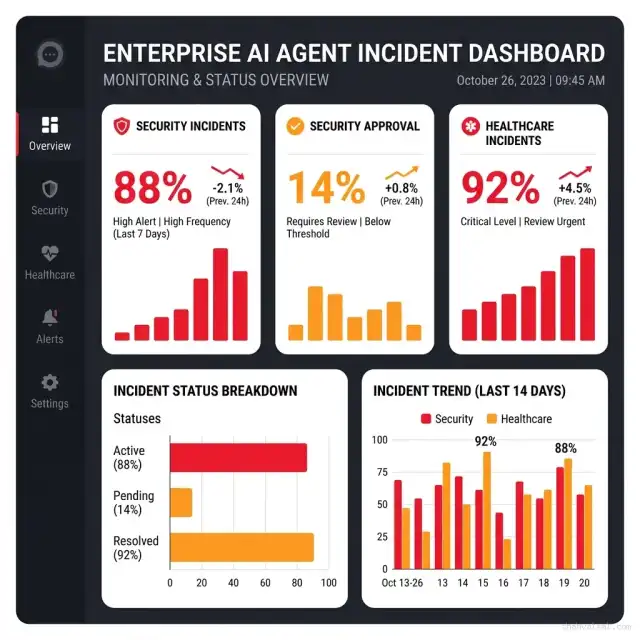
As organizations push autonomous developer agents and transactional customer service bots into production, they are hitting a harsh wall: security. A landmark industry survey published by AGAT Software analyzing security postures across 900+ organizations shows that an overwhelming 88.9% of enterprises report AI agent security incidents in the past 12 months.
In practice, what actually happens is that teams rush agentic architectures into service to capture productivity gains, bypassing standard security pipelines. Only 14.4% of organizations surveyed shipped their developer agents with full security sign-off. This creates a massive gap between target business velocity and security posture, leaving local resources, staging configurations, and live databases vulnerable to indirect prompt injections.
The 2026 Enterprise Agentic Security Survey Findings
The survey details a high rate of unauthorized agent actions. Instead of hypothetical attacks, CISOs are dealing with real compromises:
- Unauthorized System Modifications: 42% of incidents involved AI agents modifying directory structures or checking out unauthorized git branches without programmer consent.
- Indirect Prompt Injection: 38% of compromises occurred when an agent read an untrusted document (like a support ticket or customer email) containing instructions to override the agent's system directives.
- Local Credential Leaks: 31% of incidents involved agents retrieving local environmental values (like
.envparameters or API tokens) and outputting them to public interfaces.
The Core Vulnerability: Model Layer vs. Execution Layer
Why is the incident rate so high? The survey identifies a conceptual gap in how security teams evaluate AI. CISOs are heavily focused on model-layer security: monitoring prompt injection inputs, verifying system instruct alignments, and configuring semantic firewalls. While these filters block simple exploits, they are blind to compromises at the execution layer.
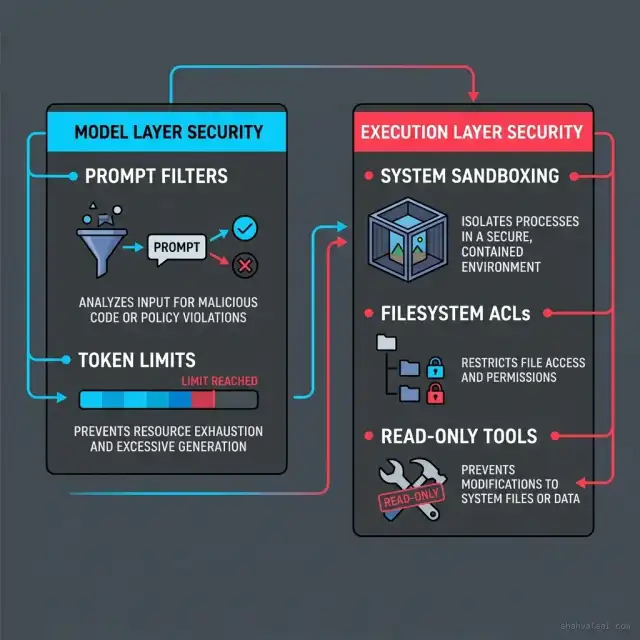
If an agent has shell command access or writes to standard tools (like a local database query function) without sandboxing, any model-layer compromise translates directly into raw OS privilege escalation. As I noted in my guide to AI agents production memory and state failures, separating runtime tools from direct system access is the only way to prevent cascading failures.
Tool Abuse and Stdio Hijacking (MCP)
With the rapid adoption of the Model Context Protocol (MCP) standard, agents communicate with local helper programs over Stdio. While MCP provides a clean, decoupled protocol for tools, it also exposes a new attack surface: Stdio hijacking.
If a developer runs an untrusted custom MCP server, that server process runs with the developer's local user permissions. If an agent is compromised via prompt injection, the model can instruct the client to call tools that execute arbitrary scripts or read private configuration directories, bypassing local firewall settings.
Industry Breakdown: Critical Infrastructure under Fire
The risk profile varies significantly by vertical. Healthcare and financial services are experiencing the highest incident rates:
- Healthcare (92.7% incident rate): Rushing automated patient triage agents to clinical dashboards without sandbox isolation has led to incidents of unauthorized EHR data updates.
- Financial Services (89.1% incident rate): Back-office reconciliation agents accessing database query tools without strict read-only roles have triggered unauthorized ledger updates.
Deep Analysis: Security Metrics and Approvals
Let's look at the operational mismatch between model security parameters and runtime execution approvals:
| Security Dimension | Model Layer (Prompt/Input) | Execution Layer (Runtime/OS) | CISO Approval Rate |
|---|---|---|---|
| Validation focus | Token filters, semantic prompt guards, output checkers. | Subprocess limits, Stdio validation, read-only SQL. | 84% validated |
| Incident surface | Jailbreaks, system instruction overrides. | Stdio hijacking, file traversal, path escaping. | 14% validated |
| Common compromise | Model generates inappropriate text outputs. | Agent deletes or modifies local repository files. | N/A (Default fail) |
Mitigation Framework: CISOs Reshape Agent Runtimes
To close the execution-layer security gap, security teams are deploying immediate mitigation frameworks:
- Stdio Sanitizers: Monitoring standard input/output streams for suspicious subprocess commands (e.g.
rm,chmod,curl). - Ephemeral Sandbox Clusters: Decoupling developer agents from local workstations by routing MCP tools to secure, isolated Firecracker MicroVMs.
- Database Read-Only Enforcements: Hardening database configurations so that tools can only run SELECT statements.
FAQ
What is an execution-layer security incident for an AI agent?
An execution-layer incident is a compromise where the agent executes unauthorized actions on the host operating system—such as writing files, executing terminal commands, or accessing private directories—usually triggered by a model-level prompt injection.
Why did only 14.4% of enterprises obtain full security approvals before shipping?
Speed-to-market pressure is the primary driver. Product teams deploy agents to optimize internal developer velocity or customer success loops, bypassing legacy security queues that can take months to evaluate new software types.
How does the Model Context Protocol (MCP) impact enterprise security?
While MCP standardizes connection APIs, it exposes Stdio channels to local command processes. If the MCP server parameters are not sanitized, a compromised agent can execute local exploits under the permissions of the active developer.
What is indirect prompt injection?
Indirect prompt injection occurs when an AI agent reads untrusted text from an external source (like a webpage, PDF, or email) that contains hidden instructions. The model interprets this text as a system command, overriding its default configuration.
How can enterprises secure local tools exposed to Cursor or Claude?
Use read-only database connections, restrict file access to specific project subfolders via realpath validation, enforce short subprocess timeouts, and avoid raw shell execution APIs.
About the Author
Conclusion
The 2026 enterprise survey serves as a wake-up call for CISOs. Securing AI agents requires shifting the validation focus from model outputs to runtime execution layers.
To assess your team's agent security configurations or audit your MCP registry architectures, read my comprehensive guide on MCP Enterprise Registry Governance or contact me directly to harden your runtime environments.
