AWS Puts OpenAI Inside Bedrock: Managed Agents Land with Native IAM and CloudTrail Governance
By Vatsal Shah | September 29, 2026 | 7 min read | Source: AWS What's New
AI SUMMARY
- Public Preview Launch:
- AWS and OpenAI have officially unveiled Bedrock Managed Agents (BMA) in public preview, deploying customized OpenAI Agents API runtimes directly within AWS cloud infrastructure.
- Enterprise Security Model:
- Introduces per-agent AWS IAM execution roles, binding least-privilege security policies directly to autonomous reasoning loops without exposing static API keys or credentials.
- Zero-Trust Observability:
- Every autonomous tool invocation, model inference step, and state mutation is natively recorded as structured, immutable events within AWS CloudTrail.
- Model Context Protocol (MCP) Standard:
- Natively supports MCP server connectors, enabling seamless bi-directional integration with Amazon S3, AWS Lambda, DynamoDB, and internal enterprise microservices.
- Preview Regional Availability & Pricing:
- Live in
us-east-1(N. Virginia),us-west-2(Oregon), andus-east-2(Ohio) via endpoint prefixbedrock-mantle. No additional management surcharge during preview beyond underlying compute and model token consumption.
Lead Paragraph
SEATTLE, Washington — On September 29, 2026, Amazon Web Services announced the public preview of Amazon Bedrock Managed Agents powered by OpenAI, bridging the long-standing architectural divide between OpenAI's frontier agent runtime and AWS's zero-trust security infrastructure. Operating via the dedicated regional endpoint prefix bedrock-mantle, the service enables enterprise cloud architects to deploy, orchestrate, and audit OpenAI reasoning agents with the same identity boundaries, network isolation, and compliance controls applied to traditional AWS workloads. By replacing static API bearer tokens with granular AWS Identity and Access Management (IAM) execution roles, the joint release addresses the single largest security blocker preventing regulated financial, healthcare, and government enterprises from scaling autonomous AI agents.
What Happened
The introduction of Bedrock Managed Agents marks a pivotal shift in the enterprise cloud landscape. Historically, organizations utilizing OpenAI's frontier reasoning models had to route data outside their Virtual Private Clouds (VPCs) across public internet endpoints using static API keys, relying on bespoke application-level proxies to log agent actions.
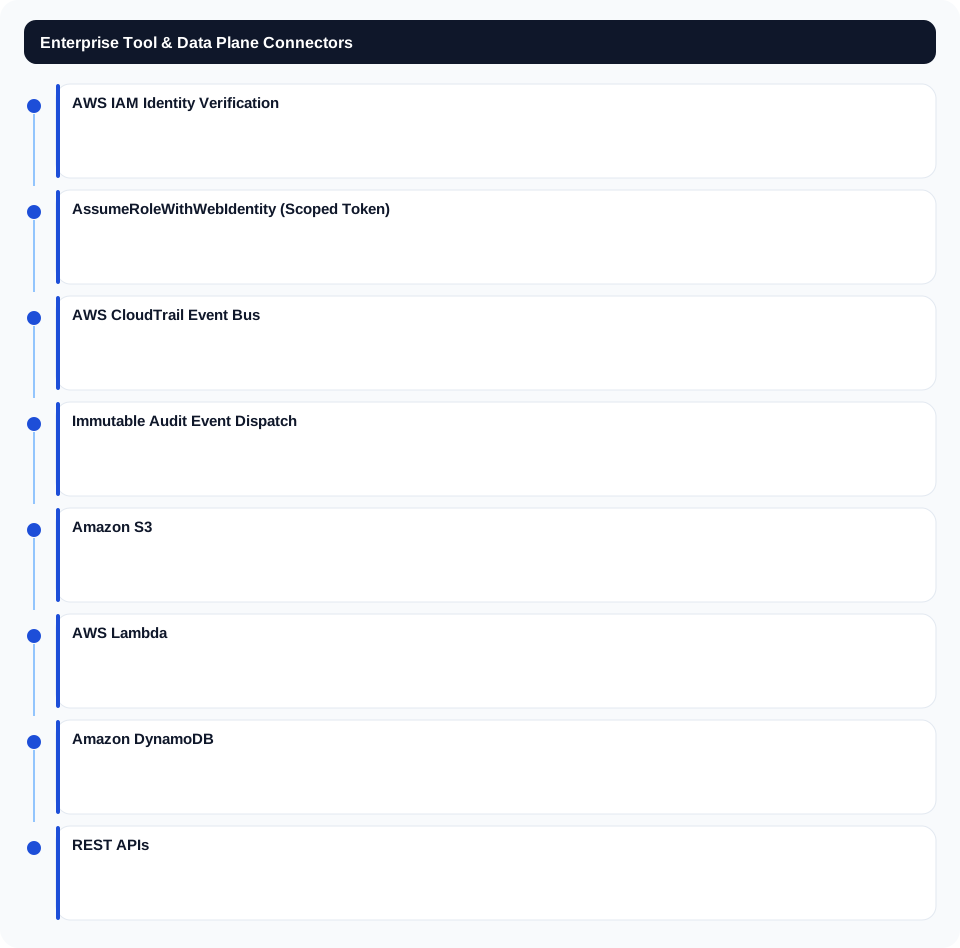
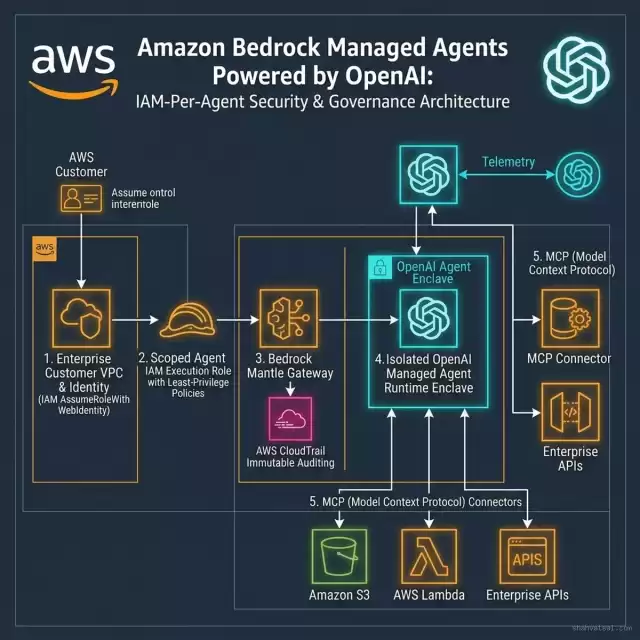
Under the new Bedrock Managed Agents architecture, AWS provisions an isolated compute and memory enclave that executes a specialized build of the OpenAI Agents API. Crucially, the service is built from the ground up around native AWS primitives:
- Public Preview Status: Launched on September 29, 2026; AWS explicitly cautions that the service is in public preview and not yet intended for mission-critical production SLAs.
- Preview Regional Endpoints: Initial deployment is constrained to three core US commercial regions: US East (N. Virginia -
us-east-1), US West (Oregon -us-west-2), and US East (Ohio -us-east-2). - Dedicated API Endpoint Prefix: Programmatic access is routed through the specialized
bedrock-mantlegateway (e.g.,bedrock-mantle.us-east-1.amazonaws.com). - Native IAM Execution Roles: Each managed agent is assigned an Amazon Resource Name (ARN) and assumes an IAM role dynamically for each tool invocation.
- Comprehensive CloudTrail Auditing: Every agent interaction—including prompt intake, internal tool dispatch, and output generation—generates non-repudiable CloudTrail management and data events.
- Model Context Protocol (MCP) Integration: Agents connect to external knowledge bases, databases, and APIs using the standardized Model Context Protocol specification.
- Zero Additional Management Fee: During the public preview window, AWS levies no additional platform orchestration surcharge; customers are billed strictly for underlying AWS resource usage and standard model token rates.
Why It Matters
For enterprise Chief Information Security Officers (CISOs) and cloud architects, the launch of Bedrock Managed Agents resolves the primary governance failure mode of autonomous agent deployment: credential sprawl and untracked lateral privilege execution.
In a traditional setup, if an autonomous agent is tasked with diagnosing an internal service error, it typically receives broad database or shell access tied to a shared application service account. If prompt injection or model hallucination occurs, the agent can execute destructive commands with the full privileges of that shared key.
By contrast, Bedrock Managed Agents implements strict IAM-per-agent isolation. Security teams can write fine-grained Attribute-Based Access Control (ABAC) policies ensuring that Agent A (e.g., a read-only telemetry analyzer) can only assume permissions to query CloudWatch metrics and read specific S3 bucket prefixes, while Agent B (e.g., a ticket resolution worker) is restricted to invoking designated Lambda functions.
Furthermore, the integration provides decisive financial advantages. Enterprise agreements with AWS frequently include substantial Enterprise Discount Program (EDP) minimum spend commitments. Previously, dollars spent directly with OpenAI could not retire AWS EDP balances. By transacting OpenAI agent workloads through Bedrock, organizations can draw down their committed AWS cloud spend while consolidating billing under a single master enterprise agreement.
Technical Deep Dive: Bedrock vs Direct OpenAI API
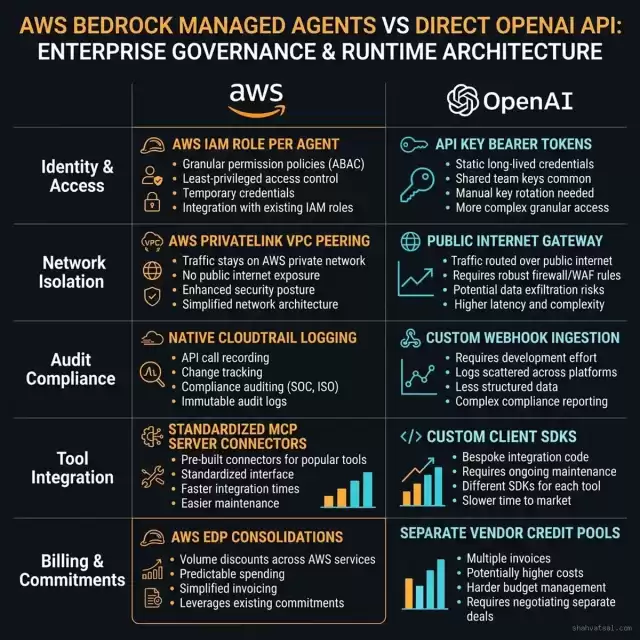
To understand when to leverage Bedrock Managed Agents versus continuing with the direct OpenAI Developer API, platform architects must evaluate five core architectural pillars:
1. Identity Delegation vs Static Bearer Keys
In the direct OpenAI API, client authentication relies on bearer tokens (sk-proj-...). Even with recent Project-level and Service Account key scoped permissions, credentials remain long-lived strings stored in developer environment variables or secrets managers. Bedrock Managed Agents eliminates static secrets entirely; agents authenticate using AWS Signature Version 4 (SigV4) and short-lived STS credentials generated on demand.
2. PrivateLink Network Isolation
Direct API calls require outbound traffic over port 443 to api.openai.com, forcing organizations to permit egress traffic through NAT Gateways or proxy clusters. Bedrock Managed Agents connects directly through AWS PrivateLink interface VPC endpoints. Network traffic never leaves the Amazon backbone network, eliminating exposure to public internet routing anomalies and man-in-the-middle vector analysis.
3. Native Model Context Protocol (MCP) Bridging
Bedrock Managed Agents establishes MCP as the first-class interface for agent tool invocation. Rather than writing custom JSON function schemas and managing manual dispatch loops in client code, developers register standard MCP servers hosted on AWS Lambda or Amazon Elastic Container Service (ECS). The Bedrock agent runtime handles protocol handshakes, schema discovery, parameter validation, and error serialization automatically.
Enterprise Implementation: Deploying a Managed Agent via SDK
To provision and execute a managed agent in the us-east-1 preview region using the AWS Boto3 SDK, developers specify the agent role ARN, model parameters, and MCP tool attachments:
import boto3
import
# Initialize the Bedrock Mantle preview client
client = boto3.client(
    service_name="bedrock-mantle",
    region_name="us-east-1"
)

# Define an IAM-isolated agent definition
agent_definition = {
    "agentName": "production-log-auditor",
    "description": "Autonomous security log auditor with restricted S3 read access",
    "modelConfiguration": {
        "modelId": "openai.gpt-6.1-sol-preview",
        "temperature": 0.0,
        "maxReasoningTokens": 8192
    },
    "iamExecutionRoleArn": "arn:aws:iam::123456789012:role/BedrockAgentSecAuditRole",
    "mcpToolConfigurations": [
        {
            "toolName": "s3_log_inspector",
            "serverEndpoint": "arn:aws:lambda:us-east-1:123456789012:function:mcp-s3-server",
            "protocolVersion": "1.0",
            "timeoutSeconds": 30
        }
    ],
    "memoryConfiguration": {
        "sessionTtlMinutes": 120,
        "storageType": "ENCRYPTED_DURABLE"
    }
}

# Create the managed agent resource
response = client.create_managed_agent(**agent_definition)
agent_id = response["agentId"]
print(f"[SUCCESS] Bedrock Managed Agent provisioned with ID: {agent_id}")

# Execute a multi-turn audit task within a durable session
session_response = client.invoke_managed_agent(
    agentId=agent_id,
    sessionId="audit-session-2026-10-06-001",
    inputPrompt=(
        "Audit the last 24 hours of CloudTrail logs in s3://corp-audit-logs/2026/10/05/. "
        "Identify any unauthorized DescribeSecurityGroups failures and isolate suspect IP addresses."
    )
)

print("[AUDIT RESULT]:", session_response["completion"])
Critical Preview Limitations: What Is Not in Scope
While the public preview introduces foundational enterprise features, AWS documentation explicitly notes several key boundaries that prospective adopters must account for:
- No Multi-Agent Subagent Hierarchies: The preview release supports only single-agent tool execution loops. Hierarchical multi-agent swarms (e.g., supervisor-worker topologies where one agent dispatches tasks to subordinate agents) are scheduled for subsequent iterations.
- Text and Structured Data Only: Input payloads and tool outputs are limited to text, JSON, and code files. Multi-modal image analysis and real-time audio streams are not supported on the
bedrock-mantleendpoints during this preview phase. - Geographic Pinning: Workloads must be initialized in
us-east-1,us-west-2, orus-east-2. Organizations with strict EU or Asia-Pacific data residency mandates must await regional expansion before piloting with sensitive production data. - Preview SLAs: Consistent with AWS public preview policies, the service does not carry commercial uptime service level agreements (SLAs), and AWS recommends against deploying mission-critical production financial transactions onto preview endpoints.
Strategic Ecosystem Impact: The Cloud Agent Battleground
The partnership between AWS and OpenAI signals an aggressive repositioning in the battle for cloud AI workloads. For the past two years, Microsoft Azure held a near-exclusive advantage as the enterprise home of OpenAI's models through Azure OpenAI Service. By welcoming OpenAI agents natively into Amazon Bedrock, AWS blunts Microsoft's architectural moat while expanding customer optionality beyond Anthropic's Claude family.
For OpenAI, the integration provides direct access to AWS's massive installed base of enterprise cloud infrastructure, dramatically expanding API consumption without requiring AWS customers to navigate complex third-party vendor onboarding, procurement reviews, or foreign network peering.
What to Watch Next
As enterprises begin exploring Bedrock Managed Agents throughout the preview phase, watch for three decisive milestones:
- Regional Expansion to EMEA and APAC: Track when AWS deploys
bedrock-mantleendpoints to Frankfurt, Dublin, and Tokyo to meet sovereign compliance requirements. - Subagent Swarm Support: Monitor AWS roadmap updates for native support of multi-agent supervisor hierarchies and dynamic swarm orchestration.
- GA Milestone and Enterprise SLA: Watch for the transition from public preview to General Availability (GA), expected alongside comprehensive SOC 2, HIPAA, and ISO 27001 certification packages.
Source
Primary source announcement: AWS What's New — Announcing Amazon Bedrock Managed Agents Powered by OpenAI (Public Preview) (Published September 29, 2026).
