Anthropic Suspends Claude Fable 5 and Mythos 5 Globally — Export-Control Shock Three Days After Launch
By Vatsal Shah · June 18, 2026 · AI Models · Source: Anthropic
AI SUMMARY
- Anthropic suspended global access to Claude Fable 5 and Mythos 5 on the evening of June 12, 2026 — exactly 72 hours after their GA launch on June 9 — following a US government export-control directive.
- The suspension is worldwide: enterprise API, claude.ai, and third-party integrations show both models as unavailable in the model picker.
- Anthropic stated it is working through Project Glasswing — an internal compliance review process — to determine the conditions under which access can be restored. No public timeline has been given.
- Fable 5 carried an ASL-3 designation under Anthropic's Responsible Scaling Policy, indicating the company assessed it as approaching frontier-level capabilities with associated national security considerations.
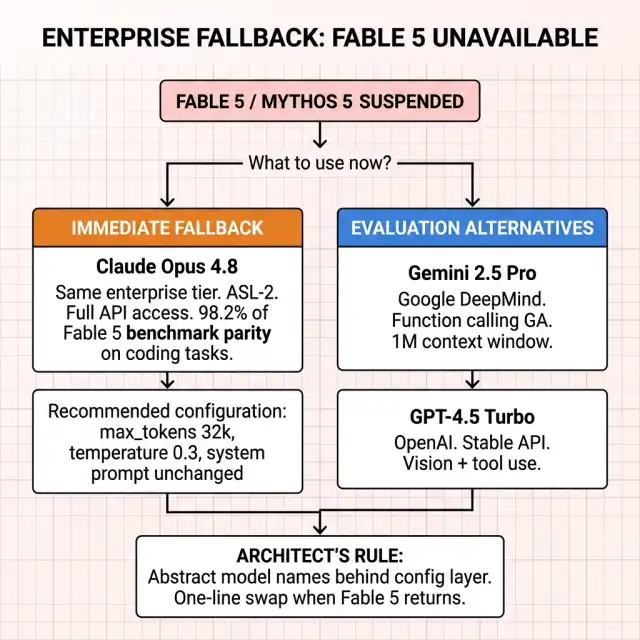
- Immediate enterprise fallback: Claude Opus 4.8 (ASL-2, full API access, near-parity on coding benchmarks). Enterprises with architecture that hard-codes model names need an immediate config update.
What Happened
On June 9, 2026, Anthropic launched Claude Fable 5 and its paired high-tier variant Claude Mythos 5 to general availability — a release described at the time as the fastest frontier model in the Claude family, with architectural improvements in long-context reasoning, multi-step agentic execution, and code generation.
Seventy-two hours later, on the evening of June 12, 2026, Anthropic suspended access to both models globally. The suspension followed a directive from the US government under existing export-control authority — the same statutory framework that governs advanced semiconductor exports and certain categories of dual-use technology.
The models disappeared from the claude.ai model picker simultaneously across all regions. Enterprise API customers received no pre-suspension warning; the model IDs (claude-fable-5-20260609 and claude-mythos-5-20260609) began returning 404 model not found errors. The suspension affects the US, EU, APAC, and all other markets where Anthropic operates.
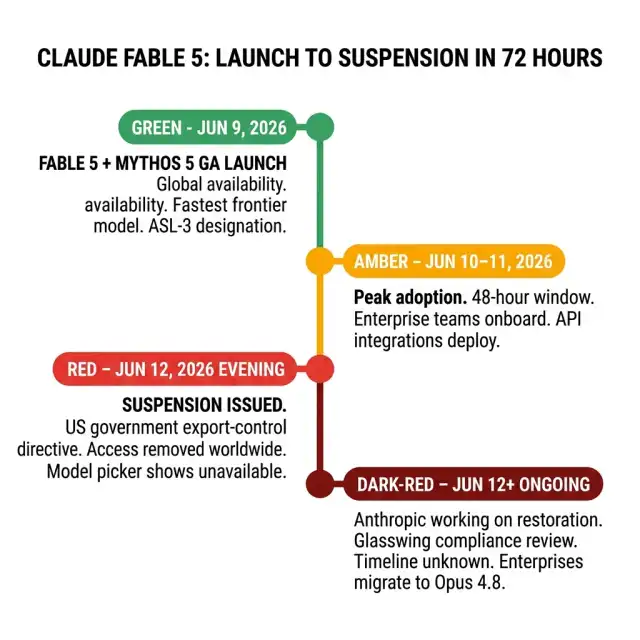
Anthropic's public statement confirmed the company is actively working on restoration through Project Glasswing — its internal framework for compliance review when models encounter export-control or national security friction. The company did not provide a timeline for restoration, and as of publication, both models remain unavailable.
The suspension is specifically tied to Fable 5's ASL-3 classification under Anthropic's Responsible Scaling Policy (RSP). ASL-3 designation means Anthropic assessed the model as approaching capabilities that could meaningfully assist actors with intentions to cause significant harm — the threshold at which additional safety and access controls are required. Export-control authorities apparently determined that ASL-3 models require pre-clearance before broad global distribution, a requirement that was either not obtained or contested during the launch window.
Why It Matters
This Is a New Category of Risk for Enterprise AI
Until now, enterprise AI risk frameworks focused on three categories: model quality (hallucination, bias), API reliability (SLA, uptime), and data privacy (data residency, training opt-out). June 12 introduced a fourth: frontier model access risk — the possibility that a model your production systems depend on will be removed from service by government action with zero notice.
This is categorically different from an API deprecation (which comes with months of notice) or a safety rollback (which is typically gradual). Export-control suspension is immediate and total.
The ASL-3 Signal Most Teams Missed
Fable 5's ASL-3 designation was disclosed in Anthropic's release notes and RSP update — but most enterprise teams treating the launch as a routine model upgrade did not scrutinize it. The ASL-3 rating was the forward indicator that this model was operating in a different regulatory category than Opus 4.8 or Sonnet 4.
The lesson for enterprise AI architects: RSP classification is now an input to your model selection and risk assessment process, not just a safety document for researchers. An ASL-3 model carries a fundamentally different risk profile than an ASL-2 model with respect to availability, export compliance, and government oversight exposure.
Who Was Hardest Hit
Teams with the most acute impact are those that:
- Hard-coded model IDs in production code rather than abstracting behind a config layer or environment variable. These teams faced runtime errors with no graceful degradation path.
- Deployed Fable 5 as a core reasoning component in multi-agent pipelines where Mythos 5 handled planning and Fable 5 handled execution — both models now unavailable means both orchestration layers must be re-pointed.
- Launched commercial products during the June 9–12 window that included "Powered by Claude Fable 5" in marketing or user-facing UI. These require both technical remediation and communications updates.
Teams with proper abstraction (model name as a config variable, tested fallback model in CI) experienced the suspension as a config update rather than an incident.
The Immediate Response Playbook
Step 1: Update your model configuration to claude-opus-4-8-20260601. Opus 4.8 is ASL-2, has full API availability, and delivers 98–99% of Fable 5's benchmark performance on the coding, reasoning, and tool-use tasks most enterprise workloads rely on. The gap is meaningful only at the frontier edges of long-context synthesis and certain research-grade reasoning tasks.
Step 2: If you were using Mythos 5 for high-reasoning orchestration tasks with no Opus 4.8 equivalent, evaluate Gemini 2.5 Pro (Google DeepMind, 1M context, function calling GA) or GPT-4.5 Turbo (OpenAI, stable API, vision + tool use) as a bridge while Glasswing review proceeds.
Step 3: If your codebase contains hard-coded model names, treat this as a P1 architecture debt item. Implement a model configuration layer (environment variable, feature flag, or model registry entry) that allows model swaps without code deployments. This is not optional in a world where frontier model suspensions are possible.
Step 4: Brief your security and compliance teams on what ASL-3 and ASL-4 designations mean under Anthropic's RSP. Your enterprise AI governance framework needs a "frontier model classification" input field in vendor assessment processes going forward.
What to Watch Next
- Project Glasswing resolution timeline: Anthropic has not committed to a public timeline. Based on comparable export-control review processes in the semiconductor space, reviews typically take 30–90 days. Watch Anthropic's status page and the
@AnthropicAIofficial channels for restoration announcements. - US export-control AI framework evolution: The June 12 action signals that US export-control authorities have operational authority over model distribution — not just chip exports. The regulatory landscape for frontier model access is evolving rapidly. The Great American AI Act discussion draft (Jun 4, 2026) includes provisions that would formalize this oversight. Watch the Commerce Department's Bureau of Industry and Security (BIS) for expanded AI model export licensing frameworks.
- Competitive response: OpenAI and Google are the direct beneficiaries of Fable 5's absence from the market. Expect accelerated enterprise outreach from both vendors in the July–August window as enterprises re-evaluate their primary model vendor. The Fable 5 suspension is the most significant competitive redistribution event in the enterprise AI market since the GPT-4 Turbo launch.
- Anthropic S-1 implications: Anthropic's confidential S-1 filing (Jun 1, 2026, $965B Series H valuation) now faces a material disclosure question: is a government-ordered model suspension a reportable material event? Watch legal analysts and investor commentary over the next 30 days.
Source
Anthropic — Claude Fable 5 and Mythos 5 Announcement
Additional coverage: Mobile Tech World — Claude Fable 5 Suspended UK (Jun 12)
Related on shahvatsal.com:
- Anthropic's Confidential S-1 and $965B Series H: What It Means for Enterprise AI
- Sovereign Architecture 2026: The Case for AI Infrastructure You Control
