CNCF Dapr Agents v1.0 GA Delivers Production-Grade Durable Workflows for Kubernetes Agent Fleets
By Vatsal Shah | June 17, 2026 | 5 min read | Source: CNCF Announcement
The Cloud Native Computing Foundation (CNCF) has announced the General Availability (GA) of Dapr Agents v1.0. This release introduces a standardized runtime and virtual actor framework that solves the primary challenges of scaling stateful AI agent fleets on Kubernetes, including persistent context management, zero-trust security boundaries, and automatic state checkpoint recovery.
AI SUMMARY
- CNCF GA Release
- Dapr Agents reaches v1.0 stability after 20 release candidates, guaranteeing stable APIs and backward compatibility for cloud-native AI teams.
- DurableAgent Workflows
- The new programming model automatically serializes cognitive state, memory, and tool history to distributed databases.
- Automatic Checkpoint Recovery
- Resumes agent execution from the exact step of failure after a node crash or pod eviction.
- Zero-Trust Security
- Implements SPIFFE identity and mTLS encryption to define granular access control boundaries within agent fleets.
What Happened: The CNCF GA Milestone
The March 23, 2026, announcement by the CNCF confirms that the APIs for Dapr Agents have reached v1.0 stability. This means developers can now build on stable interfaces that guarantee backward compatibility, enabling long-term enterprise roadmaps. The framework introduces a specialized virtual actor model tailored for stateful agent runtimes. Rather than requiring developers to manually write database queries to serialize agent states, Dapr's virtual actor model automatically handles state persistence, routing, and lifecycle management.
A core feature of the v1.0 release is Dapr's out-of-the-box support for over thirty state stores, including Redis, PostgreSQL, Amazon DynamoDB, and Google Cloud Firestore. This database abstraction layer ensures that enterprise developers can transition from local testing environments to multi-cloud production systems without altering a single line of agent code. Additionally, Dapr Agents v1.0 integrates deeply with the CNCF ecosystem, utilizing SPIFFE (Secure Production Identity Framework for Everyone) and mTLS to enforce zero-trust security boundaries between individual agent pods.
During the extensive release candidate phase, early adopters reported significant operational improvements. According to benchmarks published in the CNCF announcement, enterprises deploying Dapr Agents v1.0 achieved up to a thirty percent reduction in infrastructure compute overhead compared to custom-built state serialization layers. Furthermore, the framework's native event-driven architecture reduced the latency of inter-agent messages, enabling real-time collaboration across complex agentic workflows.
Why It Matters: DurableAgent Workflows and State Checkpointing
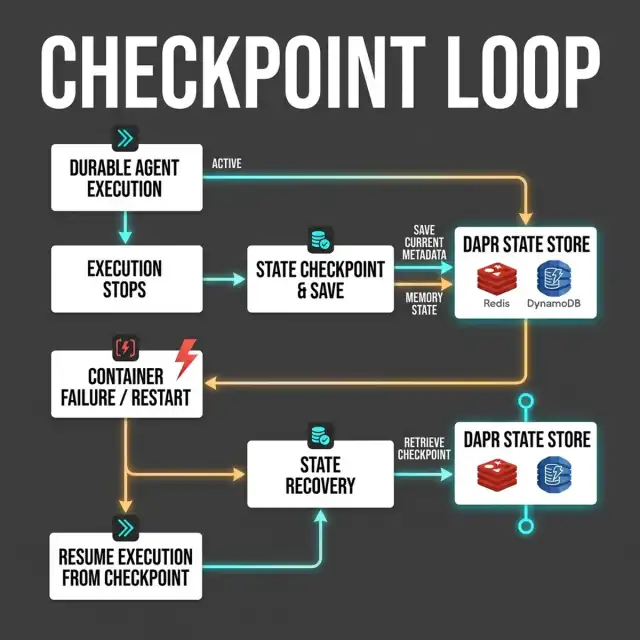
The architectural core of Dapr Agents v1.0 is the DurableAgent class. This programming construct allows developers to define stateful, multi-step agent workflows that survive restarts, network failures, and resource reallocations. Whenever a DurableAgent executes a step—such as querying an LLM, parsing a document, or executing a tool—its current memory, variables, and progress are automatically checkpointed to the active state store.
This checkpointing mechanism is highly optimized. Rather than saving the entire container state, Dapr serializes only the logical diff of the agent's cognitive context and execution stack. In the event of a pod eviction or node failure on a Kubernetes cluster, a new instance of the agent is instantly scheduled. The new pod retrieves the latest checkpoint from the state store, restores its context, and resumes execution from the exact point of failure. This transparent recovery process ensures that long-running operations—which often span hours or days and consume costly tokens—are never lost.
Beyond reliability, Dapr Agents v1.0 introduces a standardized tool execution gateway. When an agent needs to interact with an external API or internal database, it routes the request through Dapr's tool invocation sidecar. This design pattern ensures that tools are executed within a secure, permissioned sandbox, protecting the host system from potential exploits. The gateway also handles rate-limiting, retries, and cryptographic logging, providing an immutable audit trail for regulatory compliance.
From a security perspective, the inclusion of SPIFFE-based identity mapping is a major advancement for enterprise AI. In multi-agent swarms, different agents often possess varying levels of privilege. For example, a customer-facing support agent should not have the authority to directly execute a database write to the ERP. By mapping unique SPIFFE identities to individual agents, operators can define fine-grained access control policies at the networking layer, preventing unauthorized tool execution or lateral escalation.
Vatsal's Expert Take: Decoupling State from Cognitive Logic
The release of Dapr Agents v1.0 represents a major paradigm shift in how we architect agentic systems. For the past two years, the AI landscape has focused heavily on cognitive orchestration frameworks like LangGraph, AutoGen, and CrewAI. While these libraries excel at defining routing graphs and reasoning loops, they are fundamentally runtime-agnostic and place the burden of infrastructure reliability squarely on the developer.
In practice, when you scale an agent fleet to handle thousands of concurrent enterprise workflows, cognitive logic is only half the battle. The real challenge lies in managing state, handling failures, securing boundaries, and integrating with enterprise databases. Dapr's genius is that it does not compete with existing cognitive frameworks; instead, it serves as a robust foundation. You can build your reasoning graphs in Python or TypeScript using your library of choice, and run them within Dapr's stateful, secure enclaves.
What to Watch Next: The Road to Kubernetes Agent Sandbox
Following the GA release, the CNCF Dapr working group has laid out a clear roadmap for the remainder of 2026. The next major milestone is the proposed Kubernetes Agent Sandbox Custom Resource Definition (CRD). This upcoming standard, currently developed in collaboration with SIG Apps, aims to introduce native Kubernetes resources for defining agent deployments, scaling metrics, and state store bindings.
Once the Agent Sandbox CRD is stabilized, developers will be able to manage their agent fleets using standard declarative YAML configurations. This will enable GitOps-style deployment pipelines for AI agents, allowing teams to version, test, and audit their agent definitions alongside their core infrastructure. Major cloud providers, including Google Cloud and Microsoft Azure, have already announced plans to offer managed runtimes for Dapr Agents, promising seamless integration with GKE and AKS clusters.
As the enterprise AI landscape shifts from proof-of-concept pilots to production agent fleets, frameworks that prioritize operational reliability and security will dominate the market. The general availability of Dapr Agents v1.0 provides the stable, standardized, and battle-tested foundation that enterprise architects need to deploy autonomous agents with confidence.
