AI SUMMARY
- Headline
- DeepFabric Hits GA: 50+ Specialized AI Agents to Automate Supply Chain Execution
- Global impact
- DeepFabric, a developer of agentic enterprise software, announced on July 8, 2026, the general availability of its specialized AI agent platform for supply chain execution.
- India lens
- Assess DPDP, RBI, and GCC delivery exposure — India-scale teams often feel vendor shifts 2–4 weeks before US HQ.
- My take
- I would brief the architecture board this week with one owner, one metric, and one rollback plan.
STRATEGIC OVERVIEW
DeepFabric, a developer of agentic enterprise software, announced on July 8, 2026, the general availability of its specialized AI agent platform for supply chain execution.
DeepFabric, a developer of agentic enterprise software, announced on July 8, 2026, the general availability of its specialized AI agent platform for supply chain execution. Backed by early enterprise adopters including HelloFresh, TwinMed, Merchants Fleet, and Weber, the platform includes a catalog of over 50 task-oriented agents designed to automate the manual coordination work that sits between ERP, warehouse management, transportation, and finance systems.
The Operational Problem: The System Handoff Tax
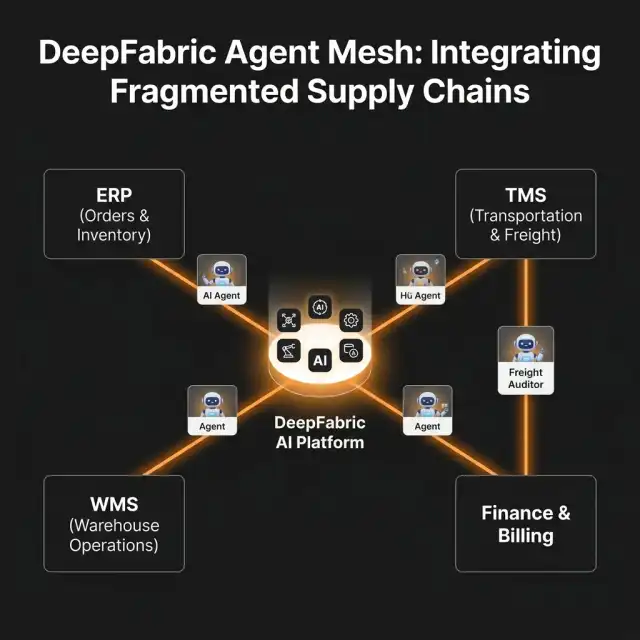
Modern supply chains run on sophisticated, multi-million dollar software suites. Enterprise Resource Planning (ERP), Transportation Management Systems (TMS), Warehouse Management Systems (WMS), and Billing platforms form the backbone of global commerce. Yet, despite massive investments in these transactional systems of record, supply chain execution remains highly manual.
The friction lives in the handoffs. When an exception occurs—such as a freight invoice discrepancy, a delivery delay, a custom shipping request, or a stock mismatch—systems of record do not coordinate. Instead, operational teams spend hours copying data between applications, reviewing PDF invoices manually, routing approvals via email, and reconciling discrepancies.
DeepFabric is positioning its agent platform directly at this operational handoff layer. By deploying specialized agents that sit between disparate systems, the platform aims to automate these micro-processes without requiring enterprises to rip and replace their existing software suites or construct brittle custom integrations.
The DeepFabric Product Strategy: Packaged and Purpose-Built
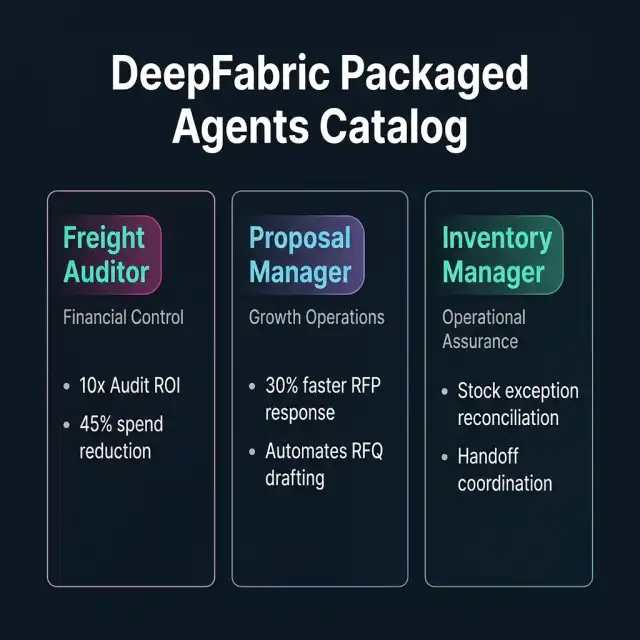
Rather than offering a generic, open-ended chat assistant, DeepFabric's strategy centers on packaged, task-specific agents. The platform launches with over 50 specialized agents grouped into operational divisions:
- Financial Control & Assurance: Focused on protecting margins. The Freight Auditor agent automatically ingests freight invoices, matches them against bill-of-lading documents and contracted tariff rates in the TMS, flags billing anomalies, and routes verified invoices to the ERP for payment.
- Growth Operations: Accelerating the sales loop. The Proposal Manager agent monitors inbound RFPs, reads complex shipping requirements, references historical contract margins, drafts complete bid proposals, and loads them into customer portals.
- Operational Assurance: Coordinating physical execution. The Inventory Manager agent tracks stock levels across warehouse sites, identifies demand spikes, triggers purchase requisitions, and coordinates stock transfer orders across WMS and TMS setups.
Early Customer Milestones and ROI
DeepFabric's launch is backed by a group of named enterprise production customers, including:
- HelloFresh (meal kit provider)
- TwinMed (medical supply distributor)
- Merchants Fleet (fleet management provider)
- Weber (grill manufacturer)
- Kenco and NFI (third-party logistics providers)
According to DeepFabric, early adopters have seen substantial operational improvements, including up to a 10x ROI on freight audits, a 45% reduction in audit spend, and RFP response times cut by up to 30%. While these are vendor-reported outcomes, they indicate the scale of operational efficiency that can be achieved by targeting high-volume, manual tasks rather than generic productivity improvements.
How the Platform Operates
DeepFabric's platform is designed to deploy within existing enterprise environments with minimal technical friction:
Zero-Data-Cleanup Integration: Agents can read unstructured documents (PDFs, emails, custom formats) and interact with legacy systems through APIs, database connections, or RPA-style interfaces. The vendor claims new agents can be configured and live within a day without internal data-cleansing initiatives.
Explainable Decisions: Every agent action is accompanied by an audit trail. If a Freight Auditor agent flags a bill, it highlights the exact line item, displays the source tariff rate, and attaches the matching bill-of-lading. This transparency allows operational teams to quickly verify recommendations and build trust in the automated workflow.
Human-in-the-Loop Safeguards: For production-grade safety, agents do not operate in a vacuum. High-value approvals, payment releases, or outbound customer proposals are routed to human dashboards for sign-off. As operational confidence grows, teams can adjust the autonomy threshold, allowing the agent to auto-approve tasks that fall within defined parameter ranges.
Market Analysis: The Move to the Execution Layer
DeepFabric's GA represents a broader market trend: the transition of enterprise AI from planning and analysis to operational execution.
For the past several years, supply chain AI has focused on predictive planning—using machine learning to forecast demand, optimize inventory levels, and schedule logistics routes. However, the execution of those plans remained bottlenecked by manual administrative coordination.
By building a specialized agent mesh that handles the handoffs between applications, DeepFabric is attempting to establish a new system of intelligence. If successful, this layer will capture the high-value workflow logic, turning underlying systems of record like SAP or Oracle into commodity databases.
This shift has created intense competitive dynamics among enterprise software vendors. It mirrors other industry plays, such as AWS's $1 billion Forward Deployed Engineering organization and Uber's internal agentic pods playbook, both designed to automate operational processes by embedding engineering talent and specialized AI agents deep inside corporate workflows.
Practical Implementation Steps for Supply Chain Leaders
For CIOs and supply chain leaders evaluating DeepFabric or similar agent platforms, the following steps are recommended:
Audit the Handoffs: Before deploying agents, map the existing process flows between ERP, TMS, and WMS. Identify the specific tasks where human operators are copy-pasting data, performing manual audits, or waiting on email approvals. These handoffs are the highest-leverage targets for agentic automation.
Verify Integration Quality: While DeepFabric claims one-day deployment, real-world enterprise environments require careful integration validation. Verify how agents handle rate updates, custom ERP schemas, and multi-tenant security configurations.
Establish Clear Governance: Set strict thresholds for agent autonomy. High-value transactions, billing releases, or customer-facing commitments should remain subject to human approval. Build clear escalation paths for anomalies that fall outside the agent's trained parameters.
Sources: ERP Today · SiliconANGLE
What is DeepFabric?
DeepFabric is a specialized enterprise AI company that provides an agentic platform designed to automate manual coordination and handoff tasks in supply chain execution, logistics, and financial operations.What are the key agents included in the DeepFabric platform?
The platform features over 50 packaged agents, including the Freight Auditor (for billing assurance), the Proposal Manager (for automated RFP/RFQ drafting), and the Inventory Manager (for coordinating warehouse stock exceptions).Which enterprise customers have deployed DeepFabric?
DeepFabric's launch is backed by production customers including HelloFresh, TwinMed, Merchants Fleet, Weber, Kenco, and NFI.What metrics and ROI have early adopters reported?
Production clients report achieving up to a 10x ROI on freight audits, cutting audit spend by 45%, and reducing RFP/proposal response times by 30%.How does DeepFabric handle integration and security?
The platform connects to existing ERP, TMS, WMS, and finance systems without requiring data cleanup. It uses human-in-the-loop safeguards, explainable audit trails for all actions, and supports strict data governance where customer data stays isolated.