Google Search Enters the Agent Era — Information Agents and Gemini 3.5 Flash Default
By Vatsal Shah | June 18, 2026 | 4 min read | Source: Google Search I/O Blog
Google has announced a structural overhaul of its core search engine at the I/O 2026 conference, shifting from conversational retrieval to autonomous agent execution. Under the new "AI Mode," Gemini 3.5 Flash becomes the default processing engine globally, driving continuous background execution tasks and rendering results via dynamic Generative UI cards rather than static blue links.
AI SUMMARY
- Gemini 3.5 Flash Default
- The new lightweight, sub-100ms latency model is integrated natively as the default routing engine for Google Search AI Mode globally.
- Information Agents
- Introduces 24/7 background execution flows allowing users to delegate complex, multi-step monitoring tasks like apartment hunting directly to Google Search.
- Generative UI Engine
- Search results now bypass standard templates, dynamically generating interactive widgets and control panels tailored to individual query contexts.
- MCP Integration
- Native support for Model Context Protocol (MCP) allows search agents to securely interface with local user data and third-party tools.
What Happened: The Agentic Transformation of Search
At Google I/O on May 19, 2026, Google announced that its search engine has officially transitioned from a passive information retriever to an active agentic runtime. The centerpiece of this launch is the integration of Gemini 3.5 Flash as the default model driving "AI Mode" for all search queries. Optimized for low-latency processing and high-frequency tool calls, Gemini 3.5 Flash enables Google Search to execute complex operations, make multi-layered decisions, and trigger external APIs in under one hundred milliseconds.
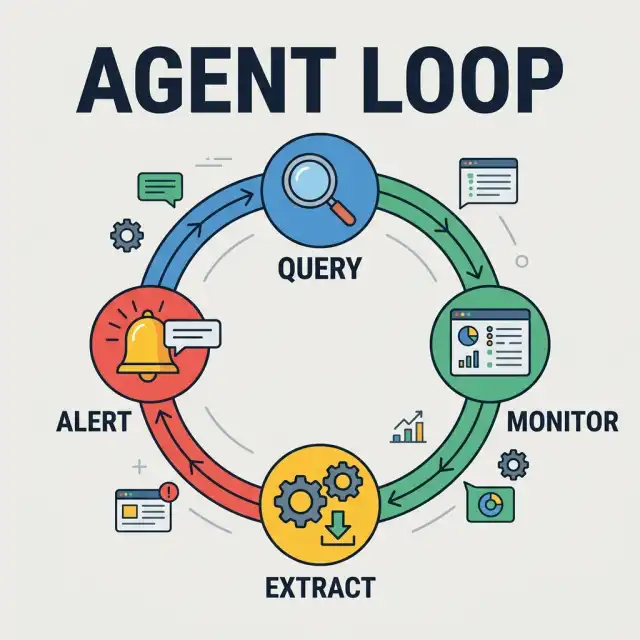
The most prominent feature introduced is the "Information Agent" suite. Users can now assign long-running, asynchronous tasks to Google Search. For instance, instead of manually searching for housing listings daily, a user can instruct a background agent to monitor properties, cross-reference pricing databases, verify lease terms, and send an alert once a matching unit becomes available. The search engine executes these workflows continuously in the background, utilizing secure sandboxed runtimes to interact with web elements.
Passive Search (Legacy):
[User Query] -> [Static Index Lookup] -> [Flat Link List] -> [Manual User Sorting]

Agentic Search (2026):
[User Goal] -> [Gemini 3.5 Flash Router] -> [Background Agent Loop] -> [Generative UI Response]
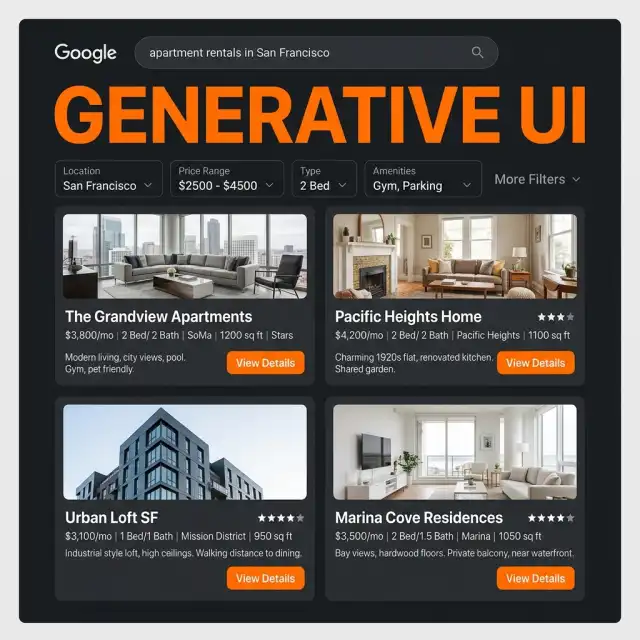
Additionally, Google unveiled its Generative UI engine. Rather than outputting standard text snippets or predefined widgets, the model dynamically creates custom interfaces on the fly. When a user conducts a query, the search engine renders an interactive control panel featuring custom filters, booking buttons, and comparison charts generated in real time, matching the user's specific context.
Why It Matters: Continuous Execution and Generative UI
The shift from conversational chatbots to autonomous agents marks a major evolution in digital interfaces. Traditional Search Engine Optimization (SEO) relied on matching keywords and optimizing meta tags for static indices. In the agentic era, websites must optimize for agentic discovery. If an autonomous agent cannot parse, verify, and authenticate a website's content, that website will be completely bypassed during background research runs.
Generative UI introduces another layer of complexity for digital platforms. When the search engine renders custom transactional cards directly on the results page, the traditional click-through pipeline to external websites is bypassed. Users can complete transactions—such as booking an apartment or purchasing a ticket—without leaving the Google interface. Platforms must adapt by exposing clean APIs and machine-readable data structures that Google's agents can query and interact with programmatically.
Furthermore, Google's integration of the Model Context Protocol (MCP) ensures that these agents can securely access a user's local context, such as calendar entries or email archives, with explicit permissions. This personalization allows search agents to evaluate search results against a user's real-world constraints, such as verifying if a prospective apartment location is within a reasonable commute of their workplace.
Vatsal's Expert Take: The Transition from Indexes to Execution
Google's agentic search rollout is a structural shift in the economics of the web. For three decades, the web has run on an attention-based click model. By introducing 24/7 background information agents, Google is effectively decoupling retrieval from active human attention. The agents do the heavy lifting in the background, consuming API tokens rather than ad impressions.
For enterprises and engineers, this means that traditional content marketing is no longer sufficient. To remain discoverable in 2026, platforms must implement schema graphs, structured APIs, and robust Model Context Protocol endpoints. If your services cannot communicate with autonomous routing agents in real time, you will become invisible to the next generation of consumers who consume the web through curated AI dashboards.
What to Watch Next: The Summer Rollout
Google plans to roll out the Gemini 3.5 Flash AI Mode default to all users in North America and Europe by the end of June 2026. The advanced "Information Agent" background execution features will launch as a developer preview in July, allowing engineers to build custom integrations and plugins.
Additionally, industry rumors suggest that Google is preparing to submit a standardized "Generative UI Schema" to Schema.org, establishing a global metadata standard for how web applications describe their interactive components to search agents. This proposed framework could allow independent developers to control how their brand widgets are rendered within Google's dynamic search cards.
