AI SUMMARY
- Headline
- TypeScript 7.0 RC Released - Compiler Rewritten in Go Delivers 10x Speedup
- Global impact
- TypeScript 7.0 RC Released - Compiler Rewritten in Go Delivers 10x Speedup By Vatsal Shah | June 18, 2026 | 8 min read | Source: TypeScript Developer Blog --- Lead Paragraph REDMOND, Washington.
- India lens
- Assess DPDP, RBI, and GCC delivery exposure — India-scale teams often feel vendor shifts 2–4 weeks before US HQ.
- My take
- I would brief the architecture board this week with one owner, one metric, and one rollback plan.
STRATEGIC OVERVIEW
TypeScript 7.0 RC Released - Compiler Rewritten in Go Delivers 10x Speedup By Vatsal Shah | June 18, 2026 | 8 min read | Source: TypeScript Developer Blog --- Lead Paragraph REDMOND, Washington — Microsoft has announced the Release Candidate of TypeScript 7.0,.
TypeScript 7.0 RC Released - Compiler Rewritten in Go Delivers 10x Speedup
By Vatsal Shah | June 18, 2026 | 8 min read | Source: TypeScript Developer Blog
COMPILER PERFORMANCE INSIGHT
- Go Migration Milestone:
- Moving the compiler codebase from TypeScript-on-Node to Go unlocks native CPU execution and bypasses the overhead of the JavaScript garbage collector.
- Multithreading Capability:
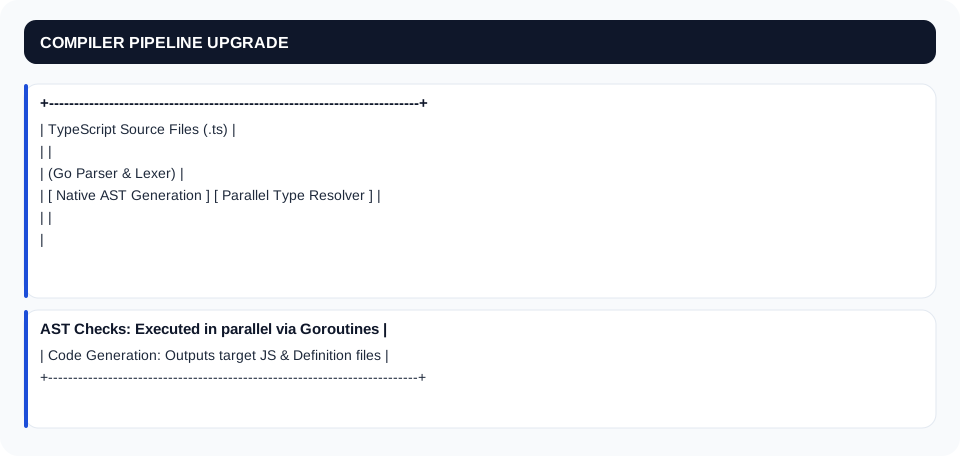
- By utilizing Go's native goroutines, the compiler can perform type checking and AST parsing across all CPU cores in parallel.
- Backwards Compatibility:
- The compiler maintains full syntax compatibility with existing TypeScript projects, requiring no changes to target source files.
Lead Paragraph
REDMOND, Washington — Microsoft has announced the Release Candidate of TypeScript 7.0, introducing a complete rewrite of the TypeScript compiler from JavaScript into Go. This architectural change shifts the language's build tools from the Node.js runtime to native machine binaries. By leveraging Go's memory efficiency and native concurrency, TypeScript 7.0 delivers up to a 10x speedup in build and type-checking performance on enterprise-scale codebases. The Release Candidate represents a major milestone in Microsoft's efforts to optimize modern web build chains, providing developers with faster compile times while maintaining full backward compatibility.
What Happened
The TypeScript 7.0 release upgrades the underlying compiler runtime while preserving the syntax developers use daily. Key updates include:
- The Go Compiler Rewrite: The core compiler (
tsc) has been rebuilt in Go, allowing developers to run type checks and transpilations as a native binary. - Shared-Memory Concurrency: Type checking is split across multiple worker routines, allowing parallel processing of files and module resolution.
- Integrated Bundling: The Go binary includes built-in bundling capabilities, reducing the need for separate toolchains in local setups.
Why It Matters
As web applications have grown in complexity, compiling large TypeScript codebases has become a significant bottleneck. Developers often wait minutes for incremental builds to complete. While tools like esbuild and swc have speeded up transpilation by dropping type checks, running thorough safety audits and generating .d.ts definition files has remained slow because the compiler ran on the single-threaded Node.js engine.
By porting the compiler to Go, Microsoft addresses this performance gap. The new compiler utilizes modern, multi-core processors, running parsing and type-checking tasks in parallel. This speedup is especially beneficial for large-scale systems, where faster feedback loops increase productivity and reduce CI/CD runner costs.
The JS-to-Go Compiler Architecture
The new compiler replaces the Node.js execution loop with a multi-threaded Go application. This design optimizes the phase where TypeScript code is read and turned into an Abstract Syntax Tree (AST).
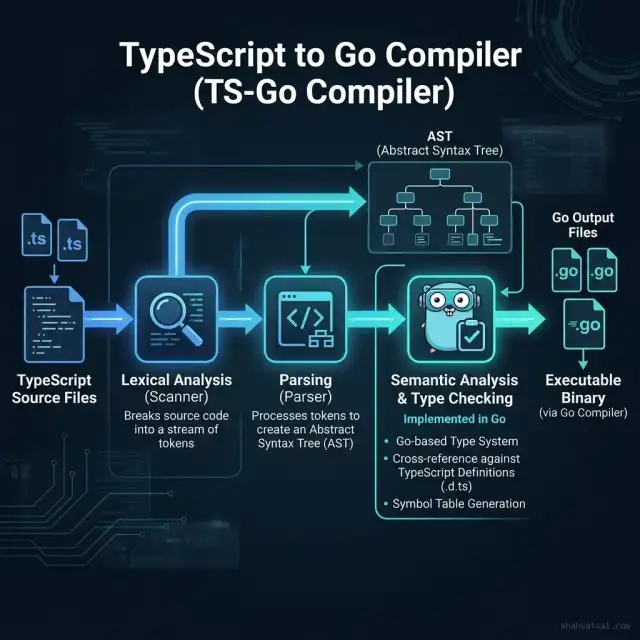
In the new setup, the lexical analyzer reads the source files and generates tokens. Rather than allocating Javascript heap objects for each node, the Go-based parser writes nodes directly to a structured memory layout. This approach reduces memory fragmentation and allows subsequent steps—such as module resolution and type checking—to read the AST from shared memory without replication.
Speed Benchmarking: TS 6.0 vs TS 7.0
Performance comparisons highlight the speed improvements of the new Go-based compiler over the previous Node.js-based runtime.
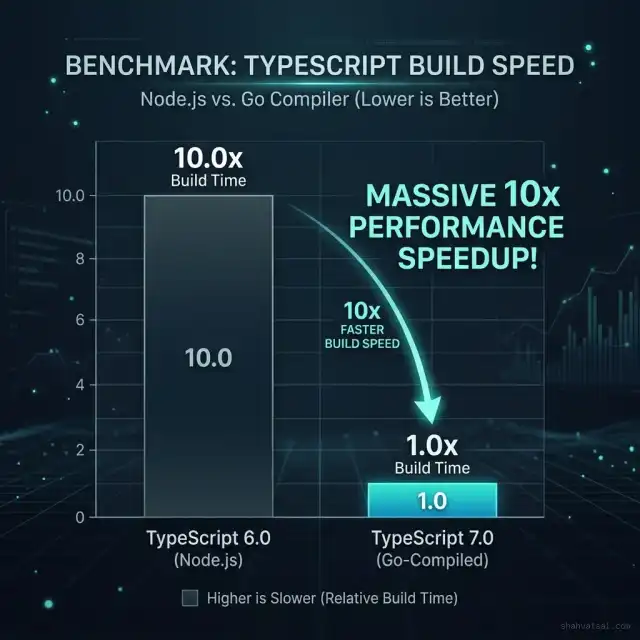
On projects with thousands of modules, type-checking times dropped from minutes to seconds. Go's garbage collector is optimized for low latency, which prevents the pauses that often occur during JavaScript heap sweeps when compiling large projects. This efficiency ensures stable performance during continuous deployment runs.
Integration: Native Concurrency in Go
To illustrate the concurrency model of the rewrite, the following example shows how a Go-based compiler parses multiple TypeScript files in parallel, using channels to coordinate the AST generation before the final type-checking phase:
package main

import (
	"fmt"
	"sync"
	"time"
)

// TypeScriptFile represents the source file metadata
type TypeScriptFile struct {
	Path    string
	Content string
}

// ASTResult holds the parsed Abstract Syntax Tree output
type ASTResult struct {
	Path string
	AST  string
	Err  error
}

// ParseTypeScriptFile simulates AST parsing of a source file in Go
func ParseTypeScriptFile(file TypeScriptFile) ASTResult {
	// Simulate parsing execution delay
	time.Sleep(150 * time.Millisecond)

	// Returns a simplified AST representation for demonstration
	astRepresentation := fmt.Sprintf("AST_ROOT(%s)", file.Path)
	return ASTResult{
		Path: file.Path,
		AST:  astRepresentation,
		Err:  nil,
	}
}

func main() {
	// Sample list of TypeScript files in an enterprise project
	files := []TypeScriptFile{
		{"src/index.ts", "import { App } from './app';"},
		{"src/app.ts", "export class App { run() {} }"},
		{"src/utils.ts", "export function format(val: string) {}"},
		{"src/models.ts", "export interface User { id: number; }"},
	}

	// Channel to gather AST results from parallel parsers
	resultChan := make(chan ASTResult, len(files))
	var wg sync.WaitGroup

	fmt.Println("Initializing native Go compilation sweep...")
	start := time.Now()

	// Spin up goroutines to parse files in parallel
	for _, file := range files {
		wg.Add(1)
		go func(f TypeScriptFile) {
			defer wg.Done()
			// Each file is processed in parallel on a separate thread
			resultChan <- ParseTypeScriptFile(f)
		}(file)
	}

	// Close channel once all files are processed
	go func() {
		wg.Wait()
		close(resultChan)
	}()

	// Read results from the channel
	for result := range resultChan {
		if result.Err != nil {
			fmt.Printf("Error parsing %s: %v\n", result.Path, result.Err)
		} else {
			fmt.Printf("[PARSED] %s -> %s\n", result.Path, result.AST)
		}
	}

	fmt.Printf("Compilation completed successfully in %v\n", time.Since(start))
}
Strategic Shift: Modern Tooling Dynamics
The Go compiler rewrite comes at a time when software development tools are changing. As analyzed in the discussion on Vibe Coding & Senior Engineering, developers are looking for tools that offer speed and stability over complex configurations. A compiler that runs instantly helps maintain focus during development sessions.
Additionally, front-end ecosystems are moving toward pre-compiled patterns. As noted in the overview of React Hydration and Compiler Trends, build steps are shifting toward native solutions. TypeScript 7.0 aligns with this trend, providing a fast, reliable base for modern application frameworks.
What to Watch Next
- Plugin Ecosystem Migration: Watch how TypeScript's custom linter and transformer plugin community adapts to Go's compiled model, which may require WebAssembly (Wasm) extensions.
- Editor Integration Speeds: Monitor VS Code and other editors to see if editor-level autocomplete and diagnostics experience similar speedups.
- Wasm Compilations: Track whether Microsoft provides Wasm versions of the compiler to maintain type-checking capabilities within browser-based sandboxes and dev environments.
Read the official release notes on the Microsoft blog → TypeScript Developer Blog
Key Takeaways
- Architecture Rewrite: The TypeScript 7.0 compiler has been rewritten in Go, replacing the Node.js runtime with native binaries.
- Significant Speedup: Build and type-checking performance is up to 10x faster on large projects.
- Shared-Memory Concurrency: Goroutines run type checks in parallel across all CPU cores.
- Full Backwards Compatibility: Syntactic compatibility is maintained, ensuring existing code compiles without changes.
- Optimized Resource Use: The compiler avoids the memory overhead of the JavaScript garbage collector.
FAQ
