Vercel Launches eve — Filesystem-First Open-Source Agentic Workflow Framework for TypeScript
By Vatsal Shah · June 18, 2026 · Open Source · Source: Vercel
AI SUMMARY
- Vercel launched eve at its Vercel Ship event in London, introducing an open-source, filesystem-first agentic workflow framework under the Apache 2.0 license.
- The framework introduces a directory-based agent model, where each agent is defined as a filesystem directory containing structured Markdown prompts and typed tools.
- Eve integrates a durable execution engine that automatically checkpoints agent state, allowing workflows to pause, resume, and recover from failures without losing progress.
- Built-in support for the Model Context Protocol (MCP) enables eve agents to discover and connect to external developer tools, APIs, and enterprise data sources.
- Designed to fit the TypeScript ecosystem, the framework allows developers to initialize agents using
npx eve@latest init, mimicking the Next.js developer experience.
What Happened
At its annual Vercel Ship event in London, Vercel announced eve, an open-source framework for building autonomous agents and durable workflows using TypeScript. Released under the Apache 2.0 license, eve introduces a filesystem-first design that treats individual agents as structured directories containing configuration files, typed tools, and Markdown-based prompts.
Early agentic frameworks often suffered from complex abstractions, requiring developers to write long configuration files or learn proprietary orchestration APIs. Debugging these agents was difficult because their runtime states, prompt templates, and execution paths were split across different modules in a codebase.
Vercel's framework addresses this by mirroring the project organization patterns of modern web frameworks like Next.js. In eve, an agent is represented by a single directory. A standard agent folder contains:
agent.config.jsonfor model selection and hyperparameters.prompt.mdfor system instructions and contextual prompt templates.tools.tsfor exposing typed TypeScript functions to the model.
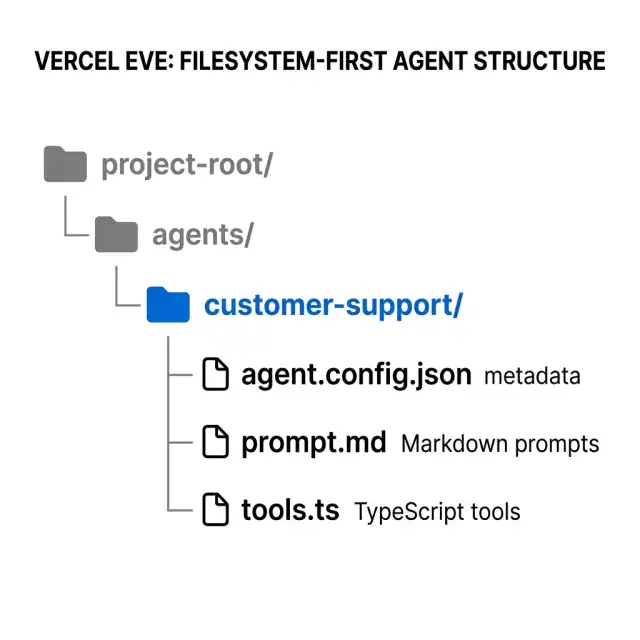
To initialize a new project, developers run a single CLI command:
npx eve@latest initThis command scaffolds a local environment where agents are organized as route-like directories under a main agents folder. The framework automatically parses these directories, compiles the prompt files, validates the tool schemas using TypeScript type definitions, and exposes the agent as a callable service within the application.
A key feature of the framework is its durable execution engine. Long-running agentic tasks, such as multi-step code generation or data synchronization, are prone to runtime interruptions due to API timeouts, network failures, or server restarts. Eve resolves this by automatically checkpointing the agent's state at each execution step.
If an agent encounters a failure during a multi-hour workflow, it does not need to restart from the beginning. Instead, the runtime recovers the last valid checkpoint and resumes execution from that point, saving API costs and execution time.
Why It Matters
Vercel is entering a competitive market for TypeScript agent frameworks, competing with established options like Mastra, LangGraph, and Inngest's AgentKit. This launch positions Vercel to capture developer mindshare in the growing field of agentic application development.
Mirroring the Next.js Developer Experience
Vercel’s success with Next.js was driven by providing a polished developer experience (DX) and simplifying complex deployment processes. The company is applying the same strategy to agent development.
By treating agents as directories and prompts as raw Markdown files, eve removes the barrier of proprietary APIs. Developers can use standard file system operations to manage their agent assets. Because prompts are written in Markdown, non-technical team members can review and edit agent instructions directly in version control systems like GitHub, simplifying the collaboration between prompt engineers and developers.
Durable Execution for Real-world Reliability
In production, agents frequently encounter unpredictable failures when interacting with third-party APIs or running long-context reasoning loops. Traditional frameworks require developers to write custom retry logic and state management layers to handle these edge cases.
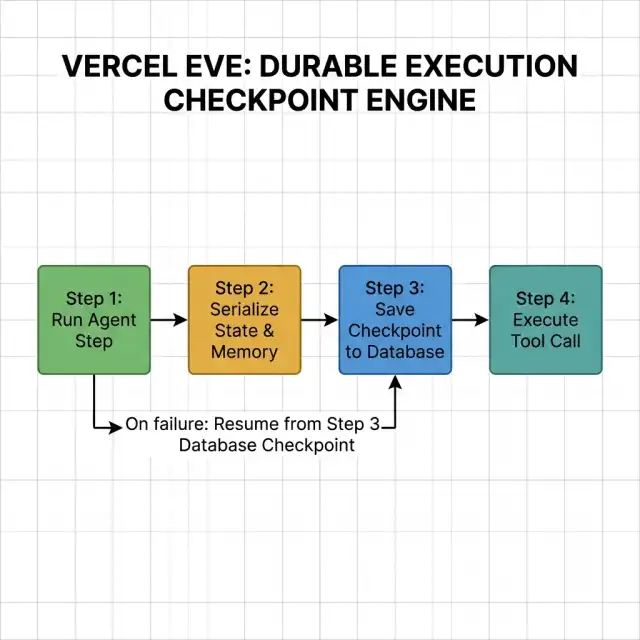
By integrating a durable checkpoint engine into the core runtime, eve simplifies the creation of reliable agentic pipelines. Developers can build multi-step agents that run for hours or days, knowing the framework will handle state recovery and process resume operations automatically behind the scenes.
Embracing the Model Context Protocol (MCP)
As the industry moves toward standardized agent communication, Vercel has built native support for the open Model Context Protocol (MCP) directly into eve. This protocol allows agents to discover and connect to external developer tools, database services, and enterprise APIs using a standardized interface.
Through MCP integration, an eve agent can connect to external services without custom integration code. This standards-based approach helps developers build modular agents that can easily adapt to new tools and models as the AI ecosystem evolves.
What to Watch Next
- Vercel Platform Integration: While eve is open-source and can run on any infrastructure, Vercel will likely launch specialized hosting features on its own platform. Watch for the release of managed durable execution runtimes and real-time agent observability dashboards in the Vercel console.
- Ecosystem Libraries and Presets: To compete with richer frameworks, eve needs a robust ecosystem of pre-built tools and connectors. Watch for Vercel to release official integrations for common databases, authentication services, and vector search engines.
- Next.js Deep Integration: Look for future updates to Next.js that introduce native support for eve agents, such as specialized React Server Components or API route handlers designed specifically for streaming agent responses to frontend interfaces.
Source
Official documentation: eve framework docs
Related on shahvatsal.com:
- Model Context Protocol (MCP) 1.0: The New Standard for Agentic Tool Integration
- Multi-Agent Orchestration 2026: Architectures, Frameworks, and Trade-offs
