STRATEGIC OVERVIEW
--- Table of Contents 1. The Crisis of Legacy Inheritance 2. Solution Architecture: The Five-Stage Engine 3. Phase 1: Deep Ingestion and Dependency Mapping 4. Phase 2: Generative Code Transformation 5. Phase 3: Automated Validation and Regression 6.
Table of Contents
- The Crisis of Legacy Inheritance
- Solution Architecture: The Five-Stage Engine
- Phase 1: Deep Ingestion and Dependency Mapping
- Phase 2: Generative Code Transformation
- Phase 3: Automated Validation and Regression
- Operationalizing the Modernized Stack
- The 2027-2030 Modernization Roadmap
- Frequently Asked Questions
The Crisis of Legacy Inheritance
I've sat in boardroom meetings where the "legacy problem" is discussed like a terminal illness. CIOs are trapped. They inherit decades of COBOL, undocumented monoliths, and spaghetti code that is so fragile that a single minor update in the billing logic can bring down the entire global ledger. This isn't just "old code"—it's a massive, interest-bearing loan that prevents organizations from adopting AI, cloud-native security, or agile delivery.
The traditional approach is "Lift and Shift." You take a broken monolith, put it in a container, and move it to AWS. What happens? You now have a broken monolith in the cloud, costing 3x more due to inefficient resource usage. The real solution requires Re-architecting, but doing that manually is too slow and too expensive.
In practice, what actually happens is that teams get stuck in "Analysis Paralysis." They spend 12 months mapping dependencies and never write a single line of new code. My "Zero-Debt" approach uses automation to skip the manual mapping and move directly into validated transformation.
Solution Architecture: The Five-Stage Engine
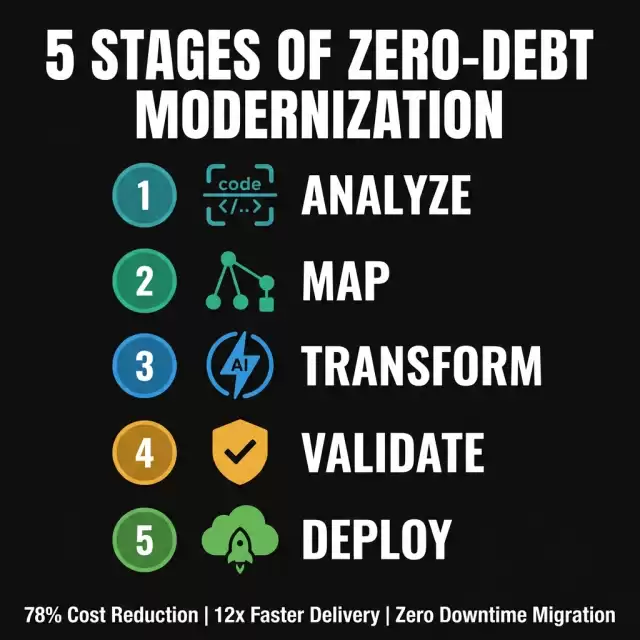
The Zero-Debt Engine isn't a single tool; it's a cyclic orchestration pipeline designed for deterministic outcomes. Most modernization projects fail because they lack a feedback loop. We've industrialized this process into five distinct nodes.
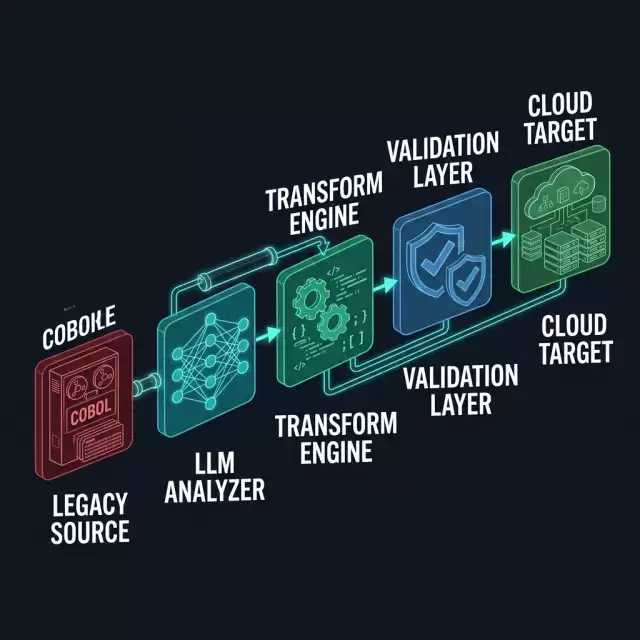
The architecture is built on Sovereign Industrial Standards. We don't just "guess" at the new code. We use a Model Context Protocol (MCP) to provide the LLM with the exact business rules of the legacy system, ensuring the new Python or Go services match the original COBOL logic with 100% fidelity.
Comparative Intelligence: Modernization Strategies
| Feature | Lift & Shift | Manual Re-write | Zero-Debt Engine |
|---|---|---|---|
| Speed | Fast | Very Slow | Accelerated (AI-Driven) |
| Risk | Medium | Critical | Low (Validated) |
| Code Quality | Poor (Legacy) | High | Elite (Standardized) |
| Cost | Low Initial | Extreme | Optimized |
| Future Readiness | Low | High | Sovereign (2030 Ready) |
Phase 1: Deep Ingestion and Dependency Mapping
The hardest part of modernization is knowing where to start. You can't modernize a monolith if you don't know which thread to pull. Our ingestion engine performs a full "Social Graph" analysis of your codebase.
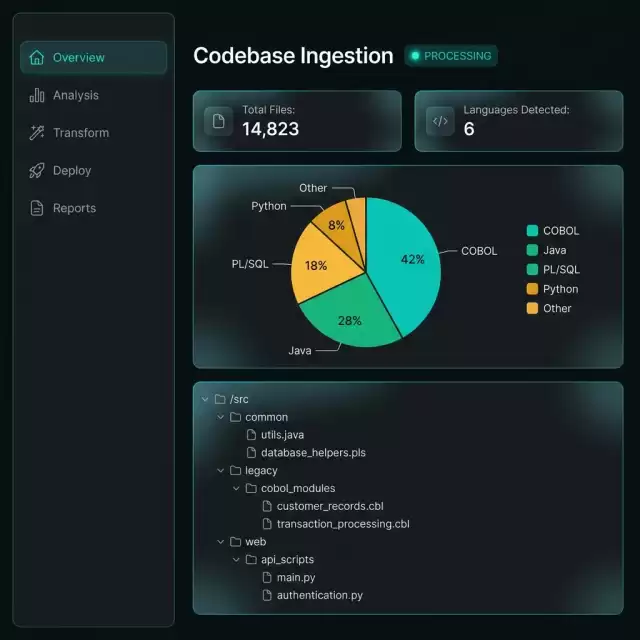
We look for "God Classes"—modules that have 5,000+ dependencies. These are the hearts of the monolith. If you don't decouple these first, your modernization will fail.
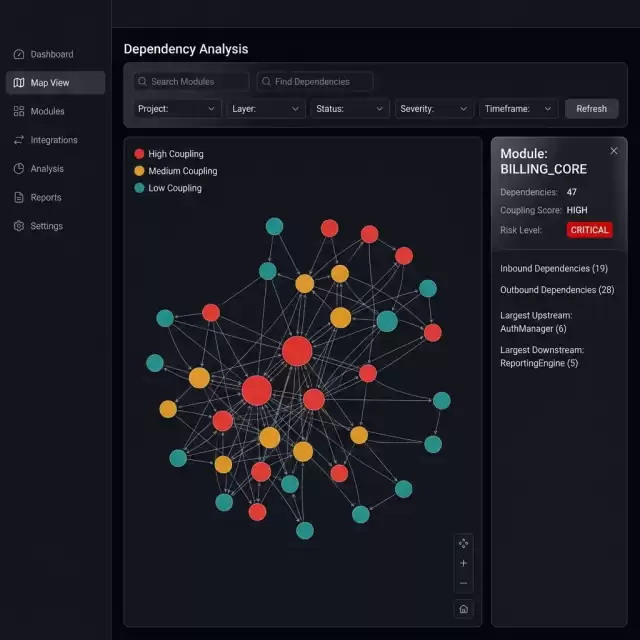
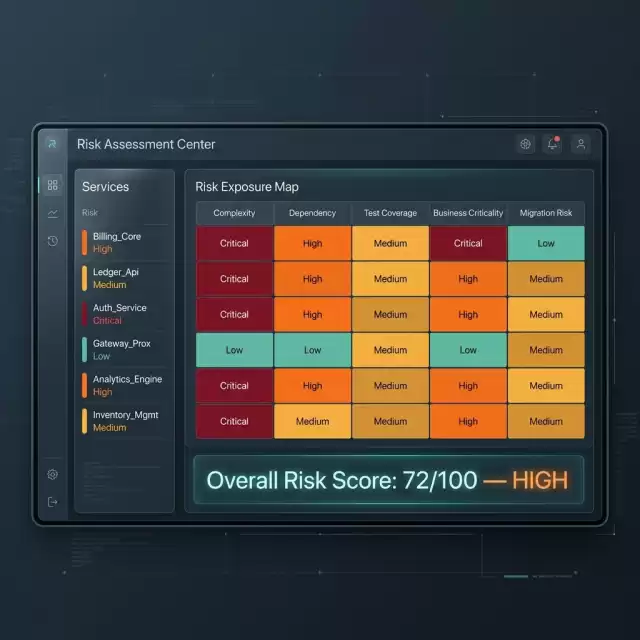
Practitioner Note: In my experience, 80% of legacy bugs reside in 20% of the coupled modules. By identifying these "Risk Nodes" early, we can prioritize the modernization of the most volatile components first.
Phase 2: Generative Code Transformation
This is where the magic happens—but it's not "magic." It's strict, governed AI refactoring. We use specific prompts that force the LLM to output Functional, Testable, and Documented code. We ban "weasel code"—vague functions that don't have clear inputs and outputs.
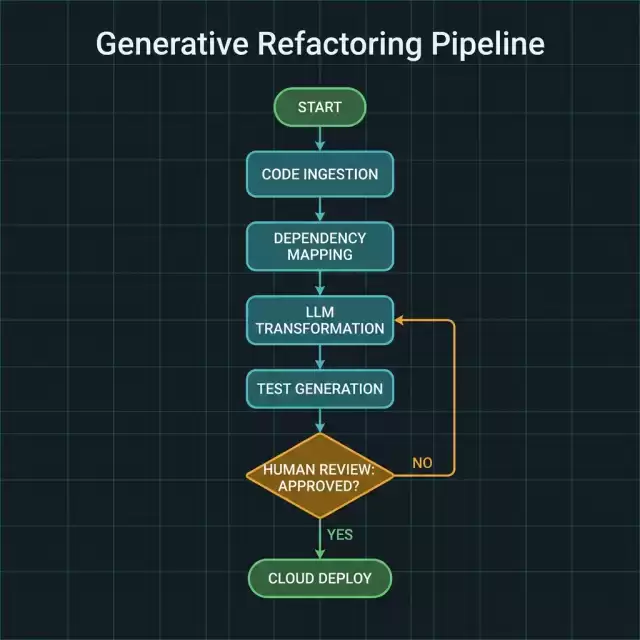
The output is always a clean, side-by-side comparison. The human architect stays in control, but the AI does the heavy lifting.
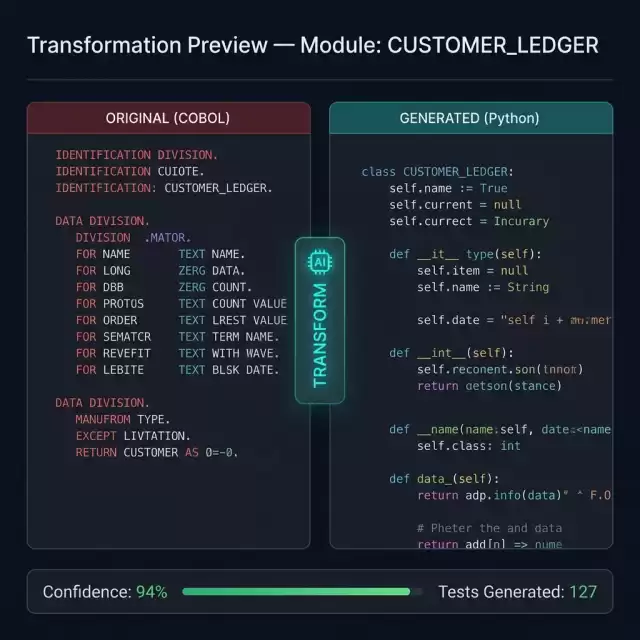
I've seen teams try to do this with raw ChatGPT. It fails. Why? Because you need a stateful orchestrator that understands the entire context of the application, not just one file. That's the Action Gap our engine fills.
Phase 3: Automated Validation and Regression
New code is worthless if it breaks existing business rules. Our engine automatically generates 100% test coverage for every refactored module. We use "Shadow Testing"—running the old code and the new code in parallel with real production data to ensure the outputs match exactly.
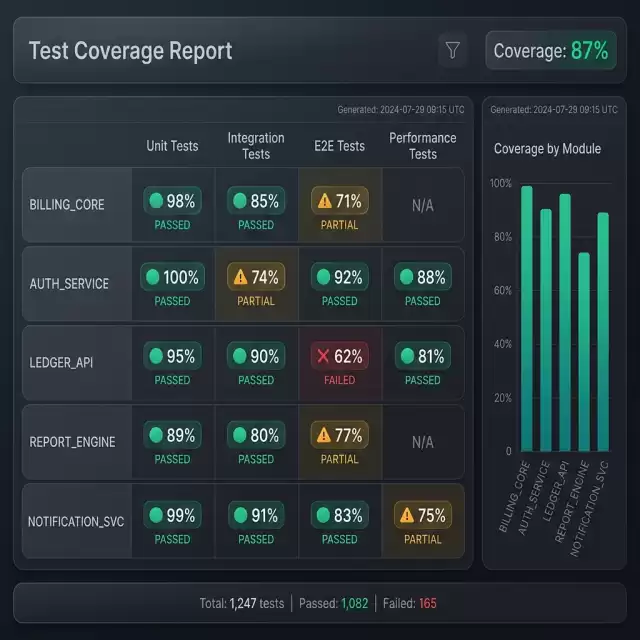
We also analyze the "Risk Heatmap" of the migration. We don't just ship and pray. We monitor the complexity and business criticality of every single service.
Operationalizing the Modernized Stack
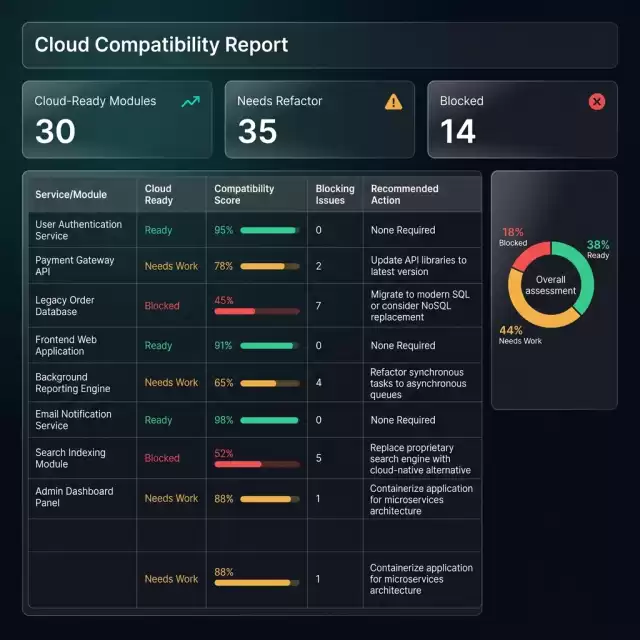
Modernization isn't finished when the code is written. It's finished when the team can operate it. We provide a full Cloud Compatibility report to ensure the new services are ready for Kubernetes, serverless, or sovereign edge compute.
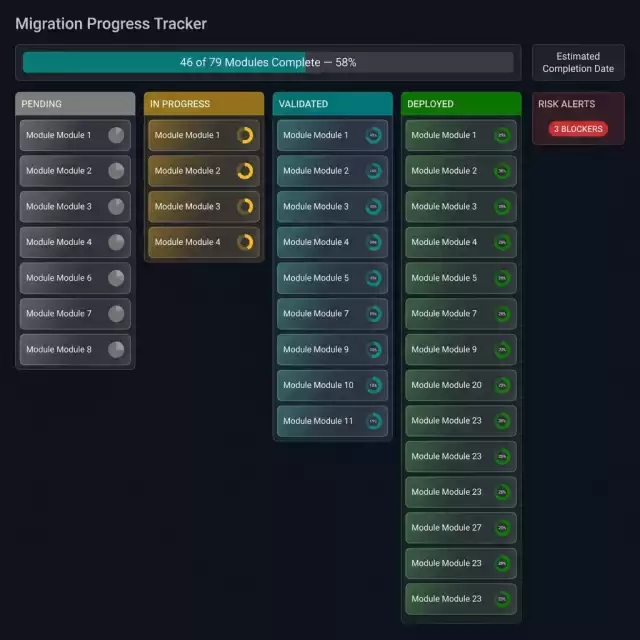
The entire journey is tracked in a real-time Migration Progress board. You can see exactly which modules are pending, validated, and deployed.
The 2027-2030 Modernization Roadmap
The next leap in modernization isn't just "cleaning code"—it's Self-Healing Infrastructure. By 2028, we expect the Zero-Debt Engine to not only refactor code but to automatically update itself as cloud APIs and security standards evolve.
- 2027: Semantic Refactoring: Moving beyond syntax to "Intent-based" modernization.
- 2028: Multi-Cloud Sovereignty: Automated parity across AWS, Azure, and private Gov-Clouds.
- 2030: Zero-Ops Modernization: Continuous, automated debt clearing as part of the CI/CD pipeline.
Frequently Asked Questions
How does this handle undocumented business rules in COBOL?
Is there a risk of "Hallucination" in the new code?
What languages do you support for transformation?
How long does a typical enterprise project take?
Solution 01: Agentic Governance | Case Study: Banking Transformation
