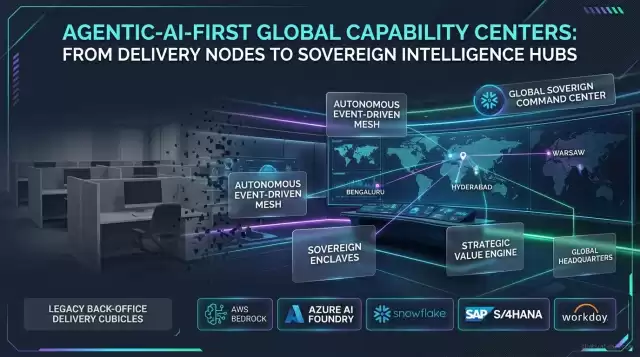
The era of Global Capability Centers (GCCs) competing on low-cost labor arbitrage is over. EY's 2026 enterprise research reveals the new paradigm: next-generation GCCs are Agentic-AI-First by design. Explore how Fortune 500 multinationals transform offshore delivery centers into sovereign intelligence hubs running autonomous multi-agent meshes, event-driven orchestration, and cross-border regulatory enclaves.
Executive Summary: The Structural Collapse of the Labor Arbitrage Model
For over a quarter of a century, the economic justification for the Global Capability Center (GCC)—formerly termed Global In-House Centers (GICs) or offshore shared services—rested on a single, uncomplicated variable: labor cost arbitrage. Multinational corporations in North America and Western Europe established sprawling operational campuses across Bengaluru, Hyderabad, Manila, Warsaw, and Guadalajara to capture 60% to 75% wage discounts on transactional back-office workloads: accounts payable data entry, level-1 IT ticket routing, standard HR onboarding, and manual compliance reporting.
By early 2026, that traditional economic thesis suffered a terminal structural failure.
The convergence of double-digit technical wage inflation in primary offshore hubs, enterprise attrition rates exceeding 22%, escalating geopolitical cross-border data mandates (such as the EU AI Act, DORA, and India's DPDP Act), and the emergence of production-grade autonomous multi-agent AI systems has permanently eroded the value proposition of human-centric labor arbitrage.
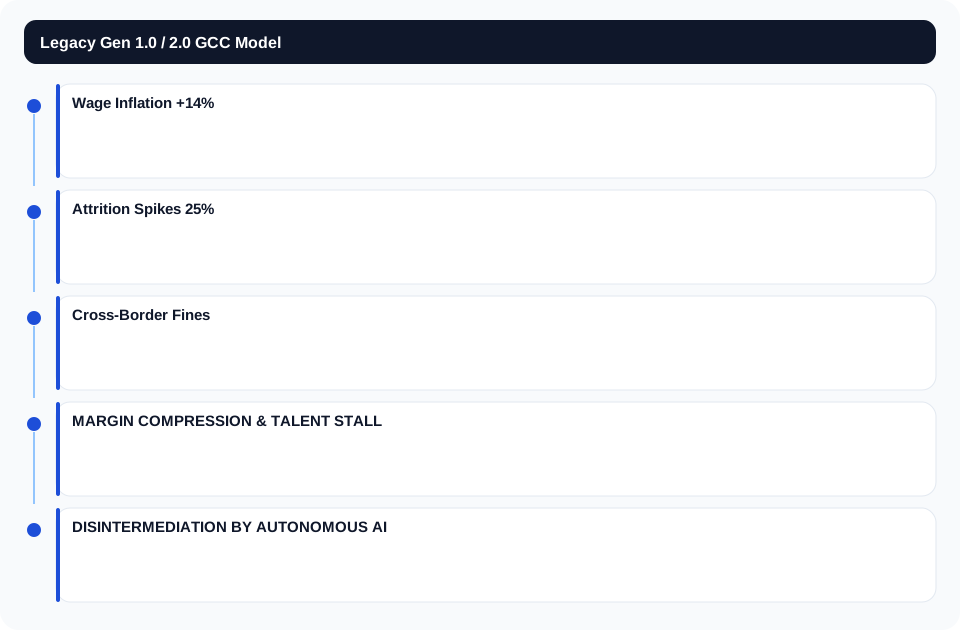
As highlighted in Ernst & Young's (EY) 2026 Global Capability Center Thesis, leading enterprises have concluded that:
"Next-generation GCCs cannot merely be 'digital-first' or 'AI-enabled' overlays on top of legacy processes. The GCC of 2026 and beyond must be Agentic-AI-First by design. Artificial intelligence is no longer an employee co-pilot; it is the core execution fabric of the enterprise, while the global human workforce shifts permanently from repetitive transactional execution to cognitive governance, domain systems architecture, and supervisory oversight."
When an autonomous multi-agent system can execute end-to-end 3-way invoice matching in SAP S/4HANA in 4 seconds for \$0.04 in token compute—compared to a human offshore team taking 48 hours and \$12.50 per ticket—the enterprise does not require 500 transactional clerks in an offshore delivery center.
Instead, the enterprise requires a Sovereign Intelligence Hub: a high-leverage organizational node where specialized cross-functional squads design, govern, fine-tune, and orchestrate autonomous agent meshes that execute core business processes with microsecond velocity.
This definitive technical and strategic playbook outlines the operational, architectural, and financial blueprints required by corporate boards, Chief Information Officers (CIOs), Chief Operating Officers (COOs), and GCC Managing Directors transitioning to an Agentic-AI-First Operating Model.
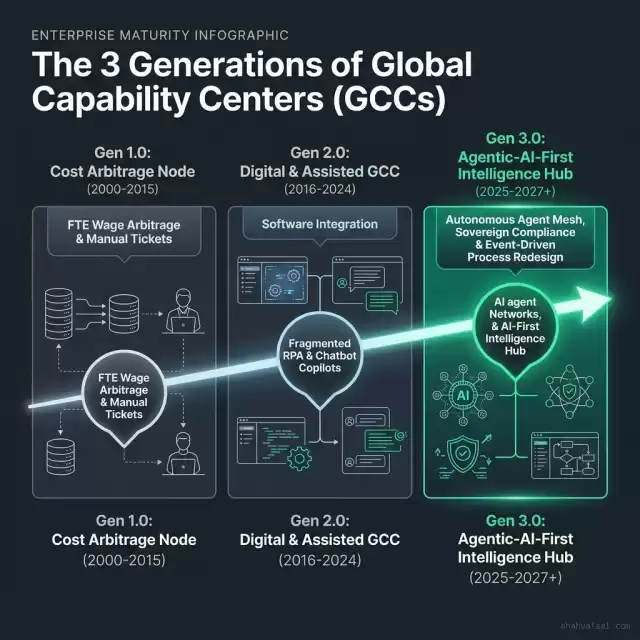
The Three Generations of Global Capability Centers (GCC Evolution Maturity Model)
To understand the strategic magnitude of this inflection point, enterprise leaders must trace the generational evolution of the GCC organizational structure over the past two decades.
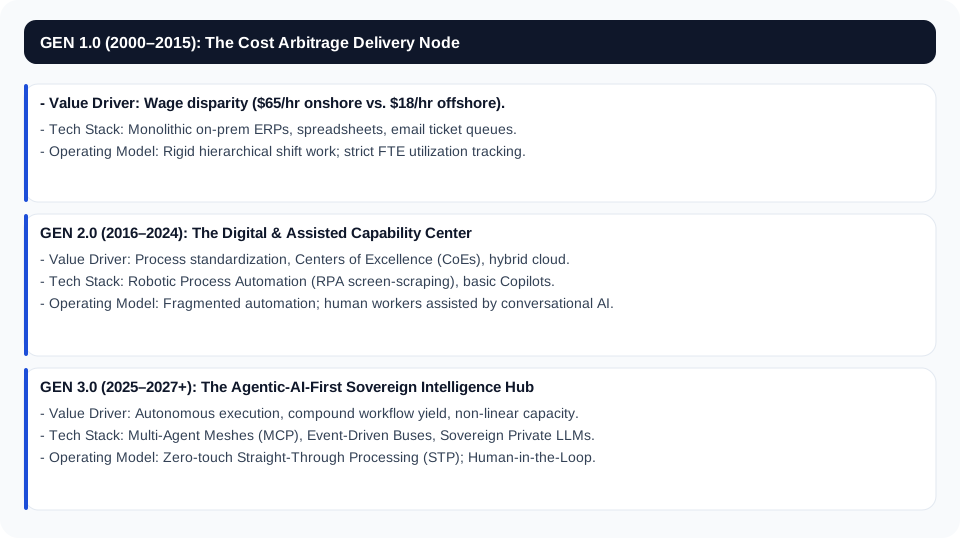
Generational Comparative Topology
| Architectural Vector | Gen 1.0: Cost Arbitrage Node | Gen 2.0: Digital/Assisted GCC | Gen 3.0: Agentic Intelligence Hub |
|---|---|---|---|
| Primary Value Metric | Blended cost per FTE hour saved | Cost savings + Process SLA adherence | Intelligence Velocity & Margin bps |
| Execution Layer | 100% Manual Human Labor | 75% Human Labor + 25% RPA/Copilot | 85%+ Autonomous Multi-Agent Mesh |
| Human Role | Repetitive task keyboard entry | Manual reviewer & chatbot prompter | Cognitive Supervisor & Workflow Architect |
| Process Model | Batch-processed sequential tickets | Hybrid digital queue routing | Real-Time Event-Driven Streaming |
| Data Governance | Unencrypted cross-border exports | Perimeter VPNs + Role-based ACLs | Sovereign Private Enclaves (Zero-Egress) |
| Headcount Scaling | Linear ($1\times \text{Volume} = 1\times \text{FTEs}$) | Quasi-linear ($1\times \text{Volume} = 0.7\times \text{FTEs}$) | Asymptotic ($10\times \text{Volume} = 1.05\times \text{FTEs}$) |
In Gen 3.0, the traditional distinction between "headquarters business domain" and "offshore delivery center" evaporates. The GCC becomes the co-inventor and principal governor of the company’s operating algorithms.
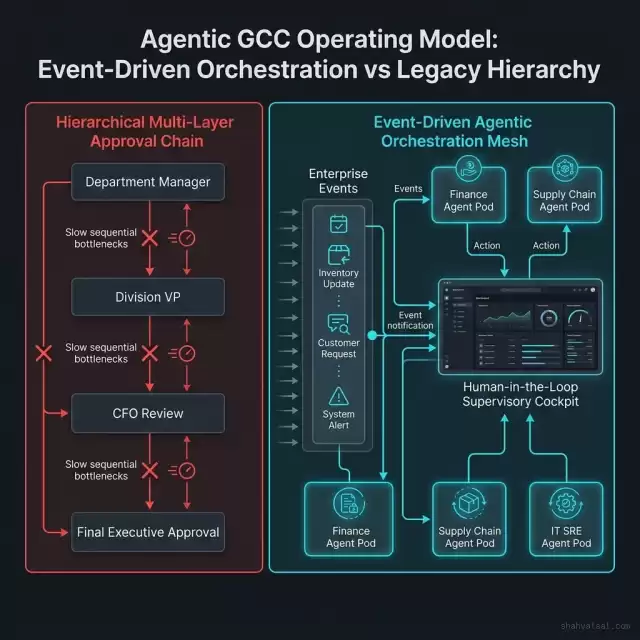
The Agentic Operating Model: Event-Driven Orchestration vs. Hierarchical Approval Chains
The operational architecture of traditional Gen 1.0 and Gen 2.0 GCCs is deeply bureaucratic. A transactional event (e.g., an invoice discrepancy, an employee relocation request, or a security vulnerability alert) enters an administrative queue, gets assigned to a junior analyst, passes to a team lead for review, ascends to a regional manager for sign-off, and finally reaches global headquarters for financial disbursement.
This sequential approval chain creates catastrophic latency:
$$\text{Total Processing Time} = \sum_{i=1}^N \Big( \text{Queue Wait}_i + \text{Review Duration}_i + \text{Handshake Overhead}_i \Big)$$
In modern digital enterprises, where market volatility and customer expectations operate in seconds, multi-day approval latency destroys competitive advantage.
The Event-Driven Agentic Orchestration Mesh
The Gen 3.0 GCC replaces rigid, hierarchical ticketing queues with an Event-Driven Agentic Orchestration Mesh.
Under this architecture, business systems of record (SAP S/4HANA, Workday, Salesforce, Datadog) publish granular state changes to an enterprise message bus (Apache Kafka, AWS EventBridge, or Google Cloud Pub/Sub). Dedicated Autonomous Agent Pods subscribe to these event streams, instantiate multi-step cognitive reasoning graphs, invoke enterprise APIs via the Model Context Protocol (MCP), and resolve transactions autonomously.
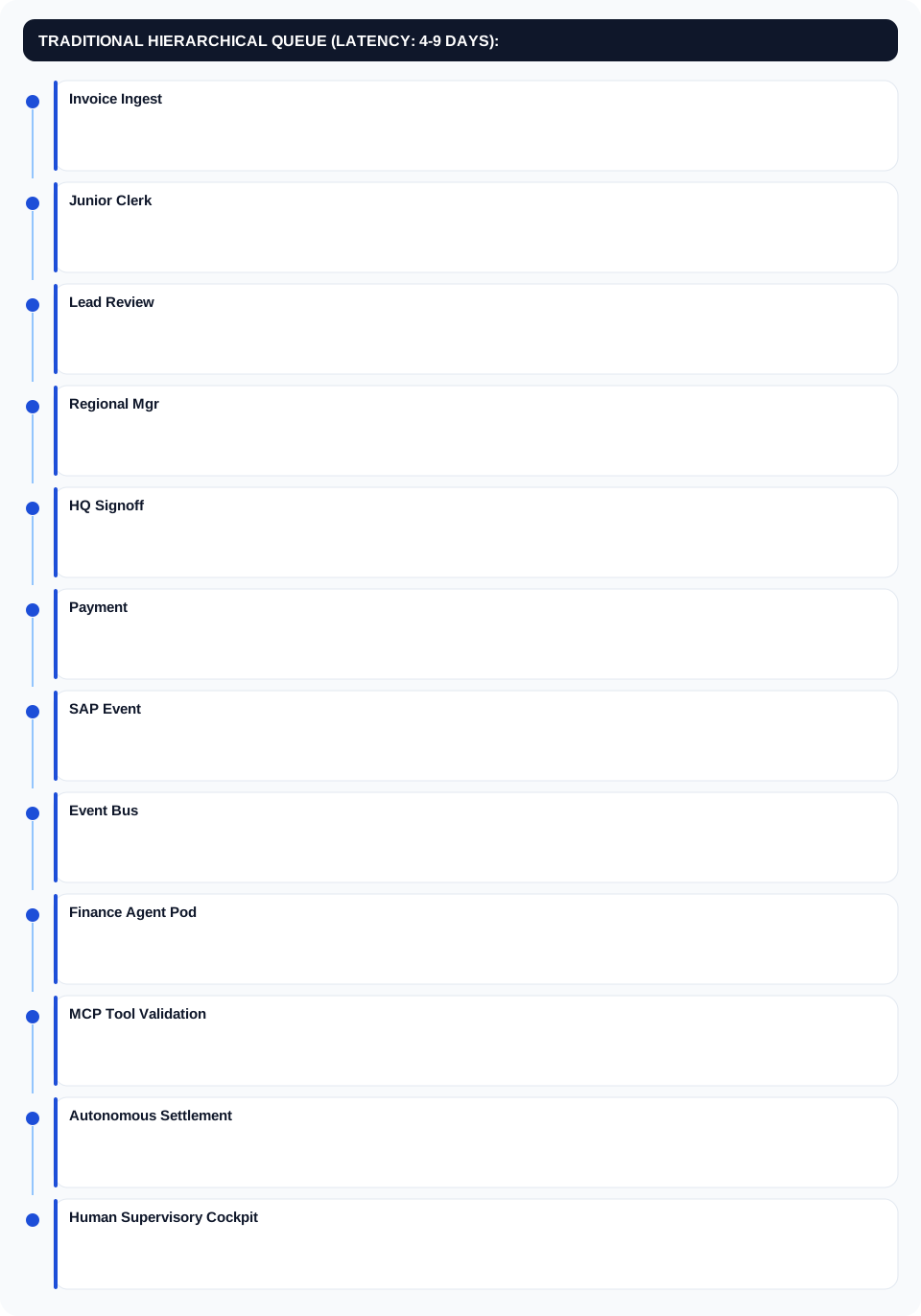
The Human-in-the-Loop Supervisory Cockpit
Human workers in an Agentic GCC do not perform mechanical data entry. Instead, they operate from a unified Supervisory Cockpit:
- Exception Triage: The agent mesh resolves 85% to 92% of transactions with zero human intervention. When confidence scores dip below acceptable thresholds (e.g., $<98.5\%$) or when regulatory policy limits are exceeded, the transaction pauses and surfaces in the Supervisory Cockpit with a pre-compiled explanation, evidentiary citations, and recommended actions.
- Behavioral Steering & Prompt Refinement: Supervisory operators observe agent failure modes in real time, refining system prompts and updating domain edge-case rules to prevent recurring exceptions.
- Synthetic Evaluation Generation: Supervisors turn resolved edge cases into synthetic test vectors added to the CI/CD golden evaluation dataset.
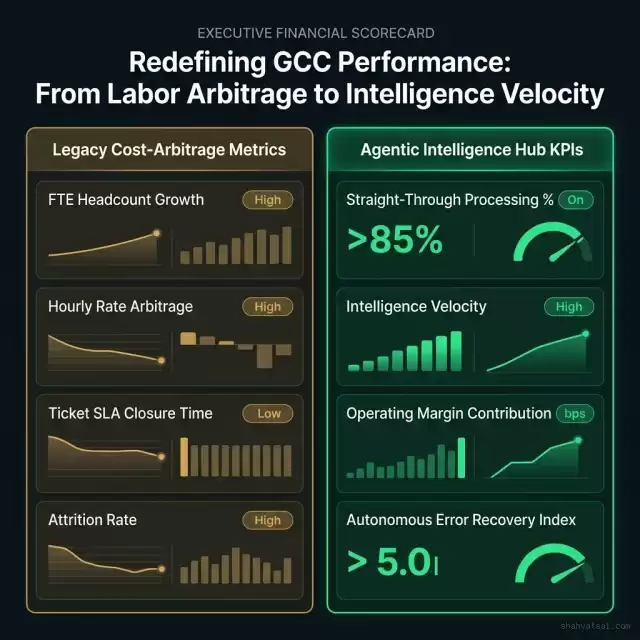
Redefining GCC KPIs: From Labor Arbitrage to Intelligence Velocity
For over twenty years, GCC executive scorecards were dominated by input-based, capacity-oriented metrics: Total Headcount Added, Seat Utilization, Blended Cost per Hour, and Ticket SLA Adherence. In an Agentic-AI-First GCC, these metrics are completely obsolete. Measuring an AI-native organization by headcount added is akin to evaluating a cloud infrastructure provider by the number of physical server racks its technicians manually assemble.
Enterprise boards in 2026 evaluate GCC performance across four High-Leverage Intelligence Metrics:
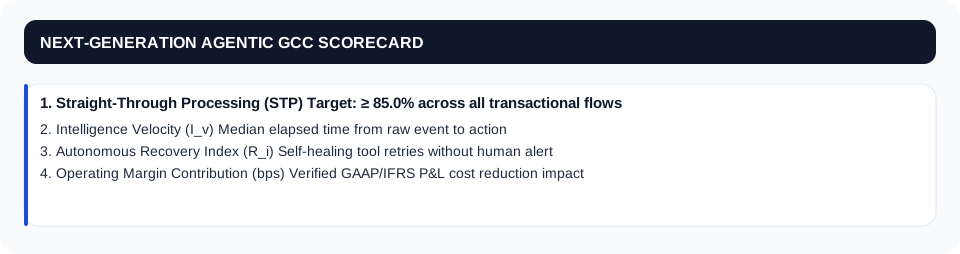
Mathematical Formulations of Agentic GCC Performance
1. Intelligence Velocity Index ($I_v$)
Intelligence Velocity measures how rapidly the capability center translates raw operational entropy into validated business execution:
$$I_v = \frac{\mathcal{C}{\text{Complexity}}(\text{Workflow})}{\mathbb{E}[T{\text{Ingest}\to\text{Action}}] \cdot \big(1 - \Phi_{\text{Error Rate}}\big)}$$
Where:
- $\mathcal{C}_{\text{Complexity}}$ represents the cyclomatic and cognitive complexity score of the business process.
- $\mathbb{E}[T_{\text{Ingest}\to\text{Action}}]$ is the expected end-to-end elapsed time in seconds.
- $\Phi_{\text{Error Rate}}$ is the post-settlement reconciliation error rate.
2. Autonomy Yield & Compound Scaling Factor ($A_y$)
Autonomy Yield calculates the economic leverage factor of the GCC workforce:
$$A_y = \frac{\mathcal{V}{\text{Transactions Processed}}}{\mathcal{N}{\text{Human Supervisors}} \times \overline{\mathcal{W}}{\text{Loaded Cost}}} \times \left( \frac{\text{STP}{\text{Rate}}}{1 - \text{STP}_{\text{Rate}}} \right)$$
As the Straight-Through Processing rate $\text{STP}_{\text{Rate}} \to 0.95$, the Autonomy Yield scales asymptotically, enabling the GCC to absorb a $10\times$ surge in enterprise transaction volume with near-zero incremental payroll overhead.
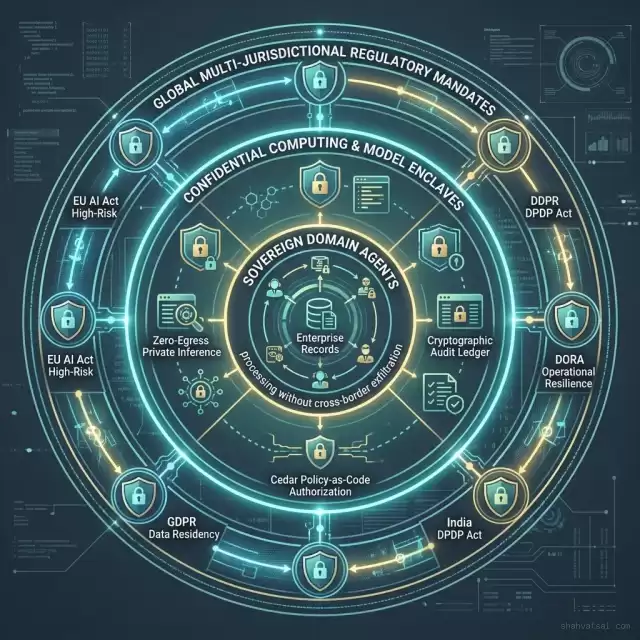
Sovereign Intelligence & Cross-Border Regulatory Resilience
As GCCs transition from low-risk transactional data entry to executing high-stakes business processes, they become exposed to an intricate web of global regulatory mandates:
- European Union AI Act (High-Risk Systems): Mandates rigorous technical documentation, risk management systems, fundamental rights impact assessments (FRIA), and human oversight for AI systems used in credit scoring, employment recruiting, and critical infrastructure management.
- European Union DORA (Digital Operational Resilience Act): Imposes strict business continuity, third-party ICT risk oversight, and incident reporting rules on financial institutions and their capability centers.
- India Digital Personal Data Protection (DPDP) Act: Imposes strict penalties (up to ₹250 Crore per incident) for unconsented cross-border exfiltration or processing of personal digital identifiers.
- United States HIPAA & SOX Mandates: Strict cryptographic separation of healthcare records and immutable audit logging for corporate financial close workflows.
The Sovereign Enclave Architecture
To insulate the enterprise against catastrophic regulatory penalties, the Agentic GCC deploys a Sovereign Intelligence & Confidential Computing Framework:
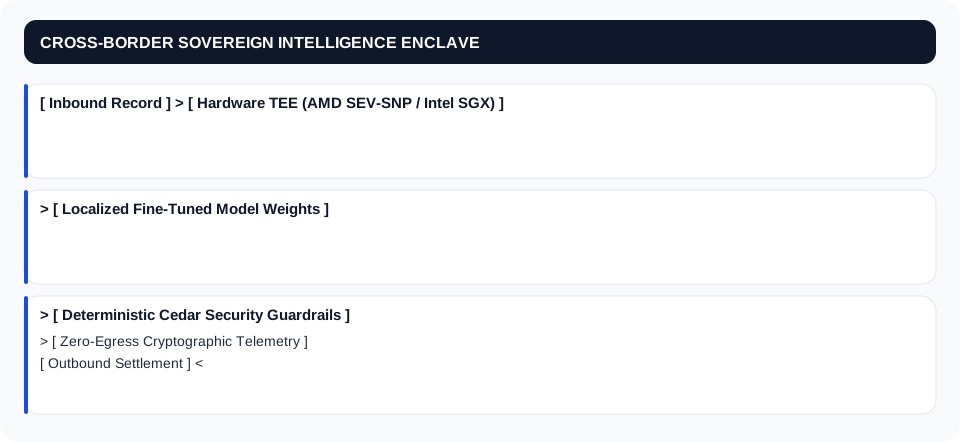
- Hardware Trusted Execution Environments (TEEs): Agent pods run inside confidential virtual machines (such as AWS Nitro Enclaves or Azure Confidential Computing) utilizing hardware-level memory encryption. Even cloud infrastructure administrators or local GCC sysadmins cannot inspect plaintext prompt context or customer records.
- Zero-Egress Localized Inference: PII/PHI-sensitive records never leave the sovereign boundary. High-performance open-weights models (such as Meta Llama 4 405B or Mistral Large 2) are hosted within in-country private cloud regions, fine-tuned specifically on local regulatory statutes.
- Cedar Policy-as-Code Authorization: Every autonomous tool invocation is verified in real-time by a deterministic Cedar Policy Decision Point (PDP). If an agent attempts to execute an action violating cross-border data transfer rules, the hardware policy engine intercepts the call and forces execution into local sovereign storage.
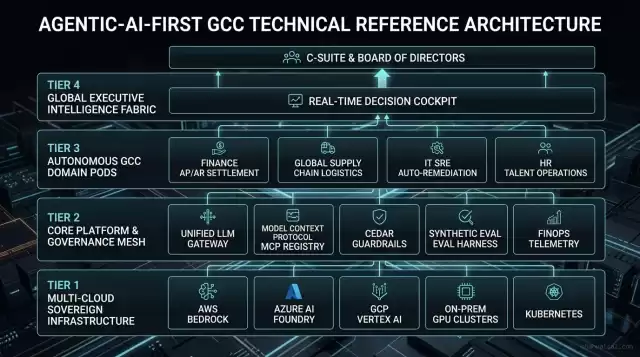
Enterprise Technical Reference Architecture for Agentic GCCs
To operationalize the agentic capability center, enterprise architects must implement a robust 4-tier system blueprint that spans multi-cloud infrastructure, unified governance meshes, domain agent pods, and executive decision fabrics.
Tier 1: Multi-Cloud Sovereign Infrastructure Plane
- Foundational Compute: Hardened Kubernetes / OpenShift clusters provisioned across multi-cloud regions (AWS, Azure, GCP) and private on-premises GPU colocation centers (NVIDIA H100/B200 clusters).
- High-Throughput Event Streaming: Enterprise-grade Kafka and Pulsar clusters configured with active-active cross-region replication for sub-10ms event distribution.
Tier 2: Core Platform Mesh & Governance Plane
- Unified Foundation Model Gateway: Intelligent routing layer managing dynamic model selection across AWS Bedrock, Azure AI Foundry, Vertex AI, and private local vLLM instances with automatic semantic caching and rate limiting.
- Model Context Protocol (MCP) Server Hub: Enterprise registry of hardened, authenticated tool connectors exposing core corporate applications (SAP, Workday, ServiceNow, Salesforce, Snowflake) via standardized JSON-RPC protocols.
- Cedar Security Guardrails: Real-time Policy Decision Point (PDP) executing sub-millisecond RBAC and ABAC authorization checks on every agent tool invocation.
- Automated Synthetic Evaluation Harness: Continuous regression pipeline running 500+ golden test vectors against candidate agent graphs before production graduation.
- FinOps Telemetry Engine: Real-time token tracking linking every model call to a specific GCC domain cost center.
Tier 3: Autonomous GCC Domain Pods
Decentralized autonomous squads executing high-impact business domains:
- Finance Autonomous Settlement Pod: Reconciles global vendor statements, resolves multi-currency FX discrepancies, and automates monthly balance sheet closing.
- Global Supply Chain Logistics Pod: Orchestrates multi-modal freight rerouting, tracks customs tariff compliance, and manages supplier risk indices.
- IT SRE & Cyber Auto-Remediation Pod: Triages distributed infrastructure alerts, correlates root-cause telemetry, and commits verified auto-remediation patches.
- Global HR Talent Operations Pod: Executes end-to-end recruitment pipelines, verifies technical candidate assessments, and coordinates multinational employee relocations.
Tier 4: Global Executive Intelligence Fabric
- Executive Command Cockpit: Bi-directional telemetry connecting the GCC directly to the global C-Suite and Board of Directors, streaming real-time operational margin contribution, risk heatmaps, and capacity forecasts.
The Transformed GCC Workforce: New Career Paths & Org Design
The transition to an Agentic-AI-First GCC does not signify the elimination of offshore talent; rather, it represents a massive upward elevation of human capital. The low-skill data entry clerk and script-following call center agent become obsolete, replaced by a new class of High-Leverage AI Professionals.
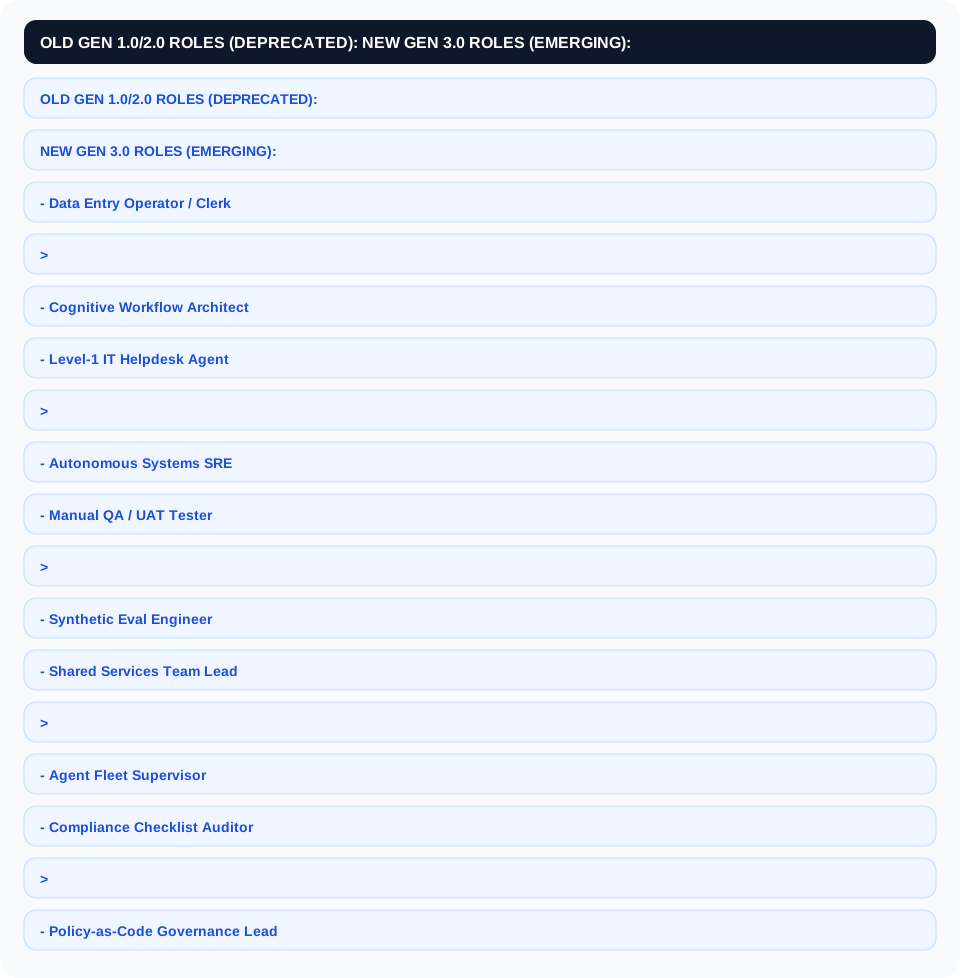
Detailed Profiles of the Emerging Roles
1. Cognitive Workflow Architect
- Mission: Deconstruct complex, cross-functional business processes and re-engineer them into directed acyclic graphs (DAGs) using frameworks like LangGraph, CrewAI, and Temporal.
- Core Skillset: Deep domain expertise in finance/supply chain coupled with state-machine design, prompt engineering, and MCP tool specification.
2. Synthetic Evaluation Engineer
- Mission: Curate, maintain, and generate high-entropy "Golden Datasets" that rigorously benchmark candidate agents against hallucination, tool-calling precision, and edge-case drift.
- Core Skillset: Statistical regression modeling, adversarial red-teaming, automated testing pipelines, and LLM-as-a-judge scoring frameworks.
3. Agent Fleet Supervisor
- Mission: Monitor production agent execution dashboards, resolve high-complexity human-in-the-loop exceptions, and continuously calibrate confidence thresholds.
- Core Skillset: Advanced domain judgment, rapid root-cause debugging, and exception pattern recognition.
Conservative Economic Modeling & Multi-Year P&L Impact
To justify the capital expenditure required to transition from a Gen 2.0 delivery center to a Gen 3.0 Agentic Intelligence Hub, finance leaders must build rigorous 3-year economic models that account for both infrastructure investments and structural cost-to-serve reductions.
Baseline vs. Agentic GCC Economic Model (3,000-Seat Center)
Consider a Fortune 500 manufacturing conglomerate operating a 3,000-seat global capability center in Hyderabad with an annual operating budget of \$120M.
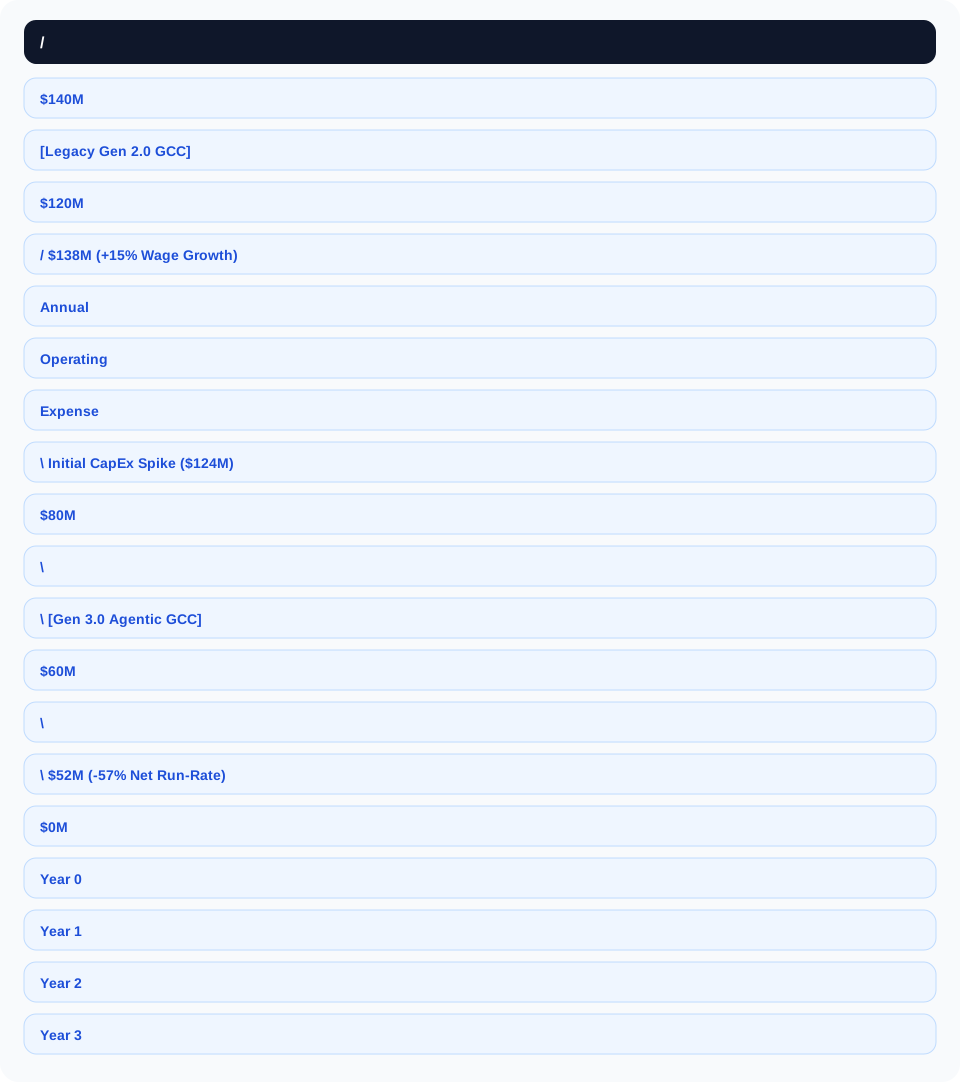
3-Year Audited Financial Waterfall
| Financial Vector | Year 0 (Legacy Baseline) | Year 1 (Migration & CapEx) | Year 2 (Scaling Agents) | Year 3 (Sovereign Hub) |
|---|---|---|---|---|
| Gross Transaction Volume | 100% (Baseline) | 130% | 185% | 280% |
| Human Headcount | 3,000 FTEs | 2,750 FTEs | 1,800 FTEs | 1,150 High-Skill FTEs |
| Payroll & Facility OpEx | \$108,000,000 | \$104,500,000 | \$72,000,000 | \$51,750,000 |
| Model Tokens & Cloud Compute | \$2,400,000 | \$9,800,000 | \$14,500,000 | \$18,200,000 |
| Platform CapEx (Tooling & GPUs) | \$9,600,000 | \$10,200,000 | \$4,100,000 | \$2,500,000 |
| Total Annual Center Cost | \$120,000,000 | \$124,500,000 | \$90,600,000 | \$72,450,000 |
| Unit Cost per Transaction | \$12.00 | \$9.58 | \$4.90 | \$2.59 (-78.4%) |
| Net Cumulative Free Cash Flow | \$0 | -\$4,500,000 | +\$24,900,000 | +\$72,450,000 |
Even under highly conservative assumptions—factoring in elevated LLM token consumption fees and hardware amortization—the Agentic GCC model delivers an audited net run-rate cost reduction of 40% to 57% while expanding total enterprise transaction processing capacity by 280%.
4-Phase Migration Roadmap: From Delivery Center to Sovereign Intelligence Hub
Transforming a traditional capability center into an agentic powerhouse requires an 18-month phased roadmap.
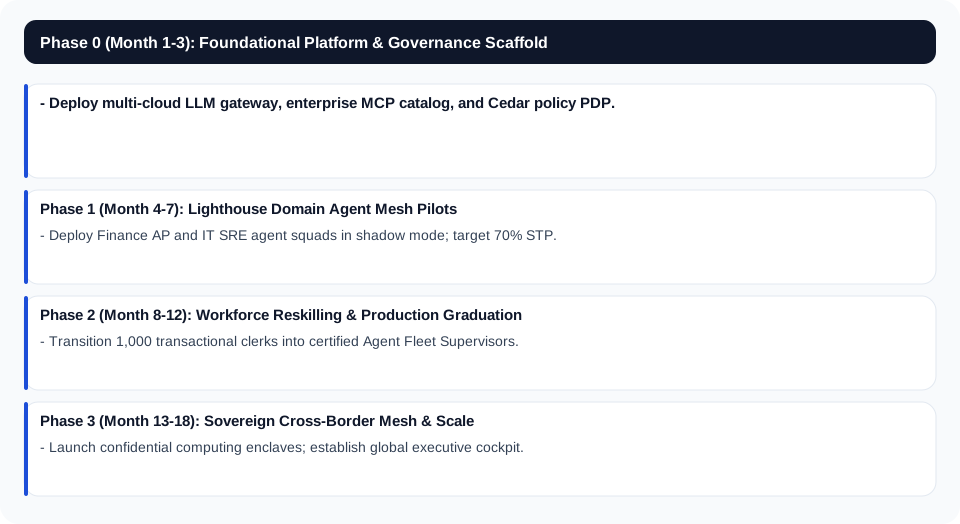
Transition Checklist for GCC Leaders
- [ ] **Phase 0: Architecture & Foundation (Months 1–3)**
  - [ ] Appoint GCC Head of Agentic Transformation reporting directly to Global CIO/COO.
  - [ ] Establish centralized AI Platform Engineering Core (8 senior distributed systems engineers).
  - [ ] Implement Model Context Protocol (MCP) server hub across SAP, Salesforce, and Workday.
  - [ ] Configure Cedar Policy Decision Point for deterministic, real-time tool authorization.

- [ ] **Phase 1: Lighthouse Pilots (Months 4–7)**
  - [ ] Target two high-volume, rules-heavy transactional processes (e.g., Accounts Payable, SRE).
  - [ ] Build multi-agent workflows using LangGraph and CrewAI with automated fallback.
  - [ ] Run in production shadow mode alongside human analysts for 60 consecutive days.
  - [ ] Verify straight-through processing rate exceeds 75% with zero Cedar policy violations.

- [ ] **Phase 2: Organizational Reskilling (Months 8–12)**
  - [ ] Roll out Enterprise Agent Developer & Supervisor Certification across entire GCC staff.
  - [ ] Deprecate mechanical SLA ticket tracking; implement real-time Intelligence Velocity dashboards.
  - [ ] Transition Tier-1 human support into cognitive supervisory review cockpits.
  - [ ] Sunset brittle legacy RPA scripts and replace with self-healing MCP connectors.

- [ ] **Phase 3: Sovereign Expansion (Months 13–18)**
  - [ ] Deploy hardware Trusted Execution Environments (TEEs) for confidential compute.
  - [ ] Integrate local regulatory models ensuring zero-egress compliance with GDPR, DORA, and DPDP.
  - [ ] Connect GCC telemetry directly into C-Suite and Boardroom decision cockpits.
Production Implementation Artifacts
To accelerate implementation, enterprise platform teams can deploy the following production-ready architectural templates.
1. Event-Driven Agentic GCC Orchestration Gateway (Python / FastAPI)
"""
Agentic-AI-First GCC Event-Driven Orchestration Gateway
Listens to enterprise state change events and dispatches autonomous agent pods.
"""

from fastapi import FastAPI, HTTPException, BackgroundTasks, Header
from pydantic import BaseModel, Field
import structlog
import time
import httpx
from typing import Dict, Any, Optional

logger = structlog.get_logger()
app = FastAPI(title="GCC Agentic Orchestration Mesh", version="3.0.0")

class EnterpriseEvent(BaseModel):
    event_id: str = Field(..., description="Unique event identifier")
    source_system: str = Field(..., description="'SAP_S4HANA', 'WORKDAY', 'SERVICENOW'")
    domain: str = Field(..., description="'Finance', 'SupplyChain', 'IT_Ops', 'HR'")
    payload: Dict[str, Any]
    priority: str = "P2"

async def execute_agentic_workflow(event: EnterpriseEvent):
    start_time = time.perf_counter()
    logger.info("instantiating_agent_pod", event_id=event.event_id, domain=event.domain)

    # 1. Simulate Agent Reasoning Loop & MCP Tool Invocation
    # In production: LangGraph / CrewAI workflow compiled with Cedar guardrails
    confidence_score = 0.992
    discrepancy_amount = event.payload.get("amount_usd", 1250.00)

    # 2. Straight-Through Processing (STP) Decision Gate
    if confidence_score >= 0.985 and discrepancy_amount <= 5000.00:
        stp_status = "AUTONOMOUS_SETTLEMENT"
        human_intervention = False
    else:
        stp_status = "ESCALATED_TO_SUPERVISORY_COCKPIT"
        human_intervention = True

    latency_ms = round((time.perf_counter() - start_time) * 1000, 2)

    # 3. Emit Intelligence Velocity Telemetry
    logger.info(
        "gcc_workflow_completed",
        event_id=event.event_id,
        domain=event.domain,
        stp_status=stp_status,
        human_escalation=human_intervention,
        latency_ms=latency_ms,
        confidence=confidence_score
    )

@app.post("/v1/events/ingest")
async def ingest_enterprise_event(event: EnterpriseEvent, background_tasks: BackgroundTasks):
    background_tasks.add_task(execute_agentic_workflow, event)
    return {
        "status": "ACCEPTED",
        "event_id": event.event_id,
        "dispatched_to_pod": f"{event.domain}_AutonomousPod"
    }
2. Sovereign Cross-Border Data Residency Guardrail (Cedar Policy)
// Enterprise Cedar Policy for GCC Sovereign Intelligence Hub
// Governs Cross-Border Data Transfer and PII Access between Offshore GCC and HQ

// 1. Permit GCC Finance Agents to read localized EU financial records ONLY within confidential enclaves
permit (
    principal in Role::"GCC_AutonomousFinanceAgent",
    action in [Action::"ReadInvoice", Action::"ReconcileDiscrepancy", Action::"MatchPurchaseOrder"],
    resource in ResourceType::"EU_FinancialRecord"
)
when {
    context.execution_environment == "ConfidentialEnclave" &&
    context.data_sovereignty_region == "EU-Central" &&
    principal.sovereign_certification == "Valid"
};

// 2. Strict Forbid on cross-border data exfiltration of unmasked employee personal data
forbid (
    principal in Role::"GCC_Agent",
    action == Action::"ExportDataCrossBorder",
    resource in ResourceType::"PersonalData_PII"
)
unless {
    context.anonymized_format == "DifferentialPrivacy_k5" &&
    context.jurisdiction_approval == true
};
3. GCC Intelligence Velocity & Autonomy Database Schema (PostgreSQL)
-- Sovereign Intelligence Hub KPI & Telemetry Database

CREATE TABLE fact_gcc_agent_transactions (
    transaction_id VARCHAR(64) PRIMARY KEY,
    event_timestamp TIMESTAMP WITH TIME ZONE DEFAULT CURRENT_TIMESTAMP,
    domain_pod VARCHAR(64) NOT NULL,          -- 'Finance', 'SupplyChain', 'IT_Ops'
    source_system VARCHAR(64) NOT NULL,       -- 'SAP_S4HANA', 'WORKDAY'
    elapsed_time_seconds NUMERIC(8, 3) NOT NULL,
    straight_through_flag BOOLEAN NOT NULL,
    human_supervisor_id VARCHAR(64),          -- NULL if straight-through
    confidence_score NUMERIC(5, 4) NOT NULL,
    sovereign_enclave_flag BOOLEAN DEFAULT TRUE,
    estimated_token_cost_usd NUMERIC(10, 6) NOT NULL,
    manual_baseline_cost_usd NUMERIC(10, 4) NOT NULL,
    net_margin_contribution_usd NUMERIC(10, 4) NOT NULL
);

-- Executive View: Real-Time Intelligence Velocity & STP Yield
CREATE VIEW view_gcc_executive_cockpit AS
SELECT
    domain_pod,
    DATE_TRUNC('week', event_timestamp) AS reporting_week,
    COUNT(transaction_id) AS total_events_processed,
    ROUND(AVG(straight_through_flag::INT) * 100, 2) AS stp_rate_percent,
    ROUND(AVG(elapsed_time_seconds), 2) AS mean_latency_seconds,
    ROUND(SUM(net_margin_contribution_usd), 2) AS total_operating_margin_contribution,
    ROUND(SUM(net_margin_contribution_usd) / NULLIF(SUM(estimated_token_cost_usd), 0), 2) AS token_roi_multiple
FROM fact_gcc_agent_transactions
GROUP BY 1, 2;
Frequently Asked Questions (FAQ)
What is the fundamental difference between an "AI-Enabled GCC" and an "Agentic-AI-First GCC"?
An AI-Enabled GCC (Gen 2.0) simply equips existing human employees with conversational copilots or screen-scraping RPA bots; the primary execution layer remains human, and capacity scales linearly with headcount. An Agentic-AI-First GCC (Gen 3.0) uses multi-agent cognitive systems as the primary execution engine of the enterprise; humans intervene only for exception governance, system steering, and process architecture, decoupling enterprise capacity from headcount growth.
Will Agentic GCCs lead to mass layoffs in offshore delivery hubs?
No, but they will force a profound workforce composition pivot. Transactional data entry and copy-paste clerical roles will disappear, while demand for Cognitive Workflow Architects, Synthetic Evaluation Engineers, and Agent Supervisors is soaring. Leading multinationals are aggressively reskilling existing offshore staff, moving them from \$8,000/year clerical roles into \$35,000–\$65,000/year high-leverage engineering and supervisory positions.
How do Agentic GCCs solve cross-border data privacy regulations?
By deploying Sovereign Confidential Computing Enclaves. Sensitive customer and financial records are processed locally inside hardware-encrypted Trusted Execution Environments (TEEs) running localized open-weights models. Data never crosses international borders in plaintext, satisfying GDPR, EU AI Act, and India's DPDP Act mandates.
What is the expected payback period for an Agentic GCC transformation?
Across Fortune 500 implementations, full payback on initial platform CapEx and reskilling investments is achieved within 14 to 18 months, driven by 70%+ Straight-Through Processing rates, reduced vendor license overheads, and the near-total elimination of manual rework.
Conclusion: The Strategic Mandate for Corporate Boards
The transformation of Global Capability Centers from low-cost transactional delivery nodes into sovereign intelligence hubs is not an optional IT optimization project—it is a board-level survival imperative. Multinationals that continue to scale linear offshore headcount will find their operating margins crushed by wage inflation, regulatory penalties, and organizational inertia.
Conversely, enterprises that embrace the Agentic-AI-First GCC Operating Model unlock unprecedented agility: scaling operational throughput by $10\times$, slashing unit cost-to-serve by up to 78%, and empowering a high-leverage global workforce to orchestrate the future of autonomous enterprise execution.
Next Steps for Enterprise Leaders:
- Charter the Sovereign Intelligence Architecture: Mandate that all future GCC investments prioritize multi-agent orchestration and MCP tool registries over physical headcount expansion.
- Conduct an STP & Labor Arbitrage Audit: Identify transactional workflows currently staffed by 50+ manual analysts and target them for immediate agentic redesign.
- Deploy the Human-in-the-Loop Supervisory Cockpit: Replace ticket-based escalation queues with real-time exception triage and prompt calibration interfaces.
- Implement Sovereign Policy-as-Code: Enforce Cedar authorization guardrails to safeguard multi-jurisdictional compliance across all offshore agent pods.
