STRATEGIC OVERVIEW
Claude Coworker in Production: Architecting Collaborative Multi-Agent Teams in Enterprise Git Workflows By Vatsal Shah | July 10, 2026 | 20 min read Table of Contents - The Shift to Collaborative AI Coworkers - Multi-Agent Coordination Patterns - The Planner-Coder-Reviewer.
Claude Coworker in Production: Architecting Collaborative Multi-Agent Teams in Enterprise Git Workflows
By Vatsal Shah | July 10, 2026 | 20 min read
Table of Contents
- The Shift to Collaborative AI Coworkers
- Multi-Agent Coordination Patterns
- Integrating with Enterprise Git Workflows
- Implementing the Code Refactoring Loop
- Sandboxed Execution and Security Governance
- Comparative Matrix: Agent Frameworks
- 2027–2030 Evolutionary Transition Roadmap
- Monday Morning Action Plan
- Key Takeaways
- FAQ
The Shift to Collaborative AI Coworkers
Direct LLM code assistants (like simple autocomplete proxies) are hitting a performance ceiling. While single-turn prompting works for small scripts or quick utility functions, it fails completely when tasked with modifying multi-file architectures, resolving legacy technical debt, or coordinating code revisions across complex dependency trees.
This gap is where the Claude Coworker paradigm changes everything. Instead of viewing AI as an inline autocomplete utility, we treat it as an autonomous, background-running team member that sits directly inside your repository workflows. In this guide, I will outline the precise patterns, isolation configurations, and orchestration pipelines required to deploy multi-agent software engineering coworkers into production Git environments.
Multi-Agent Coordination Patterns
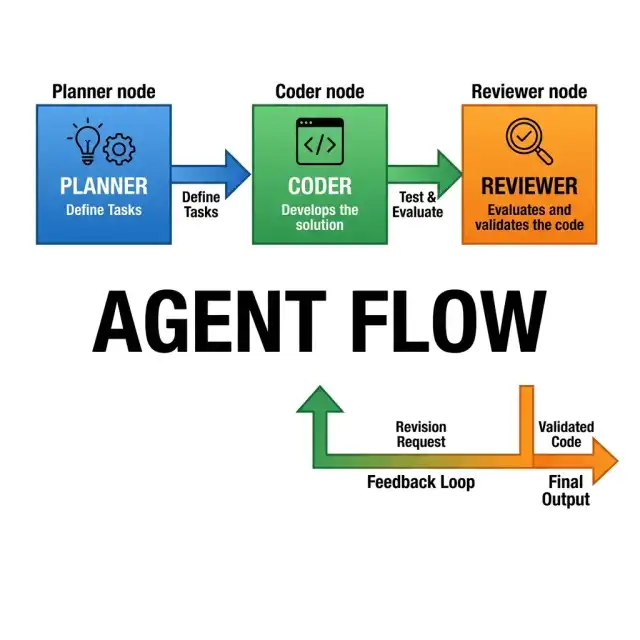
The Planner-Coder-Reviewer Triad
Orchestrating software development tasks requires specialized separation of concerns. If a single agent tries to formulate the refactoring strategy, implement the files, and audit the diff for regressions, it inevitably suffers from cognitive drift, hallucinating dependencies or skipping edge cases.
To resolve this, we implement the Planner-Coder-Reviewer Triad:
- The Planner Agent: Analyzes the task description, reads the file structure of the repository, resolves internal dependency links, and drafts a markdown-formatted execution blueprint.
- The Coder Agent: Executes the blueprint, edits specific code lines using atomic block replacement tools, and runs lint/format tests locally.
- The Reviewer Agent: Audits the resulting git diff against the planner's original requirements, ensures compliance with coding standards, and checks for potential security bugs before giving approval.
Stateful Communication and Orchestration
To prevent agents from stepping on each other's edits, we manage agent coordination through a Stateful Orchestration Graph. Agents communicate by appending structured JSON status frames to a shared session scratchpad, avoiding messy chat loops.
Here is an example state transition frame recorded on the scratchpad:
{
  "session_id": "session_90161521_ab88",
  "current_state": "VERIFYING_REFACTOR",
  "active_agent": "ReviewerAgent",
  "history": [
    {
      "step": 1,
      "agent": "PlannerAgent",
      "action": "CREATE_PLAN",
      "status": "SUCCESS",
      "output_ref": "scratchpad/plan_v1.md"
    },
    {
      "step": 2,
      "agent": "CoderAgent",
      "action": "MODIFY_FILES",
      "status": "SUCCESS",
      "modified_paths": ["app/Helpers/SEOHelper.php"]
    }
  ]
}
Integrating with Enterprise Git Workflows
Webhook Event Routing Architecture
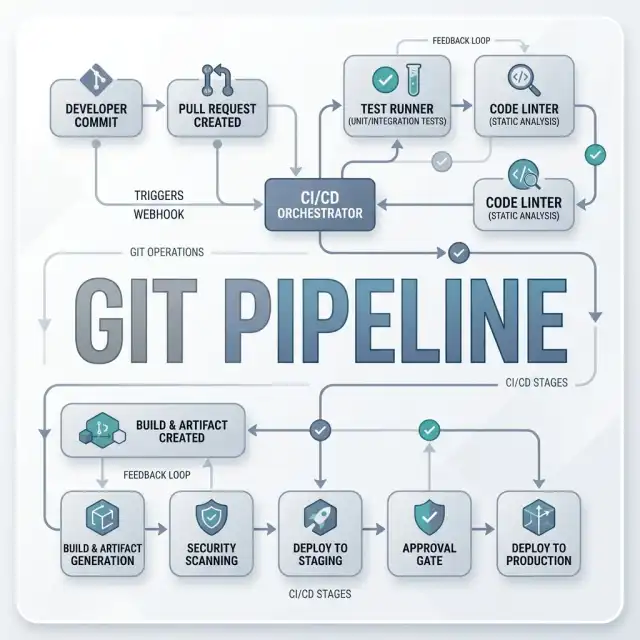
The Claude Coworker interacts with developers by monitoring Git webhook events. When a developer pushes to a branch or comments on a Pull Request, the webhook server routes the event payloads to the supervisor agent.
Securing Private Repositories
When connecting autonomous agents to private enterprise codebases, security must be zero-trust. Never give agents write access to your main branch. Always force their code commits onto isolated development branches prefixed with coworker/ and enforce branch protection rules requiring human review before merging.
Implementing the Code Refactoring Loop
Step-by-Step Execution Sequence
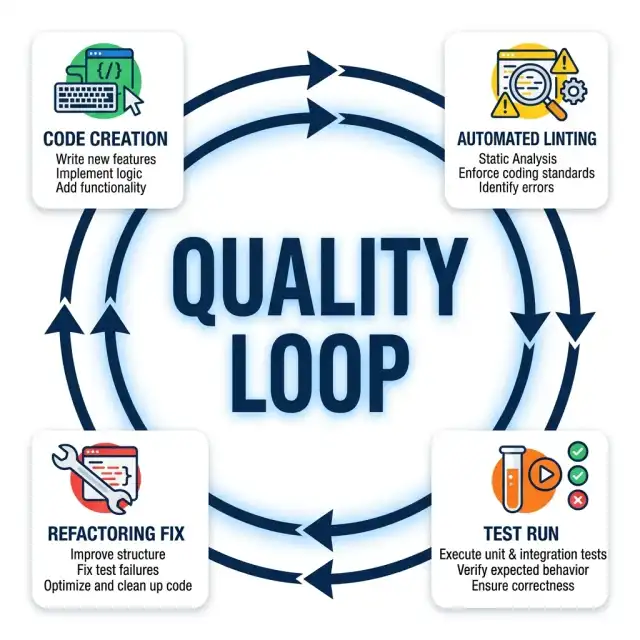
To ensure code stability, the Coder agent runs inside a strict quality feedback loop:
- Draft Replacement: The agent proposes a single contiguous edit to a target file.
- Apply & Lint: The supervisor applies the edit and executes an automated linter (e.g.
php -loreslint). - Parse Failures: If syntax or test failures occur, the console output is piped back into the agent's context.
- Iterative Fixing: The agent corrects the edit block until the linter outputs a clean pass.
Polyglot Code Implementation
Here is a Python execution runner demonstrating how the supervisor invokes the Planner-Coder-Reviewer triad inside a Git workspace:
import os
import subprocess
import

class AgentWorkspaceRunner:
    def __init__(self, repo_path: str):
        self.repo_path = repo_path
        self.state_file = os.path.join(repo_path, ".coworker_session.json")

    def load_session(self) -> dict:
        if os.path.exists(self.state_file):
            with open(self.state_file, "r") as f:
                return json.load(f)
        return {"status": "INIT", "logs": []}

    def execute_git_command(self, cmd: list) -> str:
        res = subprocess.run(
            cmd, cwd=self.repo_path, capture_output=True, text=True, check=True
        )
        return res.stdout.strip()

    def run_validation_tests(self) -> bool:
        # Run PHP lint and local verification scripts
        try:
            subprocess.run(
                ["php", "-l", "app/Helpers/SEOHelper.php"],
                cwd=self.repo_path,
                capture_output=True,
                check=True
            )
            return True
        except subprocess.CalledProcessError as e:
            print(f"Validation failed: {e.stderr}")
            return False

# Initialize and verify runner setup
runner = AgentWorkspaceRunner(repo_path="e:/wamp/www/vatsalshah")
if runner.run_validation_tests():
    print("Pre-flight checks passed successfully.")
Sandboxed Execution and Security Governance
Isolating Untrusted Code Execution
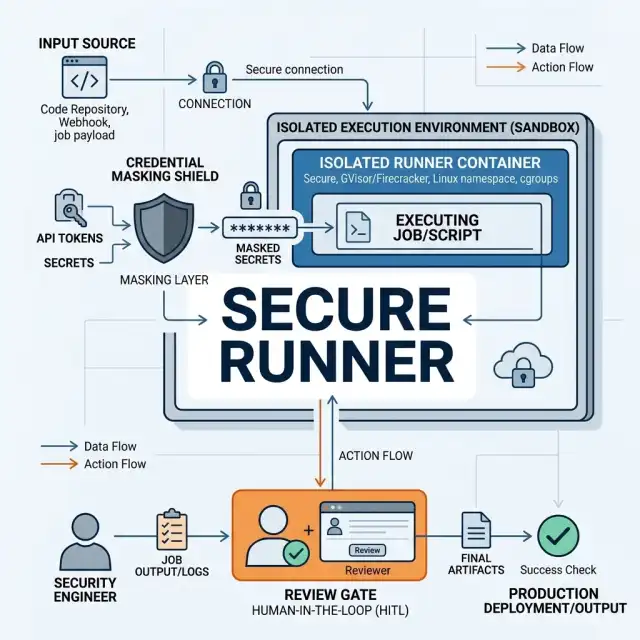
Autonomous agents have the power to write and run arbitrary command lines on your systems. If they parse a dependency or download a compromised package, they could execute malicious scripts. You MUST execute all agent processes in isolated sandboxes.
To achieve this, we run the Coder agent inside a restricted Docker container or a locked-down VM environment with limited egress internet access and strict memory ceilings.
Credential Masking and Security Guardrails
Never expose active API keys or production database credentials to the agent's context. Always mask secret variables in execution logs and inject them dynamically via locked environment variables only during runtime validation.
Comparative Matrix: Agent Frameworks
To select the right foundation for your collaborative engineering pipeline, we evaluate the industry’s leading frameworks based on production capabilities:
| Framework Name | Primary Agent Model | Git Integration | Sandboxing Support | State Management |
|---|---|---|---|---|
| Claude Coworker | Multi-Agent Collaborative | Native (Git Hooks + Webhooks) | Docker Container / Sandbox-native | Stateful JSON Shared Scratchpad |
| LangGraph | Stateful Cyclic Graphs | Manual Configuration Required | External Integration Only | In-Memory Persistence Layer |
| CrewAI | Sequential Role-playing | Manual Configuration Required | External Integration Only | Structured Output Models |
| AutoGPT | Single-Agent Loop | Not Recommended | Docker container configs | Vector Database / Memory-based |
2027–2030 Evolutionary Transition Roadmap
The evolution from simple code-writing proxies to autonomous software engineering teams is occurring in three distinct waves:
- Phase 1: Local Task Autonomy (2026–2027)
- Multi-agent execution of well-defined feature requests, automated PR review, linter fixing, and test-driven code adjustments.
- Phase 2: Semantic System Refactoring (2027–2028)
- Agents will run sitewide audits, detecting performance drift, refactoring whole file layers autonomously, and planning framework upgrades with minimal guidance.
- Phase 3: Autonomous Repository Ecosystems (2029–2030)
- Complete systems of agents managing deployment configurations, tracking performance anomalies in production, and automatically compiling patches to fix server errors.
Monday Morning Action Plan
Ready to begin? Here is your tactical steps checklist to deploy your first coworker agent:
Key Takeaways
- Role Separation: Avoid single-agent setups. Splitting tasks between a Planner, Coder, and Reviewer is crucial to prevent hallucinations.
- Safety First: Restrict coworker agent execution to secure sandboxes and mask all credentials in runtime environments.
- State Control: Communicate state through a shared JSON session frame instead of convoluted multi-step chat instructions.
FAQ
