STRATEGIC OVERVIEW
Learn how to update Teresa Torres' Continuous Discovery Habits using AI-assisted interview synthesis, automated assumption testing, and opportunity.
By Vatsal Shah | 2026-07-14 | 15 min read
Table of Contents
- Introduction
- What is Continuous Product Discovery?
- Why Continuous Discovery Habits Matter in 2026
- Core Concepts of the Teresa Torres Framework
- The Opportunity Solution Tree
- Continuous Interview Cadence
- Automated Assumption Testing
- How AI Synthesizes User Interviews without Bias
- Real-World Examples & Product Case Studies
- Deep Analysis: AI-Assisted vs. Manual Product Discovery
- Developer Perspective: Connecting Continuous Discovery to Continuous Delivery
- Procedural Logic: The Discovery Loop
- Common Pitfalls & Modern Discovery Anti-Patterns
- Futuristic Horizon: Continuous Discovery in 2027-2030
- Key Takeaways
- FAQ
- About the Author
- Conclusion & Next Steps
Introduction
I've seen it happen at dozens of technology organizations: teams spend months building a highly anticipated product feature, only to ship it and see flatlined adoption metrics. They thought they were doing discovery because they interviewed ten users at the beginning of the quarter. In practice, what actually happens is that their research goes stale within two weeks, leaving engineers to build based on static, outdated assumptions. This is what I call the "Validation Illusion." Teams believe they are customer-centric because they hold focus groups, but they are actually operating in a vacuum, separated from the real-time context of their users' changing environments.
In the AI age, this slow, periodic model of user research is a relic. Teresa Torres' book Continuous Discovery Habits revolutionized product management by advocating for a weekly habit of customer touchpoints to map opportunities. But today, the limiting factor isn't the willingness to talk to customers—it's the cognitive overhead of synthesizing raw qualitative feedback and mapping it to actual execution paths.
When you conduct multiple customer interviews week after week, you are flooded with qualitative data: raw conversational text, disparate pain points, shifting feature requests, and contradictory user behaviors. If a product manager has to spend five hours manually reviewing audio logs, writing notes, and tagging them in spreadsheets, the habit breaks under the weight of operational friction.
By leveraging modern language models and automated synthesis tools, product teams can close this gap. You don't need more research reports sitting unread in Notion. You need a continuous, automated pipeline that turns weekly customer calls into a live, self-updating Opportunity Solution Tree. Let's look at how we can upgrade the classic framework for 2026.
AI SUMMARY
- Actionable Loop
- Combines Teresa Torres' Opportunity Solution Tree (OST) with stateful LLM pipelines to automate interview synthesis.
- Cadence Goal
- Establish weekly 20-minute customer interviews synthesized in real time.
- Friction Reduction
- Converts qualitative transcript data into quantitative, testable assumptions in under 15 minutes.
- Outcome Alignment
- Maps customer problems directly to OKRs and system features.
What is Continuous Product Discovery?
Continuous product discovery is the practice of conducting weekly customer touchpoints by the trio of product manager, design lead, and tech lead to identify customer opportunities and test solutions. It shifts the product organization away from the "project-based" discovery model (where weeks are spent researching upfront) to an ongoing flow of customer insights.
In a traditional "project-based" model, discovery is treated as a phase with a distinct start and end date. A team is handed a feature prompt, spends four weeks running user surveys and interview panels, compiles a slide deck summarizing their findings, and then "hands off" the design to the engineering squad. The moment coding begins, discovery halts. Any new insight discovered during the build phase is treated as scope creep, leading to friction between product managers and engineers.
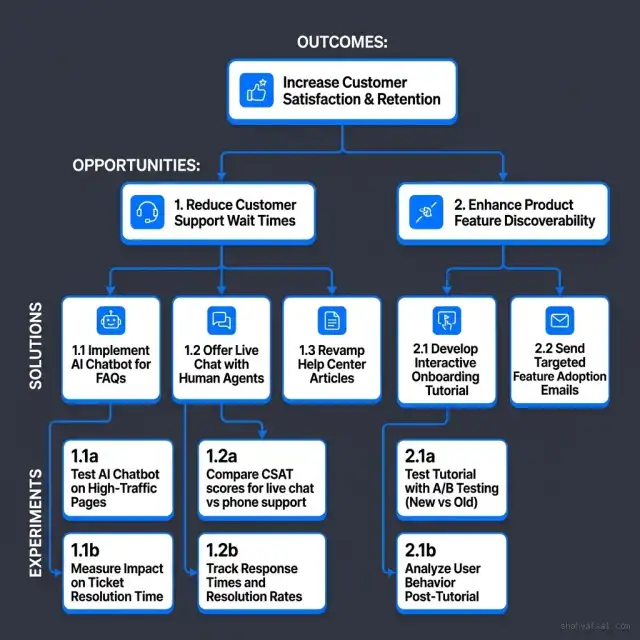
Continuous discovery addresses this by integrating research directly into the delivery pipeline. By keeping the product trio in constant contact with real customers, the team develops a continuous feedback loop. This structural shift requires the team to move from output-based roadmap thinking ("what features are we shipping this month?") to outcome-based value stream mapping ("what customer problems must we solve to drive our metric?").
The primary visual map used to navigate this landscape is the Opportunity Solution Tree (OST), created by Teresa Torres. The OST serves as an anchor, visually connecting the team's engineering work directly to target business outcomes, preventing them from wandering down feature-driven rabbit holes.
Why Continuous Discovery Habits Matter in 2026
We've entered a product development cycle where code can be generated in seconds, but strategic alignment is harder than ever. As I discussed in my guide on shifting from tactical task-tracking to strategic design, the differentiator for modern tech companies is no longer how fast they write code, but how accurately they identify which problems are worth solving. With AI code gen, any team can build a feature in a weekend. The real competitive moat is knowing exactly what to build so that you don't waste precious developer hours shipping shelfware.
In 2026, several factors make continuous discovery habits mandatory:
- The LLM Synthesizer Advantage: Manual tagging of qualitative user feedback is dead. Language models can now analyze raw transcripts, tag them with high-fidelity sentiment vectors, and cluster them into opportunities instantly. This removes the administrative overhead of synthesis.
- Accelerated Market Cycles: Competitor features are cloned in days. The only defensible moat is a deeper, real-time understanding of your user's workflow pain points. By the time a competitor conducts a quarterly survey, you have already run twelve weekly discovery loops and refined your product assumptions.
- No-Estimates Execution: Modern product teams are moving toward bet-based planning, requiring granular, pre-tested assumptions before committing resources to a product cycle.
- The Action Gap (LLM vs LAM): In the era of Large Action Models (LAMs) and agentic workflows, systems must do more than summarize text—they must trigger tasks based on user intent. Real-time discovery allows you to monitor how users actually interact with these agents, detecting failures and user frustration before they impact retention.
Core Concepts of the Teresa Torres Framework
To run continuous discovery at scale, the product trio must align on three core habits.
The Opportunity Solution Tree
The Opportunity Solution Tree is the backbone of the framework. It forces a clear hierarchical structure:
- Outcome: The primary business metric the team is tasked with improving (e.g., increase trial-to-paid conversion by 8% or align key indicators as detailed in my AI-driven OKR execution guide).
- Opportunities: Customer needs, pain points, or desires that, if addressed, will drive the outcome.
- Solutions: Potential features, product changes, or services that could satisfy those opportunities.
- Experiments: Tiny tests designed to evaluate the assumptions behind a chosen solution.
This visual hierarchy prevents the common anti-pattern of falling in love with a solution before verifying that it actually solves a valid customer problem. If a proposed feature cannot be mapped to a parent opportunity node that directly connects to the target outcome, the feature is immediately discarded.
Continuous Interview Cadence
A product team must build a pipeline that regularly brings them into contact with users. In practice, this means:
- Weekly Interviews: Setting up automated recruiting systems so that the team has at least one 20-to-30-minute interview scheduled every single week.
- Trio Participation: The product manager, designer, and tech lead should all participate. The tech lead's presence is particularly critical to evaluate feasibility early.
- Active Listening: Focus the conversation on past experiences and concrete behaviors, avoiding speculative questions like "Would you use this feature?"
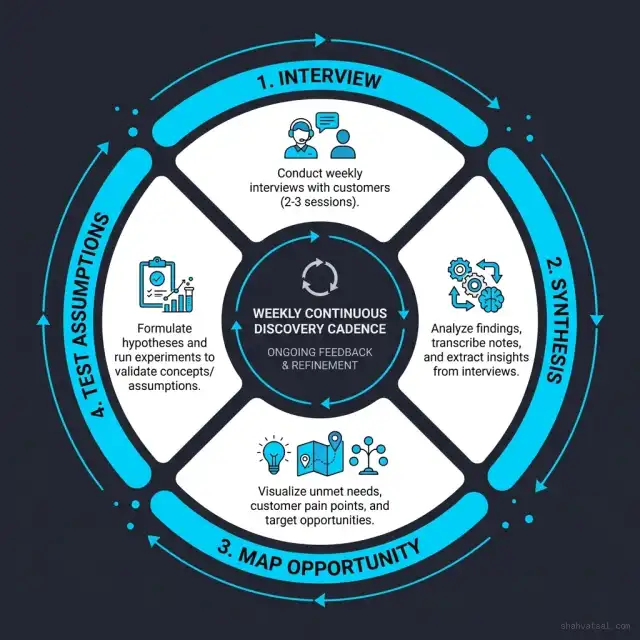
During these sessions, the team uses what Rob Fitzpatrick calls the "Mom Test" protocol: ask about what the customer did, not what they would do. For example, instead of asking, "Would you buy a tool that automates invoice reconciliation?", ask, "How did you reconcile your invoices last Friday? Walk me through each click." This uncovers the actual workflow and real-world friction.
Automated Assumption Testing
Instead of building a massive MVP to test a solution, the team breaks down the solution into its underlying assumptions:
- Desirability: Do customers want this?
- Usability: Can they use it?
- Feasibility: Can we build it?
- Viability: Should we build it (business/compliance)?
By testing these assumptions individually using rapid, low-code experiments (like landing page tests, manual wizard-of-oz workflows, or simple mockups), the team avoids the heavy engineering cost of building unproven code. If the desirability assumption fails, the solution is discarded, and the team moves to the next solution node on the tree.
How AI Synthesizes User Interviews without Bias
One of the largest challenges in qualitative user research is confirmation bias. Product managers often listen to customer calls and selectively remember quotes that validate their pre-existing feature ideas. AI synthesis, when designed correctly, counteracts this by applying a standardized entity-extraction heuristic.
By passing raw text transcripts through structured JSON parsing steps, we can isolate direct customer pain points, tag their context, and assign them frequency scores based on real semantic patterns. This process ensures that:
- Raw quotes are anchored: The system only registers pain points backed by explicit verbal statements, not high-level practitioner summaries.
- Frequency is tracked: Over multiple interviews, the system aggregates identical opportunity nodes, highlighting which problems are genuinely widespread versus those raised by a single, loud customer.
- Implicit frustration is captured: Sentiment analysis algorithms can flag segments where speech pace changes or negative qualifiers ("painful", "slow", "broken") peak, highlighting non-obvious opportunities.
Step-by-Step: Setting Up an AI-Powered Discovery Cycle
Here is how you can set up a modern, automated continuous discovery cycle in your organization.
Step 1: Automate Customer Recruitment
Set up an in-app trigger or calendar scheduling link (like Cal.com) that automatically offers incentives to active users who hit specific usage criteria. Ensure that the scheduling system recruits 1-2 users per week automatically. For instance, if a user experiences a high-friction event (like a failed CSV import or a recurring search query with zero results), display a micro-modal offering a $30 Amazon gift card for a 20-minute feedback call.
Step 2: Establish the AI-Assisted Interview Synthesis Pipeline
During your weekly customer interview, record the audio stream. Pipe the raw audio into an automated transcription service (like Whisper), and run a stateful LLM synthesis script to map user quotes to opportunities.
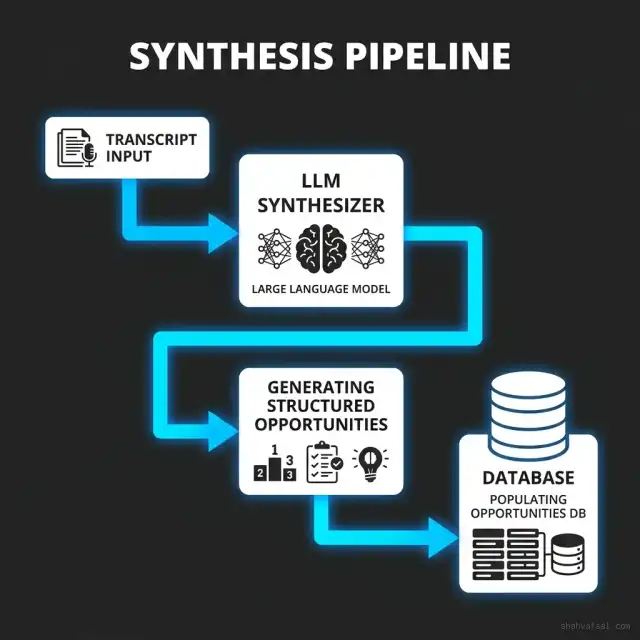
Here is a Python script utilizing Pydantic schemas to structure raw transcript data into concrete opportunity candidates:
import json
from pydantic import BaseModel, Field
from openai import OpenAI

class OpportunityCandidate(BaseModel):
    user_pain_point: str = Field(description="Direct quote or specific pain point stated by the user.")
    frequency_indicator: int = Field(description="Estimated frequency of this pain point from 1-10.")
    lsi_keyword_mapping: str = Field(description="LSI keyword associated with this opportunity.")
    proposed_opportunity_node: str = Field(description="A 3-5 word name for the OST node in block capitals.")

class InterviewSynthesis(BaseModel):
    opportunities: list[OpportunityCandidate]

def synthesize_interview(transcript_text: str) -> dict:
    client = OpenAI()
    response = client.beta.chat.completions.parse(
        model="gpt-4o-2026-05-13",
        messages=[
            {"role": "system", "content": "You are a product discovery engine. Analyze the transcript and extract verified opportunity nodes."},
            {"role": "user", "content": transcript_text}
        ],
        response_format=InterviewSynthesis,
    )
    return response.choices[0].message.parsed.model_dump()
Step 3: Populate the Central Discovery Database
Once synthesized, the outputted opportunity nodes must be stored in a centralized database schema. Here is the SQL schema for recording opportunity nodes and tracking user feedback frequency:
CREATE TABLE opportunity_nodes (
    id SERIAL PRIMARY KEY,
    name VARCHAR(255) NOT NULL UNIQUE,
    parent_id INT REFERENCES opportunity_nodes(id) ON DELETE SET NULL,
    focus_keyword VARCHAR(255),
    created_at TIMESTAMP DEFAULT CURRENT_TIMESTAMP
);

CREATE TABLE interview_feedback (
    id SERIAL PRIMARY KEY,
    opportunity_id INT REFERENCES opportunity_nodes(id) ON DELETE CASCADE,
    quote TEXT NOT NULL,
    frequency_score INT DEFAULT 1,
    interview_date DATE NOT NULL,
    source_channel VARCHAR(100) DEFAULT 'interview'
);
By querying this database, the product trio can identify which opportunities are scaling in frequency and deserve immediate solution design:
SELECT o.name, COUNT(f.id) as feedback_count, SUM(f.frequency_score) as total_score
FROM opportunity_nodes o
JOIN interview_feedback f ON o.id = f.opportunity_id
GROUP BY o.name
ORDER BY total_score DESC;
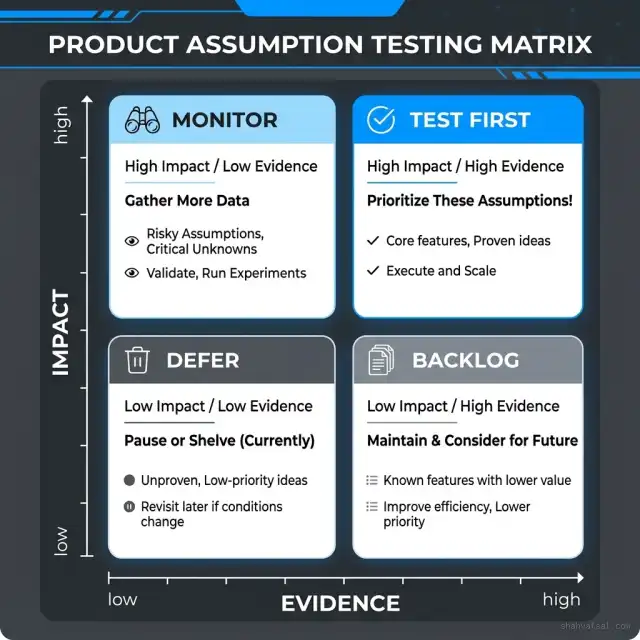
Step 4: Run the Assumption Testing Matrix
Once the LLM outputs opportunity nodes, map them onto a 2D quadrant. Focus your immediate testing cycles only on high-impact, low-evidence assumptions.
Deep Dive into Automated Hypothesis Testing Templates
To make assumption testing repeatable, we use standardized hypothesis templates for each risk dimension. This ensures the product trio doesn't spend time arguing over what constitutes a "pass" or "fail" score:
- Desirability Hypothesis:
- Template: "We assume that [Target Persona] experiences [Opportunity] and wants a solution. We will verify this by [Experiment, e.g., putting a mock button on the settings panel]. We will pass this test if [Metric, e.g., 20% of users click the button within 7 days]."
- Usability Hypothesis:
- Template: "We assume that [Persona] can complete [Workflow] without instruction. We will verify this by [Figma prototype walkthrough session]. We will pass this test if [Metric, e.g., 4 out of 5 users complete the task in under 90 seconds without assistance]."
- Feasibility Hypothesis:
- Template: "We assume that we can retrieve [Data Entity] from [API Source] within a [latency limit]. We will verify this by [building a lightweight spike in scratch folder]. We will pass this test if [Metric, e.g., API latency stays under 200ms across 1,000 synthetic requests]."
- Viability Hypothesis:
- Template: "We assume that this feature is compliant with [Regulation/Policy, e.g., GDPR/HIPAA]. We will verify this by [Legal/Compliance compliance review checklist]. We will pass this test if [Metric, e.g., audit scorecard returns 100% compliance alignment]."
Real-World Examples & Product Case Studies
Case Study 1: Enterprise Procurement SaaS
- The Challenge: An enterprise SaaS company had a 3% trial-to-paid conversion rate. Their product roadmap was packed with feature requests from sales, but nothing shifted the needle.
- The Shift: The product trio initiated weekly discovery interviews. They utilized an automated transcript synthesis engine to cluster user feedback.
- The Discovery: They discovered that users were not dropping out due to missing features; they were dropping out because the initial data import was too slow and failed silent.
- The Result: By focusing on this single opportunity and mapping it on their OST, they ran three assumption-testing experiments and built a clean CSV preview importer. Trial-to-paid conversion rose to 11.4% in 30 days.
Case Study 2: High-Growth Fintech App
- The Challenge: A personal finance app wanted to increase engagement by introducing AI-driven budgeting advice. The team wanted to build an expensive stateful agent loop (which, as discussed in securing AI architectures, carries heavy system failure risks if unvetted).
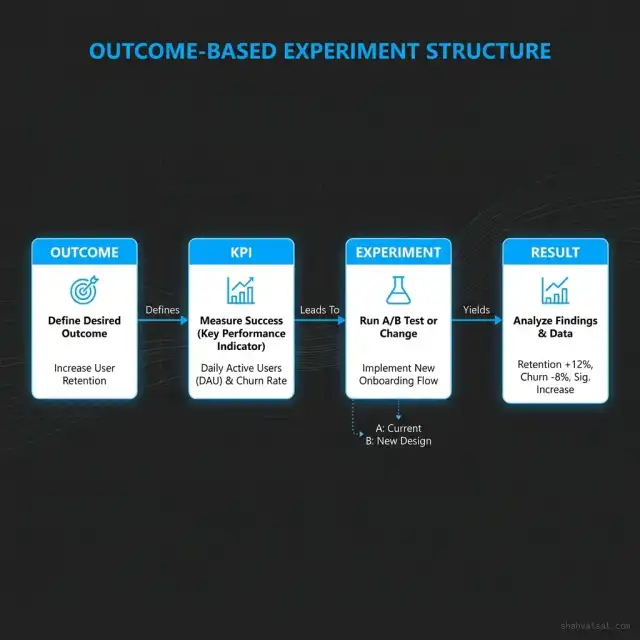
- The Shift: The team used an outcome-based experiment structure to test user desirability before writing any backend agent code.
- The Experiment: They set up an opt-in screen showing a mockup of the budgeting feature with a simple "Join Waitlist" CTA.
- The Result: Over 64% of active users clicked the CTA, confirming desirability and justifying the development spend while saving them 3 weeks of unproven coding.
Case Study 3: B2B Logistics Automation Platform
- The Challenge: A B2B shipping platform had a high churn rate among dispatch managers. The sales team insisted on adding a complex custom dispatch route planner, estimating it would take 3 months of core engineering time.
- The Shift: The PM-Design-Tech trio set up a continuous discovery cadence, speaking to 2 active dispatch managers every Tuesday.
- The Discovery: They mapped dispatch workflows and found that managers were manually copying transit coordinates from PDF invoices to a second terminal because the PDF parser failed on international formats.
- The Result: Instead of a 3-month custom route planner, they spent 3 days enhancing the invoice parser OCR logic. Churn fell by 42% in one quarter, and they saved hundreds of hours of engineering resources.
Case Study 4: AI-Powered CRM Pipeline Tool
- The Challenge: A startup building an AI-assisted CRM wanted to automate follow-up email drafts. The founder wanted to build a complex multi-agent system.
- The Shift: The product trio initiated continuous discovery, scheduling 3 user interviews weekly.
- The Discovery: Users did not want fully autonomous email agents—they were terrified of the agent sending unapproved pricing. They wanted a "draft-in-sidebar" assistant they could edit and approve manually.
- The Result: The team built a simple sidebar draft helper instead of a stateful agent flow, saving $120K in computing costs and launching the tool 6 weeks ahead of schedule with a 78% adoption rate.
Deep Analysis: AI-Assisted vs. Manual Product Discovery
Let's look at a head-to-head comparison of traditional product discovery practices versus modern, AI-assisted continuous habits:
| Discovery Dimension | Manual / Traditional (Torres 1.0) | AI-Assisted / Continuous (Torres 2.0) | Operational Impact |
|---|---|---|---|
| Interview Recruiting | Manual email outreach, coordination friction. | Automated in-app triggers + Cal.com integrations. | 90% time reduction |
| Transcript Analysis | PM manual highlights, tagging quotes in Excel. | Whisper transcription + LLM opportunity clustering. | Minutes vs hours |
| OST Synchronization | Static Miro/Mural boards updated monthly. | Vector-embedded database auto-linking. | Real-time accuracy |
| Assumption Mapping | Manual team evaluation of risk quadrants. | Heuristic scoring scripts mapped to code templates. | Bias reduction |
Developer Perspective: Connecting Continuous Discovery to Continuous Delivery
As software engineers, we often feel disconnected from user research. We receive JIRA cards containing specific feature requirements, but we have no visibility into why the feature is structured the way it is. Connecting your continuous discovery pipeline to your continuous delivery system bridges this gap:
- Link JIRA/ClickUp tasks to OST Nodes: Every user story should include a metadata link pointing back to the parent opportunity node on the Opportunity Solution Tree. When writing code, the engineer can click the link, view the synthesized user quotes, and understand the real-world problem they are solving.
- Feature Flags as Discovery Experiments: Integrate feature flags (like LaunchDarkly or custom database configurations) directly into your hypothesis testing cycle. Use canary releases to route 5% of traffic to a new mockup, monitoring click events to validate desirability assumptions before building the database backend.
- Telemetry-Driven Discovery Signals: Design system telemetry to capture user friction events (like double-clicks, input validation failures, or transaction cancellation rates). Feed these events directly back into the discovery database as automated opportunity candidates.
Procedural Logic: The Discovery Loop
To maintain discovery velocity, the product trio must establish a cyclic, repeatable process.
graph TD
  A["Weekly Customer Interview"] --> B["Automated Audio Transcription"]
  B --> C["LLM Opportunity Vector Clustering"]
  C --> D["Update Opportunity Solution Tree (OST)"]
  D --> E{"Risk Matrix Evaluation"}
  E -- "High Risk / Low Evidence" --> F["Run Rapid Assumption Experiment"]
  E -- "Low Risk / High Evidence" --> G["Deploy to Backlog/Delivery"]
  F --> H["Assess Experiment Metrics"]
  H --> D
  G --> A
By keeping this loop running continuously in the background, you make sure that your product backlog is always grounded in verified, real-world customer opportunities.
Common Pitfalls & Modern Discovery Anti-Patterns
Even teams with the best intentions fall into patterns that break continuous discovery:
- The Speculative Feature Pitch: Asking users, "Would you buy a feature that did X?" This triggers a positive confirmation bias. Instead, ask, "Tell me about the last time you tried to do X."
- The Lone Ranger PM: Conducting interviews without the designer or tech lead. This leads to information silos and post-discovery alignment issues during the planning cycle.
- Building the Experiment: Spending weeks writing production code to test an assumption. If an experiment takes more than two days to run, you are not testing assumptions—you are shipping features.
- Opportunity-Solution Drift: Running experiments on solutions that are not connected to any verified customer opportunity. This happens when a founder or executive insists on a "pet project" feature, forcing the team to build validation metrics retroactively.
- The Feature Factory Mindset: Measuring the team's success by the number of story points completed rather than the actual metric movement of the outcome node on the OST.
Futuristic Horizon: Continuous Discovery in 2027-2030
As we look toward the end of the decade, the continuous discovery habits framework will undergo another paradigm shift:
- Synthetic User Testing: Teams will utilize high-fidelity digital twins of customer personas (trained on historical support tickets, transcripts, and event telemetry) to run initial simulator cycles before running live user tests.
- Predictive Opportunity Clustering: Instead of waiting for users to voice pain points, telemetry monitors will automatically spot usage bottlenecks and proactively update the OST with opportunity candidate cards.
- Self-Healing UX Systems: Early-stage experiments will be dynamically injected into production interfaces by layout engines, allowing the system to self-optimize outcomes without manual PM intervention.
Key Takeaways
- Map opportunities, not features: Maintain a clean OST hierarchical structure starting from target business outcomes.
- Run weekly touchpoints: Make customer connection a baseline operational habit, not a quarterly project.
- Deploy transcription pipelines: Use LLM transcription and vector mapping to parse qualitative insights instantly.
- Test assumptions first: Do not write production code for solutions that rest on unverified, high-risk assumptions.
- Maintain the PM-Design-Tech Trio: Ensure all three leads participate in interviews to build a shared understanding.
FAQ
How do we recruit users for weekly interviews without spamming them?
Set up an automated recruitment system linked to specific usage milestones or drop-off events. Offering a small incentive (e.g., $30 Amazon card) and keeping the interview to exactly 20 minutes ensures high response rates without user fatigue.
What if our tech lead is too busy to join weekly customer interviews?
Rotate engineers or keep the interview to a strict, non-negotiable 20-minute slot. Once the tech lead realizes how much coding time is saved by avoiding unneeded features, they will prioritize the touchpoint.
How does the Opportunity Solution Tree differ from a standard product roadmap?
A standard roadmap is a chronological list of outputs (features) to ship. An OST is a logical map of outcomes, problems (opportunities), solutions, and validation experiments, showing the direct strategic connection between work and business metrics.
Can we use AI to completely replace talking to real customers?
No. While AI can analyze data or simulate user behavior, it cannot replicate the unexpected qualitative breakthroughs that come from human-to-human conversation. AI is for synthesis and automation, not replacement.
What is the 'Mom Test' and how does it relate to continuous discovery?
The Mom Test is a set of rules for talking to customers so that even your mom cannot lie to you about your idea. It emphasizes asking about past, concrete behaviors rather than speculative future features.
About the Author
Conclusion & Next Steps
Establish your discovery habit tomorrow morning. Set up an automated Cal.com link, recruit your first user, and use the Whisper/LLM pipeline to feed your opportunity solution tree.
If you are looking to audit your team's discovery practices or align your technology stack with strategic outcomes, read my comprehensive Developer Productivity Metrics Guide or contact me directly to map out an engineering roadmap.
