Executive Summary: The 34% Architectural Blindspot
In November 2026, enterprise information technology leadership stands at an inflection point characterized by a stark paradox between strategic capital expenditure and infrastructural readiness. Over the past twenty-four months, billions of dollars have flowed into generative foundation models, developer copilots, and retrieval-augmented generation (RAG) prototypes. Yet, as organizations pivot from passive question-answering interfaces to autonomous, decision-making agent swarms, the foundational substrate supporting enterprise software is cracking under operational stress.
Two landmark empirical studies published in early November 2026 reveal the exact dimensions of this architectural rift:
- The Accenture CIO Pulse (Released 3 November 2026): Surveying 300 global Chief Information Officers and senior IT executives across 19 vertical industries and 16 countries—representing enterprises exceeding $1 billion in annual revenue—the study revealed that while 64% of organizations are actively scaling artificial intelligence initiatives, a mere 7% report operating and optimizing these workloads at sustained enterprise scale. Furthermore, while 70% of IT leaders report measurable productivity gains at the individual employee task level, only 37% have successfully achieved end-to-end multi-system workflow orchestration. Crucially, 61% of respondents anticipate undertaking a comprehensive, fundamental Enterprise Architecture (EA) redesign within the next three years; however, only 27% explicitly report having agentic AI architectures within their immediate project scope. This represents a staggering 34% strategic blindspot.
- Gartner Enterprise Research (Released 9 November 2026): Complementing Accenture’s enterprise survey, Gartner’s cross-industry IT leadership benchmark indicated that 71% of enterprise tech leaders anticipate deploying autonomous agentic workflows into production within the next 12 months. Yet, only 21% confirm having established the requisite identity, governance, security guardrails, and cryptographic approval frameworks necessary to manage non-human software actors operating with system mutation privileges.
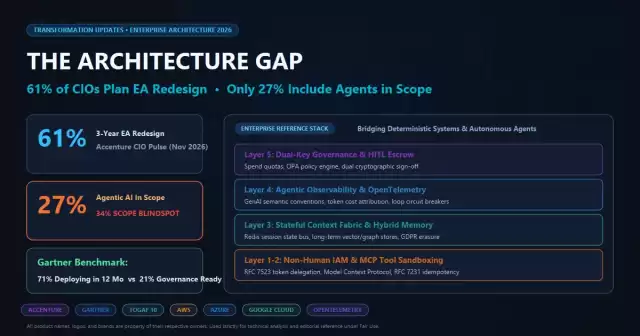
The root cause of this architectural deficit is neither budgetary hesitation nor a lack of executive enthusiasm. Rather, it is rooted in legacy conceptual models: the prevailing Enterprise Architecture frameworks—from TOGAF 10 and Zachman to standard microservice domain models—were architected around the fundamental assumption of deterministic, human-initiated transactions.
When an autonomous agent plans, reasons, selects tools dynamically, retains multi-step state, delegates tasks to downstream worker subagents, and mutates mission-critical enterprise systems of record (ERPs, CRMs, financial ledgers, and deployment pipelines), traditional perimeter firewalls, role-based access control (RBAC), and static OpenAPI schemas collapse.
This technical guide provides the definitive enterprise blueprint to bridge this gap. We analyze the survey empirical data, dissect the five structural failure modes of legacy EA, define a comprehensive five-layer Agent-Native Enterprise Reference Architecture, provide a concrete 90-Day Scope Checklist, and map these requirements across AWS, Microsoft Azure, and Google Cloud environments.
1. Dissecting the November 2026 Primary Data: The Scaling vs. Optimization Paradox
To understand why 61% of CIOs recognize the necessity of an Enterprise Architecture redesign while omitting agents from their immediate architectural scope, we must scrutinize the underlying telemetry of enterprise AI adoption.
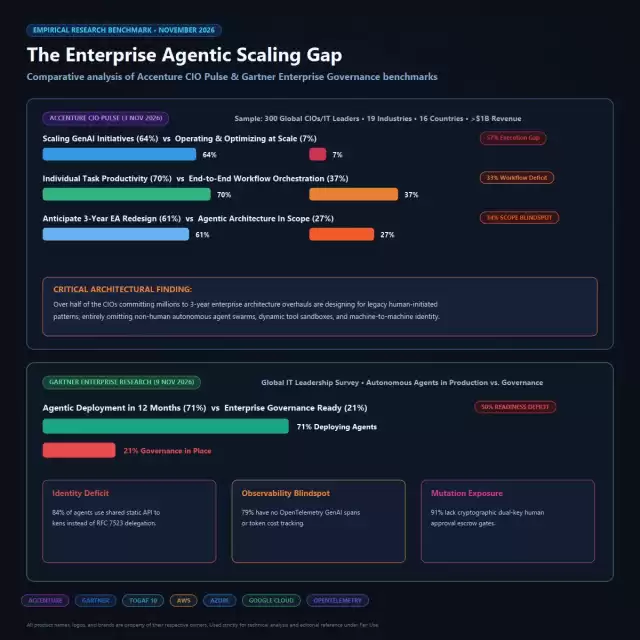
Accenture CIO Pulse (3 November 2026) In-Depth Analysis
The Accenture CIO Pulse survey represents one of the most rigorous quantitative cross-sections of Fortune 1000 and Global 2000 technical leadership. The sample characteristics provide vital context:
- Cohort Size: 300 C-level technology executives (CIOs, CTOs, Chief Digital Officers).
- Inclusion Criteria: Minimum enterprise annual revenue threshold of $1,000,000,000 USD.
- Geographic Distribution: 16 countries across North America, EMEA, APAC, and LATAM.
- Industry Coverage: 19 discrete industry sectors, including Financial Services, Healthcare & Life Sciences, Discrete Manufacturing, Energy & Utilities, Telecommunications, and Retail.
| Metric Measured | Percentage | Operational Implication & Architectural Reality |
|---|---|---|
| Scaling GenAI Initiatives | 64% | Enterprise teams have moved beyond localized sandbox experimentation. Multi-departmental pilots are active. |
| Optimizing at True Enterprise Scale | 7% | Only 1 in 14 organizations possesses the automated cost controls, latency guarantees, and SLO frameworks to run AI reliably. |
| Individual Task Productivity | 70% | Coding assistants, summarization tools, and drafting copilots deliver localized velocity boosts for knowledge workers. |
| End-to-End Workflow Orchestration | 37% | Nearly two-thirds of enterprises remain blocked when attempting to link multiple transactional systems through autonomous AI. |
| Anticipating Major EA Redesign (3 Years) | 61% | A solid supermajority acknowledges that legacy monoliths, point-to-point APIs, and data silos cannot support future computing demands. |
| Agentic Architecture Formally in Scope | 27% | The Critical Gap: Over half of the leaders planning a major architectural overhaul are designing for legacy paradigms, ignoring non-human autonomous actors. |
Gartner Enterprise Research (9 November 2026) Governance Telemetry
Gartner’s November 2026 survey reinforces the urgency of this transition by highlighting the organizational mismatch between aggressive deployment velocity and control maturity:
- 12-Month Agentic Deployment Horizon: 71% of surveyed enterprise technical leaders anticipate that autonomous software agents will execute multi-step operational decisions in their production environments by Q4 2027.
- Production Governance & Guardrails in Place: Only 21% of surveyed organizations have defined machine-to-machine identity, cryptographic approval escrow, least-privilege tool execution policies, or agent-specific telemetry pipelines.
- The Readiness Deficit: A net 50% operational gap exists between the executive mandate to deploy agents and the defensive engineering controls required to prevent unauthorized data exfiltration, runaway financial transactions, or unmonitored system corruption.
Methodological Claim Guard & Context: Readers must note that survey data reflects executive sentiment, strategic intent, and stated planning horizons rather than audited production deployments. Percentages reported by Accenture and Gartner reflect cross-industry averages; regulated verticals (such as capital markets, clinical healthcare, and aerospace) exhibit significantly stricter governance baselines than retail or media. These figures serve as an architectural compass, establishing that the primary barrier to AI value realization in 2026 is no longer model intelligence, but infrastructure design.
2. Why Traditional Enterprise Architecture Collapses Under Agentic Workloads
To understand why standard architectural patterns fail, enterprise architects must contrast the operational mechanics of traditional client-server and microservice topologies against the runtime characteristics of autonomous multi-agent systems.
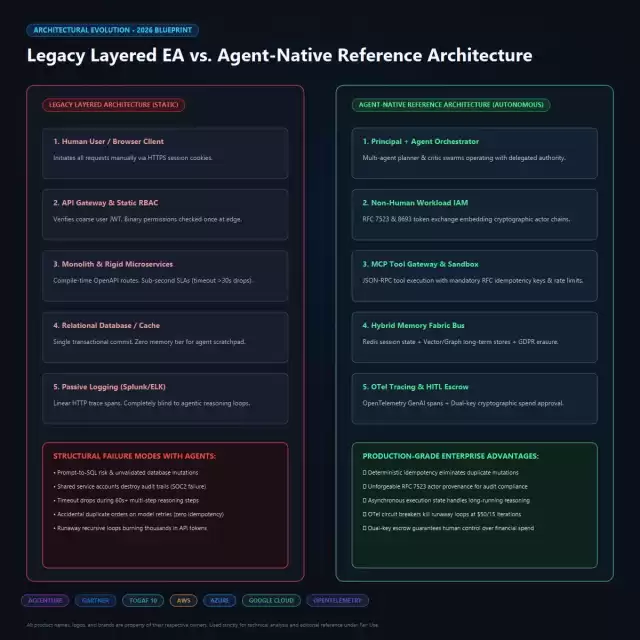
For three decades, Enterprise Architecture has rested upon five core foundational pillars:
- Deterministic code paths.
- Synchronous request-response lifecycles.
- Human-mediated identity perimeters.
- Static, pre-declared API schemas.
- Passive logging and tracing.
Every single one of these pillars is fundamentally incompatible with agentic systems.
| Architectural Dimension | Traditional Enterprise Architecture (Deterministic) | Agent-Native Enterprise Architecture (Probabilistic / Autonomous) | Failure Mode If Unaddressed |
|---|---|---|---|
| Initiation & Identity | Authenticated human user via browser/mobile app, presenting short-lived OAuth 2.0 Bearer tokens (JWT). | Autonomous software agent executing background reasoning loops with multi-tier subagent delegation. | Identity spoofing, credential leaking, absence of audit trails for non-human decisions. |
| API Contract & Invocation | Pre-compiled OpenAPI/Swagger specs, gRPC proto files, or WSDL. Static types and pre-defined routes. | Dynamic tool selection via Model Context Protocol (MCP) or JSON Schema reflection; variable argument synthesis. | Runaway parameter hallucination, unvalidated payloads mutating enterprise relational databases. |
| State & Memory | Ephemeral HTTP sessions (JWT/cookies) backed by Redis/Memcached; persistent records in SQL/NoSQL tables. | Multi-tier memory topology: conversational context, episodic session memory, vector retrieval, and semantic knowledge graphs. | Severe context drift, infinite execution loops, data leakage across multi-tenant context windows. |
| Latency & Timeout Budgets | Sub-second SLAs (p99 < 200ms). Web servers drop idle TCP connections after 30 to 60 seconds. | Asynchronous, non-deterministic reasoning steps lasting from 15 seconds to several hours. | Broken HTTP connections, premature socket termination, uncoordinated partial writes. |
| Idempotency & Retries | Standard HTTP GET retries; strict linear transaction commits via two-phase commit (2PC) or Saga orchestrators. | Non-deterministic iterative planning loops; agents retry with altered reasoning steps upon receiving tool errors. | Duplicate financial transactions, repeated external API charges, corrupted inventory levels. |
| Observability & Tracing | Distributed tracing via W3C Trace Context (TraceID/SpanID) tracking linear RPC hops through microservices. | Multi-branched hierarchical agent trees, recursive tool calls, token usage metrics, and prompt-completion payloads. | Black-box failures; complete inability to debug why an agent chose a destructive database operation. |
| Authorization & Permissions | Coarse-grained Role-Based Access Control (RBAC) checked once at the API Gateway boundary. | Fine-grained, step-by-step Attribute-Based Access Control (ABAC) with real-time Dual-Key Human-in-the-Loop Escrow. | Privilege escalation; an agent authorized to read employee records accidentally modifies executive compensation. |
The "Prompt-to-SQL" Anti-Pattern
Consider the most common failure mode observed in enterprise IT environments in 2025–2026: granting an autonomous agent direct write permissions to a core relational database via dynamically generated SQL queries.
In a traditional enterprise architecture, application code interacts with the database through an Object-Relational Mapping (ORM) layer or parameterized stored procedures. Business logic is strictly encoded in compile-time code, and security permissions are enforced through database service users with tightly scoped table grants.
When an autonomous agent is introduced without an architectural redesign, developers frequently expose database tools using naive LLM function calling. The agent constructs raw UPDATE or DELETE statements based on probabilistic token predictions. When presented with ambiguous natural language input, the agent can misinterpret business constraints, drop required WHERE clauses, or fall victim to indirect prompt injection embedded within untrusted external customer data.
Without an Agentic Tool Sandbox Layer, an Idempotency Engine, and a Policy Evaluation Interceptor, the enterprise architecture provides zero defensive barriers between a probabilistic model output and the permanent corruption of enterprise financial records.
3. The 5-Layer Agent-Native Enterprise Reference Architecture Blueprint
To bridge the 34% scope gap, Enterprise Architecture teams must adopt a standardized, decoupled, five-layer reference model. This architecture treats foundation models not as an application layer, but as a probabilistic reasoning engine residing behind deterministic enterprise controls.
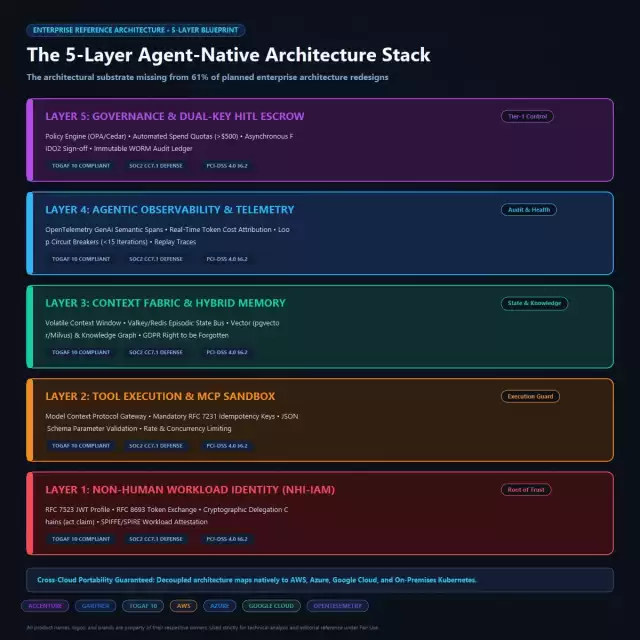
Layer 1: Non-Human Workload Identity & Delegation (NHI-IAM)
In an agentic enterprise, software agents are first-class organizational citizens that require distinct, verifiable cryptographic identities. Treating agents as shared service accounts or piggybacking on human user JWTs violates basic security standards (PCI-DSS 4.0 §6.2, SOC2 CC7.1, and ISO 27001).
RFC 7523 & RFC 8693 Token Exchange Architecture
Enterprise Architecture must mandate the implementation of RFC 8693 (OAuth 2.0 Token Exchange) combined with RFC 7523 (JSON Web Token Profile for OAuth 2.0 Client Authentication). This creates an unforgeable, cryptographically signed delegation chain:
[ Human Principal ([email protected]) ]
                │
                ▼ (Initial User Consent & Session Token)
[ Agentic Orchestrator (urn:agent:orchestrator-core) ]
                │
                ▼ (RFC 8693 Token Exchange: Subject Token + Actor Token)
[ Downstream Worker Agent (urn:agent:worker-financial-reconciliation) ]
                │
                ▼ (Delegated Scoped Bearer Token with Embedded Claim Chain)
[ Enterprise System API (SAP ERP / Salesforce CRM) ]
When the worker agent calls an enterprise API, the API Gateway does not simply verify that the token is valid; it inspects the embedded act (actor) claim to evaluate the full provenance of the request:
{
  "iss": "https://auth.enterprise.com",
  "sub": "usr_99482019482",
  "aud": "https://api.erp.enterprise.com",
  "exp": 1795488000,
  "nbf": 1795484400,
  "client_id": "agent_worker_recon_v2",
  "scope": "ledger:read ledger:draft_journal_entry",
  "act": {
    "sub": "agent_orchestrator_prod",
    "iss": "https://auth.enterprise.com",
    "act": {
      "sub": "usr_vatsal_shah_c782",
      "iss": "https://auth.enterprise.com"
    }
  },
  "agent_metadata": {
    "model_id": "claude-3-7-sonnet-enterprise",
    "prompt_hash": "e3b0c44298fc1c149afbf4c8996fb92427ae41e4649b934ca495991b7852b855",
    "max_spend_limit_usd": 5000.00
  }
}
This cryptographic structure guarantees that if the worker agent attempts to execute an action exceeding either the user's personal authority or the agent's pre-configured guardrail limits, the API Gateway immediately rejects the transaction with a 403 Forbidden response.
Layer 2: Tool Execution Sandbox & Dynamic RPC Gateway
Autonomous agents interact with enterprise systems through "tools"—remote procedure calls (RPCs) that read state or trigger mutations. Allowing agents to directly invoke microservice endpoints exposes the organization to denial-of-service loops, payload corruption, and injection attacks.
Enterprise Architecture must introduce a dedicated Agent Tool Gateway, standardized on the Model Context Protocol (MCP) specification.

The Mandate for Universal Idempotency Keys
Because foundation models operate probabilistically, tool calls will occasionally fail due to network blips, upstream latency, or model retries. If an agent calls a non-idempotent tool such as charge_invoice or provision_virtual_machine, an unhandled network timeout can cause the agent to retry the action, resulting in duplicate financial charges or orphaned cloud infrastructure.
Enterprise Architecture must enforce that every mutating agent tool implements strict RFC 7231 idempotency semantics using unique deterministic keys.
Below is a production Python implementation of an enterprise Tool Gateway Interceptor demonstrating payload validation, cryptographic idempotency hashing, and rate limiting:
"""
Enterprise Agent Tool Gateway Interceptor
Enforces schema validation, deterministic idempotency keys, and rate controls.
"""

import hashlib
import json
import time
from typing import Any, Dict, Optional
import redis

class EnterpriseToolGateway:
    def __init__(self, redis_client: redis.Redis, rate_limit_rpm: int = 60):
        self.redis = redis_client
        self.rate_limit_rpm = rate_limit_rpm

    def _generate_idempotency_key(self, agent_id: str, tool_name: str, arguments: Dict[str, Any]) -> str:
        """Constructs an unforgeable idempotency key based on execution context."""
        canonical_args = json.dumps(arguments, sort_keys=True)
        raw_fingerprint = f"{agent_id}:{tool_name}:{canonical_args}"
        return hashlib.sha256(raw_fingerprint.encode('utf-8')).hexdigest()

    def execute_tool(self, agent_id: str, tool_name: str, arguments: Dict[str, Any], handler_fn) -> Dict[str, Any]:
        # 1. Rate Limiting Check (Token Bucket via Redis)
        rate_key = f"rate_limit:{agent_id}:{int(time.time() // 60)}"
        current_calls = self.redis.incr(rate_key)
        if current_calls == 1:
            self.redis.expire(rate_key, 60)
        if current_calls > self.rate_limit_rpm:
            raise PermissionError(f"Agent {agent_id} exceeded rate limit of {self.rate_limit_rpm} calls/minute.")

        # 2. Idempotency Evaluation
        idempotency_key = self._generate_idempotency_key(agent_id, tool_name, arguments)
        cache_key = f"tool_idempotency:{idempotency_key}"

        cached_result = self.redis.get(cache_key)
        if cached_result:
            return {
                "status": "cached_replay",
                "idempotency_key": idempotency_key,
                "data": json.loads(cached_result.decode('utf-8'))
            }

        # 3. Distributed Lock to Prevent Concurrent Race Conditions
        lock_key = f"lock:{idempotency_key}"
        acquired = self.redis.set(lock_key, "locked", nx=True, ex=30)
        if not acquired:
            raise RuntimeError(f"Concurrent execution detected for tool {tool_name} with identical parameters.")

        try:
            # 4. Deterministic Handler Execution
            execution_output = handler_fn(arguments)

            # 5. Persist Output with 24-Hour Idempotency TTL
            self.redis.setex(cache_key, 86400, json.dumps(execution_output))

            return {
                "status": "executed",
                "idempotency_key": idempotency_key,
                "data": execution_output
            }
        finally:
            self.redis.delete(lock_key)
Layer 3: Stateful Context Fabric & Hybrid Memory Topology
A critical flaw in 61% of planned EA redesigns is treating AI memory as a simple key-value cache or vector database. Autonomous agents operating in complex corporate environments require a multi-tiered hybrid memory topology:
- Working Working Memory (In-Context Window): The immediate token budget containing the system prompt, active scratchpad reasoning, and immediate tool response history. This layer is strictly volatile and governed by aggressive pruning algorithms to prevent attention degradation.
- Episodic Session Memory (Distributed State Bus): High-throughput, sub-millisecond key-value storage (Redis 8 / Valkey / AWS ElastiCache) tracking the execution state across multi-turn subagent invocations. This ensures that if a container restarts mid-execution, the agent resumes from its last checkpoint without restarting the reasoning chain.
- Semantic Long-Term Memory (Hybrid Vector & Graph Store): Unstructured organizational knowledge indexed using dense embeddings alongside knowledge graph relationships (e.g., Neo4j, AWS Neptune, or Azure Cosmos DB Graph). The graph layer captures entity relationships (e.g., "Vendor X is an authorized supplier for Department Y under Master Services Agreement Z"), while the vector layer captures semantic nuances.
- Compliance & Privacy Perimeter: A hard boundary enforcing GDPR "Right to be Forgotten", CCPA data deletion, and multi-tenant isolation. When an employee departs or a customer account churns, their contextual embeddings and graph edges must be deterministically expunged from the long-term memory fabric.
Layer 4: Agentic Observability & OpenTelemetry Semantic Conventions
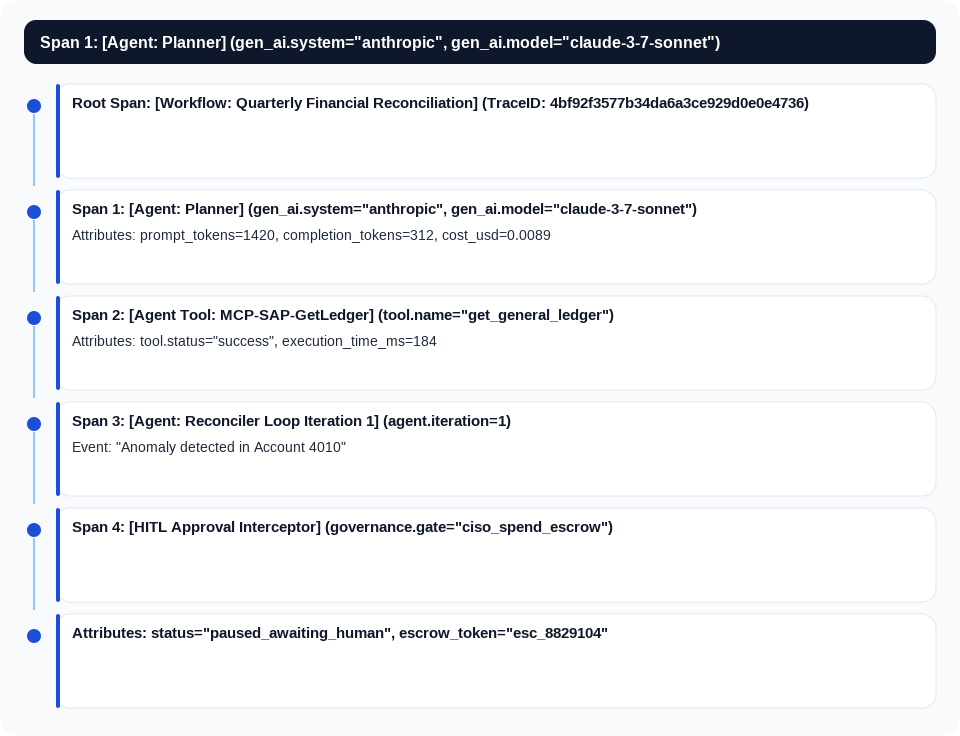
Traditional Application Performance Monitoring (APM) tools measure CPU utilization, memory pressure, and HTTP status codes. These metrics provide zero visibility into agent failure modes. An agent can execute with 100% HTTP 200 OK responses while trapped in an infinite semantic loop, burning $500 an hour in API tokens while accomplishing zero business value.
Enterprise Architecture must standardize on the OpenTelemetry (OTel) Semantic Conventions for Generative AI Systems (v1.30.0+), extended for autonomous agent swarms.
Mandatory Telemetry Attributes for Agent Spans
Every Enterprise Architecture specification must mandate that all agent runtimes emit the following standard OTel span attributes:
gen_ai.system: The vendor/engine (anthropic,openai,vertex_ai,bedrock,ollama).gen_ai.request.model: The specific model version (claude-3-7-sonnet-20260620,gpt-4o-2024-11-20).gen_ai.usage.prompt_tokens&gen_ai.usage.completion_tokens: Exact integer counts.gen_ai.usage.cost_usd: Real-time financial attribution calculated per token tier.agent.id&agent.role: The unique identifier and functional purpose (orchestrator,researcher,coder,critic).agent.iteration.count: Incremental counter tracking reasoning loop depth. An enterprise circuit breaker must automatically trigger ifiteration.count > 15, freezing the agent before execution runaway occurs.agent.tool_call.input_hash: Cryptographic fingerprint of arguments passed to downstream tools.
Layer 5: Continuous Governance & Dual-Key Human-in-the-Loop (HITL) Escrow
The final pillar of the reference architecture is the enforcement of automated guardrails and financial spend escrow.
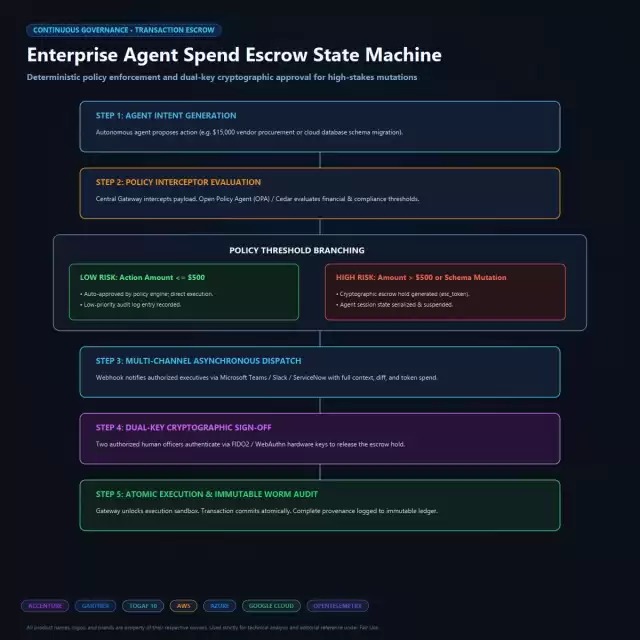
Enterprise Architecture cannot rely on soft system-prompt instructions (such as "Do not spend more than $500 without asking") to prevent unauthorized corporate actions. Models hallucinate, ignore negative constraints, and can be bypassed via prompt injection.
Controls must be enforced deterministically outside the model runtime through an Open Policy Agent (OPA) / Cedar Policy Engine integrated with an Asynchronous Dual-Key Escrow Service.
The Escrow State Machine
- Intent Generation: The agent formulates a proposal to execute a high-risk operation (e.g., updating a vendor bank account number, deleting a cloud database backup, or approving an invoice > $1,000).
- Policy Evaluation: The Tool Gateway intercepts the intent and executes an OPA policy check:REGO
package enterprise.agent.governance default allow = false # Rule: Actions below $500 auto-approved if agent has tier-1 financial clearance allow { input.action.type == "financial_transaction" input.action.amount_usd <= 500.00 input.agent.clearance_level >= 1 } # Rule: Actions above $500 require dual-key human escrow approval require_escrow { input.action.type == "financial_transaction" input.action.amount_usd > 500.00 } - Escrow Hold & Session Suspension: If
require_escrowevaluates to true, the Tool Gateway generates an immutable cryptographic escrow token, saves the serialized execution state to the episodic memory bus, and freezes the agent's reasoning loop. - Multi-Channel Dispatch: An automated webhook dispatches an interactive notification via Microsoft Teams, Slack, or ServiceNow to designated human approvers. The notification displays a complete contextual diff, token cost ledger, and reason for action.
- Dual-Key Cryptographic Sign-Off: Two authorized human officers must authenticate via Enterprise SSO / WebAuthn FIDO2 keys to release the escrow hold.
- Atomic Execution & Audit Log: Once signed, the Tool Gateway executes the transaction within an isolated sandbox, logs the full cryptographic trace to an immutable WORM (Write Once, Read Many) audit repository, and notifies the agent to resume its workflow.
4. The 90-Day CIO Scope Checklist: A Phased Action Blueprint
To operationalize this reference architecture and close the 34% gap between redesign intent and agentic scope, Enterprise Architecture teams must execute a structured, four-phase migration roadmap over 90 days.
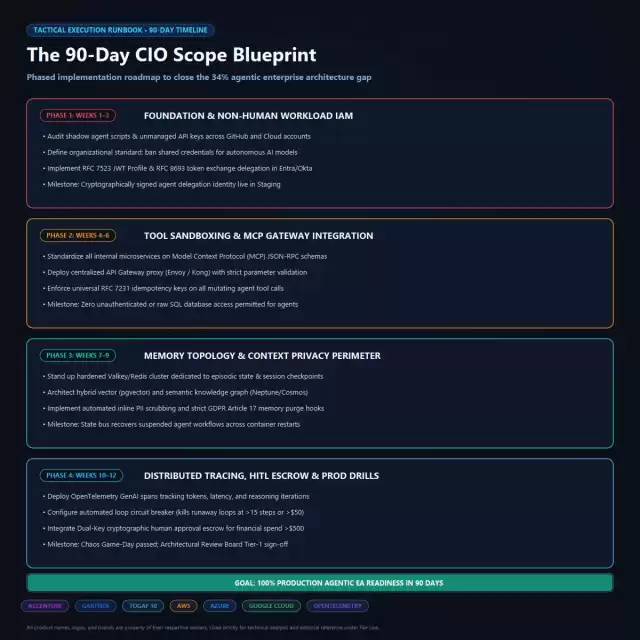
WEEKS 1–3: FOUNDATION & IAM
[ Inventory Shadow Agents ] ────► [ Define RFC 7523 NHI-IAM ] ────► [ Establish Token Gateways ]

WEEKS 4–6: TOOL SANDBOXING & MCP
[ Deploy MCP Gateway ] ────► [ Enforce Idempotency Keys ] ────► [ Rate & Circuit Breakers ]

WEEKS 7–9: MEMORY & CONTEXT BUS
[ Deploy Valkey/Redis State ] ────► [ Vector/Graph Isolation ] ────► [ Zero-Trust Data Retention ]

WEEKS 10–12: TELEMETRY & ESCROW
[ OpenTelemetry OTel Spans ] ────► [ Dual-Key HITL Escrow ] ────► [ Chaos Game-Day Drills ]
Phase 1: Foundation & Non-Human IAM Discovery (Weeks 1–3)
Phase 2: Tool Sandboxing & MCP Gateway Integration (Weeks 4–6)
Phase 3: Memory Topology & Context Privacy Perimeter (Weeks 7–9)
Phase 4: Distributed Tracing, HITL Escrow & Production Hardening (Weeks 10–12)
5. Multi-Cloud Enterprise Reference Mapping: AWS, Azure, and Google Cloud
Enterprises operate heterogeneous multi-cloud environments. The table below maps the five core layers of the Agent-Native Enterprise Reference Architecture to native services across Amazon Web Services (AWS), Microsoft Azure, and Google Cloud Platform (GCP).
| Architecture Layer | Amazon Web Services (AWS) | Microsoft Azure | Google Cloud Platform (GCP) | Open Source / Vendor-Neutral |
|---|---|---|---|---|
| Layer 1: Non-Human IAM | AWS IAM Roles Anywhere, Secrets Manager, AWS Cognito RFC 7523 | Microsoft Entra Workload ID, Managed Identities, Azure Key Vault | GCP Workload Identity Federation, Cloud IAM, Secret Manager | SPIFFE / SPIRE, Keycloak, HashiCorp Vault |
| Layer 2: Tool Sandbox | AWS Lambda SnapStart, Amazon API Gateway, ECS Fargate MicroVMs | Azure Container Apps Dynamic Sessions, Azure API Management | GCP Cloud Run Sandboxed Containers, Apigee API Hub | Model Context Protocol (MCP), Envoy Proxy, Kong |
| Layer 3: Memory & Context | Amazon ElastiCache (Valkey), Amazon OpenSearch Serverless, Neptune | Azure Managed Redis, Azure AI Search, Azure Cosmos DB Graph | Memorystore for Redis, Cloud Spanner Graph, Vertex AI Vector | Redis 8 / Valkey, Qdrant, Neo4j, pgvector |
| Layer 4: Observability | Amazon CloudWatch GenAI Tracing, AWS X-Ray, OpenSearch Service | Azure Monitor OpenTelemetry, Application Insights GenAI Spans | Google Cloud Trace, Cloud Logging, Vertex AI Model Monitoring | OpenTelemetry (OTel), Grafana Tempo / Prometheus, Langfuse |
| Layer 5: HITL Governance | AWS Verified Permissions (Cedar), Amazon Bedrock Guardrails, Step Functions | Azure AI Content Safety, Microsoft Copilot Studio HITL Escrow | Vertex AI Policy Engine, Cloud Workflows Human Tasks | Open Policy Agent (OPA / Rego), Cedar Engine |
6. The Monday Morning Action Plan for CIOs and Chief Architects
When Chief Information Officers and Enterprise Architects convene for their weekly leadership and Architectural Review Board (ARB) meetings, they must move beyond abstract strategy slides and confront operational realities.
The 7 Critical Inquiries for Monday Morning
To immediately evaluate your organization’s exposure to the 34% architecture blindspot, table the following seven diagnostic questions:
- Identity & Traceability: "If an autonomous agent modifies a production database record today, will our audit logs reflect an unforgeable delegation chain pointing to the human principal who approved the workflow, or will it show a generic shared service account?"
- Idempotency & Cost Defense: "What technical mechanism prevents our customer-facing agents from double-charging a customer or duplicating an ERP entry if a third-party API times out during a reasoning loop?"
- Loop Containment: "Do we have an automated circuit breaker in place that actively kills an autonomous agent session if it enters a recursive reasoning loop burning hundreds of dollars in foundation model tokens?"
- Tool Isolation: "Are our autonomous agents invoking internal microservices through secure, validated Model Context Protocol (MCP) gateways with schema enforcement, or are developers connecting models directly to unauthenticated internal endpoints?"
- Memory Sanitation: "When an enterprise customer requests the deletion of their personal data under GDPR Article 17, does our data engineering team have a deterministic procedure to expunge that customer’s data from our agents' vector and graph long-term memory stores?"
- Financial Escrow: "Is there a hard, programmatic, dual-key human approval gate enforced outside the LLM runtime for any financial transaction or critical infrastructure mutation exceeding $500?"
- Architecture Scope Alignment: "Does our three-year Enterprise Architecture modernization charter explicitly include autonomous, non-human agentic systems in scope, or are we modernizing our tech stack for a 2016 paradigm that no longer exists?"
7. Comparative Enterprise Readiness Scorecard
Evaluate your organization's architectural maturity using the weighted assessment matrix below:
| Architectural Domain | Nascent (0–25%) | Developing (26–50%) | Mature (51–75%) | Optimized (76–100%) | Your Score |
|---|---|---|---|---|---|
| 1. Identity & Access (NHI-IAM) | Shared API keys in code; zero agent identity tracking. | Distinct service accounts per agent; no delegation chain. | RFC 7523 token exchange; actor claims in JWTs. | Cryptographic SPIFFE/SPIRE attestation; real-time ABAC. | / 20 |
| 2. Tool Sandboxing (MCP) | Direct REST/SQL access without parameter validation. | Basic API Gateway with static API keys. | MCP server integration; JSON schema validation. | Fully sandboxed execution; mandatory RFC idempotency keys. | / 20 |
| 3. Context & Memory Fabric | Flat prompts; no long-term persistent memory. | Basic RAG vector search without session continuity. | Multi-tier memory (session + vector) with tenant isolation. | Hybrid vector-graph fabric; automated GDPR memory pruning. | / 20 |
| 4. Agentic Observability | Raw console logs; standard HTTP status code monitoring. | Centralized logging; basic token consumption tracking. | OpenTelemetry GenAI spans; cost attribution dashboards. | Real-time loop circuit breakers; token anomaly automated kill-switches. | / 20 |
| 5. Governance & HITL Escrow | System prompt instructions only ("please don't spend"). | Post-execution human audits and reconciliations. | Single-approver email/webhook notifications for high spend. | Deterministic OPA/Cedar engine; cryptographic dual-key escrow. | / 20 |
| Total Readiness Index | Target: ≥ 85 / 100 | / 100 |
Organizations scoring below 60 points are in the acute danger zone identified by Accenture and Gartner: aggressively deploying AI initiatives into business units while lacking the structural architectural controls necessary to maintain operational stability, compliance posture, and financial predictability.
Closing this 34% gap within 90 days is not merely an engineering cleanup exercise; it is the single most critical strategic imperative determining which enterprises will successfully operationalize autonomous intelligence, and which will see their AI investments stall in production chaos.
Key Primary Citations & Research References
- Accenture Newsroom: Accenture CIO Pulse Survey 2026: The Enterprise Scaling Frontier (Published 3 November 2026; primary sample of 300 Global CIOs across 19 vertical industries, enterprises >$1B revenue).
- Gartner Research: Gartner Enterprise Architecture & Agentic AI Governance Benchmark (Published 9 November 2026; cross-industry IT leadership survey on autonomous agent deployment vs. control maturity).
- Internet Engineering Task Force (IETF): RFC 7523: JSON Web Token (JWT) Profile for OAuth 2.0 Client Authentication and Authorization Grants; RFC 8693: OAuth 2.0 Token Exchange.
- The Open Group: TOGAF® Standard, 10th Edition: Enterprise Architecture Reference Methodologies and Metamodels.
- OpenTelemetry Consortium: OpenTelemetry Semantic Conventions for Generative AI Systems (Version 1.30.0).
