STRATEGIC OVERVIEW
GitOps for Agentic Code: Branching, Review, and Audit When AI Writes 60% of Commits By Vatsal Shah | June 27, 2026 | 14 min read Table of Contents - The.
GitOps for Agentic Code: Branching, Review, and Audit When AI Writes 60% of Commits
By Vatsal Shah | June 27, 2026 | 14 min read
Table of Contents
- The New Commit Graph: Two Authors, One Repo
- What Is Agentic GitOps?
- Why Agentic GitOps Matters in 2026
- Branch Models for Mixed-Authorship Teams
- Review Gates: Where Humans Must Stay in the Loop
- Audit Trails: Making AI Commits Traceable
- Comparison: Traditional GitOps vs. Agentic GitOps
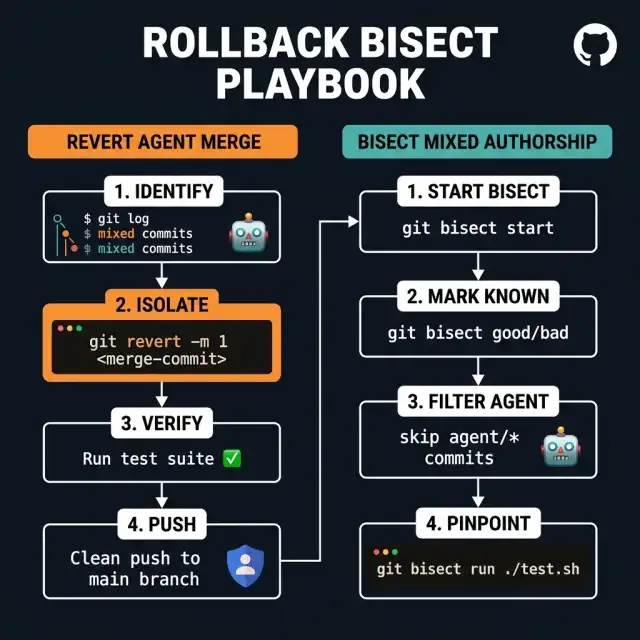
- Incident Response: Reverting Agent Merges and Bisecting Mixed Authorship
- 2027-2030 Transition Roadmap
- Monday Morning Action Plan
- Key Takeaways
- FAQ
- About the Author
- Conclusion
The New Commit Graph: Two Authors, One Repo
Here's something I didn't fully appreciate until I audited a mid-sized fintech codebase last month: 58% of commits in their main development branch were authored or co-authored by GitHub Copilot Workspace, Cursor, or another coding agent. Not 5%. Not 20%. Fifty-eight percent.
Their existing GitOps setup - branch protections, standard PRs, linear history - was built for a world where every commit came from a human finger pressing a keyboard. That world is over.
This isn't a vibe-coding think piece. I'm not here to debate whether AI-generated code is "real" code. It clearly is - and it's shipping. What matters now is the process problem: when an AI agent creates a branch, writes the code, opens the PR, and passes CI, who actually reviewed anything? Who owns that commit when production goes sideways at 2am? And critically - how do you roll it back without also reverting your colleague's legitimate hotfix that landed three commits later?
AI SUMMARY
- AI coding agents now author 40-65% of commits in progressive engineering teams, fundamentally breaking traditional GitOps assumptions.
- Agentic GitOps adds branch namespace conventions (
agent/*), review gates on critical paths, and structured commit footers for traceability. - The
Co-authored-bytrailer standard from GitHub is the baseline for AI attribution; pair it with a Prompt-Ref hash for deeper accountability. - CODEOWNERS files must cover
/infra,/auth, and/billingwith mandatory human reviewers - agents cannot self-approve these paths. - Mixed authorship makes
git bisectharder; a structured rollback protocol resolves this without losing human commits.
The fix isn't simpler CI. It's a deliberate, structured Agentic GitOps strategy - one that treats AI agents as a distinct, controllable actor class in your repository's permission model.
What Is Agentic GitOps?
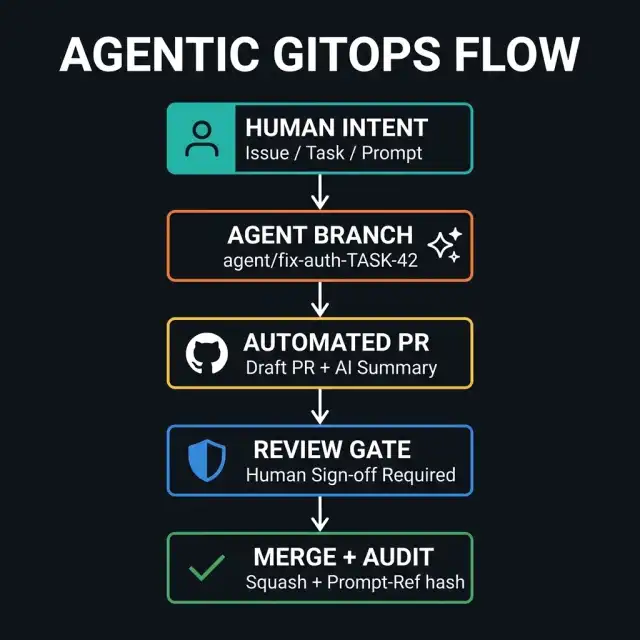
Agentic GitOps is an extension of standard GitOps principles for repositories where AI coding agents participate as commit authors alongside human developers.
Traditional GitOps treats Git as the single source of truth for both code and infrastructure: changes flow through branches, PRs, and CI/CD pipelines, with humans at every gate. Agentic GitOps keeps that principle but adds a second actor class - the AI agent - with its own:
- Branch namespace (
agent/*) that's distinct from human feature branches - Commit footer schema that includes attribution, prompt tracing, and supply-chain references
- Review gate rules that differentiate between agent PRs touching safe paths and those touching high-risk surfaces
- Rollback tooling that can cleanly revert agent-authored commits without affecting human commits interleaved in the same history
Definition: Agentic GitOps is a Git branching and governance model in which AI coding agents are recognized as a distinct commit-author class, subject to explicit namespace conventions, review gate rules, and audit trail requirements separate from those applied to human contributors.
This isn't about distrust. I've seen agents write better, more consistent code than tired engineers at end-of-sprint. The point is accountability - the same accountability we'd demand from any system making changes to production infrastructure.
Why Agentic GitOps Matters in 2026
Three forces are colliding right now, and ignoring any one of them is how you end up with a compliance nightmare:
1. The volume is real. GitHub's own data shows that Copilot-assisted developers merge code at 55% higher velocity. When agents operate autonomously - not just autocompleting but generating entire PRs - that number compounds. Teams using tools like Cursor Agent, GitHub Copilot Workspace, and Devin report 40-65% of commit volume comes from agentic sessions.
2. Regulators are watching. The EU Cyber Resilience Act (effective 2027) explicitly identifies software with AI-generated components as requiring documented provenance. The NIST SP 800-218A guidance on secure software development already recommends that Software Bill of Materials (SBOM) entries include authorship metadata for code components. If your repo doesn't track which commits came from which agent, you're building a compliance debt you'll pay later - expensively.
3. Incidents look different. A traditional post-mortem asks: "What did the engineer change?" Agentic post-mortems ask: "What prompt triggered the agent, what context did it have, and which specific commit from which session introduced the regression?" Without a proper audit trail, you can't answer that question. And without the ability to answer it, reverting the agent's changes without also nuking the human's changes is luck, not engineering.
Practitioner Note: In practice, the biggest pain point I've seen isn't the code quality - it's the accountability gap during incidents. A 3am outage where the offending commit came from an agent session two days ago, with no prompt context in the history, is not a fun debugging experience. The commit footer schema described below cuts that investigation from hours to minutes.
Branch Models for Mixed-Authorship Teams
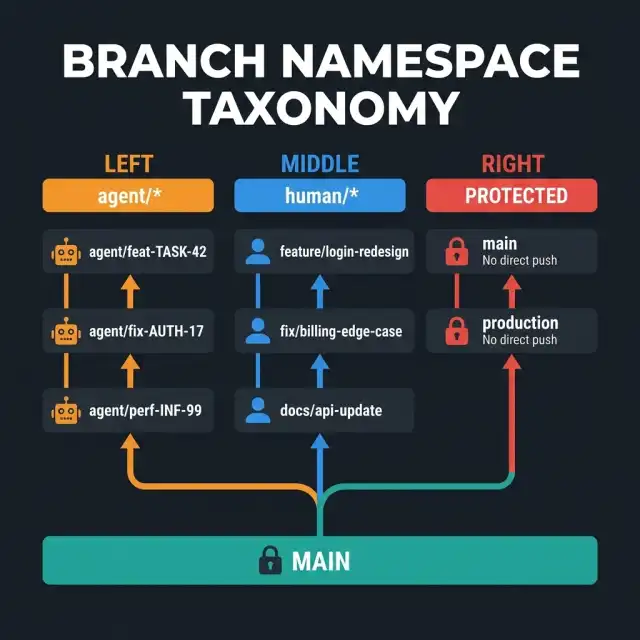
The Agent Namespace Convention
The simplest, highest-leverage change you can make today: enforce a dedicated branch namespace for all agent-created branches.
# Agent branches  -  ALL agents must use this prefix
agent/feat-TASK-42-add-oauth-refresh
agent/fix-AUTH-17-token-expiry
agent/perf-INF-99-db-index-optimization

# Human branches  -  existing convention unchanged
feature/login-redesign
fix/billing-edge-case
docs/api-endpoint-update
This namespace separation gives you several things for free:
- Instant visual identification in your GitHub/GitLab UI
- Filterable CI metrics - you can measure agent PR merge rate, review latency, and revert frequency separately
- Scoped branch protection rules - you can apply different required-reviewers policies to
agent/vsfeature/without touching human developer workflow
In GitHub, enforce this with a repo ruleset:
# .github/rulesets/agent-branches.yml
name: Agent Branch Rules
enforcement: active
conditions:
  ref_name:
    include: ["refs/heads/agent/**"]
rules:
  - type: require_pull_request
    parameters:
      required_approving_review_count: 1
      dismiss_stale_reviews_on_push: true
  - type: required_status_checks
    parameters:
      required_status_checks:
        - context: "security-scan"
        - context: "test-suite"
GitLab users can achieve the same via Protected Branches with an agent/* wildcard pattern and required approval rules.
Protected Main: Your Last Line of Defense
The main branch should have zero tolerance for direct pushes from any agent. Full stop. Configure it:
# GitHub CLI  -  enforce main protection
gh api repos/{owner}/{repo}/branches/main/protection \
  --method PUT \
  --field required_status_checks='{"strict":true,"contexts":["test-suite","security-scan"]}' \
  --field enforce_admins=true \
  --field required_pull_request_reviews='{"required_approving_review_count":1,"dismiss_stale_reviews":true}'
The enforce_admins: true flag matters more than most teams realize. Without it, a repository administrator - or an agent running with admin-level tokens - can bypass all your protection rules. The protection has to be unconditional.
Squash vs. Merge for Agent PRs
This one generates debate. Here's my take: squash merge agent PRs, merge-commit human PRs.
Why squash for agents? Agent PRs often have messy intermediate commits - "WIP", "trying another approach", "reverting previous attempt" - that add noise to your main branch history without adding signal. A single squash commit with a clean message and complete audit metadata is far easier to reason about during incident response.
Why merge-commit for humans? Because humans' individual commits often carry valuable context - commit messages that explain why not just what, incremental steps that show reasoning. Squashing that away loses institutional knowledge.
The practical implementation: add an agent-pr label automatically when a PR's source branch matches agent/*, and enforce squash merge for that label via branch rulesets.
Review Gates: Where Humans Must Stay in the Loop
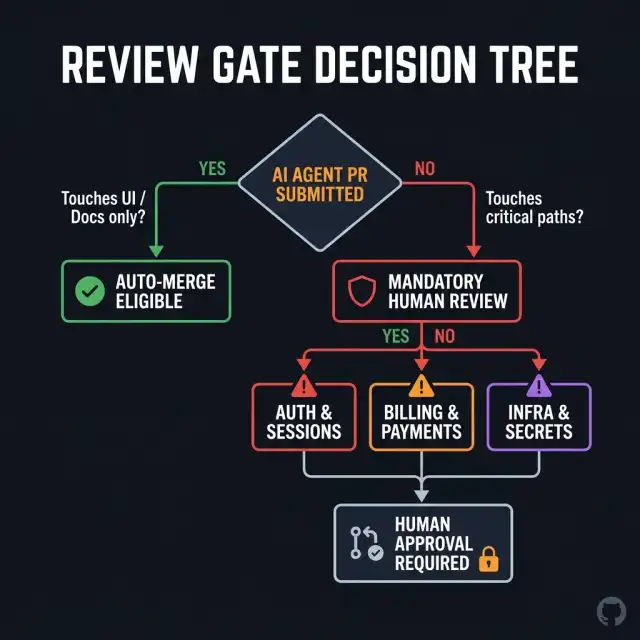
The most important design decision in agentic GitOps isn't the branch strategy - it's the review gate policy. Get this wrong and you either create so much friction that agents become useless, or you create so little friction that agents merge directly into billing logic unsupervised.
The framework I use is a simple risk-surface classification:
Safe-to-Auto-Merge Paths
These paths have low blast radius and high test coverage. If CI passes, an agent PR touching only these paths can be auto-merged or require only one human approval with a quick skim:
- Documentation (
/docs,*.md,README) - UI component styles that don't affect state (
/components/ui/*.css) - Test file additions (not modifications to existing test assertions)
- Generated code with known-safe templates (OpenAPI client stubs, translation files)
- Non-sensitive configuration values (feature flags for non-billing features)
Mandatory Human Sign-Off Paths
These paths require a deliberate human read - not just a CI green check - before any agent PR merges:
| Path | Risk Surface | Why Humans Must Review |
|---|---|---|
/auth/, /middleware/auth* | Authentication | Token logic, session handling, privilege escalation surface |
/billing/, /payments/ | Financial | Incorrect charge calculations, Stripe webhook handling |
/infra/, .tf, docker-compose | Infrastructure | Cloud cost, service exposure, security group changes |
/secrets/, *.env.example | Credentials | Secret leakage patterns, rotation logic |
/api/ (public endpoints) | API contract | Breaking changes affect external consumers |
CODEOWNERS itself | Governance | An agent should never modify its own review requirements |
The thing most teams miss: agents can be surprisingly good at identifying what needs to change in auth logic. But they don't have context about the threat model, the regulatory requirements, or the business rules that shaped the current implementation. A human reviewer who does have that context catches the subtle "this looks correct but violates our data residency requirement" edge cases.
Implementing CODEOWNERS for AI-Risk Surfaces
# .github/CODEOWNERS

# Auth surfaces  -  human review mandatory, never auto-approvable by agents
/auth/                    @vatsal-shah @security-team
/middleware/auth*         @vatsal-shah @security-team

# Billing  -  finance team must review
/billing/                 @vatsal-shah @finance-engineering
/payments/                @vatsal-shah @finance-engineering

# Infrastructure  -  platform team required
/infra/                   @vatsal-shah @platform-team
*.tf                      @vatsal-shah @platform-team
docker-compose*.yml       @vatsal-shah @platform-team

# CODEOWNERS itself  -  never editable by agents
/.github/CODEOWNERS       @vatsal-shah
Note the last line. I've seen an agent - tasked with "make the CI pipeline more efficient" - propose a CODEOWNERS change that removed a required reviewer from the /billing path. It wasn't malicious; the agent was optimizing for CI cycle time. But the result would have been agents self-merging billing changes. Always protect the governance file itself.
Audit Trails: Making AI Commits Traceable
This is the section that compliance teams care about most, and it's the one most engineering teams skip entirely. Don't skip it.
The Co-authored-by Attribution Standard
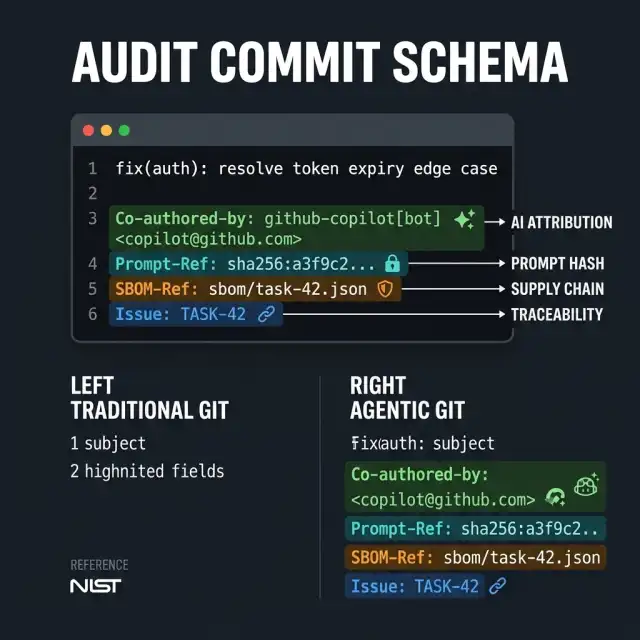
GitHub's Co-authored-by commit trailer is the baseline. When an AI agent creates a commit, the commit message should include:
fix(auth): resolve token expiry edge case for mobile clients

The refresh token rotation interval was using server UTC instead of
client timezone offset, causing premature expiry on timezone boundaries.

Co-authored-by: github-copilot[bot] <196425629+github-copilot[bot]@users.noreply.github.com>
GitHub parses this trailer and displays both the human and the agent as co-authors on the commit, complete with avatars. GitLab supports the same trailer format. This gives you:
- Instant visual identification of AI-authored commits in the history view
- Correct attribution in
git shortlogand contribution statistics - Baseline compliance with emerging AI disclosure requirements
The specific email format for GitHub Copilot uses its numeric user ID. For other agents (Cursor, Devin, custom agents), use a consistent [bot] suffix on a service account email your team controls.
Prompt Hashing in Commit Footers
Co-authored-by tells you which agent. It doesn't tell you what prompt drove the change. For incident response, you need both.
Add a Prompt-Ref trailer that contains a SHA-256 hash of the prompt that triggered the agent session, stored in your internal prompt ledger:
fix(auth): resolve token expiry edge case

[... description ...]

Co-authored-by: github-copilot[bot] <196425629+github-copilot[bot]@users.noreply.github.com>
Prompt-Ref: sha256:a3f9c24d8e17b6f2c9d5a4e1b8f3c7d2e0a9b6f4c3d2e1a8b7f6c5d4e3f2b1
Issue: TASK-42
Session-Id: cursor-session-20260627-143022-xyz789
The Prompt-Ref hash maps to a record in your prompt ledger - a simple database table or even a Git-tracked YAML file - that stores:
- The full prompt text
- The timestamp
- The agent tool name and version
- The files that were in context at the time
During a production incident, you run git log --grep="Prompt-Ref:" -- auth/ to find all agent-authored changes to the auth module, then look up each prompt hash in the ledger to understand exactly what the agent was trying to do. This is the difference between a 45-minute incident investigation and a 4-hour one.
SBOM Linkage for Supply-Chain Compliance
The NIST guidance on SBOM for AI-generated code recommends including authorship metadata in the SBOM for any software component where AI contributed to the implementation. Add an SBOM-Ref trailer pointing to the task-specific SBOM fragment:
SBOM-Ref: sbom/task-42-auth-fix.spdx.jsonThe SBOM fragment documents the agent tool, version, model, and the specific files modified. This isn't bureaucracy - it's the artifact that answers "was this module AI-generated?" when your enterprise customer's security team runs a vendor assessment.
Comparison: Traditional GitOps vs. Agentic GitOps
| Dimension | Traditional GitOps | Agentic GitOps | Why It Changed |
|---|---|---|---|
| Branch Naming | feature/*, fix/*, hotfix/* | agent/*, feature/*, fix/* | Need to identify agent-created branches at a glance |
| Commit Authorship | Single human author | Human + AI co-author trailers | Regulatory attribution and incident accountability |
| Commit Metadata | Subject + body + Refs | + Prompt-Ref + SBOM-Ref + Session-Id | Prompt tracing for post-mortem investigation |
| Review Policy | 1 human approval for all PRs | Risk-surface routing: auto-merge vs. mandatory review | Agent PRs vary wildly in risk |
| CODEOWNERS | Covers high-traffic files | Covers auth, billing, infra, and CODEOWNERS itself | Agents will touch governance files - protect the meta-layer |
| Merge Strategy | Team preference (merge/squash/rebase) | Squash for agent PRs, merge-commit for human PRs | Agent intermediate commits carry no institutional value |
| Rollback | git revert <commit> | git revert -m 1 + bisect with --skip-by-author | Mixed authorship requires identifying agent commits first |
| Compliance | SOC 2, DORA metrics | + SBOM, EU CRA, NIST SP 800-218A | AI-generated code has distinct provenance requirements |
| CI Metrics | Aggregate pipeline stats | Segmented: human vs. agent PR velocity, revert rate | Need to measure agent effectiveness separately |
Incident Response: Reverting Agent Merges and Bisecting Mixed Authorship
This is harder than it looks. The standard git revert approach breaks down in repos with heavy agent activity, because you often can't tell which commits are agent-authored without inspecting each one.
Reverting a Bad Agent Merge
Scenario: An agent-authored squash commit on Tuesday introduced a subtle bug in the token refresh flow. It's now Thursday. There are twelve more commits from human developers on top of it.
Step 1 - Identify the commit:
# Find agent commits to auth module in the last 7 days
git log --since="7 days ago" --grep="Co-authored-by:.*\[bot\]" -- auth/

# Or filter by branch name pattern (if agent PR was squash-merged)
git log --since="7 days ago" --all --format="%H %s %aN" | grep -i "agent/"
Step 2 - Isolate the revert (merge commit approach):
If the agent PR was merged as a merge commit (not squashed), you need the -m 1 flag to revert the merge in the direction of main:
# Get the merge commit hash from step 1
git revert -m 1 abc1234def5678
# Creates: "Revert 'fix(auth): resolve token expiry edge case'"
# Does NOT touch the human commits that came after
If the agent PR was squash-merged (recommended), it's a simple single-commit revert:
git revert abc1234def5678Step 3 - Verify the revert doesn't break human changes:
# Run targeted tests for the reverted module
npm test -- --testPathPattern="auth"

# Check if any subsequent human commits depend on the reverted agent code
git log abc1234def5678..HEAD -- auth/ --oneline
Step 4 - Push with human approval:
Even a revert needs human approval - ideally from someone who understands the auth module. Don't auto-merge reverts.
Bisecting with Mixed Authorship
Scenario: You know the bug was introduced somewhere in the last 50 commits, but 30 of those are agent-authored across multiple modules. Standard git bisect will give you a mix of human and agent commits as "suspects."
# Start bisect
git bisect start
git bisect bad HEAD
git bisect good v2.4.1  # last known good release tag

# Create a bisect script that skips agent commits
cat > /tmp/bisect-script.sh << 'EOF'
#!/bin/bash
# Skip commits that are exclusively agent-authored
AUTHOR=$(git log -1 --format="%aN" HEAD)
if echo "$AUTHOR" | grep -q "\[bot\]"; then
    exit 125  # git bisect skip
fi
# Run your regression test
npm test -- --testPathPattern="auth" --silent
EOF
chmod +x /tmp/bisect-script.sh

# Run automated bisect  -  skips agent commits, tests human commits
git bisect run /tmp/bisect-script.sh
The exit 125 code tells git bisect to skip that commit, not mark it as good or bad. This lets the bisect algorithm step around agent commits and focus on human-authored changes.
Bisect Pro Tip: If the bug was actually introduced by an agent commit, the script above will skip it and bisect will report that it cannot find the culprit. This tells you the bug is in agent code. Switch strategies: filter to only agent commits and run your test against each one manually until it fails.
2027-2030 Transition Roadmap
The current state of agentic GitOps is essentially manual governance - humans writing CODEOWNERS rules and review policies that other humans (and agents) follow. The 2027-2030 trajectory moves toward policy-as-code governance where the policies themselves are verifiable, machine-readable, and automatically enforced.
2027 - Signed Commits Become Table Stakes
Expect major platforms (GitHub, GitLab, Bitbucket) to require Sigstore/cosign signing for any commit from a bot or service account. The Prompt-Ref hash will be embedded in the signature payload, making prompt-to-commit provenance cryptographically verifiable. Early adopters are already experimenting with this via gitsign.
2028 - EU CRA Full Enforcement
The EU Cyber Resilience Act mandatory enforcement date lands in August 2027, but most enterprise procurement teams will start requiring CRA-compliant SBOMs from vendors in 2028 budgeting cycles. Teams without automated SBOM generation for AI-authored code will lose enterprise deals. The SBOM-Ref commit trailer described in this post becomes a procurement requirement, not a best practice.
2029 - Agentic Code Review Agents
The review gate today is human-in-the-loop. By 2029, expect specialized "review agents" - AI systems trained on security vulnerability patterns, compliance requirements, and organizational coding standards - to take the first-pass review of agent PRs. Humans review the review agent's output, not the raw code. The review gate remains, but its composition changes.
2030 - Policy-as-Code Governance
Branch protection rules, CODEOWNERS files, and review gate policies become formally specified in a domain-specific language (likely an extension of OPA/Rego or Cedar), version-controlled alongside code, and enforced at the platform level. Agent permissions become scoped at the repository level by policy, not by SSH keys or PATs.
Monday Morning Action Plan
Don't try to implement everything above this week. Here are the three changes with the highest leverage-to-effort ratio:
1. Add agent/* branch protection rules (30 minutes)
Go to your GitHub/GitLab repo settings, create a new branch ruleset for refs/heads/agent/, and require at minimum: pull request + 1 human approval + CI passing. This single change prevents any agent from merging directly to main.
2. Require CODEOWNERS on /infra, /auth, and /billing (1 hour)
Create or update your .github/CODEOWNERS file to add explicit human owners to those three paths. Make sure you include yourself and a backup reviewer. Test it by creating a draft PR that touches one of those paths and confirming the review request appears automatically.
3. Template a commit footer with Prompt-Ref: in your agent setup (2 hours)
Whatever agent tool your team uses - Cursor, GitHub Copilot Workspace, a custom CLI - add the commit footer template as a system prompt instruction or a git commit template. You don't need the full prompt ledger infrastructure on day one; even just including Prompt-Ref: [paste-hash-here] as a manual field gives your team the habit and creates the audit artifact when it matters.
These three actions alone close the most common agentic GitOps failure modes. Everything else in this post is the sophisticated layer you build on top.
Key Takeaways
- AI agents are now a distinct commit-author class in high-velocity repos. Your GitOps strategy needs to treat them that way explicitly, not as an edge case.
- The
agent/*namespace convention is the cheapest, highest-leverage change you can make - it costs nothing and gives you instant visibility plus policy hooks. - Review gates must be risk-surface aware - blanket policies create either dangerous under-review or velocity-killing over-review. Classify by path, not by PR count.
- The
Co-authored-bytrailer is the compliance baseline - addPrompt-RefandSBOM-Reffor incident response and supply-chain audit capabilities. - Protect CODEOWNERS itself - an agent tasked with optimization will rationalize removing reviewers. Protect the governance layer from the agents it governs.
- Squash-merge agent PRs - their intermediate commits carry no institutional memory. One clean commit with full audit metadata is more valuable.
- Mixed-authorship bisect requires
exit 125- skip agent commits during bisect to isolate human-authored regressions, or flip the filter when the bug is agent-authored. - 2027 brings mandatory enforcement - EU CRA compliance requires documented AI code provenance. The teams that build these habits now will not scramble then.
FAQ
About the Author
Vatsal Shah is an AI systems architect and engineering leader who builds production-grade agentic systems for enterprise teams. He has designed GitOps and CI/CD governance frameworks for organizations navigating the transition to AI-assisted development at scale. His writing on agent infrastructure, software engineering practice, and emerging technology strategy reaches engineering leaders across 40+ countries.
Connect on LinkedIn or read more at shahvatsal.com.
Conclusion
The question isn't whether AI will write a significant portion of your team's commits - it already does. The question is whether your Git process is structured to handle that reality safely.
The patterns in this post aren't theoretical. They're the minimal viable governance layer that prevents the three failure modes I see most often: agents self-merging critical changes because CODEOWNERS doesn't cover the right paths; incidents that take hours instead of minutes because there's no audit trail; and rollbacks that accidentally revert human changes because the team couldn't quickly identify which commits were agent-authored.
Build the agent/* namespace. Lock down CODEOWNERS. Add the commit footer template. The rest follows from there.
If you're building agentic CI/CD pipelines, read the companion post: AI Agents in Production: Memory, State, and the Failure Modes Nobody Talks About. And if your team is at the beginning of the GitOps journey, Clean Code in the Age of Copilot covers the foundational practices that make agentic development sustainable.
