Executive Summary: The Decade-Long Quest for Safe Navigation in Python
For more than a decade, Python core developers and application engineers have wrestled with one of the most contentious syntactic debates in modern programming language design: should Python introduce dedicated operators for handling None?
In nearly every major programming language that enterprise teams operate alongside Python—including TypeScript, JavaScript, C#, Kotlin, Swift, and Rust—developers enjoy first-class syntactic support for safe navigation and null coalescing. In Python, however, retrieving a deeply nested configuration property or traversing an API payload with optional fields still requires either an awkward chain of .get() calls, nested getattr() invocations, or multi-line defensive if guards.
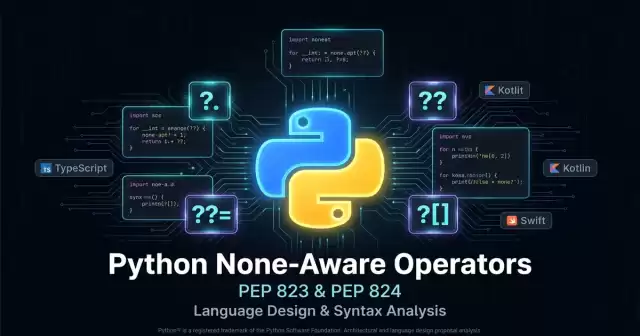
Now, that debate has reignited with unprecedented focus. Rather than attempting a monolithic syntactic revolution like the historic and ultimately stalled PEP 505 (proposed in 2015), Python core contributors have unbundled safe navigation into two surgical, companion proposals:
- PEP 823: Introduces the None-Coalescing Operators (
??and??=). - PEP 824: Introduces the None-Aware Access Operators (
?.,?[], and?()).
[!IMPORTANT] Official Claim Guard & Regulatory Status: As of November 2026 on peps.python.org, both PEP 823 and PEP 824 are in DRAFT / PROPOSED status. Neither proposal has been accepted by the Python Steering Council. Python does not currently support these operators in any released version (including CPython 3.12, 3.13, 3.14, or the 3.15 development branch). Any timeline forecasts discussing potential target releases represent analytical scenario modeling based on Steering Council review cadences, not committed roadmap features.
This comprehensive technical analysis unpacks why these proposals exist, examines the severe production bug known as the "falsy value trap," details the proposed grammar and bytecode mechanics, audits the heated community debate across discuss.python.org, and provides production-ready defensive architectural patterns you can safely use in Python today.
1. The Falsy Value Trap: Why x or default Is Python's Most Pervasive Bug
To understand why PEP 823 and PEP 824 command such intense interest across enterprise engineering teams, one must examine the fundamental limitation of Python's boolean evaluation semantics: the conflation of falsiness with non-existence.
In idiomatic Python codebases, developers frequently write the following expression to assign a default fallback:
# The classic fallback idiom in Python
timeout = config.get("timeout") or 30
port = incoming_request.get("port") or 8080
allow_retries = user_settings.get("retries_enabled") or True
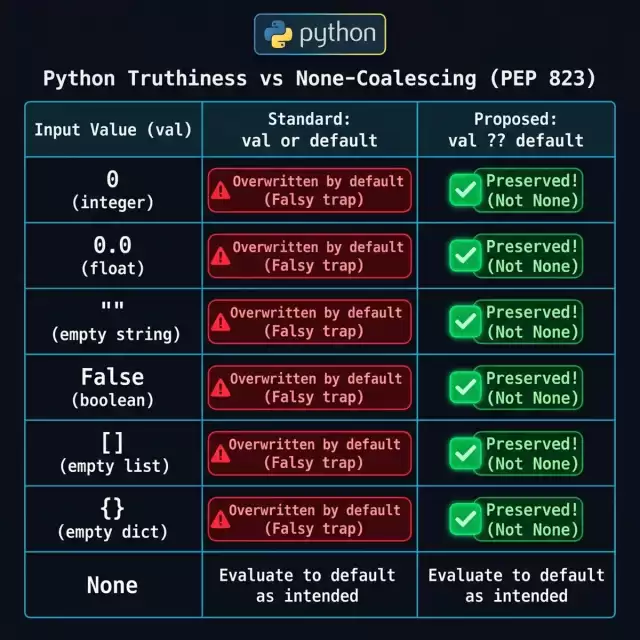
This pattern relies on the short-circuiting behavior of Python's or operator. If the left-hand operand evaluates to a truthy value, or returns it; otherwise, it evaluates and returns the right-hand operand.
Where the Idiom Fails in Production
The critical flaw in value or default is that Python considers multiple valid domain values to be falsy:
- The integer
0 - The floating-point number
0.0 - The boolean literal
False - The empty string
"" - The empty list
[] - The empty dictionary
{} - The empty set
set()
When any of these valid values appear, the or operator silently discards them and substitutes the default fallback. Consider the real-world production catastrophes this causes:
# Production Catastrophe 1: The Zero Timeout / Zero Balance Bug
def execute_database_query(query: str, timeout_seconds: float | None = None) -> QueryResult:
    # BUG: If a caller explicitly specifies timeout_seconds=0.0 (non-blocking query),
    # Python evaluates 0.0 as falsy and silently resets the timeout to 30.0 seconds!
    effective_timeout = timeout_seconds or 30.0
    return driver.run(query, timeout=effective_timeout)


# Production Catastrophe 2: The Explicit False Override Bug
def initialize_feature_flag(env_config: dict[str, Any]) -> bool:
    # BUG: If an administrator explicitly disables a feature via {"dry_run": False},
    # False is evaluated as falsy, and dry_run is silently forced back to True!
    dry_run = env_config.get("dry_run") or True
    return dry_run


# Production Catastrophe 3: The Empty String Payload Bug
def update_user_bio(user_id: str, new_bio: str | None = None) -> None:
    # BUG: If a user intentionally clears their biography by providing new_bio="",
    # Python treats "" as falsy and restores the existing bio from the database!
    existing_bio = db.get_user(user_id).bio
    bio_to_save = new_bio or existing_bio
    db.save_bio(user_id, bio_to_save)
The Truth-Table: Boolean or vs Strict None Check
The table below contrasts how Python's native or behaves against an explicit is None check and the proposed PEP 823 ?? operator across common data values:
Input Expression x | x or "DEFAULT" (Native Python) | x if x is not None else "DEFAULT" | Proposed x ?? "DEFAULT" (PEP 823) | Production Risk Level |
|---|---|---|---|---|
None | "DEFAULT" | "DEFAULT" | ✔ "DEFAULT" | Intended Behavior |
"Hello World" | "Hello World" | "Hello World" | ✔ "Hello World" | Intended Behavior |
100 | 100 | 100 | ✔ 100 | Intended Behavior |
0 (Integer zero) | ✖ "DEFAULT" (Data Loss) | 0 (Preserved) | ✔ 0 (Preserved) | Critical Bug |
0.0 (Float zero) | ✖ "DEFAULT" (Data Loss) | 0.0 (Preserved) | ✔ 0.0 (Preserved) | Critical Bug |
False (Boolean false) | ✖ "DEFAULT" (Overridden) | False (Preserved) | ✔ False (Preserved) | Severe Logic Flaw |
"" (Empty string) | ✖ "DEFAULT" (Overridden) | "" (Preserved) | ✔ "" (Preserved) | Silent Data Drift |
[] (Empty list) | ✖ "DEFAULT" (Overridden) | [] (Preserved) | ✔ [] (Preserved) | Silent Fallback |
{} (Empty dictionary) | ✖ "DEFAULT" (Overridden) | {} (Preserved) | ✔ {} (Preserved) | Silent Fallback |
To avoid the falsy trap today, Python developers are forced to write the verbose ternary expression:
effective_timeout = timeout_seconds if timeout_seconds is not None else 30.0While semantically sound, repeating this ternary idiom across hundreds of configuration keys, request arguments, and database columns creates cognitive fatigue and bloats codebases. This friction is precisely what PEP 823 seeks to eliminate.
2. From PEP 505 to PEP 823 & 824: The Unbundling Strategy
To appreciate the design of PEP 823 and PEP 824, one must revisit why safe navigation stalled in Python for nearly a decade.
In 2015, Mark E. Haase and Steve Dower introduced PEP 505: None-aware operators. PEP 505 was ambitious, bundling four distinct syntactic categories into a single proposal:
- None-coalescing binary operator:
a ?? b - None-coalescing assignment operator:
a ??= b - None-aware attribute access:
a?.b - None-aware indexing and subscription:
a?[b]
Why PEP 505 Stalled
Despite enthusiastic support from broad segments of the application development community, PEP 505 faced severe friction from core developers, including Python's creator, Guido van Rossum:
- Syntactic Complexity & Grammar Bloat: PEP 505 attempted to resolve every null-safety scenario simultaneously, creating intricate corner cases involving slice syntax (
a?[1:3]), method chaining (a?.b()?.c()), and assignment targets (a?.b = c). - Grammar Ambiguities with Formatting: In Python, the question mark was not part of the core expression grammar, leading to tokenization challenges when interacting with format strings and slice notations.
- Philosophical Resistance to "Symbol Creep": Influential voices in the Python community argued that adding punctuation-heavy operators eroded Python's defining virtue—readability and plain-English keywords. Comparisons were made to Perl and JavaScript, warning that Python risked becoming unreadable to novices.
- Exhaustion of the Debate: After hundreds of messages on the
python-ideasmailing list, discussion reached an impasse, and PEP 505 was formally deferred.
The Modern Strategy: Targeted, Modular Proposals
In 2026, realizing that the community's demand for safe navigation had only intensified with the growth of massive TypeScript codebases, core contributors chose to unbundle PEP 505 into two independent, tightly scoped proposals:
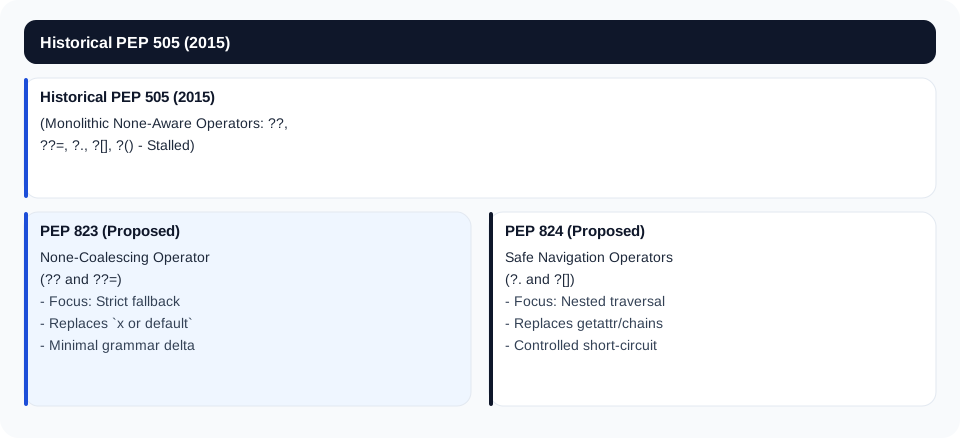
By decoupling coalescing (??) from safe traversal (?.), the authors created a strategic pathway: the Python Steering Council can evaluate and potentially accept PEP 823 (which has a near-zero grammar footprint) even if questions remain regarding the more complex AST propagation rules of PEP 824.
3. PEP 823 Deep Dive: None-Coalescing Operators (?? and ??=)
PEP 823 focuses exclusively on providing a concise, strict alternative to a or b that short-circuits only when the left-hand operand is strictly None.
Grammar and Precedence Rules
Under PEP 823, the Python grammar is extended with a new binary operator ?? and an augmented assignment operator ??=:
# Proposed PEG Grammar Delta for PEP 823
coalesce_test:
    | disjunction '??' coalesce_test
    | disjunction

augmented_assignment:
    | ...
    | '??='
Operator Precedence Hierarchy
In the proposed grammar, ?? sits with a precedence level between logical or and conditional expressions (if-else):
- Parentheses:
() - Exponentiation:
- Multiplicative:
*,/,//,% - Additive:
+,- - Bitwise shifts & comparisons:
<<,>>,<,<=,==,!= - Identity tests:
is,is not,in,not in - Logical NOT:
not - Logical AND:
and - Logical OR:
or - None-Coalescing:
??(Proposed) - Conditional Expression:
x if y else z - Assignment:
=,+=,??=
Because ?? binds looser than or and and, mixed expressions behave predictably without mandatory parentheses:
# Proposed: Evaluates (x > 0 and y > 0) first; if that result is None, falls back to False
result = (x and y) ?? False
The Single-Evaluation Guarantee
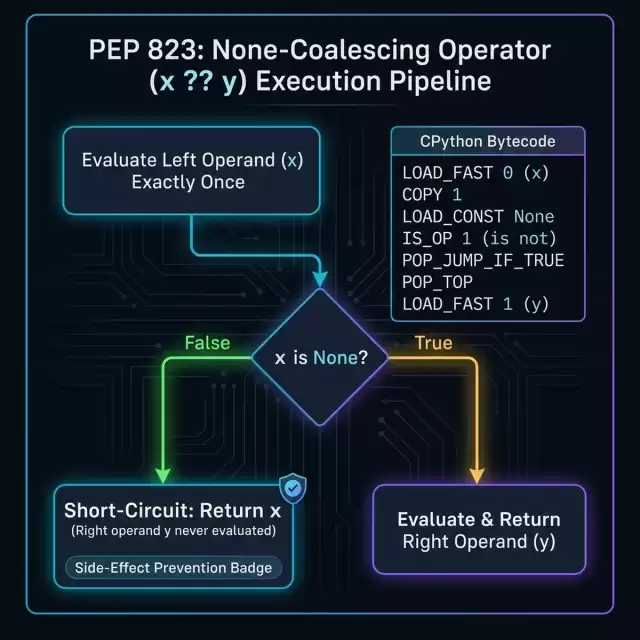
A foundational invariant of PEP 823 is that the left-hand operand is guaranteed to be evaluated exactly once.
In naive macro replacements or careless refactorings, developers frequently introduce duplicate execution bugs:
# The Hidden Side-Effect Trap with Ternary Expressions:
# If calculate_costly_metric() is slow or has side effects (e.g. increments a counter),
# writing this re-evaluates the expensive function TWICE!
val = calculate_costly_metric() if calculate_costly_metric() is not None else default_val

# How developers must write it today to prevent duplicate side effects:
temp_val = calculate_costly_metric()
val = temp_val if temp_val is not None else default_val
Under PEP 823, ?? natively guarantees single evaluation through compiler-level register assignment:
# Proposed PEP 823 Syntax:
# calculate_costly_metric() is executed EXACTLY ONCE
val = calculate_costly_metric() ?? default_val
CPython Bytecode and Compiler Mechanics
At the CPython virtual machine level, a ?? b compiles into efficient bytecode that checks object identity directly against the global Py_None singleton without invoking the type's bool() or len() dunder methods:
# Conceptual Bytecode Compilation for: val = a ?? b
        LOAD_FAST                0 (a)
        DUP_TOP                  # Duplicate top of stack for evaluation
        LOAD_CONST               1 (None)
        IS_OP                    1 (is not)    # Strict pointer check: a is not None
        POP_JUMP_FORWARD_IF_TRUE 1 (to END)    # Short-circuit if a is not None
        POP_TOP                                # Discard the None value
        LOAD_FAST                1 (b)         # Evaluate and push right-hand operand
END:    STORE_FAST               2 (val)
Because the identity check uses IS_OP against None, user-defined classes cannot override the check via eq(). A class that implements eq to return custom objects or raise exceptions will not alter the execution of ??.
Augmented Coalescing Assignment: ??=
PEP 823 also introduces ??=, enabling in-place default assignment:
# Proposed PEP 823 In-Place Assignment:
class RequestContext:
    def __init__(self, trace_id: str | None = None):
        self.trace_id = trace_id

        # If trace_id was not provided (is None), generate a new UUID.
        # If trace_id was provided as an empty string (custom blank header), it is preserved!
        self.trace_id ??= str(uuid.uuid4())
This replaces the clunky three-line guard:
if self.trace_id is None:
    self.trace_id = str(uuid.uuid4())
4. PEP 824 Deep Dive: None-Aware Access Operators (?., ?[], and ?())
While PEP 823 tackles default value assignment, PEP 824 addresses safe traversal across deeply nested object hierarchies, optional data structures, and dynamic API payloads.

The Three Operators of PEP 824
PEP 824 introduces three coordinated access operators:
- Safe Attribute Access (
?.): Traverses object attributes; returnsNoneif the target isNone. - Safe Indexing and Subscripting (
?[]): Accesses dictionary keys, list indices, or sequence slices; returnsNoneif the target isNone. - Safe Method Invocation (
?()): Invokes a callable only if the target is notNone.
The Short-Circuiting Propagation Boundary
The most critical architectural concept in PEP 824 is short-circuit propagation. When an access operator encounters None, the evaluation of the entire remaining access chain is aborted, and the overall expression immediately yields None:
# Proposed PEP 824 Nested Traversal:
city = order?.customer?.shipping_address?.city
In this expression:
- If
orderisNone, evaluation halts immediately and yieldsNone. Neither.customer,.shipping_address, nor.cityare evaluated. - If
order.customeris an object, butshipping_addressisNone, evaluation halts atshipping_addressand yieldsNone. - At no point is an
AttributeErrorraised due to accessing an attribute onNone.
Comparison: Boilerplate Today vs Proposed PEP 824 Syntax
Consider the defense required today when extracting an authenticated tenant's zip code from a complex, optional enterprise payload:
Defensive Code Today (Without PEP 824):
# Today: Multi-tier defensive guard or fragile dict.get chain
def get_tenant_zip(payload: dict[str, Any] | None) -> str | None:
    if payload is None:
        return None

    session = payload.get("session")
    if session is None:
        return None

    user = session.get("user")
    if user is None:
        return None

    organization = user.get("organization")
    if organization is None:
        return None

    address = organization.get("primary_address")
    if address is None:
        return None

    return address.get("zip_code")
Clean Code with Proposed PEP 824:
# Proposed PEP 824: One clean, short-circuiting line
def get_tenant_zip(payload: dict[str, Any] | None) -> str | None:
    return payload?["session"]?["user"]?["organization"]?["primary_address"]?["zip_code"]
Composing PEP 823 and PEP 824 Together
The true power of safe navigation emerges when PEP 823 (??) and PEP 824 (?.) are composed into a single, cohesive expression:
# Proposed: Safe navigation combined with strict None-coalescing
# If any step is None, the chain aborts to None, and ?? provides the fallback.
# If max_retries is 0, the 0 is preserved!
retry_limit = (
    config?.gateway?.circuit_breaker?.get_policy()?["max_retries"]
    ?? 3
)
5. The Community Debate: Philosophy, Complexity & "Pythonic" Identity
Few topics generate as much passion within the Python Software Foundation and the wider Python community as syntax expansions. The debate surrounding PEP 823 and PEP 824 on discuss.python.org highlights deep philosophical divisions about what makes Python unique.
The Arguments in Favor of Acceptance
Proponents of PEP 823 and 824 present compelling pragmatic and architectural arguments:
- Elimination of Pervasive Falsiness Bugs: The
x or defaultbug is not theoretical; it is one of the most common causes of silent data corruption in production Python systems. Giving developers an ergonomic??operator directly eliminates this entire class of defects. - Reduced Cognitive Overhead: Enterprise software engineering teams frequently build applications spanning both Python and TypeScript (e.g., Python AI microservices consumed by React/Next.js frontends). Requiring developers to switch between modern safe navigation in TypeScript and clumsy
getattr()pyramids in Python creates needless friction. - Cleaner Structural Code: Codebases become vastly more readable when five lines of defensive boilerplate collapse into a single expressive statement. Reviewers can focus on business logic rather than verifying that every intermediate variable was checked against
None.
The Arguments Against Acceptance
Opponents, including veteran core contributors and language purists, raise substantive objections:
- "Symbol Proliferation" and Visual Noise: Python has historically favored human-readable English words over cryptic punctuation symbols (
and,or,not,is,in). Critics argue that introducing?.,??,??=, and?[]degrades Python's signature aesthetic, making code resemble Perl, C#, or regex-heavy scripts. - Encouraging Sloppy Object Modeling: Architectural purists argue that needing safe navigation is an anti-pattern indicating poor system design. According to the "Tell, Don't Ask" principle and the Law of Demeter, an object should not reach through four layers of intermediate structures (
a.b.c.d). Opponents contend that making deep navigation effortless encourages developers to write brittle, highly coupled data pipelines. - The
KeyErrorvsNoneAmbiguity: A subtle concern with?[]is whether it catchesKeyErroror only suppressesNone. In PEP 824,a?[b]only checks ifa is None; ifais a valid dictionary that simply lacks the keyb, it still raisesKeyError. Critics worry that novices will mistakenly expect?[]to act as an automaticdict.get(), leading to confusion. - Impact on Tooling and AST Parsers: Adding new multi-character tokens like
??=and?.complicates the Python grammar, requires updates across every linter, formatter (Black, Ruff), code analyzer, and syntax highlighter, and introduces edge-case interactions with Python's existing walrus operator (:=).
6. Static Typing & Tooling Impact: How mypy and pyright Will Adapt
Modern enterprise Python is statically typed. Any syntax addition must integrate seamlessly with Python's typing ecosystem, governed by typing modules, mypy, pyright, and PEP 484 / PEP 604 union types.
Type Narrowing with PEP 823 (??)
Under PEP 823, static type checkers can perform immediate, deterministic type narrowing:
# Proposed Typing Behavior with PEP 823:
def compute_metrics(timeout: float | None, fallback: float) -> float:
    # Type of timeout: float | None
    # Type of fallback: float

    resolved = timeout ?? fallback

    # Type of resolved is narrowed to: float
    # The None type is stripped from the union!
    return resolved * 1.5
If the right-hand operand also contains None, the type checker preserves the union:
# Both operands can be None
x: int | None = get_primary_score()
y: int | None = get_secondary_score()

# Inferred type of z: int | None
z = x ?? y
Type Propagation with PEP 824 (?.)
For safe navigation under PEP 824, the type checker automatically wraps the return type in a union with None:
class Address:
    zip_code: str

class Profile:
    address: Address | None

class User:
    profile: Profile | None

def inspect_user(user: User | None) -> None:
    # If any link can be None, the final inferred type is str | None
    code = user?.profile?.address?.zip_code

    # reveal_type(code) -> str | None
This clean alignment with TypeScript-style control flow analysis means static analysis tools can catch invalid property accesses downstream without special-case compiler hacks.
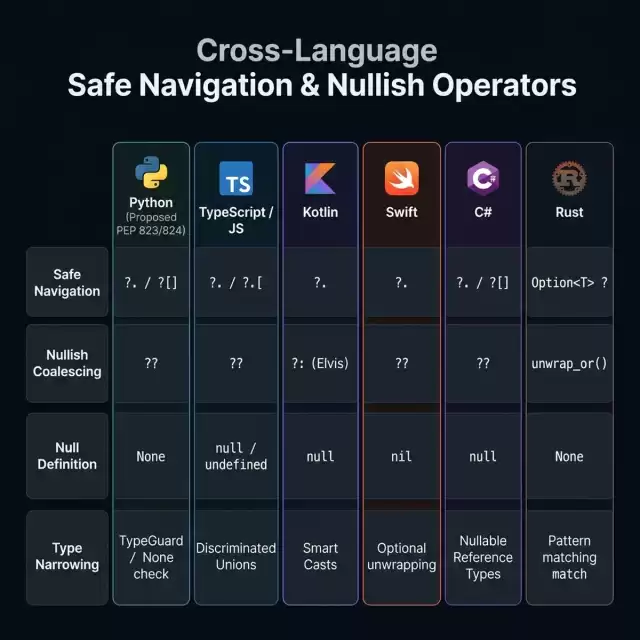
7. Comparative Matrix: Safe Navigation Across Modern Languages
To contextualize where Python's proposals fit into modern language design, the following matrix compares safe navigation and coalescing semantics across the major programming ecosystems:
| Language | Null Coalescing Syntax | Safe Attribute Access | Safe Indexing Syntax | Truthy vs Null Evaluation | Status / Adoption |
|---|---|---|---|---|---|
| Python (Proposed PEP 823/824) | a ?? b | a?.b | a?[b] | Strict is None (Proposed) | Draft / Under Review |
| Python (Native 3.x Today) | a or b (Falsy trap) | getattr(a, 'b', None) | a.get(b) (Dict only) | Boolean Falsiness (Traps 0, False, "") | Standard CPython |
| TypeScript / JavaScript | a ?? b | a?.b | a?.[b] | Strict null and undefined | Standard (ECMAScript 2020) |
| C# | a ?? b | a?.b | a?[b] | Strict null | Standard (C# 6.0 / 8.0) |
| Kotlin | a ?: b (Elvis) | a?.b | a?.get(b) | Strict null | Standard (Kotlin 1.0) |
| Swift | a ?? b | a?.b | a?[b] | Strict Optional.none | Standard (Swift 1.0) |
| Rust | .unwrap_or(b) | ? operator | .get(b) | Explicit Option Enum | Standard (Rust 1.0 / 2018) |
Notice that every modern typed language distinguishes null-coalescing from boolean disjunction. Python remains one of the few high-level languages where developers still rely on boolean or for default fallback assignment, perpetuating the falsy value trap.
8. What to Do Today: Production Defensive Patterns in Python 3.12–3.15
Because PEP 823 and PEP 824 are proposals that cannot be used in production Python today, enterprise engineering teams must adopt robust, idiomatic defensive patterns that prevent bugs without sacrificing maintainability.
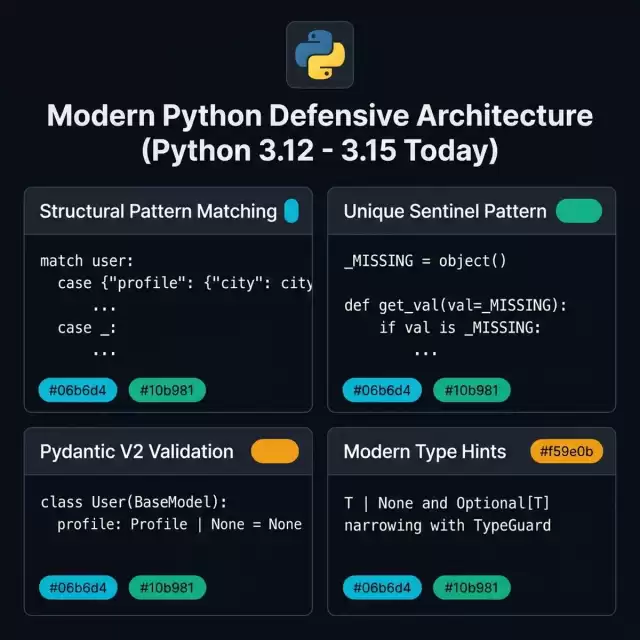
Pattern 1: The Explicit Sentinel Object for Real Defaults
When writing functions where None is a valid, intentional input value distinct from "unspecified," use a private sentinel object rather than None:
# Robust Sentinel Pattern in Python 3.12+
from typing import Any

# Unique singleton instance guaranteed never to collide with user data
_MISSING = object()

def configure_cache_eviction(
    max_entries: int | None = _MISSING,  # type: ignore[assignment]
    eviction_policy: str = "LRU"
) -> dict[str, Any]:
    # Check explicitly against the sentinel
    if max_entries is _MISSING:
        # Default behavior when parameter was omitted
        final_max = 10_000
    else:
        # Explicit None means "unlimited entries" (no eviction)
        # Explicit 0 means "zero caching"
        final_max = max_entries

    return {"max_entries": final_max, "policy": eviction_policy}
Pattern 2: Structural Pattern Matching (match / case) in Python 3.10+
Python's pattern matching engine provides one of the cleanest, most expressive mechanisms for unpacking nested optional data structures without safe navigation:
# Clean nested extraction via structural pattern matching
def extract_shipping_postal_code(payload: dict[str, Any] | None) -> str | None:
    match payload:
        case {
            "customer": {
                "addresses": [
                    {"type": "shipping", "postal_code": str(code)},
                    *_
                ]
            }
        }:
            return code
        case _:
            return None
This pattern has immense advantages:
- It verifies structure and types simultaneously.
- It will never raise an
AttributeErrororKeyError. - It completely eliminates chained
.get()pyramids.
Pattern 3: Pydantic v2 Schema Coercion for External Payloads
For API requests and JSON payloads, the gold standard in enterprise Python is delegating null-safety to Pydantic v2. Instead of writing runtime navigation guards, define a strict schema that automatically coerces and validates nested fields:
from pydantic import BaseModel, Field

class ShippingAddress(BaseModel):
    postal_code: str = Field(default="00000")
    country_code: str = Field(default="US")

class CustomerProfile(BaseModel):
    address: ShippingAddress | None = None

class IngestionPayload(BaseModel):
    customer: CustomerProfile | None = None

# Production usage:
def process_webhook(raw_json: dict[str, Any]) -> str:
    # Automatically validated and parsed in C/Rust via pydantic-core
    data = IngestionPayload.model_validate(raw_json)

    # Safe access with guaranteed defaults
    if data.customer and data.customer.address:
        return data.customer.address.postal_code
    return "00000"
Pattern 4: A Lightweight Safe-Navigation Helper Function
If your team frequently navigates dynamic dictionaries from legacy third-party systems, write a typed recursive helper:
from typing import Any

def safe_get(target: Any, *keys: str | int, default: Any = None) -> Any:
    """
    Safely traverse nested dictionaries, lists, and objects.
    Returns `default` if any intermediate link is None or missing.
    """
    curr = target
    for key in keys:
        if curr is None:
            return default

        if isinstance(curr, dict):
            curr = curr.get(key)
        elif isinstance(curr, (list, tuple)) and isinstance(key, int):
            try:
                curr = curr[key]
            except IndexError:
                return default
        else:
            curr = getattr(curr, str(key), None)

    return curr if curr is not None else default

# Production usage:
zip_code = safe_get(raw_api_data, "customer", "profile", "address", "zip", default="UNKNOWN")
9. Strategic Outlook: Steering Council Scenarios and the Monday-Morning Verdict
As the Python community deliberates on PEP 823 and PEP 824, what is the realistic outlook for enterprise engineering leaders?
Three Realistic Scenarios for the Steering Council
- Scenario A: Acceptance of PEP 823 Only (Most Probable Pathway): The Python Steering Council could choose to accept PEP 823 (
??and??=) while deferring or rejecting PEP 824. Because??solves the catastrophic falsy value trap with minimal grammar intrusion and zero ambiguity around object boundaries, it enjoys broad consensus. If accepted during the Python 3.16 development cycle, it could reach production as early as late 2027. - Scenario B: Rejection of Both PEPs (The Status-Quo Pathway): The Steering Council may reaffirm Python's traditional design philosophy: that punctuation-based operators dilute Python's readable prose aesthetic, and that existing tools (Pydantic,
dataclasses, structural pattern matching) already solve data traversal satisfactorily. - Scenario C: Acceptance of Both PEP 823 and PEP 824: If the community unites around the ergonomic and developer-productivity benefits observed across the TypeScript and C# ecosystems, both proposals could be accepted together, completing Python's modern syntax evolution.
The Monday-Morning Strategic Verdict for Engineering Teams
Regardless of how the Steering Council ultimately rules on PEP 823 and PEP 824, engineering leaders must enforce rigorous standards in their codebases starting today:
- Audit and Eradicate the
orFallback Trap: Review your team's code for occurrences ofx or defaultwherexrepresents numbers, booleans, or strings. Replace them immediately with explicitx if x is not None else defaultexpressions. - Standardize on Pydantic v2 for Ingress: Stop writing manual defensive traversal loops over raw JSON payloads. Let Pydantic validate and normalize data at the system boundary.
- Leverage Structural Pattern Matching: Encourage senior developers to use
match / casefor complex data extraction, establishing clean, self-documenting code patterns. - Follow the Debate on Discuss.python.org: Monitor the PEP 823 and 824 discourse to understand the architectural trade-offs shaping the next decade of Python core language design.
Related Technical Resources & Architectural Guides
- Framework Architecture: TanStack Start 1.0 Is Stable: What You Commit To (Vite 8, Validators, Sessions)
- Enterprise Upgrade Guide: Angular 20 Security Support Ends 28 Nov 2026: Upgrade Path to 22
- AI Architecture Deep Dive: Vectorless RAG: Structure-First Retrieval with PageIndex & MarkIndex
- Interactive Architecture Tools: Explore our Enterprise Software Architecture Evaluation Matrix
