STRATEGIC OVERVIEW
The software industry is undergoing a structural realignment in how engineering work is organized. For over a decade, Scrum has reigned as the default framework for software delivery.
The software industry is undergoing a structural realignment in how engineering work is organized. For over a decade, Scrum has reigned as the default framework for software delivery. Yet, entering 2026, a growing cohort of Chief Technology Officers, product leaders, and senior engineers are challenging Scrum's dominance. The critique centers on a persistent pattern: two-week sprints have devolved into administrative conveyor belts, prioritizing velocity points and meeting overhead at the expense of deep focus, architectural integrity, and actual product outcomes.
In response, Basecamp's Shape Up methodology is experiencing a practitioner-led renaissance. By replacing the constant estimation loop of Scrum with six-week cycles, bet-based planning, and dedicated cool-down periods, Shape Up offers an alternative for teams looking to restore builder autonomy and eliminate sprint fatigue.
This analysis evaluates both frameworks from a practitioner's perspective, analyzing the operational trade-offs, cultural impacts, and structural differences that define the Shape Up vs. Scrum debate in 2026.
1. The Core Architecture of Shape Up
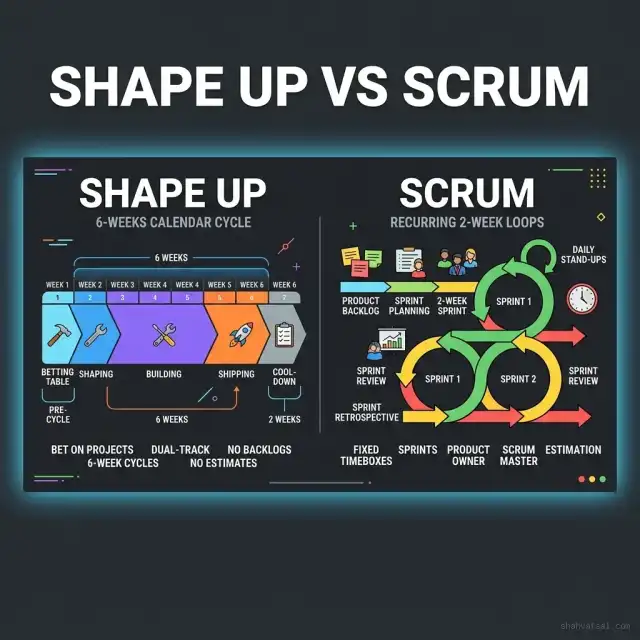
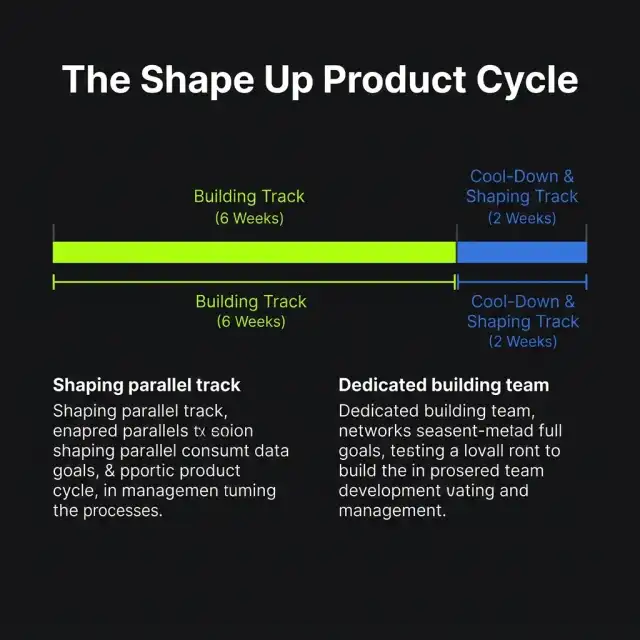
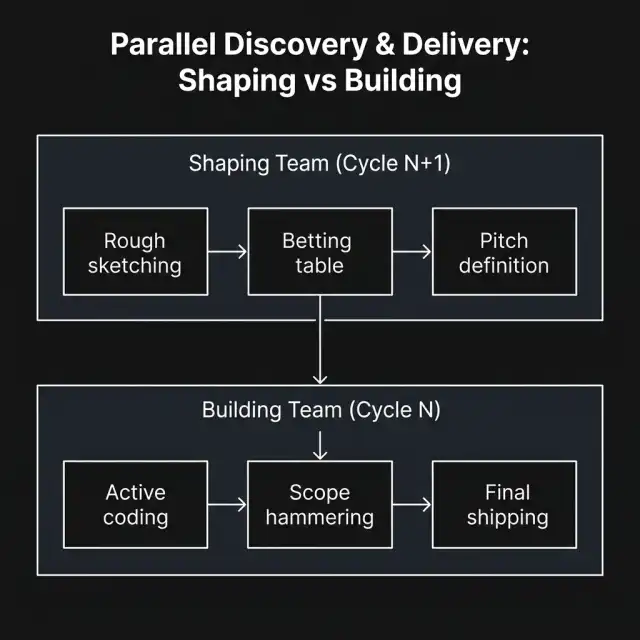
Developed by Ryan Singer and the team at Basecamp, Shape Up is designed to protect developers from micro-management and context switching. The methodology structures product development into two parallel tracks: Shaping and Building.
[ Shaping Track ]  -> Define Pitch (Problem, Appetite, Solution, Rabbit Holes, No-Gos)
                          |
                          v
                    [ Betting Table ] (Commit or Drop the Pitch)
                          |
                          v
[ Building Track ] -> 6-Week Focused Delivery Cycle -> 2-Week Cool-Down (No Scheduled Work)
The Six-Week Cycle and Cool-Down
Shape Up operates on an eight-week repeating rhythm.
- 6 Weeks of Building: During this phase, the engineering team is completely dedicated to a single project. They are shielded from interruptions, new feature requests, and daily status meetings. The scope is not detailed down to individual sub-tasks; instead, the team is given a shaped boundary and is trusted to discover, design, and implement the solution.
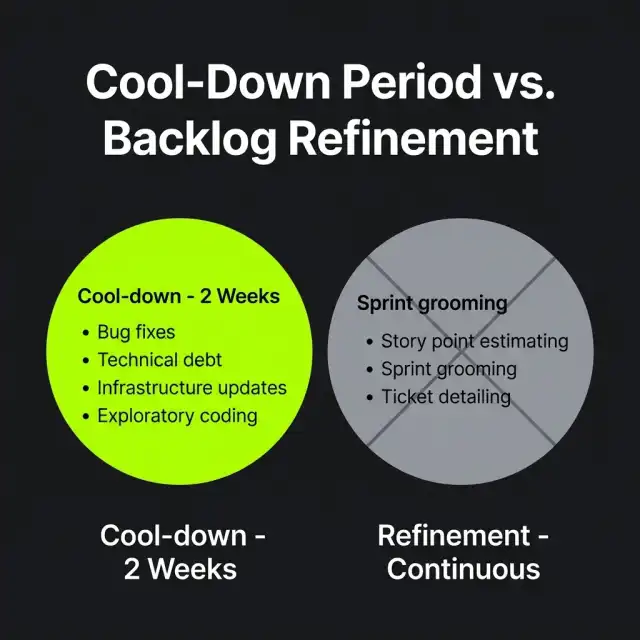
- 2 Weeks of Cool-Down: A critical release valve. During the cool-down period, there is no scheduled backlog work. Engineers have complete autonomy to fix bugs, address technical debt, upgrade developer tooling, or run exploratory spikes. This prevents the constant exhaustion associated with back-to-back development sprints.
The Concept of Appetite
In traditional Scrum, teams ask: "How long will this take to build?" This leads to complex estimation rituals using story points or hours.
Shape Up inverts this question. It asks: "How much time do we want to spend on this problem?" This is the Appetite. Appetites are set as a fixed budget—typically either a "Big Batch" (six weeks for a dedicated team) or a "Small Batch" (two weeks for a smaller effort).
If a problem is worth two weeks of engineering time, the product team must shape a solution that fits within that constraint. If a solution cannot be built in two weeks, they do not extend the time block; instead, they cut the scope of the solution to fit the appetite.
Fat-Marker Sketching
Shaping is done in private by a small, senior group (typically a product manager and a lead designer/architect) before the cycle begins. The output of shaping is a Pitch defined at the right level of abstraction: concrete enough for the team to understand the boundaries, but abstract enough for developers to design the implementation details.
To maintain this balance, shapers use "fat-marker sketches"—low-fidelity drawings made with thick markers or simple block diagrams. These sketches define the key interactions and data inputs without specifying visual designs or code implementations, leaving space for the builders to problem-solve during the cycle.
2. The Core Architecture of Scrum
Scrum is a structured, iterative framework built on the principles of empiricism and lean thinking. It relies on a set of fixed roles, ceremonies, and artifacts to manage complex software delivery.
Sprints and Velocity
Scrum divides work into short, time-boxed iterations called Sprints, typically lasting two weeks. The goal of every sprint is to deliver a "Done," usable, and potentially releasable product increment.
The framework measures progress using Velocity—the average number of story points a team completes per sprint. This metric is used by product owners to forecast future release timelines, assuming that a team's velocity will remain relatively stable over time.
The Backlog and Ceremonies
Scrum relies on continuous, collaborative planning through five key ceremonies:
- Sprint Planning: The team selects items from the Product Backlog that they commit to delivering during the upcoming sprint.
- Daily Scrum (Standup): A 15-minute daily synchronization meeting where team members discuss what they did yesterday, what they will do today, and any blockages.
- Sprint Review (Demo): A meeting at the end of the sprint where the team demonstrates the completed increment to stakeholders.
- Sprint Retrospective: An inspection event where the team reviews their processes and identifies improvements for the next sprint.
- Backlog Refinement (Grooming): A continuous process where the product owner and the team review, clarify, and estimate future backlog items to ensure they are ready for upcoming sprints.
This structure is designed to establish visibility and adaptability. By breaking work into two-week blocks, stakeholders receive constant updates and can pivot the product direction at the end of any sprint.
3. Deep Comparison: Pitch vs. Backlog Grooming
The primary point of divergence between Shape Up and Scrum is how work is discovered, defined, and prepared for engineering teams.
| Dimension | Backlog Grooming (Scrum) | Pitch Definition (Shape Up) |
|---|---|---|
| Author | Collaborative (PO, Scrum Master, Team) | Private (Shapers: PM, Designer, Architect) |
| Output | Granular user stories with acceptance criteria | High-level Pitch document with boundaries |
| Estimation | Story points, Planning Poker (relative sizing) | Fixed appetite (2-week or 6-week time budget) |
| Granularity | Highly detailed sub-tasks and UI layouts | Fat-marker sketches and functional boundaries |
| Focus | Answering "What" and "How" down to the variable | Answering "Why" and setting out-of-scope "No-Gos" |
The Scrum Backlog Grooming Loop
In Scrum, the product backlog is a prioritized list of user stories, bug reports, and technical tasks. During backlog refinement, the entire engineering team sits in meetings to review these tickets, debate implementation details, and assign story points.
This process often introduces several inefficiencies:
- Analysis Paralysis: Teams spend hours estimating tickets that may not be built for months, leading to wasted effort.
- Low-Leverage Meetings: Having five to nine engineers debate whether a ticket is a 3 or a 5 on the Fibonacci scale is a high-cost, low-yield activity.
- Developer Disengagement: Because the user stories are written with granular acceptance criteria and pre-defined UI layouts, engineers often feel like "ticket takers," executing predetermined steps rather than designing creative technical solutions.
The Shape Up Pitch Structure
In Shape Up, the output of the shaping phase is a formal Pitch. The pitch is a document that must contain five specific elements:
- Problem: A clear statement of the user pain point or business opportunity, establishing the "Why."
- Appetite: The time budget (e.g., 6 weeks).
- Solution: A high-level concept shown via fat-marker sketches or lazy-render mockups.
- Rabbit Holes: Known technical risks, API limitations, or design edge cases that could derail the project if not addressed.
- No-Gos: Specific features, configurations, or edge cases that are explicitly out of scope for the cycle.
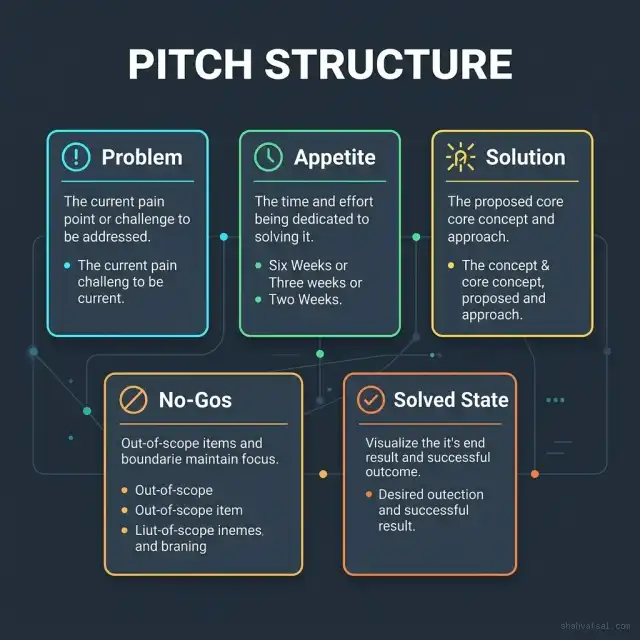
By defining the solution at a high level and documenting the "Rabbit Holes" and "No-Gos," the pitch provides the building team with a clear box to work inside. The builders do not start with a list of tickets; they start with the pitch document and are given full ownership of how they split the work, write the code, and design the database schema to achieve the goal within the cycle.
4. Deep Comparison: Sprints vs. 6-Week Cycles
The operational delivery cadences of Scrum and Shape Up create distinct working environments for software developers.
The Two-Week Scrum Sprint
The strength of the two-week sprint is its rapid feedback loop. It forces teams to decompose large features into small, releasable slices.
However, this short time-box introduces structural problems:
- Sprint Fatigue: The end of one sprint is immediately followed by the planning of the next. Developers experience a continuous pressure to perform, with no space to pause, reflect, or clean up code. Over a long project, this leads to burn out and technical debt.
- Lack of Deep Work: Because tasks must fit into a two-week window, complex engineering challenges—such as major database migrations, performance refactoring, or security auditing—are difficult to schedule. Teams often split these tasks across sprints, leading to fragmented implementation.
- Scope Creep via Estimation Failures: If a team misestimates a task, the unfinished stories "spill over" into the next sprint. This disrupts the planning of the upcoming sprint and distorts the team's velocity metrics.
The Six-Week Shape Up Cycle
Shape Up uses six weeks because it is long enough to design and build a substantial, complete feature, but short enough to maintain a sense of urgency.
Week 1-2: Orienting & Scope Defining (Locating the hill, splitting into scopes)
Week 3-4: The Hill Climb (Solving the hardest technical problems first)
Week 5-6: Downhill Run (Refining, testing, QA, polishing, and shipping)
During these six weeks, the team is fully dedicated to the pitch. There are no daily standups to report progress, and the product manager cannot add new requirements. The team is responsible for managing their own schedule, using tools like "Hill Charts" to track real progress instead of completed tickets.
Hill Charts vs. Burndown Charts
In Scrum, progress is tracked using Burndown Charts that measure the number of story points remaining in the sprint. This assume that progress is linear and that completing half the tasks means you are halfway done.
Practitioners know this is false. The hardest part of engineering is not writing the code; it is figuring out the unknown details.
Shape Up addresses this with the Hill Chart. Every task is modeled as climbing and descending a hill:
- Climbing the Hill (The Unknown): You are still figuring out the technical approach, defining APIs, and solving integration problems. You cannot predict when the task will be done.
- The Top of the Hill: The unknowns are resolved. The design is decided, the APIs are defined, and only execution remains.
- Descending the Hill (The Known): You are writing clean code, styling the UI, writing tests, and polishing. You can predict the exact path to completion.
Developers move their scopes along the Hill Chart dynamically during the cycle, giving stakeholders a realistic view of where projects stand without requiring status meetings.
5. Deep Comparison: Cool-Down vs. Refinement
The management of technical debt and team health highlights the cultural differences between the two frameworks.
| Dimension | Backlog Refinement (Scrum) | Cool-Down Period (Shape Up) |
|---|---|---|
| Frequency | Continuous (every week) | Structured (every 6 weeks, lasts 2 weeks) |
| Control | Product Owner (guided by business priority) | Engineering Team (100% self-directed) |
| Activity | Estimating future user stories | Fixing bugs, cleaning tech debt, prototyping |
| Team Health | Constant sprint pressure | Regular restorative breaks |
The Scrum Refinement Trap
In Scrum, technical debt is placed in the same backlog as business features. When sprint planning occurs, the product owner must balance developer requests for refactoring against stakeholder demands for new features.
Because business features have immediate visibility, technical debt is often deprioritized. Developers are forced to sneak refactoring tasks into feature tickets, leading to unreliable estimates and compromised codebases. Additionally, the constant refinement meetings keep the team focused on future planning rather than active code health.
The Shape Up Cool-Down Release Valve
The cool-down period in Shape Up is a dedicated two-week block where no product work is scheduled. It is not a vacation; it is unstructured working time for the engineering team.
During cool-down, engineers can:
- Fix edge-case bugs that were out of scope during the cycle.
- Refactor messy code blocks and upgrade libraries.
- Prototype new technologies or spike prospective solutions.
- Shape pitches for future cycles based on recent development insights.
This structured downtime protects the codebase from decay. It also serves as a mental reset for developers, who start the next six-week cycle energized and focused.
6. The Betting Table vs. Sprint Planning
The decision-making process for initiating development highlights the governance differences between the two frameworks.
Sprint Planning: The Velocity Commitment
In Scrum, sprint planning is a commitment ceremony. The team reviews the top of the backlog, calculates their capacity based on historical velocity, and selects the stories they commit to delivering.
This commitment model can create friction:
- The Velocity Trap: Teams are pressured to continuously increase their velocity, leading to "point inflation" where developers inflate estimations to show artificial productivity gains.
- Loss of Big-Picture Context: Because sprint planning is focused on two-week increments, teams often lose track of the larger product strategy, focusing instead on finishing the current batch of tickets.
The Betting Table: The Strategic Bet
In Shape Up, projects are selected at the Betting Table. This is a meeting held during the two-week cool-down, attended by the CEO, product leaders, and engineering directors.
The inputs to the betting table are shaped pitches. The participants review the pitches and decide which ones to build in the next cycle. They do not plan tasks or assign developers; they place bets.
A bet has three core parameters:
- Explicit Commitment: When a pitch is selected, the team is fully committed to it for six weeks. There are no changes, additions, or interruptions.
- Fixed Time, Variable Scope: The team has a fixed appetite (e.g., 6 weeks). The scope of the solution, however, is variable. The team is expected to cut secondary features to ensure they deliver the core solution within the time block.
- The Circuit Breaker: This is the ultimate risk mitigation mechanism. If a team does not finish a project within the six-week cycle, the project is canceled. It does not automatically spill over into the next cycle. If the team wants to continue, they must reshape the project, write a new pitch explaining what went wrong, and bet on it again at the next betting table.
This circuit breaker forces teams to manage scope aggressively and prevents zombie projects from dragging on for months.
7. Practitioner Verdict: Framework Selection Framework
To help organizations choose between Shape Up and Scrum, we have developed a decision framework based on team maturity, product type, and organizational constraints.
                     Is your product in early discovery?
                                 /         \
                               Yes          No
                               /             \
                   Use Lean/Kanban      Are you plagued by Sprint Fatigue?
                                            /           \
                                          Yes            No
                                          /               \
                                    Are your PMs     Keep using Scrum
                                   ready to shape?
                                     /         \
                                   Yes          No
                                   /             \
                             Use Shape Up     Use Hybrid (Dual-Rhythm)
When to Choose Scrum
Scrum remains highly effective under specific organizational conditions:
- Junior Teams: Teams with many junior developers often benefit from the structure, clear daily check-ins, and granular task definitions of Scrum.
- Contract/Agency Work: When client contracts are structured around specific deliverables and strict timeline commitments, Scrum provides the granular tracking required for billing verification.
- High-Churn Environments: If your business model requires you to pivot your product direction every week based on sales demands, the two-week sprint offers the necessary flexibility.
When to Choose Shape Up
Shape Up is the superior choice for organizations that meet these criteria:
- Experienced Builders: Teams composed of senior engineers who value autonomy, enjoy problem-solving, and do not need daily task assignment.
- Product-Led Organizations: Companies focused on delivering deep, well-crafted features rather than hitting arbitrary release dates.
- Sprint Fatigue Symptoms: Organizations experiencing high developer turnover, declining velocity, growing technical debt, or endless planning meetings.
The Dual-Rhythm Agile Hybrid
For many enterprises, a complete migration to Shape Up is culturally difficult. In these cases, a hybrid approach—Dual-Rhythm Agile—can bridge the gap:
- Product Management: Runs on a continuous, monthly shaping rhythm, producing high-level pitches rather than user stories.
- Engineering Teams: Execute in two-week Scrum sprints to maintain delivery cadence, but pull work from a shaped pitch rather than a traditional backlog, keeping the team focused on a single unified goal.
- Cool-Down Integration: Every third or fourth sprint is designated as an internal "Cool-Down Sprint" to address technical debt and prevent developer burnout.
The Step-by-Step Transition Playbook: Migrating to Shape Up
For engineering organizations experiencing sprint fatigue, migrating from Scrum to Shape Up requires a managed transition. The following four-phase playbook outlines the operational steps to execute a pilot cycle:
Phase 1: The Preparatory Shaping Cycle (4 Weeks Before Kickoff)
The organization runs a parallel shaping track before touching team schedules. This prevents developers from sitting idle at the start of the first cycle:
- Define the Shapers: Appoint a small group (typically one Product Manager, one Lead Designer, and one Tech Lead) to operate as the shaping team.
- Draft the Pitches: The shaping team identifies the highest-leverage initiatives. They draft three to four formal pitch documents, focusing on the problem statement, appetite, and solution boundaries.
- Run Technical Spikes: If a pitch relies on an unverified third-party API or a new infrastructure stack, run targeted spike operations to eliminate rabbit holes.
- Define the Betting Table Rules: Establish the list of decision-makers (CEO, Head of Product, Tech Directors) and share the pitches to allow for prep work.
Phase 2: The Betting Table (1 Week Before Kickoff)
The betting table replaces sprint planning. The session should be time-boxed to two hours:
- Review the Pitches: Read through the pitched documents. The PM presents the business appetite while the Tech Lead addresses complexity boundaries.
- Commit the Bets: Choose which pitches to fund for the upcoming six weeks. Assign developers and designers to the funded pitches, ensuring that each building team is cross-functional and fully self-contained.
- Freeze Interruptions: Communicate to stakeholders that the building teams are locked. Any new feature requests or bug reports must go to the support desk; the builders cannot be diverted.
Phase 3: The Building Track Execution (Weeks 1 to 6)
During the six weeks of building, the team shifts from ceremony execution to autonomous delivery:
- Week 1 (Orientation & Handoff): The team reads the pitch document, sets up local workspaces, and maps out the initial scopes. They do not write user stories or create Jira sub-tasks; they write a physical list of functional areas that need integration.
- Week 2 (The Hill Climb): Developers focus on the hardest technical challenges first (e.g., getting the primary database connector working or defining key API schemas). This is represented as climbing the Hill Chart, solving unknowns before touching visual Polish.
- Week 3 (Scope Hammering): As technical challenges are solved, the team begins descending the Hill. During this phase, scope adjustments are made. If a secondary UI widget is taking too long to design, the PM and team hammer the scope, dropping it to preserve the delivery timeline.
- Week 4 (Integration & Handoffs): Functional areas are wired together. Designers styled layouts using real database structures, while frontend devs link components to APIs.
- Week 5 (QA & Bug Swarms): The team stops writing new code and begins testing the integrated features. The entire building team swarms on edge-case bug fixes to stabilize the application.
- Week 6 (The Downhill Run & Ship): The product is compiled, deployed to a staging stack, and verified against browser test suites. The team ships the code to production and celebrates.
Phase 4: The Cool-Down Release Valve (Weeks 7 & 8)
Once the building cycle ends, the team moves into the cool-down block:
- Developer Autonomy: Engineers pick their own tasks. No product backlog grooming sessions are scheduled.
- Codebase Restoration: Developers refactor technical debt introduced during the build, run database optimization audits, and clean up workspace configurations.
- Retrospective Reflection: The team runs a single retrospective session during Week 7 to evaluate how the cycle went, identify improvements, and refine Hill Chart accuracy for the next cycle.
- Shaping Parallel Run: While engineers cool down, the shaping team holds the next betting table, ensuring that fresh pitches are ready for the upcoming building cycle.
8. Summary Comparison Matrix
The following matrix summarizes the structural differences between the two frameworks:
| Feature / Metric | Scrum (Sprints) | Shape Up (Cycles) |
|---|---|---|
| Core Cadence | 2-week iterations (continuous) | 6-week cycles + 2-week cool-downs |
| Planning Mechanism | Backlog refinement & Sprint planning | Shaping pitches & The Betting Table |
| Scope Enforcer | Fixed scope per sprint (in theory) | Variable scope (Fixed appetite) |
| Progress Tracker | Burndown charts (story points) | Hill Charts (visual scope progress) |
| Failure Resolution | Tasks spill over to the next sprint | Circuit breaker (project is canceled) |
| Meeting Overhead | High (Daily standup, grooming, review, retro) | Low (Betting table, internal syncs) |
| Developer Role | Ticket execution (Task-oriented) | Solution design (Outcome-oriented) |
| Technical Debt | Handled via backlog prioritisation | Handled natively during cool-down |
9. Conclusion: The AI and Autonomous Agent Influence
As we advance through 2026, the adoption of AI coding assistants and autonomous agents is transforming software development. AI agents can generate code, write tests, and refactor applications at a scale that makes two-week estimation cycles obsolete.
In an AI-augmented environment, the bottleneck is no longer coding velocity; it is product design, system architecture, and scoping logic.
This shift favors the structural model of Shape Up. By separating product development into a dedicated shaping track (where humans define the boundaries, logic, and out-of-scope constraints) and a building track (where engineers partner with AI agents to construct the solution inside a protected cycle), Shape Up provides a framework built for the modern engineering era.
Ultimately, the choice between Shape Up and Scrum is a choice of trust. Scrum trusts the process, enforcing structure to manage output. Shape Up trusts the builders, enforcing boundaries to protect focus. For organizations looking to ship high-quality software while keeping engineering teams motivated and creative, the practitioner verdict is clear: it is time to stop estimating points and start shaping solutions.
Sources: Basecamp Shape Up Official Resource · Practitioner Workflow Studies (2026)
What is the main difference between Shape Up and Scrum?
Scrum estimates how long a feature will take using story points and delivers it in continuous two-week sprints. Shape Up sets a fixed time budget (an appetite, e.g., six weeks) and cuts the feature's scope to fit that budget, followed by a two-week cool-down period.What is a cool-down period in Shape Up?
The cool-down period is a two-week block at the end of every six-week cycle where no product work is scheduled. Engineers have complete autonomy to fix bugs, refactor code, address technical debt, or prototype new technologies.How does the circuit breaker work in Shape Up?
If a team does not finish a project within the designated six-week cycle, the circuit breaker triggers and the project is canceled. The team does not get an extension, and the task does not spill over. To continue, the project must be reshaped and bet on again.What is a fat-marker sketch?
A fat-marker sketch is a low-fidelity drawing made with thick markers or block diagrams during the shaping phase. It defines functional boundaries, key inputs, and basic flows without specifying visual designs or code implementations, leaving space for developers to problem-solve.Can you combine Shape Up and Scrum?
Yes. Organizations often use a hybrid model (Dual-Rhythm Agile) where product managers shape pitches in monthly cycles, while developers execute them in two-week sprints, integrating a dedicated cool-down sprint every few cycles.