AI SUMMARY
- Headline
- Anthropic Launches Claude for Government: FedRAMP High Compliance for Claude Code and Cowork
- Global impact
- On July 7, 2026, Anthropic announced the public beta launch of Claude for Government, a secure, specialized platform designed to bring the capabilities of Claude 4, Claude Code, and Claude.
- India lens
- Assess DPDP, RBI, and GCC delivery exposure — India-scale teams often feel vendor shifts 2–4 weeks before US HQ.
- My take
- I would brief the architecture board this week with one owner, one metric, and one rollback plan.
STRATEGIC OVERVIEW
On July 7, 2026, Anthropic announced the public beta launch of Claude for Government, a secure, specialized platform designed to bring the capabilities of Claude 4, Claude Code, and Claude Cowork to federal, state, and local government agencies.
On July 7, 2026, Anthropic announced the public beta launch of Claude for Government, a secure, specialized platform designed to bring the capabilities of Claude 4, Claude Code, and Claude Cowork to federal, state, and local government agencies. By securing a FedRAMP High authorization boundary, Anthropic is addressing one of the most significant barriers to public-sector AI adoption: the strict data sovereignty, security, and administrative compliance mandates of public sector operations.
This launch represents a major milestone in public-sector technology. While enterprise software development teams have rapidly integrated agentic tools (such as the terminal-based Claude Code interface), government organizations have historically been locked out due to the risk of exposing sensitive public information to public model endpoints. With this dedicated deployment architecture, public agencies can begin implementing autonomous software engineering workflows under strict security safeguards.
The Catalyst: Public Sector Beta Launch of Claude for Government
The public beta introduces two primary entry points tailored to government agencies:
- Claude for Government Desktop App: A secure desktop client managed via corporate Mobile Device Management (MDM) profiles, isolating all user chats and workspace attachments.
- Gov-compliant API Gateways: A private API gateway supporting developer command-line interfaces, including headless integrations of Anthropic's terminal agent, Claude Code.
By enabling direct support for agentic coding tools under a compliant framework, Anthropic is bypassing the traditional multi-year delay that government developers face when waiting for enterprise-grade tooling. Government engineers can now use autonomous agents to debug legacy COBOL mainframes, write compliant APIs, and refactor public service infrastructure, matching the software velocity of private-sector development teams.
To maximize developer onboarding, agencies can leverage established training frameworks such as our comprehensive Claude Code developers masterclass playbook.
The Security Boundary: Deconstructing FedRAMP High Authorization
At the core of Claude for Government is its FedRAMP High security boundary. FedRAMP (Federal Risk and Authorization Management Program) standardizes security assessments for cloud services used by federal agencies. A "High" impact level indicates that the unauthorized disclosure of data managed by the system could have severe or catastrophic adverse effects on organizational operations, assets, or individuals.
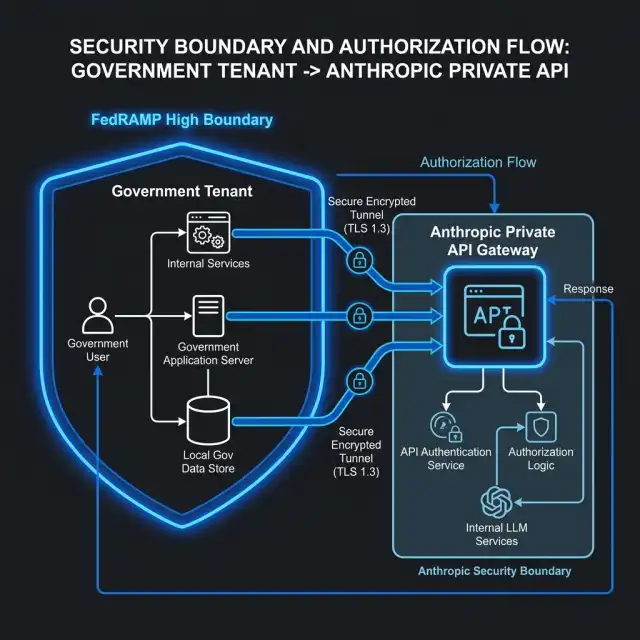
To satisfy these parameters, Anthropic's architecture implements several physical and network isolation mechanisms:
Physical and Data Isolation
Government data is processed in isolated server environments that run on dedicated hardware, completely separated from Anthropic's public-sector consumer clusters. This prevents any data leakage or cross-tenant interference.
Zero-Training Mandate
Anthropic guarantees that no data submitted to Claude for Government endpoints—including chat logs, prompt context windows, and code files processed by Claude Code—will be used to train future foundation models.
Cryptographic Tunnels
All data in transit is protected using FIPS 140-2 validated cryptographic modules. Restricting API calls to TLS 1.3 ensures that data payloads cannot be intercepted by eavesdroppers.
Implementing this boundary is crucial for agencies attempting to align high-level corporate governance with actual developer behavior, a core theme discussed in our board AI governance and ROI reporting playbook.
Administration and Governance: Spend Controls, Audit Trails, and MDM
Public sector deployments require strong administrative controls. Unlike private corporations where developers can freely add API keys to their personal accounts, government agencies must track and authorize every dollar of AI spend and maintain audit logs for all automated actions.
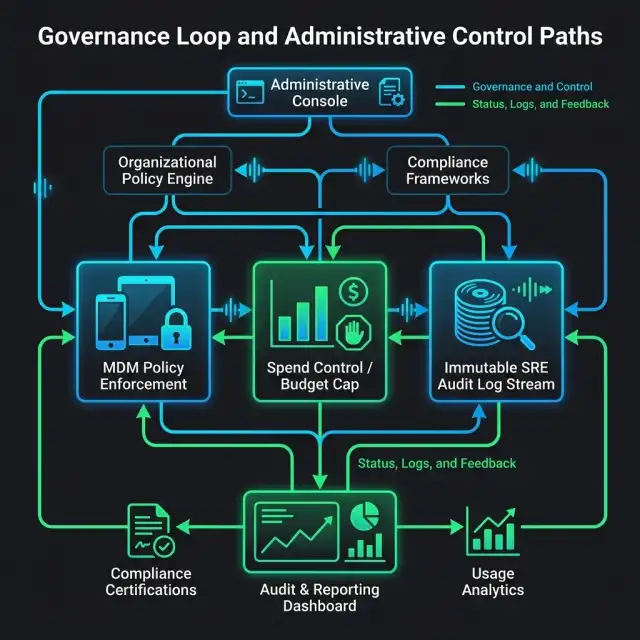
The Claude for Government administrative control panel introduces three key governance capabilities:
1. MDM Policy Support
System administrators can deploy the Claude Desktop application silently across thousands of federal workstations using standard MDM solutions (such as Microsoft Intune or MobileIron). MDM profiles can enforce security policies, such as disabling local file uploads or restricting copy-paste functionality to secure agency folders.
2. Dynamic Spend Controls
Administrators can set strict daily, weekly, or monthly token spend caps at the organization, department, or individual user level. If a developer's local Claude Code agent enters an infinite loop, the system automatically terminates the execution once the allocated budget threshold is reached, protecting the agency from unexpected cloud cost overruns.
3. Immutable SRE Audit Log Streaming
Every request, model output, and automated tool invocation is recorded and streamed in real-time to the agency's Security Information and Event Management (SIEM) platform (such as Splunk or Datadog). This provides an unalterable log trail for compliance auditors, tracking exactly what code was modified by the AI agent and which human developer authorized the merge.
These administrative parameters are highly aligned with the enterprise controls outlined in our Claude Code CXO blueprint playbook, helping executives maintain policy compliance across distributed developer environments.
Strategic Implications: The Public-Sector Autonomous Engineering Era
The release of Claude for Government marks the beginning of a new era for public-sector IT. Historically, government agencies have struggled to attract and retain elite software development talent, leaving them dependent on expensive external systems integrators to maintain legacy codebases.
By introducing autonomous code agents directly into government development environments under a FedRAMP High umbrella, agencies can significantly reduce their technical debt:
- Refactoring Legacy Systems: Modernizing government infrastructure by translating legacy code (COBOL, Fortran) to modern, cloud-native frameworks automatically.
- Continuous Compliance Scanning: Programmatically checking public service codebases for security vulnerabilities (such as OWASP Top 10 exploits) before they are deployed to public portals.
- Automated Documentation: Documenting millions of lines of undocumented public-sector code, ensuring operational continuity as senior developers retire.
Frequently Asked Questions
What is FedRAMP High and why does it matter for clinical or government AI?
FedRAMP High represents the highest tier of security compliance for cloud applications serving US government agencies. It ensures that the system is protected against catastrophic data disclosures and infrastructure attacks.Can government developers use Claude Code directly in the terminal?
Yes. Government developers can authenticate their local terminal environment to the Gov-compliant API gateway using secure authentication protocols, enabling the use of Claude Code.Is patient health data (PHI) allowed inside Claude for Government?
Yes. Because the platform runs within a FedRAMP High boundary, agencies and healthcare providers can sign Business Associate Agreements (BAAs) to process PHI under HIPAA rules.How does the system prevent runaway model spend?
Administrators can configure strict token budget limits at the organization or individual level, automatically disabling API access once budget caps are reached.Where are the servers hosting Claude for Government located?
Servers are hosted within isolated, dedicated US-based data centers that meet federal physical security requirements.Conclusion
Anthropic's launch of Claude for Government is a significant milestone for public-sector technology. By combining the power of autonomous developer agents with a FedRAMP High security boundary, Anthropic is showing that high compliance standards do not have to come at the expense of developer velocity. Government agencies can now begin their AI transformation journeys, safe in the knowledge that patient data, public records, and developer environments are protected by the highest standards of data security.
Social Share Copy
