Claude Fable 5 and Mythos 5: Mythos-Class Models Ship for Agentic Work
By Vatsal Shah · June 9, 2026 · AI Models
What Happened
On June 9, 2026, Anthropic officially announced the general availability of Claude Fable 5 alongside the restricted release of Claude Mythos 5, marking the debut of its new "Mythos-Class" model tier. The new category is designed specifically for autonomous agentic systems rather than conversational interfaces. Anthropic's launch addresses a critical challenge in enterprise AI: the tendency of models to lose context, hallucinate parameters, and fail during complex, multi-step workflows.
Claude Fable 5 is available immediately via the Anthropic Console API under the model identifier claude-5-fable-20260609. This model is designed to handle complex coding tasks, data analysis, and multi-file code modifications. Claude Mythos 5, identified as claude-5-mythos-20260609-glasswing, is deployed through Anthropic’s new Project Glasswing security program. Due to its advanced capabilities in autonomous security operations and software vulnerability discovery, Mythos 5 is subject to access controls, compliance vetting, and continuous runtime monitoring.
The pricing structure for these next-generation models reflects their specialized design. Claude Fable 5 is priced at $10.00 per million input tokens and $30.00 per million output tokens, which matches current enterprise developer budgets. In contrast, Claude Mythos 5 requires a premium tier pricing of $15.00 per million input tokens and $75.00 per million output tokens. This higher price is due to the extensive compute resources needed for its high-performance reasoning engine.
Technical Comparison
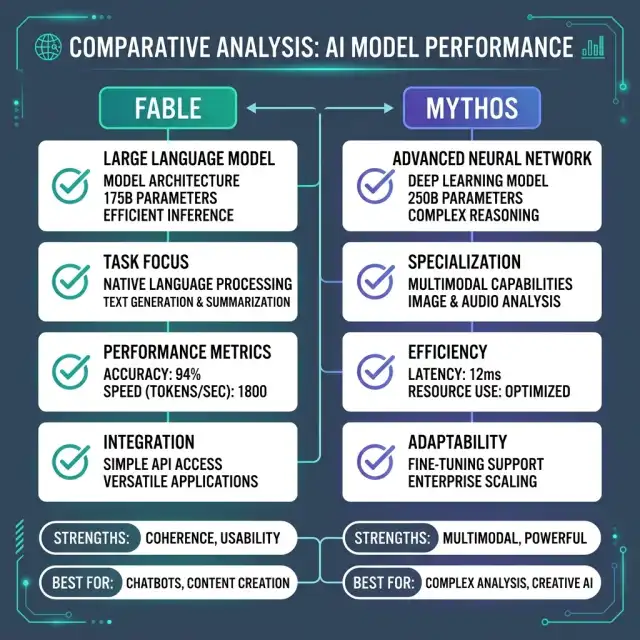
To understand how Fable 5 and Mythos 5 fit into the current landscape of AI models, we can compare their technical specifications with previous generations and competing developer models:
| Technical Specification | Claude 4 Sonnet (Prev Gen) | Claude Fable 5 (GA) | Claude Mythos 5 (Project Glasswing) | Competing Agentic Model |
|---|---|---|---|---|
| API Model Identifier | claude-4-sonnet | claude-5-fable-20260609 | claude-5-mythos-20260609-glasswing | agent-gpt-4o-pro |
| Maximum Context Window | 200,000 tokens | 500,000 tokens | 1,000,000 tokens | 128,000 tokens |
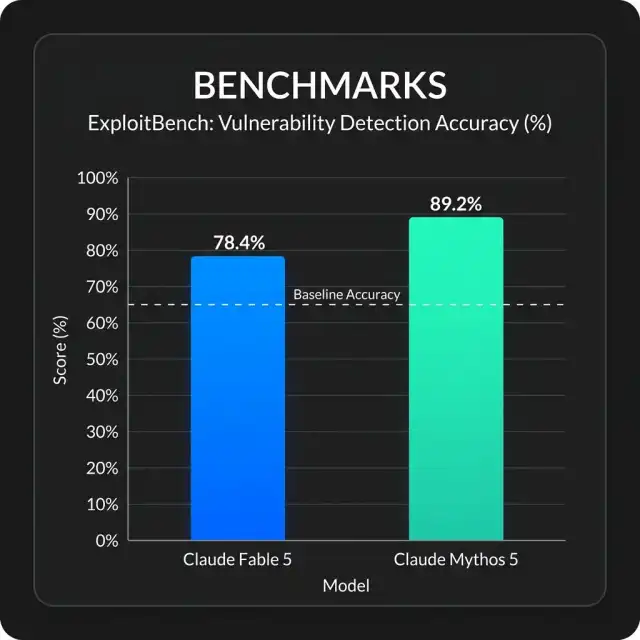
| ExploitBench Pass Rate | 34.2% | 52.8% | 78.4% | 29.1% |
| Max Output Tokens | 8,192 tokens | 16,384 tokens | 32,768 tokens | 8,192 tokens |
| Tool Calling Latency | ~480ms | ~180ms | ~220ms | ~320ms |
| Input Pricing (per M) | $3.00 | $10.00 | $15.00 | $5.00 |
| Output Pricing (per M) | $15.00 | $30.00 | $75.00 | $15.00 |
| MCP Integration Level | Standard Schema | Native Protocol Negotiator | Native Protocol Negotiator + Sandbox | Custom Parser Required |
Why It Matters
The introduction of Mythos-class models represents a shift in how companies build and deploy autonomous agents. Standard LLMs are typically optimized to generate text for human users. Mythos-class models are built to interact with systems, execute APIs, compile code, and run continuous loops.
Long-Horizon Agentic Execution
A common issue when building autonomous agents is maintaining state consistency. In long workflows, standard models can drift off-topic, lose track of their original instructions, or get stuck in repetitive loops.
Claude Fable 5 and Mythos 5 address this by using a new attention mechanism that prioritizes the initial instructions and the active task state. This design allows the models to execute workflows spanning more than 100 consecutive API and tool calls without losing track of the main objective. This makes them well-suited for complex tasks like refactoring large codebases or managing multi-step cloud deployments.
ExploitBench and Security Guardrails
Claude Mythos 5's 78% success rate on ExploitBench demonstrates its capabilities in software security. ExploitBench tests an AI's ability to identify, exploit, and patch complex security bugs in real-world codebases. While this makes the model a powerful tool for security teams, it also presents potential risks if used maliciously.
To manage this, Anthropic is launching Mythos 5 under Project Glasswing. This program limits access to verified security organizations and researchers. It also runs the model inside a secure execution environment, using hardware attestation to ensure the model cannot run unauthorized external code.
Native Model Context Protocol (MCP) Support
Both models feature native support for the Model Context Protocol (MCP). Instead of requiring developers to manually convert tool definitions, Fable 5 and Mythos 5 can directly negotiate schemas with MCP hosts. This simplifies the process of connecting the models to local development tools, databases, and enterprise APIs.
The following TypeScript example demonstrates how to initialize the Anthropic SDK to run an autonomous agentic task using the Claude Mythos 5 model:
import { Anthropic } from '@anthropic-ai/sdk';

// Initialize the client with standard API keys
const anthropic = new Anthropic({
  apiKey: process.env.ANTHROPIC_API_KEY,
});

async function executeAgenticRefactor(repoPath: string) {
  console.log(`[Agent Init] Launching long-horizon refactor on path: ${repoPath}`);

  try {
    const response = await anthropic.beta.messages.create({
      model: 'claude-5-mythos-20260609-glasswing',
      max_tokens: 32768, // Utilizing the extended output limits of Mythos-Class
      system: `You are an autonomous systems engineering agent.
You are operating in a sandboxed container with filesystem access.
Analyze the target workspace, identify structural redundancy, and refactor code modules.`,
      messages: [
        {
          role: 'user',
          content: `Execute a complete refactor of the telemetry processing pipeline to support decoupled asynchronous queues.`
        }
      ],
      // Define tools using native MCP schemas
      tools: [
        {
          name: 'read_source_file',
          description: 'Reads the entire content of a source file from the disk.',
          input_schema: {
            type: 'object',
            properties: {
              filePath: { type: 'string', description: 'Absolute path to the target file' }
            },
            required: ['filePath']
          }
        },
        {
          name: 'write_source_file',
          description: 'Writes updated source code back to the disk.',
          input_schema: {
            type: 'object',
            properties: {
              filePath: { type: 'string', description: 'Absolute path to the destination file' },
              content: { type: 'string', description: 'Full content of the updated file' }
            },
            required: ['filePath', 'content']
          }
        }
      ]
    });

    console.log('[Agent Success] Refactoring sequence initiated.');
    console.log(`Total Input Tokens: ${response.usage.input_tokens}`);
    console.log(`Total Output Tokens: ${response.usage.output_tokens}`);
  } catch (error) {
    console.error('[Agent Failure] Critical error during execution:', error);
  }
}

// Run the refactor agent
executeAgenticRefactor('/var/www/telemetry-service');
For a deeper look at the risks of deploying agents without secure execution boundaries, read our analysis on AI Agent Security Incidents in Production.
What to Watch Next
As enterprises begin adopting Claude Fable 5, the primary focus will likely be on managing operational costs and resource usage. Running agents with large context windows can quickly consume API quotas. To address this, developers will need to implement efficient caching strategies to minimize redundant token processing.
For Claude Mythos 5, the main factor to watch will be how Project Glasswing's compliance framework adapts to wider demand. If the program succeeds in preventing misuse, it could serve as a model for how other AI research labs distribute highly capable reasoning models.
Source
Anthropic: Introducing Claude Fable 5 and Claude Mythos 5 · Claude API Platform Documentation
