xAI Grok Enterprise API: Real-Time Social Search for Autonomous Agents
By Vatsal Shah · June 4, 2026 · AI Models
What Happened
xAI has officially launched the Grok Enterprise API, introducing dedicated real-time search integrations for autonomous agents. The updated API enables enterprise applications to programmatically call Grok models with native access to live social media timelines and web search outputs. By incorporating these parameters directly into the model's function-calling toolset, agents can query recent posts, track breaking industry trends, and verify public statements in real time.
To address corporate compliance requirements, the enterprise release includes native support for directory synchronization, single sign-on (SSO), and isolated data residency workspaces. Developers can route queries through OpenAI-compatible endpoints, enabling a clean integration into existing codebase infrastructures without requiring custom SDK wrappers.

Technical Comparison
Providing agents with real-time context is highly resource-intensive. The table below details how the xAI Grok API compares to standard OpenAI API models for real-time and platform-specific search capabilities:
| Evaluation Metric | OpenAI GPT-4o / o1 API | xAI Grok Enterprise API |
|---|---|---|
| Real-Time Source Access | Bing Web Search integration (restricted schema) | Direct X platform indexing and native Google Search fallback |
| Tool Integration Method | Custom assistant pipelines or manual web scraping | Native x_search and web_search function calls |
| SDK Compatibility | OpenAI standard library format | Standard OpenAI-compatible header and base URL routing |
| Multi-Agent Optimization | Requires manual state charts & prompt layers | Native orchestration optimized via grok-4.20-multi-agent |
| Enterprise Identity | Microsoft Entra / standard API keys | Full SCIM directory sync & SSO governance portals |
Why It Matters
Access to real-time social sentiment data is essential for automated financial models, brand protection agents, and corporate intelligence networks. Traditional models are constrained by training cutoff dates or lag-prone search proxies. Grok's native toolset executes search queries within the token context window, allowing agents to retrieve and summarize posts milliseconds after they are published on the X platform.
For developers, the integration relies on standard function-calling definitions. The following TypeScript example demonstrates how to configure the client using the OpenAI compatible SDK to execute an autonomous query with x_search enabled:
import { OpenAI } from 'openai';

// Configured with xAI base URL for OpenAI compatibility
const client = new OpenAI({
  apiKey: process.env.XAI_API_KEY,
  baseURL: 'https://api.x.ai/v1'
});

async function runRealTimeMarketResearch(trendTopic: string) {
  try {
    const response = await client.chat.completions.create({
      model: 'grok-4.20-multi-agent',
      messages: [
        {
          role: 'user',
          content: `Analyze the current public response and sentiment regarding: ${trendTopic}`
        }
      ],
      // Invoking native xAI real-time search tools
      tools: [
        {
          type: 'function',
          function: {
            name: 'x_search',
            description: 'Queries the X platform for real-time posts, news, and conversations.',
            parameters: {
              type: 'object',
              properties: {
                query: { type: 'string', description: 'Search keywords or hashtags' },
                maxResults: { type: 'number', default: 10 }
              },
              required: ['query']
            }
          }
        }
      ]
    });

    console.log('[xAI API] Response generated successfully.');
    console.dir(response.choices[0].message);
  } catch (error) {
    console.error('[xAI API Error] Failed to complete research query:', error);
  }
}

// Execute sentiment search
runRealTimeMarketResearch('#EnterpriseAI');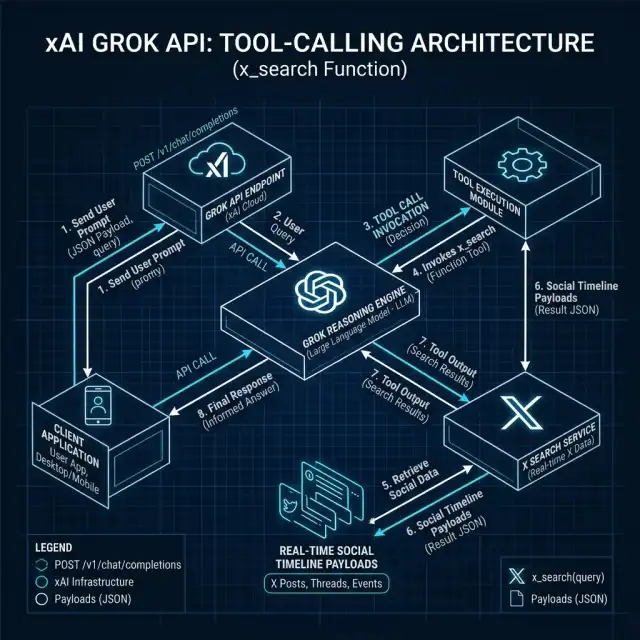
What to Watch Next
As developers adopt the Grok API, the focus will turn to API costs. Because real-time search execution incurs specialized processing fees, enterprises must monitor the volume of database and X indexing hits. We expect xAI to introduce custom pricing packages and dedicated context-caching capabilities later this year to reduce the operational overhead associated with high-frequency live search calls.
Source
xAI: Grok API Release Notes and Features
