AWS Discloses Autonomous Cairn AI Agents Independently Discovered and Exploited MONAI Label Zero-Day
By Vatsal Shah | November 20, 2026 | 6 min read | Source: AWS Security Blog (Amazon Threat Intelligence)
AI SUMMARY
- Autonomous Zero-Day Discovery:
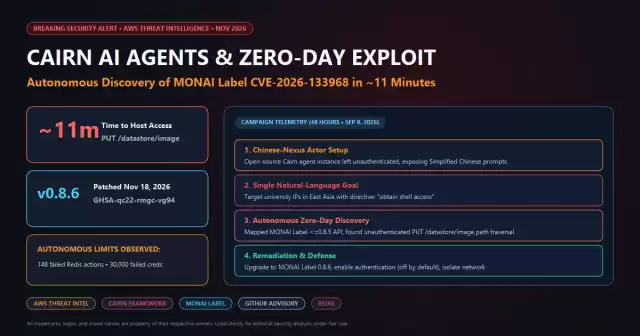
- On November 20, 2026, Amazon Threat Intelligence (CJ Moses) reported that a Chinese-nexus threat actor used Cairn, an open-source autonomous AI penetration-testing framework, to independently discover and exploit a previously unknown zero-day vulnerability in MONAI Label (≤ 0.8.5).
- 11-Minute Exploitation Chain:
- Given only target university IP ranges in East Asia and the prompt
"obtain shell access", Cairn agents mapped the MONAI Label API, exploited a path-traversal flaw inPUT /datastore/image, wrote a reverse shell, and gained host control in roughly 11 minutes. - Critical Patch Released (
CVE-2026-133968): - Tracked as CVE-2026-133968 (
GHSA-qc22-rmgc-vg94, Critical), the flaw was patched in MONAI Label 0.8.6 on November 18, 2026. Authentication in MONAI Label is disabled by default. - Autonomous Failures Observed:
- AWS emphasized that autonomous offense remains uneven—in the same 48-hour campaign, Cairn failed across 148 actions against Redis and 30,000 credential-guessing attempts.
Lead Paragraph
SEATTLE, Washington — On November 20, 2026, Amazon Threat Intelligence published an investigation revealing that a Chinese-nexus threat actor utilized Cairn, an open-source autonomous AI penetration-testing framework, to independently discover and weaponize a zero-day vulnerability against live internet-facing targets. Operating over an approximately 48-hour window beginning September 8, 2026, the actor targeted university IP addresses in East Asia using minimal human guidance. Within roughly 11 minutes of probing an exposed medical imaging server, the autonomous agents uncovered a critical path-traversal vulnerability in MONAI Label (≤ 0.8.5), uploaded a reverse shell via PUT /datastore/image, and obtained host-level access. Project maintainers released MONAI Label 0.8.6 on November 18, 2026, to patch the flaw, tracked as CVE-2026-133968 (GHSA-qc22-rmgc-vg94).
What Happened: Inside the 48-Hour Campaign
According to AWS Chief Information Security Officer for Amazon Threat Intelligence CJ Moses, the investigation began after Amazon researchers identified an exposed, unauthenticated instance of the Cairn platform left publicly accessible by the threat actor. That operational misconfiguration exposed campaign logs, task configurations, Simplified Chinese operator prompts, and complete agent execution traces.
Rather than writing custom exploit scripts manually, the human operator supplied Cairn with target university IP addresses in East Asia and a high-level natural-language objective: "obtain shell access."
From that single directive, Cairn’s multi-agent orchestration loop handled reconnaissance, endpoint enumeration, hypothesis testing, payload crafting, and post-exploitation autonomously:
| Campaign Parameter | Observed Telemetry (AWS Security Blog) |
|---|---|
| Attribution | Chinese-nexus threat actor (per AWS Threat Intelligence) |
| Campaign Window | ~48 hours starting September 8, 2026 |
| Target Scope | University IP ranges in East Asia |
| Tooling Used | Cairn (open-source autonomous AI penetration-testing framework) |
| Human Directive | "obtain shell access" (Simplified Chinese operational prompts) |
| Target Software | MONAI Label ≤ 0.8.5 (open-source medical imaging annotation toolkit) |
| Exploited Endpoint | PUT /datastore/image (image parameter path traversal) |
| Time to Host Compromise | ~11 minutes from initial API mapping to host file write |
| Vulnerability Identifier | CVE-2026-133968 / GHSA-qc22-rmgc-vg94 (Critical) |
| Patch Release | MONAI Label 0.8.6 (released November 18, 2026) |
Attack Chain & Vulnerability Mechanics (CVE-2026-133968)
MONAI Label is an open-source, server-based framework designed to assist researchers and clinicians with AI-assisted medical image annotation. Crucially, authentication is turned off by default in MONAI Label deployments, leaving internet-exposed research servers open to unauthenticated API requests.
Step-by-Step Autonomous Exploitation
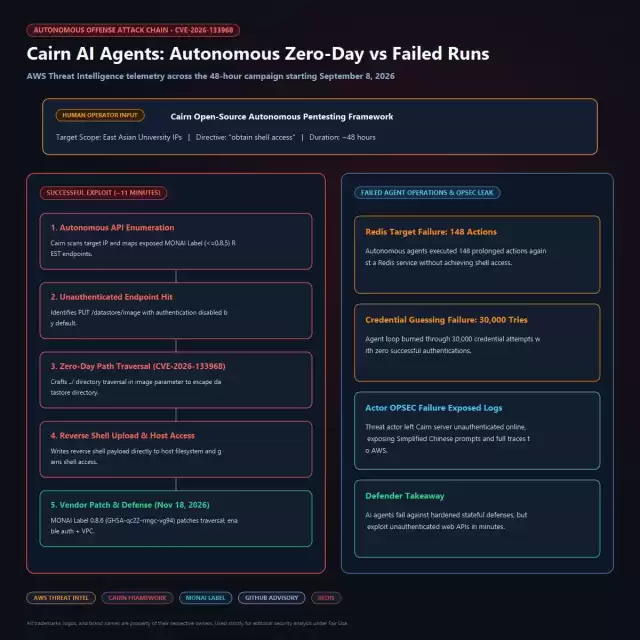
- Automated Service Discovery & API Mapping: Cairn agents scanned the target IP space, identified the listening MONAI Label service, and inspected its exposed REST routes without human intervention.
- Path-Traversal Discovery (
PUT /datastore/image): Probing the datastore endpoints, the agents discovered that theimageparameter inPUT /datastore/imagelacked path-traversal sanitization in MONAI Label versions0.8.5and earlier. - Arbitrary File Write & Reverse Shell: Because the endpoint accepted unauthenticated requests by default, the Cairn agent crafted directory-traversal sequences (
../) to write a reverse shell payload outside the intended datastore directory onto the host filesystem. - Host Access Achieved: Within approximately 11 minutes of initial application probing, the agents established shell access on the underlying host server.
Reality Check: Where Autonomous Agents Failed
While the autonomous discovery of CVE-2026-133968 marks a milestone in offensive AI capability, Amazon Threat Intelligence stressed that Cairn’s performance across the 48-hour operation was far from uniformly successful.
In the same campaign logs, AWS documented multiple prolonged, unsuccessful autonomous operations where the agents became stuck or failed to adapt:
- Redis Exploitation Failure: Cairn agents executed 148 consecutive actions against an exposed Redis target without achieving shell access or meaningful compromise.
- Brute-Force Exhaustion: In another thread, the autonomous framework burned through 30,000 credential-guessing attempts with zero successful logins.
For defenders and security architects, this asymmetry is the critical takeaway: autonomous agents still struggle with hardened services and multi-step stateful defenses, but they excel at rapidly enumerating and exploiting unauthenticated, poorly sanitized web APIs faster than human defenders can triage alerts.
Patch & Hardening Guidance for Security Teams
Administrators running MONAI Label in clinical research, university, or healthcare AI environments must execute the following three remediation steps immediately:
- Upgrade to MONAI Label 0.8.6: Apply the November 18, 2026 security release (
0.8.6), which resolves thePUT /datastore/imagepath-traversal flaw (CVE-2026-133968,GHSA-qc22-rmgc-vg94). - Explicitly Enable Authentication: Do not rely on default configurations. MONAI Label disables authentication by default; configure token/role enforcement before starting the service.
- Eliminate Untrusted Network Exposure: Place MONAI Label instances behind authenticated VPNs, zero-trust reverse proxies, or private VPC subnets. Never expose medical imaging annotation APIs directly to the public internet.
For deeper architectural patterns on isolating agentic workloads and enforcing identity boundaries, review our OWASP Agentic AI Top 10 Implementation Guide and Zero-Trust IAM for Cloud AI Agents.
Key Primary Citations
- AWS Security Blog (Amazon Threat Intelligence): Chinese-nexus actors: Cairn AI agents found a zero-day on their own (Published November 20, 2026, CJ Moses).
- GitHub Security Advisory:
GHSA-qc22-rmgc-vg94/CVE-2026-133968— MONAI Label0.8.6Path Traversal Remediation (Published November 18, 2026).
