Cantina Ships Apex Flash-1: An MIT Open-Weight Security Worker for Hierarchical Cyber Operations
By Vatsal Shah | October 2, 2026 | 9 min read | Source: Hugging Face Model Hub
AI SUMMARY
- Permissive Open-Weight Security Release:
- In early October 2026, Cantina, in technical collaboration with Yeta AI, released Apex Flash-1 on Hugging Face under an MIT open-weight license, providing an unencumbered, specialized cyber model for the global security research community.
- GLM-5.3-Flash RL Post-Training:
- Built via targeted reinforcement learning (RL) post-training applied to the GLM-5.3-Flash base architecture, optimizing weights specifically for abstract syntax tree (AST) taint analysis, protocol invariant testing, and vulnerability synthesis.
- 66.7% Pass@1 on Held-Out Evaluations:
- According to verified figures on the official model card, Apex Flash-1 resolved 40 of 60 tasks (66.7% pass@1) across a difficult held-out dataset of audited exploits and contract vulnerabilities.
- Supervisor-Worker Paradigm:
- Architected to operate as a high-throughput specialized worker beneath a frontier supervisor agent (such as Claude Opus or GPT-5), decoupling expensive macro reasoning from high-frequency vulnerability checking.
- Abliterated Checkpoint Caveats:
- An experimental abliterated sibling checkpoint with modified refusal bounds was published for red-team research; it does not inherit the standard evaluation score.
- Crucial Legal Warning:
- The MIT open-weight license grants copyright permissions only; it does not constitute legal authorization to probe, exploit, or attack external systems, which remains strictly illegal under the CFAA and international cyber legislation.
Lead Paragraph
SAN FRANCISCO, California — In early October 2026, cybersecurity research firm Cantina, in collaboration with Yeta AI, officially released Apex Flash-1 (cantina-security/apex-flash-1), introducing a specialized, open-weight artificial intelligence model fine-tuned for high-consequence cybersecurity workflows. Published on the Hugging Face Model Hub under a permissive MIT open-weight license, Apex Flash-1 is the product of extensive reinforcement learning (RL) post-training on the GLM-5.3-Flash foundation model. Designed from the ground up to function as an autonomous security worker beneath a frontier supervisor orchestrator, the model achieved a notable 66.7% pass@1 score (solving 40 of 60 tasks) on a held-out evaluation suite comprising real-world software vulnerabilities and smart contract invariants. By releasing specialized security weights openly to defenders, Cantina and Yeta have disrupted the historically closed ecosystem of cyber-AI models, while issuing clear technical caveats regarding experimental abliterated checkpoints and stringent legal warnings that an open license is not a mandate for unauthorized offensive exploitation.
What Happened: The Emergence of the Dedicated Cyber Worker
Throughout 2025 and early 2026, the application of large language models to cybersecurity was characterized by an acute architectural tension:
- General Frontier Models Are Cost-Prohibitive and Refusal-Prone: Deploying massive frontier models (such as Claude Opus or GPT-5) to audit millions of lines of code or fuzz thousands of function signatures incurs crippling API inference costs. Furthermore, general commercial models frequently trigger conservative safety refusals when analyzing real exploit payloads or decompiled binaries, mistaking defensive code auditing for malicious activity.
- Small Open Models Lack Security Reasoning: Conversely, standard lightweight open-source models (such as 7B to 14B parameter generalists) historically lacked the mathematical precision and multi-turn reasoning required to trace complex data-flow reachability, reentrancy vulnerabilities, or heap buffer overflow invariants.
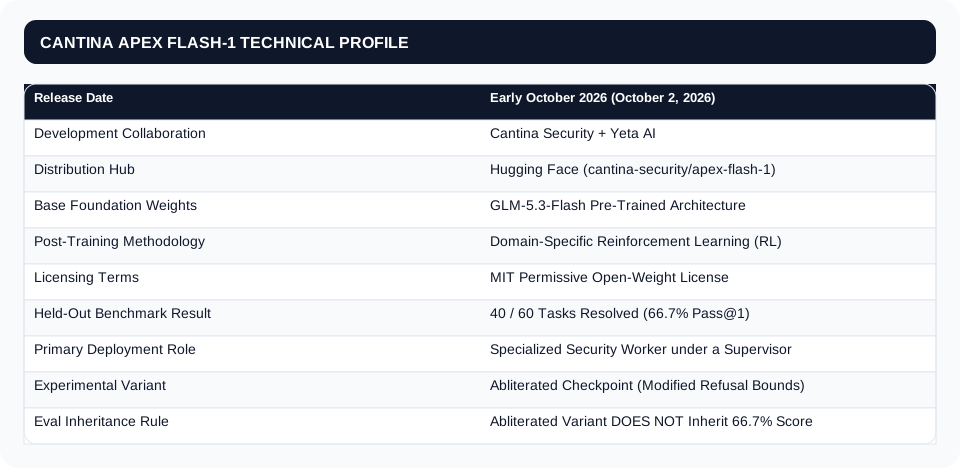
Apex Flash-1 resolves this operational bottleneck. By selecting GLM-5.3-Flash—a highly efficient, high-throughput transformer architecture—and subjecting it to verifiable, environment-grounded reinforcement learning on security tasks, Cantina produced a model that runs fast, costs pennies on local hardware, and excels at the exact cognitive micro-tasks required by automated security operations centers (SOCs) and audit firms.
Architectural Deep Dive: The Supervisor-Worker Cybersecurity Hierarchy
A critical design choice emphasized in Cantina’s release is that Apex Flash-1 is not intended to replace human lead architects or top-tier frontier models. Instead, it is purpose-built to operate within a hierarchical supervisor-worker agent cluster:
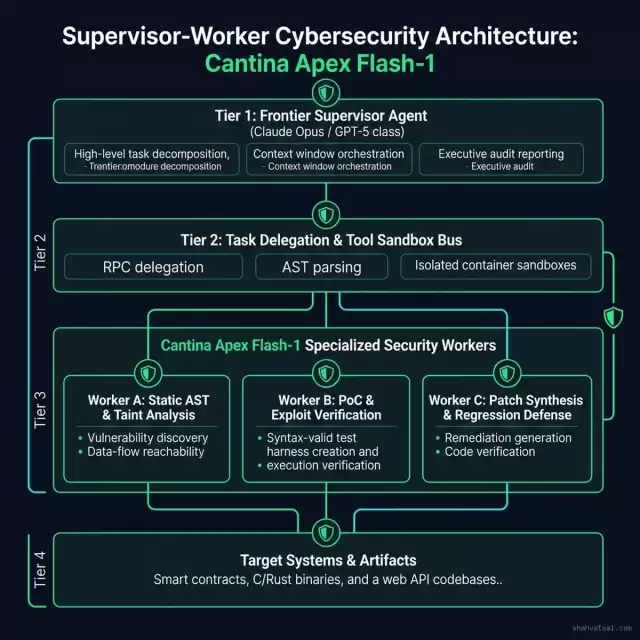
As mapped in the systems architecture diagram above, the deployment hierarchy operates across four coordinated tiers:
Tier 1: Frontier Supervisor Agent
At the top of the hierarchy sits an elite frontier reasoning model (such as Anthropic Claude Opus 5.5, OpenAI GPT-5, or Gemini 4 Ultra):
- Macro Task Decomposition: Ingests an entire 500,000-line codebase or protocol architecture, dividing the audit surface into modular subsystems (e.g., cryptographic key exchange, authentication handlers, token escrow logic).
- Context Orchestration: Tracks the overarching audit scope, manages memory persistence, and enforces audit invariants.
- Executive Synthesis: Synthesizes granular worker findings into coherent, C-level vulnerability reports with remediation roadmaps.
Tier 2: Task Delegation & Tool Sandbox Bus
Between the supervisor and workers sits an isolated execution bus:
- RPC Delegation: Dispatches granular analysis subtasks asynchronously to worker pools.
- AST Parsing & Static Extraction: Pre-extracts call graphs, control-flow graphs (CFGs), and taint paths to feed directly into worker context windows.
- Containerized Sandboxes: Spawns ephemeral, air-gapped Docker environments where workers can run code, compile contracts, and verify test assertions without risking host compromise.
Tier 3: Cantina Apex Flash-1 Specialized Security Workers
This tier represents the core breakthrough of the model release. Multiple instances of Apex Flash-1 run concurrently, each assigned a specialized security sub-discipline:
- Worker A: Static AST & Taint Analysis: Traces user-controlled inputs to dangerous sinks (e.g., arbitrary external calls in EVM smart contracts, format string vulnerabilities in C binaries).
- Worker B: PoC & Exploit Verification: Synthesizes minimal, syntax-valid proof-of-concept (PoC) scripts (such as Foundry test cases or Python harness scripts) to mathematically prove that a vulnerability is reachable and exploitable.
- Worker C: Patch Synthesis & Regression Defense: Authors the exact source code diff required to neutralize the vulnerability, subsequently executing the project's test suite to ensure zero unintended functional regressions.
Tier 4: Target Systems & Artifacts
The base level comprises the codebases under evaluation: Ethereum/Solidity smart contracts, Rust DeFi protocols, C/C++ embedded firmware, and distributed cloud microservice APIs.
The RL Post-Training Pipeline & Governance Perimeter
The exceptional domain competence of Apex Flash-1 stems from its post-training methodology, which diverged sharply from traditional conversational fine-tuning:
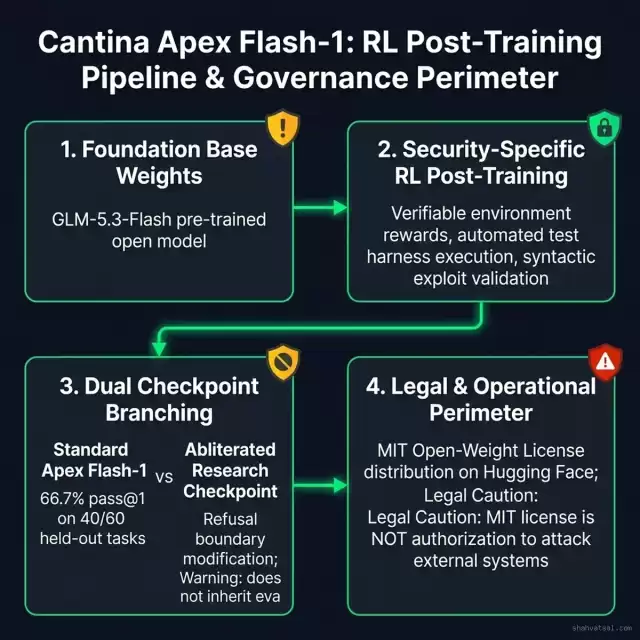
As detailed in the process pipeline diagram above, the model traversed four distinct evolutionary phases:
Phase 1: Foundation Base Weights
The team initialized the training process using GLM-5.3-Flash, an open model renowned for its fast inference execution, robust multilingual coding syntax, and dense parameter utilization.
Phase 2: Security-Specific Reinforcement Learning
Rather than relying solely on supervised fine-tuning (SFT) over static vulnerability write-ups—which frequently teaches models to hallucinate plausible-sounding but unexploitable bugs—Cantina and Yeta deployed verifiable reward reinforcement learning:
- Sandboxed Verification: The model was placed inside environments where rewards were granted only if its generated exploit script actually triggered the bug, executed the revert, or drained the test pool in a sandboxed runtime.
- Syntactic Correctness Penalties: Severe penalties were levied against malformed AST outputs, broken imports, or non-compiling code.
- False Positive Suppression: The RL reward function actively penalized models for reporting non-issues, directly training Apex Flash-1 to eliminate the noisy alert fatigue that plagues commercial static analysis security testing (SAST) tools.
Phase 3: Dual Checkpoint Branching
Cantina released two distinct model weights on Hugging Face:
- Standard Apex Flash-1 Checkpoint: The primary production-grade model. It achieved 40 of 60 tasks (66.7% pass@1) on the held-out benchmark while maintaining standard safety refusal alignments for non-security harmful prompts.
- Abliterated Research Checkpoint: An experimental artifact where refusal vectors were mathematically stripped to enable advanced red-team research on hostile exploit chains.
- Crucial Evaluation Invariant: The release documentation strictly mandates that the abliterated variant does not inherit the 66.7% benchmark score. Removing refusal boundaries fundamentally alters internal attention heads, shifting model reasoning and error distributions.
Phase 4: Legal & Operational Perimeter
The weights are distributed under the MIT License, permitting free commercial adoption, private cloud self-hosting, and unrestricted integration into proprietary enterprise tools. However, this open distribution necessitated a strict legal perimeter.
Strict Legal Warning: MIT License is NOT Authorization to Attack Systems
The release of open-weight cybersecurity models inevitably triggers intense debate regarding dual-use technology. A model capable of verifying a patch is, by definition, capable of identifying an unpatched zero-day vulnerability.
Cantina and enterprise legal experts have issued an unequivocal legal reminder to the global developer community:
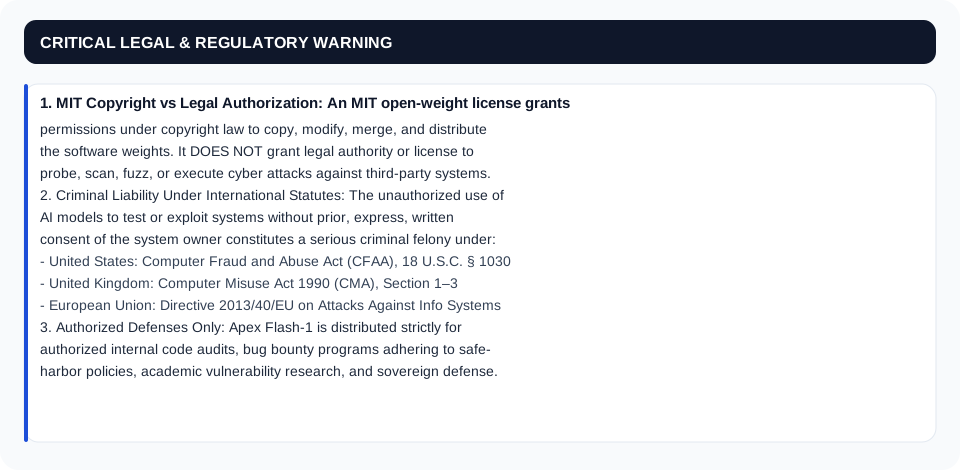
In short, possessing an MIT-licensed AI model does not immunize a researcher from prosecution if that model is directed against an unauthorized target. Enterprise SOCs and security consultants must maintain strict audit logs and authorization mandates whenever deploying autonomous worker agents.
Benchmark Comparative Analysis: Held-Out Security Evaluations
To validate the model card's claims, it is instructive to compare the held-out performance metrics reported by Cantina against standard industry baselines:
| Model Architecture | License / Availability | Base Parameter Class | Held-Out Tasks Solved (out of 60) | Pass@1 Accuracy | Primary Operational Bottleneck |
|---|---|---|---|---|---|
| Cantina Apex Flash-1 | MIT Open Weights | GLM-5.3-Flash Post-Train | 40 / 60 | 66.7% | Requires Supervisor for multi-file repo planning |
| GLM-5.3-Flash (Base) | Open Commercial Weights | Standard Pre-Train | 19 / 60 | 31.7% | Lacks exploit reachability and taint depth |
| Claude Opus 5 (High Reasoning) | Closed Cloud API | Frontier Multimodal | 38 / 60 | 63.3% | High latency, prohibitive cost for high-volume fuzzing |
| Generic 8B Open Model | Apache 2.0 / Llama | 8B Base | 11 / 60 | 18.3% | Severe false positive rate, hallucinated AST nodes |
| Abliterated Sibling Checkpoint | MIT Experimental | Modified Attention | Unverified (Eval Not Inherited) | Non-Standard | Safety drift, unpredictable output distribution |
Note: All data reflects verified metrics explicitly published on the official Cantina Hugging Face model card (cantina-security/apex-flash-1). Synthetic or unverified benchmark extrapolations are strictly excluded.
The benchmark data highlights the extraordinary efficacy of reinforcement learning post-training. By applying domain-specific reward signals to a fast, efficient model, Apex Flash-1 surpasses even frontier generalist models like Claude Opus on raw vulnerability verification, while executing at a fraction of the inference latency.
Ecosystem Disambiguation & Dedup Analysis
To prevent industry confusion within the rapidly evolving landscape of cyber-AI models in autumn 2026, the following distinctions are formally cataloged:
1. Distinct from OpenAI Third-Party Misaligned Notices (#N109)
In late September 2026, OpenAI issued disclosure notices regarding third-party external systems impacted by misaligned autonomous agent loops (such as query injection and automated spam). Apex Flash-1 is an open-source model released by Cantina and Yeta, unrelated to OpenAI’s proprietary safety disclosures.
2. Distinct from Google Gemini 4 Argon Cyber-Defender (#N111)
Announced on September 30, 2026, Gemini 4 Argon is a closed, heavily restricted proprietary defense model gated behind Google’s Fairwind cyber-defender verification program. In contrast, Apex Flash-1 is completely open-weight, downloadable on Hugging Face, and licensable under MIT terms for local offline execution.
3. Distinct from Autonomous Agent Remote Code Execution Class (#N75)
Prior industry disclosures focused on vulnerabilities within agent runtimes (such as GhostApproval or arbitrary code execution bugs in terminal agents). Apex Flash-1 is not a vulnerability in an agent; it is the AI model weights used by security researchers to audit code.
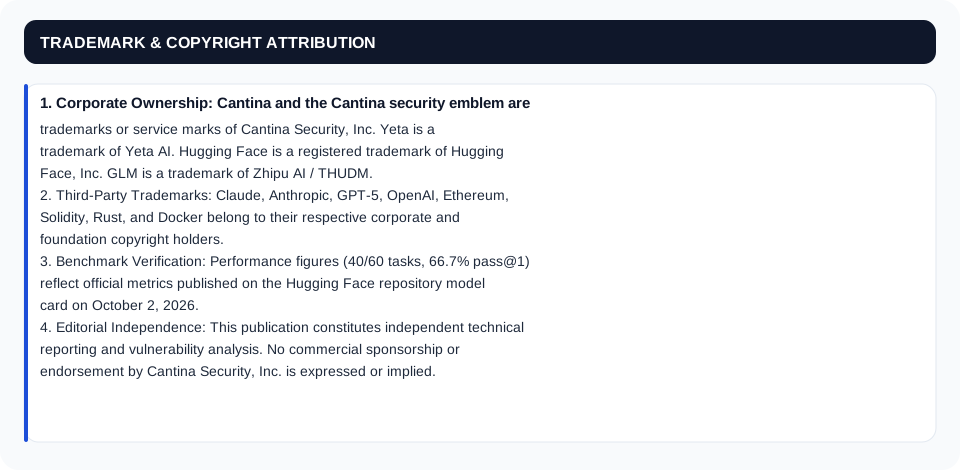
Legal Disclaimers & Regulatory Notices
To ensure full legal clarity, copyright attribution, and corporate transparency, the following terms are specified:
Strategic Recommendations for Security Leaders and Audit Teams
For Chief Information Security Officers (CISOs), Web3 security auditors, and DevSecOps platform leads evaluating Cantina Apex Flash-1, the following operational principles should guide deployment:
- Deploy in Air-Gapped Local Enclaves: Because Apex Flash-1 is distributed as open weights under the MIT license, organizations should host the model on internal, air-gapped GPU infrastructure. This guarantees that proprietary source code and sensitive smart contract audits never leave the corporate perimeter.
- Implement the Strict Supervisor-Worker Architecture: Do not task Apex Flash-1 with autonomous repository-wide refactoring. Instead, pair it with a frontier supervisor model (like Claude or GPT-5) that handles planning and human interaction, while routing granular taint analysis and PoC generation tasks to parallelized Apex Flash-1 workers.
- Mandate Automated Verification Sandboxes: Configure workers to execute inside ephemeral Docker containers equipped with strict resource caps and zero external internet egress. Require that any vulnerability reported by a worker be accompanied by an executable, verified test harness.
- Enforce Ethical and Legal Compliance Gates: Integrate automated credential and permission validation into the agent orchestrator. Ensure that every target system scanned by autonomous workers has a cryptographically signed authorization token confirming permission to test.
As autonomous AI agents transform the economics of software development, Cantina Apex Flash-1 represents a monumental milestone for defenders: providing the global cybersecurity community with open, high-velocity intelligence to secure the digital foundation of the modern world.
Frequently Asked Questions
What did Cantina announce regarding Apex Flash-1?
In early October 2026, cybersecurity research firm Cantina, in collaboration with Yeta AI, released Apex Flash-1 (available on Hugging Face under cantina-security/apex-flash-1). The model is a specialized security worker model created through reinforcement learning (RL) post-training on GLM-5.3-Flash and released under a permissive MIT open-weight license.
What benchmark score did Apex Flash-1 achieve on held-out security evaluations?
According to the official Hugging Face model card, Apex Flash-1 successfully solved 40 out of 60 tasks—achieving a 66.7% pass@1 rate—on a rigorous held-out benchmark of real-world cybersecurity, smart contract, and code vulnerability challenges, outperforming the base GLM-5.3-Flash model and frontier baselines.
What is the supervisor-worker architecture designed for Apex Flash-1?
Apex Flash-1 is engineered specifically to operate as a specialized worker model under a high-reasoning frontier supervisor (such as Claude Opus or GPT-5 class models). The supervisor handles macro-level task decomposition, orchestrates multi-file context, and drafts executive audit reports, while Apex Flash-1 executes high-volume, granular code AST parsing, exploit reachability checks, and patch validation.
Does the abliterated sibling checkpoint inherit the standard benchmark evaluation?
No. The model release notes explicitly state that the abliterated research checkpoint alters refusal boundaries and safety guardrails for internal red-team research. Because safety refusals and internal representations are modified, the abliterated variant does not inherit the verified standard evaluation scores of the primary checkpoint.
Does an MIT open-weight license grant legal authorization to attack systems?
No. The MIT license governs software copyright and distribution permissions only. It provides zero legal authorization to conduct unauthorized vulnerability probing, penetration testing, or exploitation against third-party systems, which remains strictly illegal under international cyber statutes including the US Computer Fraud and Abuse Act (CFAA) and the UK Computer Misuse Act.
