Gemini 4 Argon Stays Inside Google’s Cyber-Defender Gate: Limited Fairwind Access Before Public GA
By Vatsal Shah | September 30, 2026 | 8 min read | Source: Google Blog / Google DeepMind
AI SUMMARY
- Frontier Capability Leap:
- Google DeepMind has unveiled Gemini 4 Argon, an advanced frontier model demonstrating state-of-the-art proficiency in complex software engineering, deep knowledge synthesis, and automated cyber defense.
- Strictly Gated Deployment:
- In an unprecedented departure from standard consumer rollouts, Gemini 4 Argon is not in public General Availability (GA). It is completely unavailable to standard API consumers, Gemini Advanced subscribers, or commercial enterprises.
- The Project Fairwind Gate:
- Initial access is restricted exclusively to vetted cyber defenders through Project Fairwind, encompassing accredited national CERTs, critical infrastructure operators, and authorized cybersecurity research laboratories.
- Dual-Use Containment:
- DeepMind’s frontier evaluations revealed that Argon's automated vulnerability discovery and exploit simulation reach dual-use hazard thresholds, compelling Google to enforce defensive-only deployment filters.
- Defensive Asymmetry Mandate:
- Project Fairwind aims to give defensive teams a temporal advantage—empowering them to discover, audit, and patch vulnerabilities across open-source and enterprise codebases before offensive actors can weaponize generative capabilities.
- No Speculative GA Timeline:
- Google explicitly refrained from providing a public release date, maintaining that broader commercial and developer availability will remain paused until international safety commitments and red-teaming milestones are satisfied.
Lead Paragraph
MOUNTAIN VIEW, California — On September 30, 2026, Google DeepMind introduced Gemini 4 Argon, a frontier artificial intelligence model engineered for advanced software engineering, high-cognition knowledge work, and autonomous cybersecurity operations. However, in a disclosure penned by Google DeepMind CTO Koray Kavukcuoglu, Google confirmed that Gemini 4 Argon is not entering public General Availability (GA). Recognizing that the model’s unprecedented reasoning power introduces severe dual-use cyber risks—specifically the automated discovery of novel software flaws and synthetic exploit generation—Google has locked Argon behind a restricted deployment gate known as Project Fairwind. Accessible solely to accredited national defense teams, critical infrastructure operators, and vetted enterprise cyber defenders, the deployment establishes a controlled testing ground designed to ensure defensive cybersecurity systems maintain structural superiority before the model is ever considered for broader commercial distribution.
What Happened
Throughout 2025 and 2026, the cadence of frontier AI model releases typically adhered to a familiar playbook: a research announcement accompanied by instant API availability, Google AI Studio integration, and immediate deployment to consumer subscription tiers.
With Gemini 4 Argon, Google DeepMind broke that paradigm.
According to the official technical briefing published on September 30, 2026, Gemini 4 Argon represents Google's most sophisticated neural architecture to date. The model demonstrates breakthrough performance in:
- Autonomous Long-Context Coding: Executing repository-wide refactors across millions of lines of legacy code, resolving subtle distributed concurrency bugs, and migrating complex memory-unsafe C/C++ libraries into memory-safe Rust with automated formal proofs.
- Deep Knowledge Synthesis: Multi-step logical deduction across dense scientific literature, patent archives, and complex financial regulatory standards.
- Autonomous Cyber Operations: High-speed decompilation of compiled binaries, static and dynamic vulnerability identification, automated fuzzing guidance, and real-time generation of zero-day virtual patches.
Yet, precisely because Argon excels at analyzing binary instructions and identifying hidden memory-corruption flaws, Google DeepMind’s Frontier Safety Framework categorized the model as meeting "High-Severity Dual-Use Cyber Hazard" benchmarks. If deployed indiscriminately through an unauthenticated public API, adversarial nation-states and criminal cartels could weaponize the system to automate zero-click intrusion chains and develop self-propagating malware at unprecedented machine scale.
Consequently, Google made the deliberate decision to halt public commercial release, routing early access exclusively through Project Fairwind.

Inside Project Fairwind: The Trusted Defender Gate
Project Fairwind is Google’s specialized trust-and-safety pipeline established to validate high-risk, high-capability frontier models in live defensive environments while preventing offensive proliferation.
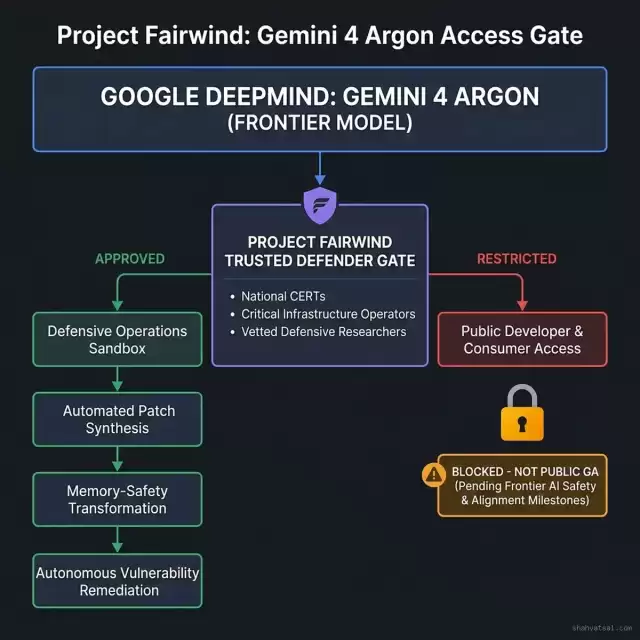
As depicted in the architectural workflow above, access to Gemini 4 Argon requires navigating a multi-stage vetting and isolation protocol:
1. Rigorous Identity and Accreditation Vetting
Project Fairwind access is not sold as a self-service cloud subscription. Organizations must undergo formal institutional background validation. Qualified applicants are restricted to:
- National Computer Emergency Response Teams (CERTs): Government cybersecurity coordination agencies (e.g., US CISA, UK NCSC, German BSI).
- Critical Infrastructure Operators: Vetted telecommunications carriers, power grid operators, nuclear control systems, and major financial clearinghouses.
- Accredited Defensive Research Centers: Academic and independent labs with verified track records in responsible disclosure and defensive telemetry synthesis.
2. Isolated Sandboxes and Non-Exportable Weights
No organization receives model weights. Gemini 4 Argon runs exclusively within dedicated, highly audited Google Cloud Infrastructure (GCI) enclaves with air-gapped network configurations. Input code samples, target binaries, and output audit logs cannot be extracted to third-party infrastructure.
3. Asymmetric Defensive Sandboxing
Defenders accessing Argon through Fairwind are provided specialized tooling designed specifically for defensive workflows:
- Automated Memory-Safety Transpilation: Ingesting vulnerable C/C++ firmware and automatically producing mathematically verified, memory-safe Rust implementations.
- Automated Patch Synthesis: Analyzing disclosed CVEs and synthesizing targeted, non-breaking micro-patches for mission-critical software systems before exploits are weaponized in the wild.
- Dynamic Intrusion Forensics: Parsing terabytes of distributed Security Information and Event Management (SIEM) telemetry to trace adversary lateral movement in real time.
Conversely, standard public developer accounts and consumer subscriptions (such as Gemini Advanced or Google Workspace AI) are completely blocked by the Fairwind security perimeter.
The Dual-Use Paradox: Why Offensive Capabilities Were Suppressed
The governance dilemma confronting Google DeepMind with Gemini 4 Argon centers on the inherent symmetry of cybersecurity: the mathematical skills required to discover a flaw in a software binary are virtually indistinguishable from the skills required to write an exploit for that same flaw.
To maintain defensive utility without empowering malicious actors, Google implemented fine-grained constitutional alignment layers and inference-time execution monitors.
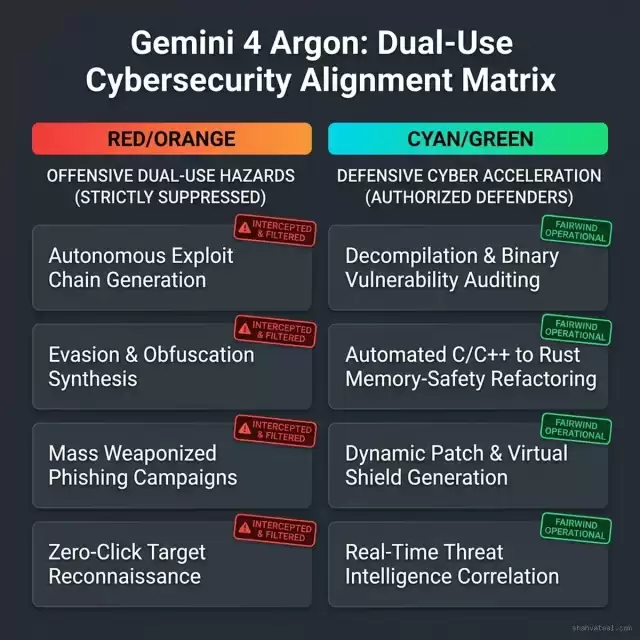
The operational matrix above delineates the strict boundary enforced by Gemini 4 Argon's guardrails:
Intercepted and Filtered (Offensive Hazards)
- Autonomous Exploit Chaining: The model is programmatically constrained from generating functional return-oriented programming (ROP) chains, heap spray payloads, or zero-click shellcode.
- Evasion and Obfuscation: Argon refuses prompts requesting code metamorphic obfuscation, anti-analysis packing, or sandbox-detection subroutines intended to bypass Endpoint Detection and Response (EDR) agents.
- Weaponized Social Engineering: Generative outputs targeting human deception, spear-phishing credential harvesting, and personalized deepfake scripts are blocked at the token generation layer.
Fairwind Operational (Defensive Capabilities)
- Binary Decompilation & Auditing: The model accurately reconstructs high-level algorithmic intent from stripped x86-64 and ARM64 machine code, identifying buffer overflows, race conditions, and cryptographic nonce reuse.
- Automated Patch Generation: For any identified flaw, Argon produces human-readable diffs, regression test cases, and virtual firewall rules (Snort/YARA signatures) within milliseconds.
- Cryptographic Hygiene Verification: Scanning enterprise codebases for legacy cipher suites, weak entropy generation, and post-quantum vulnerability vectors.
By enforcing this asymmetric filtering, Google DeepMind aims to ensure that while defenders gain exponential operational velocity, attackers cannot use Argon as an automated exploit factory.
Frontier Coding and Knowledge Work Performance
While the cybersecurity restrictions have captured industry headlines, Gemini 4 Argon’s core cognitive capabilities represent a significant leap over previous frontier architectures.
Next-Generation Software Engineering
In internal evaluations conducted by Google DeepMind across complex software benchmarks, Argon demonstrated capabilities that surpass traditional autocomplete assistants:
- Autonomous Multi-Repository Debugging: Argon can ingest entire organizational dependency trees, trace intermittent distributed deadlock bugs across microservice boundaries, and produce coordinated pull requests with accompanying integration tests.
- Formal Verification Integration: Unlike purely heuristic coding models, Argon integrates symbolic solvers directly into its chain-of-thought scratchpad, mathematically proving the correctness of generated algorithmic logic.
Complex Knowledge Reasoning
In domain-specific knowledge evaluations, Argon exhibited advanced competence in legal analysis, biomedical research synthesis, and macroeconomic modeling. The model can synthesize thousands of disparate research papers, resolve conflicting methodological claims, and generate structured executive theses with accurate primary citation grounding.
However, despite these enterprise-ready capabilities, Google DeepMind’s safety protocols dictate that access to Argon’s non-cyber knowledge capabilities will also remain gated under the Project Fairwind umbrella until the full model safety envelope is validated.
Comparison and Deduplication
To maintain precision across frontier AI news coverage, it is critical to distinguish Gemini 4 Argon from parallel Google initiatives and rival lab announcements:
- Vs. AlphaEvolve Autonomous AI Architecture (#N78): AlphaEvolve focused on genetic evolutionary algorithms for self-optimizing neural network topologies. Gemini 4 Argon is a trained, production-grade frontier reasoning model.
- Vs. Gemini Consumer / Android On-Device Models: Argon is a massive, datacenter-scale frontier model that cannot run locally on client hardware and is completely separate from mobile Android Gemini Nano updates.
- Vs. OpenAI GPT-6.1 Sol (#N110): OpenAI’s GPT-6.1 Sol focused on commercial availability, aggressive token cost reductions ($0.20/$1.00 per million tokens), and rapid distribution across GitHub Copilot. In contrast, Gemini 4 Argon is deliberately withheld from commercial APIs due to safety gating.
- Vs. Claude Sonnet 5.5 (#N112): Anthropic’s Sonnet 5.5 release is a commercially available workhorse targeted at developer cost efficiency ($2/$10 pricing), whereas Argon remains an unpriced, invite-only defensive research deployment.

The Road to General Availability: What Must Happen First?
Google DeepMind’s refusal to provide a target General Availability date has generated intense discussion across the tech ecosystem. When will enterprise software developers, enterprise IT leaders, and general consumers gain access to Gemini 4 Argon?
According to Google’s Frontier Safety Framework, several mandatory milestones must be achieved before any public commercialization:
- Empirical Defensive Telemetry: Project Fairwind partners must demonstrate that Argon’s automated defensive tools have successfully remediated more vulnerabilities in production code than the model could theoretically discover for offensive actors.
- Red-Teaming Residual Risk Audits: External third-party red teams—including the US and UK AI Safety Institutes—must conduct exhaustive jailbreaking evaluations to confirm that constitutional guardrails cannot be bypassed through adversarial prompt injection, steganographic token encoding, or multi-turn persona persuasion.
- Regulatory Alignment with Global AI Acts: Compliance reviews under the European Union AI Act’s stringent Tier-1 systemic risk regulations and US executive guidelines governing dual-use cyber foundation models.
- Architectural Distillation: Google engineering teams must develop distilled, safety-hardened commercial variants that strip raw offensive exploitation mechanics while preserving high-speed coding synthesis and document reasoning.
Until those benchmarks are independently certified, Google’s official stance remains resolute: Gemini 4 Argon will not be released to public developers or consumers.
Strategic Takeaways for Cybersecurity and IT Leaders
The gated deployment of Gemini 4 Argon carries three critical strategic lessons for technology executives:
- Defensive Automation Is Mandatory: If frontier AI models can identify complex vulnerabilities across millions of lines of code in seconds, human-paced patching is officially obsolete. Security operations centers (SOCs) must embrace automated static analysis and dynamic patch deployment to survive.
- Apply for Trusted Access Early: Critical infrastructure operators and enterprise organizations managing sensitive national infrastructure should explore formal partnership channels with Project Fairwind to leverage frontier defensive tooling before threat actors develop comparable open-source alternatives.
- Audit Legacy C/C++ Codebases: With models capable of automated decompilation and exploit synthesis on the horizon, legacy unmanaged code represents an existential liability. Enterprises should prioritize automated migrations to memory-safe languages (Rust, Go, Swift) as a foundational defense.
Google DeepMind's decision to gate Gemini 4 Argon behind Project Fairwind marks a pivotal moment in artificial intelligence governance: a recognition that at the frontier, responsible deployment sometimes means withholding commercial access until defensive resilience is guaranteed.
Frequently Asked Questions
What is Gemini 4 Argon and what capabilities does it introduce?
Gemini 4 Argon is Google DeepMind's next-generation frontier multimodal model engineered for complex software engineering, multi-step knowledge synthesis, and advanced autonomous cyber defense operations, including binary decompilation and automated vulnerability mitigation.
Can the general public or standard API developers access Gemini 4 Argon today?
No. Gemini 4 Argon is not in general availability (GA) and is not accessible to public developers, consumers, or standard Google AI Studio users. Initial access is strictly restricted to vetted national computer emergency response teams (CERTs), critical infrastructure operators, and accredited defensive security researchers through Google's Project Fairwind.
Why is Google restricting Gemini 4 Argon behind the Project Fairwind gate?
Because the model possesses unprecedented dual-use cyber capabilities capable of rapidly discovering novel software flaws and synthesizing zero-day exploit primitives, Google DeepMind restricted deployment behind a controlled verification gate to ensure defensive advantages are distributed to trusted guardians before any broader public deployment.
Has Google announced an official public General Availability (GA) date for Gemini 4 Argon?
No. Google DeepMind explicitly declined to provide a public GA timetable. Public release remains contingent on extensive red-teaming evaluations, dual-use risk assessments under international frontier AI safety frameworks, and validation of real-world defensive telemetry.
How does Gemini 4 Argon differ from GPT-6.1 Sol or Claude Sonnet 5.5?
While OpenAI’s GPT-6.1 Sol and Anthropic’s Claude Sonnet 5.5 were released as publicly accessible commercial developer models optimized for low inference costs, Gemini 4 Argon is treated as a high-hazard frontier model subject to non-commercial, gated deployment specifically for cybersecurity defense.
