Cursor Projects Puts a Coordinator Over Months of Work: Cloud-Native Multi-Agent Orchestration with Persistent Shared Memory
By Vatsal Shah | September 10, 2026 | 11 min read | Source: Cursor Official Blog & Release Notes
EXECUTIVE SUMMARY
- Public Beta Rollout:
- On September 10, 2026, Anysphere officially unveiled Cursor Projects in public beta, rolling out to all Cursor users to manage long-horizon software development initiatives spanning weeks and months.
- The Coordinator Architectural Model:
- Unlike monolithic coding assistants, Cursor Projects introduces an executive coordinator agent that does not write code directly. Instead, it decomposes complex engineering epics, tracks long-term technical debt, enforces repository invariants, and synthesizes architectural roadmaps.
- Delegation to Thousands of Subagents:
- Cursor claims the coordinator can dynamically spawn, monitor, and coordinate thousands of specialized execution subagents running in parallel across isolated sandboxes.
- Cloud Computer Runtime (Laptop-Off Execution):
- Execution is decoupled from local workstations. Running inside persistent cloud virtualization environments, projects continue executing autonomously when the developer's laptop is closed, sleeping, or offline. Local agents are summoned only when physical machine checks are required.
- Event-Driven Subscriptions:
- Subscribes natively to Slack channels, GitHub pull requests, cron schedules, and issue tracker webhooks, transforming reactive coding into autonomous continuous development.
- Clear Wave 18 Deduplication:
- Strictly distinct from single-task background agents, shell-level hooks, and deployment monitoring bots; Cursor Projects introduces cross-session shared memory and long-horizon multi-agent governance.
Lead Paragraph
SAN FRANCISCO, California — On September 10, 2026, Anysphere, the company behind the popular AI-first code editor Cursor, officially launched Cursor Projects into public beta across its entire developer user base. Representing a fundamental departure from single-turn autocomplete and isolated chat agents, Cursor Projects introduces a cloud-native coordinator agent designed to oversee and sustain complex engineering initiatives across months of development. Crucially, the coordinator agent does not write code itself; instead, it acts as an autonomous engineering manager and systems architect—breaking down high-level specifications into directed acyclic task graphs, maintaining shared cross-session project memory, and delegating actual implementation work to thousands of parallel subagents. Powered by persistent cloud virtualization environments, Cursor Projects executes continuously without requiring the developer's laptop to stay awake or connected. By pairing cloud-native persistence with event subscriptions across Slack, cron timers, and GitHub pull requests, Cursor has redefined autonomous software engineering from ephemeral micro-tasks into coordinated, multi-agent program execution.
The Paradigm Shift: From Ephemeral Prompts to Long-Horizon Projects
The fundamental bottleneck of first-generation AI coding assistants was their ephemeral context lifespan. Whether interacting through an IDE sidebar or a terminal command line, every developer interaction historically suffered from acute memory degradation:
- Context Fragmentation Across Turns: When a developer closed their editor window or concluded a coding session, the model's working memory was wiped clean. Resuming architectural work required manually re-prompting the model with design files, architectural constraints, and previous failure modes.
- The "Do-It-All" Monolithic Anti-Pattern: Early autonomous coding agents attempted to use a single reasoning model to both architect a multi-package refactor and edit syntax on line 42 of a CSS stylesheet. The resulting cognitive overload routinely triggered severe context drift, regression bugs, and premature loop termination.
- Local Machine Attachment: Traditional IDE-bound agents were physically tethered to the developer’s active workstation. If a developer initiated a complex full-stack migration requiring two hours of test runs and closed their laptop to commute or attend a meeting, the agent process stalled immediately.CODE
+---------------------------------------------------------------------------------------------------+
|                              CURSOR PROJECTS TECHNICAL PROFILE (BETA)                             |
+----------------------------+----------------------------------------------------------------------+
| Feature Name               | Cursor Projects                                                      |
+----------------------------+----------------------------------------------------------------------+
| Release Status             | Public Beta (Rolling out to all Cursor tiers, September 10, 2026)    |
+----------------------------+----------------------------------------------------------------------+
| Core Architectural Agent   | Project Coordinator Agent (Executive Orchestration Engine)           |
+----------------------------+----------------------------------------------------------------------+
| Code Authorship Rule       | Coordinator DOES NOT write code directly (Pure Delegation & Review)   |
+----------------------------+----------------------------------------------------------------------+
| Subagent Capacity          | Up to thousands of parallel execution subagents (Cursor's claim)     |
+----------------------------+----------------------------------------------------------------------+
| Execution Runtime          | Cloud Computer (Ephemeral, containerized cloud virtualization)       |
+----------------------------+----------------------------------------------------------------------+
| Offline Continuity         | Full "Laptop-Off" persistence; tasks run when local machine sleeps   |
+----------------------------+----------------------------------------------------------------------+
| Local Machine Role         | Local agents invoked strictly for hardware or local runtime checks   |
+----------------------------+----------------------------------------------------------------------+
| Ingestion & Event Triggers | Slack threads, GitHub PRs, scheduled cron jobs, CLI & webhooks       |
+----------------------------+----------------------------------------------------------------------+
| Memory Subsystem           | Persistent Cross-Session Project Graph & Architectural State         |
+----------------------------+----------------------------------------------------------------------+
Cursor Projects resolves these architectural limitations. By splitting executive coordination from tactical execution and hosting the coordinator inside a durable cloud virtualization layer, software engineering initiatives transition from fragile, single-session chat prompts into durable, long-horizon projects that evolve over weeks and months.
Architectural Hierarchy: Coordinator Agent vs. Worker Subagents
The primary architectural breakthrough in Cursor Projects is the strict decoupling of strategic planning from code manipulation:
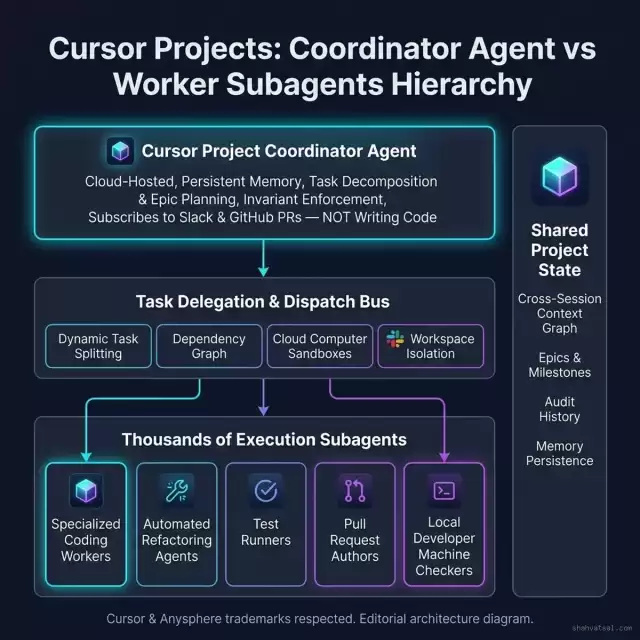
As illustrated in the system architecture diagram above, Cursor Projects operates across three distinct operational strata and a persistent memory plane:
Stratum 1: The Cursor Project Coordinator Agent
At the pinnacle of the hierarchy resides the cloud-hosted Coordinator Agent. The coordinator operates under an absolute architectural constraint: it never writes code directly.
- Macro Epic Decomposition: When presented with a complex objective—such as migrating an enterprise monorepo from Next.js 14 Pages Router to Next.js 16 App Router—the coordinator breaks down the epic into an ordered Directed Acyclic Graph (DAG) of atomic sub-tasks.
- Repository Invariant Enforcement: It continuously evaluates global architectural rules (e.g., verifying that all public API endpoints implement strict schema validation, or that zero raw database queries bypass the ORM layer).
- Cross-Session Memory Curation: It maintains and updates the project’s semantic state, recording which technical approaches succeeded, which failed, and why specific library versions were pinned.
- Review & Reconciliation: When worker subagents complete code modifications, the coordinator reviews the resulting diffs against the high-level specification, running integration checks before assembling the final pull request.
Stratum 2: Task Delegation & Dispatch Bus
Sitting between the coordinator and worker subagents is an asynchronous dispatch bus:
- Dynamic Task Splitting: Dispatches tasks that can be executed independently in parallel, while buffering sequential dependencies.
- Isolated Cloud Sandboxes: Automatically provisions ephemeral containerized workspaces with pre-installed toolchains, dependency caches, and repository mirrors.
- Context Boundary Enforcement: Rather than overwhelming a coding model with 500,000 lines of codebase context, the dispatch bus packages only the exact file slices, type definitions, and test suites needed for the assigned micro-task.
Stratum 3: Thousands of Execution Subagents
Tactical implementation is handed to pools of specialized execution subagents. Cursor claims the architecture can scale to thousands of subagents executing concurrently:
- Specialized Coding Workers: Fine-tuned to implement concrete code changes, such as refactoring a single React component or writing a database migration script.
- Automated Refactoring Agents: Systematically apply linting fixes, dependency updates, and boilerplate code across hundreds of files in parallel.
- Test Runners & Fuzzers: Execute unit tests, integration harnesses, and edge-case fuzzing in parallel sandbox containers.
- Pull Request Authors: Package verified code diffs into clean, structured Git commits with explanatory pull request descriptions.
- Local Developer Machine Checkers: When an execution step requires hardware-specific testing—such as verifying an iOS simulator build, connecting to a local USB hardware security key, or validating a local GPU driver—the coordinator reaches out to the developer's local Cursor client to execute a targeted local agent verification.
Stratum 4: Shared Project State Plane
Running alongside all strata is the Shared Project State Plane:
- Cross-Session Context Graph: Tracks code dependencies, architectural decisions, and known failure patterns across weeks of development.
- Milestone & Epic Tracking: Records progress against high-level roadmaps, allowing human engineers to inspect where a multi-week initiative stands at any moment.
- Audit History: Captures complete prompt, response, and tool invocation traces for compliance and debugging.
The Cloud Computer Lifecycle: True "Laptop-Off" Asynchronous Execution
A transformative capability emphasized in Cursor's September 10 announcement is Cloud Computer Execution. In traditional IDE setups, an agent's execution lifetime is tied directly to the developer's workstation operating system and process tree.
With Cursor Projects, execution moves entirely into the cloud:
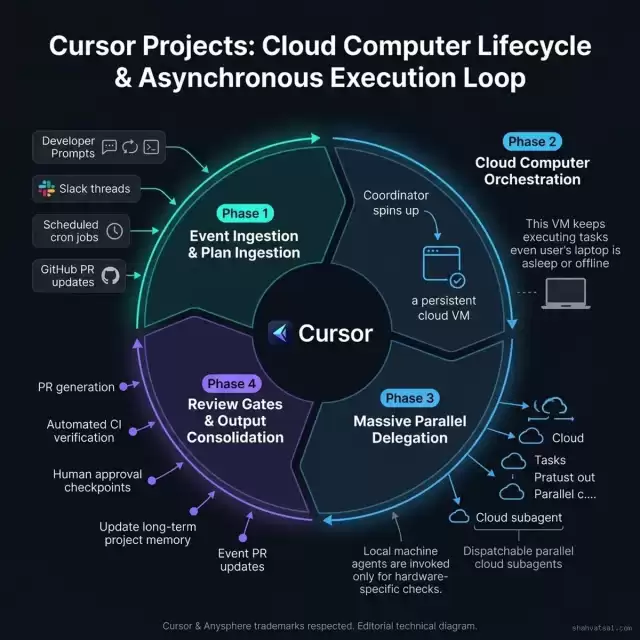
The execution loop operates across four continuous phases:
Phase 1: Event Ingestion & Plan Ingestion
A Cursor Project does not merely wait for a human developer to type a prompt into an active editor window. It continuously listens for diverse asynchronous event sources:
- Developer Prompts & Roadmap Epics: High-level specifications entered via the Cursor IDE, web dashboard, or mobile interface.
- Slack Threads & Channels: A project can subscribe to a dedicated Slack channel (e.g.,
#proj-payments-migration). When team members discuss bug reports or post requirements in the thread, the coordinator ingests the context and queues relevant tasks. - Scheduled Cron Jobs: Periodic triggers configured to run weekly dependency audits, daily security vulnerability scans, or nightly integration suites.
- GitHub Pull Requests & Issue Trackers: Incoming PR reviews, failed CI notifications, or newly opened issue tracker tickets that match project labels.
Phase 2: Cloud Computer Orchestration
Upon ingesting an event, the coordinator initiates execution inside a persistent Cloud Computer:
- Persistent Cloud VM: An ephemeral, dedicated cloud virtual machine containing full Linux terminal access, network egress, and secure secrets management.
- Laptop-Off Continuity: Because the coordinator and execution environment reside entirely on Cursor’s cloud infrastructure, the developer can shut down their IDE, close their laptop lid, or board an airplane. The project continues to make progress autonomously in the cloud.
Phase 3: Massive Parallel Delegation
The coordinator orchestrates execution across multiple sandboxes:
- Cloud Subagent Dispatch: Dispatches parallel tasks to dedicated cloud subagent instances. A complex migration involving 200 microservices can have 200 subagents running concurrently, reducing a 20-hour sequential chore to a 10-minute parallel burst.
- Local Fallback Gate: If an operation explicitly requires local hardware execution (e.g., local Docker daemon on developer's private LAN, native macOS build tools), the coordinator queues a lightweight notification to the developer's local Cursor client. When the laptop reconnects, the local check runs and returns the result to the cloud coordinator.
Phase 4: Review Gates & Output Consolidation
Before code changes touch production branches, rigorous governance gates are enforced:
- Pull Request Generation: Changes are consolidated into clean, atomic GitHub pull requests.
- Automated CI Verification: The coordinator monitors the project's external GitHub Actions or CI/CD pipelines, automatically dispatching subagents to fix any lint or test failures.
- Human Approval Checkpoints: Critical architectural changes or high-risk diffs pause execution, waiting for human approval via Slack or the Cursor dashboard.
- Long-Term Memory Update: Once approved, the project's persistent memory graph is updated with the new baseline, completing the lifecycle.
Technical Configuration: Defining Projects and Invariants
Under Cursor Projects, project configuration, architectural invariants, and event subscriptions can be declared deterministically using repository configuration files:
{
  "$schema": "https://cursor.com/schemas/projects/v1.json",
  "project": {
    "name": "enterprise-api-gateway-modernization",
    "version": "1.0.0-beta",
    "description": "Multi-month initiative migrating legacy REST handlers to gRPC and TypeSpec schemas",
    "runtime": {
      "type": "cloud-computer",
      "region": "us-east-1",
      "allow_laptop_off": true,
      "max_parallel_subagents": 64
    },
    "coordinator": {
      "model": "claude-3-7-sonnet-thought",
      "strict_role": "coordinator-only",
      "disallow_direct_code_edits": true,
      "memory_persistence": "enabled"
    },
    "subscriptions": [
      {
        "type": "slack",
        "channel": "C08472910AA",
        "listen_events": ["thread_mention", "emoji_reaction_gear"]
      },
      {
        "type": "github",
        "events": ["pull_request.opened", "issues.labeled.project-gateway"],
        "branches": ["feature/gateway-*"]
      },
      {
        "type": "cron",
        "schedule": "0 2 * * 1",
        "action": "run_full_invariant_audit"
      }
    ],
    "invariants": [
      {
        "id": "INV-001",
        "name": "strict-input-validation",
        "rule": "Every newly added public handler must define a TypeSpec schema and zod validator."
      },
      {
        "id": "INV-002",
        "name": "zero-direct-db-queries",
        "rule": "Handlers must invoke the domain repository interface; direct SQL execution is prohibited."
      }
    ],
    "verification_strategy": {
      "run_local_agents_for": ["macos-keychain-test", "metal-gpu-harness"],
      "require_human_approval_for_merges": true
    }
  }
}
This declarative model provides engineering organizations with unprecedented governance. Security teams can enforce invariant rules across an entire multi-month project, ensuring that autonomous subagents never drift outside corporate coding and compliance guidelines.
Comparative Matrix: Wave 18 AI Coding Agent Surfaces
To clarify where Cursor Projects fits within the rapidly evolving landscape of autonomous developer tools in autumn 2026, consider how it compares against concurrent industry advancements:
| Feature / Dimension | Cursor Projects (#N128) | Claude Code Mods (#N124) | GitHub Copilot Dynamic Workflows (#N125) | Cursor Rollouts & Security Bot (#N127) | Codex Cloud Environments (#N126) |
|---|---|---|---|---|---|
| Primary Architectural Role | Long-horizon Project Coordinator | In-process agent plugin extension | Code-defined custom agent workflows | Automated deploy monitoring & CVE detection | Persistent cloud workspace containers |
| Execution Horizon | Weeks to Months | Single terminal session | Single workflow or script run | Deploy phase of a Pull Request | Reusable task workspaces |
| Coordinator Code Authorship | NO (Pure Delegation & Planning) | Yes (mod executes within tool loops) | Configurable by developer code | No (opens revert PRs or reviews) | Yes (executes coding tasks directly) |
| Subagent Scaling | Up to thousands of subagents (claimed) | Single agent with custom JS hooks | User-scripted sequential/parallel agents | 2 specialized bots (Rollouts, Sec Review) | Single cloud agent per environment task |
| Runtime Infrastructure | Cloud Computer (Laptop-Off) | Local terminal process | CLI / App runtime (Experimental) | GitHub PR background monitoring | Cloud VM (Laptop-off capable) |
| External Event Triggers | Slack, GitHub PRs, Cron, Webhooks | Local CLI lifecycle events | CLI commands (/every, /after) | GitHub PR deploy events | Linear, GitHub, Web dashboard |
| Shared Memory Subsystem | Cross-session persistent project graph | In-memory session state | Ephemeral workflow memory | PR comment history | Stored environment snapshots |
| Current Availability | Public Beta (Sep 10, 2026) | GA in Claude Code 2.1.287 | Public Preview (Oct 1, 2026) | Teams & Enterprise (Sep 23, 2026) | DevDay Rollout (Sep 29, 2026) |
Deduplication & Ecosystem Boundary Analysis
To prevent ambiguity across concurrent releases, the following clear boundaries are cataloged:
1. Distinct from Cursor Background Agents (Single-Task Runs)
Earlier in 2026, Cursor introduced background cloud agents capable of fixing an isolated bug or refactoring a single file in the cloud. Cursor Projects operates an entire layer above: it is a persistent coordinator managing shared memory across multiple weeks, orchestrating hundreds of individual background agents toward a unified epic.
2. Distinct from Cursor Shell Hooks and Grind Loops (#N91)
Cursor shell hooks (and the deterministic grind loop pattern) operate as local stop hooks and shell lifecycle guards within the developer's workstation. Cursor Projects is a cloud-hosted multi-agent orchestration platform that manages distributed cloud VMs.
3. Distinct from Cursor Rollouts and Security Review (#N127)
Announced on September 23, 2026, Cursor Rollouts is an automated post-deployment monitoring bot that tracks production metrics after a PR merge, while the Security Review bot detects exploitable CVEs. In contrast, Cursor Projects is an end-to-end project management and development coordinator.
4. Distinct from Claude Code Mods (#N124)
Claude Code mods are in-process JavaScript/TypeScript plugins that modify tool execution permissions inside the local Claude Code terminal process. Cursor Projects is a cloud-based multi-agent coordinator that manages fleets of subagents across cloud computers.
Legal Notices, Trademark Attribution & Regulatory Disclaimers
To maintain full corporate transparency, legal accuracy, and intellectual property attribution:
[!NOTE] Corporate & Intellectual Property Disclaimers 1. Trademark Attribution: Cursor and the Cursor 3D cube logo are trademarks or service marks of Anysphere, Inc. All rights reserved. 2. Third-Party Trademarks: GitHub, GitHub Copilot, Slack, Claude, Anthropic, Next.js, Vercel, Docker, Kubernetes, Linux, and other referenced software systems are the property of their respective trademark holders. 3. Metric & Performance Claims: All statements regarding "thousands of subagents," "coordinator does not write code," and cloud computer execution parameters reflect official product claims published by Anysphere on the Cursor Blog (
cursor.com/blog/projects) on September 10, 2026. Independent benchmarks may vary based on cloud compute quotas and tier limits. 4. Release Status Notice: Cursor Projects is currently in Public Beta. Feature configurations, API schemas, and cloud execution quotas are subject to ongoing modification prior to general availability. 5. Editorial Independence: This article constitutes independent technical reporting and software architecture analysis. No commercial sponsorship, early access payment, or corporate endorsement was provided by Anysphere, Inc.
Strategic Guidance for Engineering Leaders & Development Teams
For Engineering Directors, Platform Architects, and Lead Developers evaluating Cursor Projects for production workflows:
- Establish Clear Project Invariants in Code: Take advantage of declarative project definitions. Define explicit invariant rules for testing coverage, database access patterns, and security constraints so the coordinator agent can enforce organizational standards across all spawned subagents.
- Embrace the Coordinator-Worker Separation: Train engineering teams to interact with Cursor Projects at an architectural level. Avoid treating the coordinator as a simple autocomplete tool; provide high-level epics, acceptance criteria, and architectural constraints, allowing the coordinator to handle task decomposition and delegation.
- Audit Cloud Computer Egress and Secrets Management: Because Cursor Projects executes inside persistent cloud virtualization environments, ensure corporate secrets, API keys, and repository deploy tokens are managed through centralized, scoped secrets providers rather than plain-text local environment files.
- Leverage Event Subscriptions for Continuous Refactoring: Set up scheduled cron jobs and Slack thread subscriptions to automate continuous codebase maintenance—such as weekly dependency bumps, deprecation cleanups, and automated test suite expansions—turning maintenance chores into automated background operations.
By establishing a persistent coordinator agent that supervises long-horizon software engineering while leaving developers free to close their laptops, Cursor Projects signals the dawn of truly autonomous, continuous software development.
Frequently Asked Questions
What did Cursor announce regarding Cursor Projects on September 10, 2026?
On September 10, 2026, Cursor (Anysphere) announced the public beta rollout of Cursor Projects. The feature introduces a persistent, cloud-hosted coordinator agent engineered to supervise long-horizon software engineering initiatives spanning weeks and months of development across thousands of delegated subagents.
Does the Cursor Projects coordinator agent write source code directly?
No. Cursor explicitly specifies that the coordinator agent does not write code itself. Instead, it functions as an autonomous technical lead: decomposing architectural epics, maintaining project memory graphs, enforcing repository invariants, dispatching modular tasks to worker subagents, and reconciling final pull requests.
How does cloud computer execution enable work to continue when a laptop is closed?
Cursor Projects runs inside persistent cloud-hosted virtualization environments rather than on the developer's local workstation. Because execution resides on a cloud computer, engineers can trigger initiatives, shut down their local IDE, close their laptop, or walk away, while the coordinator and cloud subagents continue uninterrupted. Local machine agents are invoked only when on-device verification or hardware-specific tests are required.
What external event triggers and integrations does Cursor Projects support?
Cursor Projects natively subscribes to external asynchronous communication channels and repository events, including Slack thread notifications, scheduled cron timers, GitHub pull request updates, issue tracker webhooks, and manual CLI invocations, automatically triggering coordinator workflows when events occur.
How is Cursor Projects distinct from Cursor background agents and other Wave 18 releases?
Cursor Projects is distinct from prior Cursor background agents (which handled single-task, isolated cloud executions), Cursor shell hooks and grind loops (which govern local loop termination), and Cursor Rollouts (which automate deployment monitoring). Cursor Projects establishes a persistent coordinator with shared project-level memory over long-horizon roadmaps, distinct from Claude Code in-process mods or GitHub Copilot dynamic workflows.
