Cursor Ships Rollouts and Security Review: Autonomous Deploy Monitoring and Vulnerability Scanning
By Vatsal Shah | September 23, 2026 | 7 min read | Source: Cursor Changelog
AI SUMMARY
- Dual Autonomous Capabilities:
- Anysphere has released Cursor Rollouts and Cursor Security Review, expanding the Cursor platform from local IDE code synthesis into autonomous CI/CD deploy observability and security audit gating.
- Enterprise Plan Gating:
- Access is strictly gated to Cursor Teams and Enterprise tiers; individual Pro and Hobbyist accounts are excluded.
- Structured Deploy Verdicts:
- Rollouts analyzes pull requests, generates an environment-specific monitoring plan, tracks release telemetry, and outputs a three-way verdict:
Healthy,Regression, orInconclusive. - Strict Human-in-the-Loop Safeguards:
- Cursor explicitly mandates that Rollouts does not merge or roll back on its own; it can draft a revert PR or dispatch findings to a Cloud Agent, but execution requires human authorization.
- Domain Separation with Bugbot:
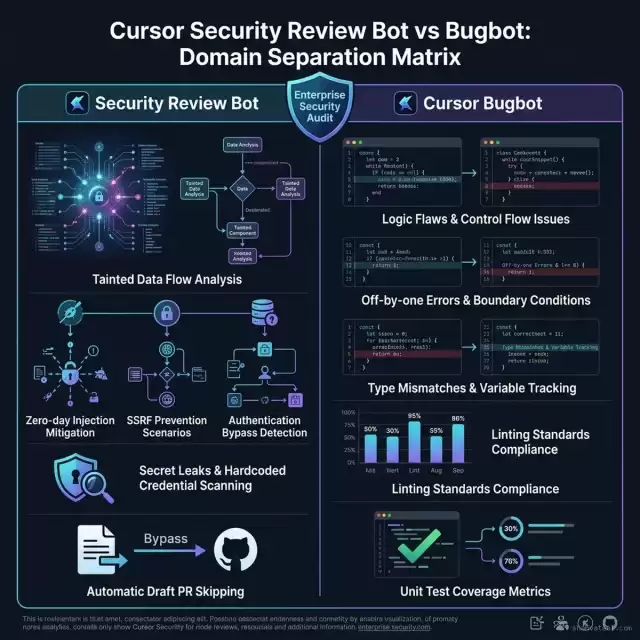
- The new Security Review bot scans solely for exploitable vulnerabilities and automatically skips draft PRs, while general code quality and linting remain under Cursor Bugbot.
- Promotional Trial Allocation:
- Includes launch trial credits of roughly 50 changes on Teams and roughly 500 changes on Enterprise plans, valid for a 10-day promotional window.
Lead Paragraph
SAN FRANCISCO, California — On September 23, 2026, Anysphere announced the rollout of two coordinated autonomous bots for its Cursor development platform: Cursor Rollouts and Cursor Security Review. Available exclusively to organizations on Cursor Teams and Enterprise plans, the release bridges the gap between AI-driven code generation and post-merge production reliability. By attaching automated deploy observability plans to GitHub pull requests and executing targeted exploit analysis prior to release, Cursor aims to prevent AI-generated software regressions from compromising production clusters. Crucially, the company emphasized that both bots operate under strict human-in-the-loop boundaries, declaring that the system does not autonomously merge code or execute unapproved production rollbacks.
What Happened
As developer adoption of asynchronous AI agents has accelerated throughout 2026, engineering organizations have experienced a massive surge in pull request volume. However, existing continuous integration (CI) pipelines—primarily designed for human-paced commit frequencies—frequently fail to detect subtle runtime performance degradations, memory leaks, and latent security vulnerabilities introduced by automated agent coding loops.
To address this challenge, Cursor’s September 2026 update introduces two distinct autonomous agents that operate directly within an organization’s version control and deployment pipelines:
- Plan Availability & Access Gates: Enabled exclusively for Cursor Teams and Cursor Enterprise accounts.
- Cursor Rollouts: When a developer or background agent opens a pull request, Rollouts inspects the changed files and commits a structured monitoring plan directly as a PR comment. Following merge, it hooks into CI/CD pipelines and APM providers to watch deployments per environment (Staging, Canary, and Production).
- The Three-Way Verdict: Upon completing observation, Rollouts assigns one of three explicit verdicts:
1. Healthy: Key telemetry metrics, latency budgets, and error rates remain within baseline tolerances.
2. Regression: Anomalous error spikes or service degradations detected; the bot automatically drafts a revert PR or dispatches a diagnostic context to a Cursor Cloud Agent.
3. Inconclusive: Deployment traffic volume was insufficient to establish statistical confidence within the evaluation window.
- Explicit Human Boundary: Cursor explicitly affirmed that Rollouts does not merge or roll back on its own, ensuring platform engineering leads retain final execution authority.
- Cursor Security Review: A dedicated security scanner running alongside GitHub Actions that identifies exploitable vulnerabilities (such as tainted data injection, SSRF, authorization bypass, and credential leaks). Draft pull requests are automatically skipped to eliminate review noise.
- Trial Credit Grants: To facilitate enterprise evaluation, Cursor is granting promotional trial allowances of roughly 50 changes on Teams tiers and roughly 500 changes on Enterprise tiers across a 10-day testing window.
                      CURSOR AUTONOMOUS PR LIFECYCLE (2026)
+---------------------------------------------------------------------------------+
| Stage 1: PR Creation         | Developer / Agent submits code diff              |
|                              | • Security Reviewer scans for exploitable bugs   |
|                              | • Draft PRs automatically ignored                |
+------------------------------+--------------------------------------------------+
| Stage 2: Pre-Merge Planning  | Rollouts writes environment-aware telemetry plan |
|                              | • Identifies targeted metrics & latency budgets  |
+------------------------------+--------------------------------------------------+
| Stage 3: Deploy Observation  | Observes Canary -> Staging -> Production rollout |
|                              | • Tracks APM errors, exceptions, and latency     |
+------------------------------+--------------------------------------------------+
| Stage 4: Verdict Resolution  | • Healthy: Cleared with zero intervention        |
|                              | • Inconclusive: Flagged for manual traffic check |
|                              | • Regression: Opens Draft Revert PR (No auto-op) |
+---------------------------------------------------------------------------------+
Why It Matters
The introduction of Rollouts and Security Review represents an important evolution in the AI developer tooling sector. Over the past eighteen months, AI coding assistants have focused almost entirely on generation speed—increasing token output rates, supporting larger context windows, and automating boilerplate syntax.
However, enterprise software leaders have recognized that faster code synthesis often creates a downstream bottleneck at the code review and site reliability engineering (SRE) layers. When an engineering team relies on background agents to produce dozens of pull requests daily, human reviewers cannot manually audit every database transaction boundary or trace every potential data sanitization bypass.
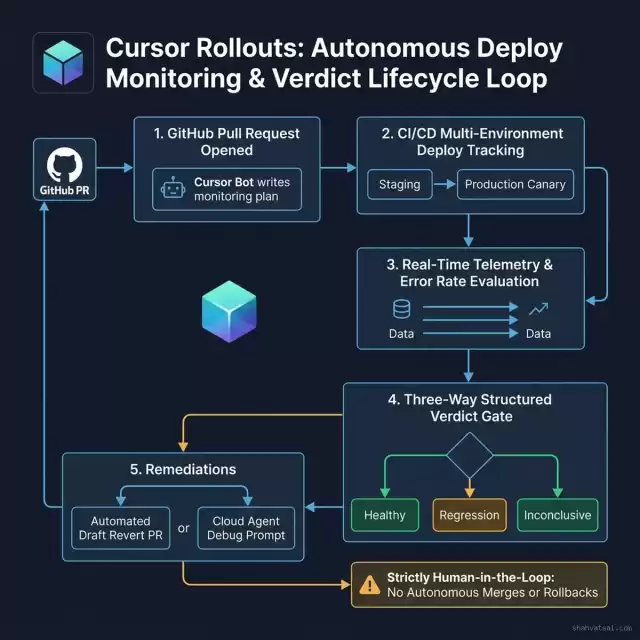
By embedding deployment telemetry directly into the pull request conversation, Cursor Rollouts shifts incident response leftward into the code review workflow. Rather than discovering a memory leak three hours after an on-call engineer signs off, the team receives a structured notification indicating that Canary error rates exceeded historical thresholds within six minutes of container launch.
Simultaneously, the strict policy decision to prevent autonomous merges or unapproved rollbacks reflects growing enterprise caution regarding agentic autonomy. Regulated enterprises subject to SOC 2 Type II, FedRAMP, and ISO 27001 mandates require non-repudiable human authorization before any production system configuration is altered.
Technical Deep Dive: Security Reviewer vs Bugbot Separation
A critical architectural distinction highlighted in Cursor’s release is the division of labor between Cursor Security Review and the existing Cursor Bugbot:
1. Exploitation Vector Analysis vs Code Style
Traditional static analysis tools (linters) frequently overwhelm engineers with thousands of formatting warnings, variable naming preferences, and stylistic discrepancies. Cursor Security Review bypasses stylistic commentary entirely, utilizing semantic taint analysis models to trace untrusted user input from API entry points to database queries or file system sinks.
If a pull request introduces an unvalidated SQL query, an insecure deserialization path, or an overly permissive CORS header, Security Review flags the vulnerability with a reproducible proof-of-concept payload and a suggested code remediation.
2. Suppression on Draft Pull Requests
To preserve developer focus during iterative prototyping, Security Review automatically suppresses notifications on pull requests designated as Draft. The bot only executes its comprehensive audit pass when the author transitions the pull request to "Ready for Review," ensuring that incomplete work-in-progress branches do not trigger premature security alerts.
3. Handoff to Cursor Cloud Agents
When Rollouts flags a Regression verdict on a production deployment, it does not simply drop a generic stack trace. Instead, Rollouts packages the runtime exception telemetry, the exact commit SHA range, and the active monitoring plan into a structured prompt, automatically handing the diagnostic packet to a Cursor Cloud Agent.
The Cloud Agent can independently spin up a container sandbox, reproduce the regression against the failed test cases, and attach a candidate fix branch directly to the pull request conversation.
Enterprise Governance and CI/CD Integration
To integrate Cursor Rollouts into enterprise deployment workflows, teams link their monitoring providers (such as Datadog, Prometheus, or AWS CloudWatch) through the Cursor Enterprise Admin Dashboard. The following configuration example illustrates how a team defines custom rollout health thresholds within a project-level .cursor/rollouts.json specification:
{
  "version": "1.0",
  "environments": {
    "staging": {
      "observationWindowMinutes": 15,
      "metrics": {
        "http_5xx_rate": {
          "thresholdMaxPercent": 0.05,
          "comparison": "baseline_ratio"
        },
        "p99_latency_ms": {
          "thresholdMax": 250,
          "alertOnRegression": true
        }
      }
    },
    "production": {
      "observationWindowMinutes": 45,
      "canaryStages": ["10%", "50%", "100%"],
      "metrics": {
        "unhandled_exceptions_total": {
          "thresholdMax": 0
        },
        "database_connection_pool_saturation": {
          "thresholdMaxPercent": 80.0
        }
      },
      "actionsOnRegression": {
        "generateDraftRevertPR": true,
        "notifySlackChannel": "#eng-incidents",
        "dispatchCloudAgent": true,
        "autoRollbackEnabled": false
      }
    }
  }
}
Notice that even when generateDraftRevertPR is set to true, the autoRollbackEnabled flag remains locked to false, adhering strictly to Cursor's safety protocol requiring a human SRE or tech lead to click the merge button on the generated revert branch.
Strategic Market Context: The Shift to Closed-Loop DevOps
Cursor's announcement arrives amidst an escalating battle for developer mindshare across AI coding environments. With GitHub Copilot, Anthropic Claude Code, and autonomous agents like Devin and Windsurf expanding their feature footprints, the developer IDE is transitioning from a passive text editor into an active operational control plane.
By incorporating deploy monitoring into the IDE's cloud tier, Cursor is moving to capture territory traditionally held by standalone observability and continuous delivery platforms. If an engineering organization can plan, author, test, review, deploy, and monitor code within a unified Cursor workspace, the dependency on third-party code review automation tools diminishes significantly.
What to Watch Next
As engineering teams deploy Rollouts and Security Review into production pipelines over the coming weeks, watch for three decisive technical and business developments:
- APM Integration Breadth: Track whether Cursor expands native integration support beyond primary cloud providers to include OpenTelemetry semantic convention streams.
- Post-Trial Pricing Tiers: Monitor how Cursor prices Rollouts and Security Review following the expiration of the 10-day promotional credits (roughly 50/500 changes).
- False-Positive Ratios in Security Review: Evaluate whether the dedicated exploit scanner maintains a sufficiently high precision rate to avoid alert fatigue among enterprise application security teams.
Source
Primary source announcement: Cursor Changelog — Rollouts and Security Reviewer (Published September 23, 2026).
