HCLSoftware Moves to Acquire Robotiq.ai: Bridging Agentic Decisioning to Legacy RPA Execution
By Vatsal Shah | September 28, 2026 | 7 min read | Source: PR Newswire / HCLSoftware
AI SUMMARY
- Intent to Acquire Announced:
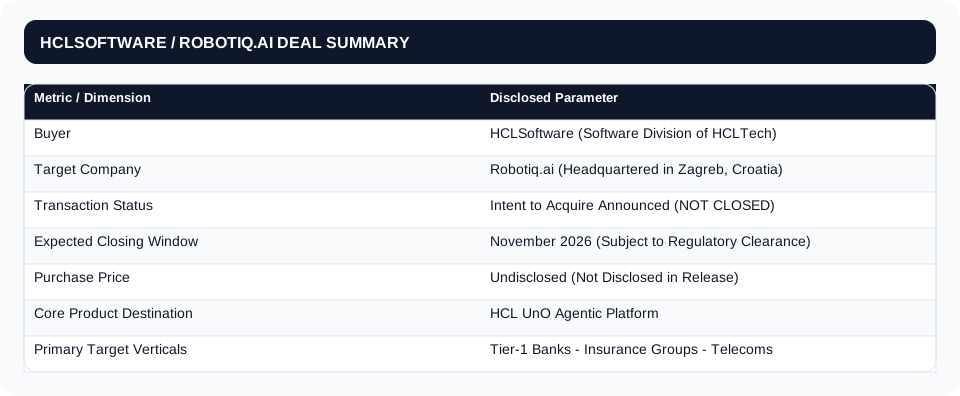
- HCLSoftware, the enterprise software division of global technology conglomerate HCLTech, announced its intent to acquire Robotiq.ai, an established robotic process automation (RPA) provider based in Zagreb, Croatia.
- November 2026 Closing Target:
- The announcement represents a definitive intent rather than a completed merger; formal completion is anticipated in November 2026 subject to standard closing conditions. Financial valuation and acquisition pricing were not disclosed.
- The "Missing API" Bottleneck:
- The transaction directly targets the critical execution bottleneck in enterprise agent adoption: autonomous AI agents cannot execute transactions in mission-critical legacy applications that lack REST/GraphQL APIs or provide incomplete endpoints.
- Unifying Brains and Hands:
- Robotiq.ai will be folded into HCL UnO Agentic, providing the deterministic robotic execution layer necessary to translate autonomous LLM reasoning into physical keystrokes, terminal commands, and Citrix UI actions.
- Regulated Enterprise Focus:
- Specifically targeted at large commercial banks, global insurance providers, and telecommunications operators burdened by legacy AS/400 mainframes and complex policy clearing ledgers.
- Strict Compliance Envelope:
- Robotiq.ai brings ISO-certified security frameworks, tamper-evident audit logging, and flexible hybrid deployment options (air-gapped on-premises or managed cloud).
Lead Paragraph
NOIDA, India & ZAGREB, Croatia — On September 28, 2026, HCLSoftware, the software business unit of HCLTech, announced its intent to acquire Robotiq.ai, an enterprise robotic process automation (RPA) platform headquartered in Zagreb, Croatia. The transaction, slated for completion in November 2026, represents a calculated strategic move to bridge the growing disconnect between generative AI agentic decisioning and the fragmented reality of legacy enterprise IT. While modern autonomous agents possess extraordinary reasoning capabilities, large enterprises in banking, insurance, and telecommunications remain handcuffed by core transaction engines that completely lack Application Programming Interfaces (APIs). By integrating Robotiq.ai’s surface automation and computer-vision robotics natively into HCL UnO Agentic, HCLSoftware aims to deliver a complete "orchestration-to-execution" platform capable of executing agent workflows across modern cloud microservices and decades-old green-screen mainframes alike.
What Happened
The past eighteen months of enterprise AI adoption have revealed an uncomfortable truth: while foundation models have mastered human-like reasoning, enterprise adoption has stalled at the "execution boundary."
In theory, an autonomous agent can ingest a customer loan default notice, cross-reference credit risk scores, simulate restructuring scenarios, and decide to issue an amended repayment schedule. In practice, however, actually recording that decision often requires logging into an IBM AS/400 terminal emulator, navigating eight sequential text menus, and keying data into a 30-year-old COBOL ledger—an interface entirely inaccessible to standard API-driven AI agents.
Recognizing that complete core modernization across Fortune 500 enterprises will take another decade and trillions of dollars, HCLSoftware’s planned acquisition of Robotiq.ai provides a pragmatic shortcut. Rather than waiting for legacy backends to expose REST APIs, Robotiq.ai equips HCL’s agentic layer with robotic "hands" capable of manipulating any user interface with deterministic precision.
Financial details of the transaction were not disclosed in the September 28 press announcement. The deal is slated to close in November 2026, subject to customary regulatory approvals and closing covenants.
The Strategic Problem: The Enterprise Agentic Execution Gap
The prevailing narrative in Silicon Valley suggests that robotic process automation (RPA) is a legacy technology rendered obsolete by large language models. HCLSoftware’s acquisition takes the opposing view: RPA is the indispensable mechanical layer that agentic AI requires to become operationally viable.
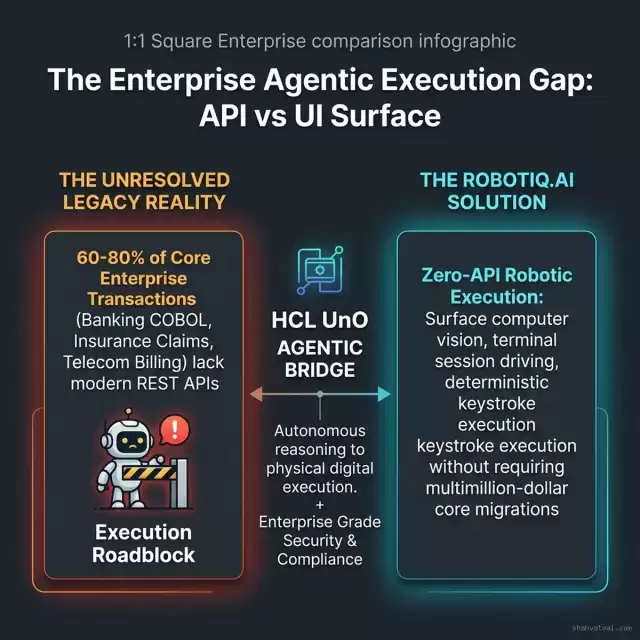
As illustrated in the comparative analysis above, enterprise automation faces a stark divide:
The Illusion of Universal APIs
While modern SaaS environments (Salesforce, ServiceNow, Workday) offer robust, well-documented RESTful endpoints, industry studies show that between 60% and 80% of core transaction volume across global banking, insurance, and telecommunications continues to execute on legacy infrastructure:
- Core Banking: Decades-old mainframe deposits, loan accounting, and SWIFT message clearing.
- Insurance: Legacy policy administration systems running in virtualized Citrix environments.
- Telecom: Complex Billing and Operational Support Systems (BSS/OSS) with closed, proprietary interfaces.
When an autonomous AI agent encounters an application without an API, it reaches a catastrophic roadblock. It cannot execute its plan, forcing organizations to route work back into human ticketing queues—destroying the productivity gains promised by agentic transformation.
The Robotiq.ai Bridge
Robotiq.ai resolves this roadblock by providing:
- Computer Vision Screen Recognition: Identifying UI controls, input boxes, and dropdown menus regardless of resolution changes, Citrix compression artifacts, or dynamic frame positioning.
- Terminal and Mainframe Emulation Drivers: Interacting directly with IBM 3270/5250 emulators and Unix terminal sessions with millisecond keystroke precision.
- Deterministic State Machine Execution: Ensuring that if a screen fails to load or an unexpected modal dialog appears, the robot does not hallucinate an action, but safely halts, snapshots the session state, and alerts supervisory governance monitors.
The Orchestration-to-Execution Architecture
The technical integration between HCL UnO Agentic and Robotiq.ai establishes a unified dual-tier automation stack.
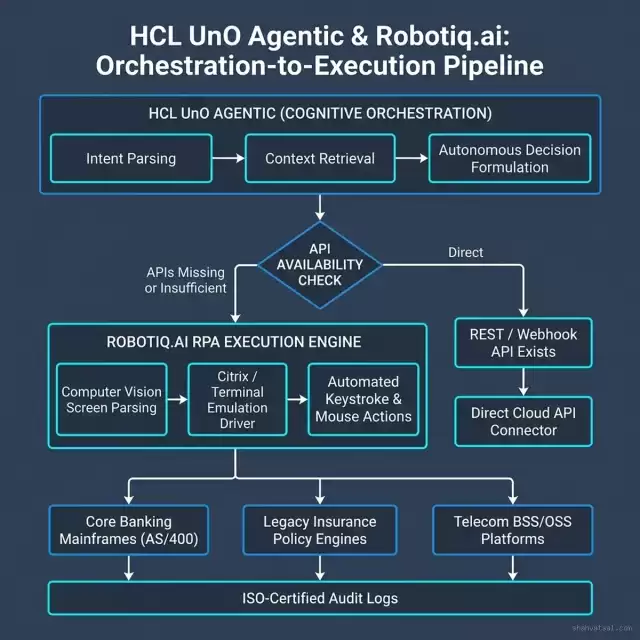
As detailed in the architecture above, end-to-end task execution proceeds through four distinct operational phases:
Phase 1: Cognitive Orchestration (HCL UnO Agentic)
Incoming business requests—such as a complex commercial insurance claim or a cross-border corporate account opening—are received by HCL UnO Agentic. The system leverages generative AI to:
- Parse unstructured customer emails, PDF policy documents, and regulatory filings.
- Retrieve contextual customer history from enterprise knowledge bases.
- Formulate an optimized multi-step resolution plan and determine the required backend system updates.
Phase 2: Dynamic Execution Routing
Once the plan is generated, the platform evaluates the target systems:
- If the target system exposes a modern cloud API, UnO routes the request through direct REST/Webhook connectors.
- If the target system lacks an API or requires interaction with a locked virtual desktop, UnO dispatches the payload to the Robotiq.ai Execution Engine.
Phase 3: Robotic Surface Execution
Robotiq.ai spins up an ephemeral, secure execution runtime. It launches the legacy application, authenticates using encrypted credential vaults, navigates to the appropriate account screen, populates fields with deterministic keystrokes, and executes the transaction commit.
Phase 4: Immutable Audit & Telemetry
Every action executed by the robot is recorded in an immutable audit ledger:
- Step-by-step video capture of UI interactions.
- Input data hashes validating that no unapproved fields were modified.
- ISO-certified compliance metadata matching SOX, GDPR, and PCI-DSS requirements.
Target Industry Verticals: BFSI and Telecom
HCLSoftware's official announcement explicitly identifies three core market sectors as the primary beneficiaries of the acquisition:

In all three sectors, the financial cost of refactoring legacy core software into modern cloud microservices often exceeds hundreds of millions of dollars. The combined HCL UnO Agentic and Robotiq.ai offering allows IT leaders to achieve immediate agentic automation velocity without undertaking high-risk architectural re-platforming.
Market Positioning and Deduplication
To provide clear industry perspective, HCLSoftware’s move must be differentiated from other recent enterprise automation milestones:
- Vs. ServiceNow Otto & Control Tower (#N103): ServiceNow focuses on IT service management (ITSM) workflows, cloud employee tickets, and service desk automation. In contrast, HCLSoftware is addressing deep transactional core system execution in legacy BFSI environments.
- Vs. UiPath Cartographer (#N138): UiPath Cartographer builds dynamic process discovery maps ("Map of Work") to document how human employees execute workflows before automation is designed. HCL’s acquisition of Robotiq.ai is an execution engine acquisition rather than a process mining and mapping release.
- Vs. Salesforce Agentforce / AIforce (#N136): Salesforce operates predominantly in front-office customer engagement and CRM pipelines. HCLSoftware’s focus with Robotiq.ai is on back-office, mission-critical operational systems where Salesforce APIs cannot reach.

Strategic Takeaways for Enterprise CIOs
For IT leaders grappling with the paradox of advanced AI models stalled by legacy technical debt, HCLSoftware’s acquisition of Robotiq.ai offers three clear strategic takeaways:
- Stop Waiting for Universal APIs: Modernizing legacy mainframes and core policy engines to support clean REST APIs is an admirable long-term goal, but competitive pressures demand immediate automation. Using robotic surface execution as a bridge allows organizations to capture AI value today.
- Require Immutable Execution Audit Trails: As autonomous agents begin manipulating UI surfaces directly, the potential for error cascades increases. Enterprise architectures must mandate granular, tamper-evident audit logging for every robotic click and keystroke.
- Decouple Reasoning from Action: The most robust enterprise architectures separate the probabilistic cognitive layer (LLMs generating plans) from the deterministic execution layer (RPA scripts carrying out verified steps under strict authorization gates).
With the transaction scheduled to close in November 2026, HCLSoftware is establishing a formidable bridgehead in the enterprise automation landscape: proving that in the real world of global enterprise IT, autonomous agents cannot thrive without robotic hands.
Frequently Asked Questions
What did HCLSoftware announce regarding Robotiq.ai?
On September 28, 2026, HCLSoftware, the software division of HCLTech, announced its intent to acquire Zagreb, Croatia-based Robotiq.ai. The transaction is structured as an acquisition agreement with closing expected in November 2026, subject to customary regulatory approvals. The financial terms were not disclosed.
Why is HCLSoftware acquiring an RPA platform in the era of autonomous AI agents?
While autonomous LLM agents excel at high-level reasoning and decision-making, they encounter hard roadblocks in legacy enterprise applications that lack modern REST or GraphQL APIs. Robotiq.ai provides an intelligent robotic process automation (RPA) execution engine that acts as the physical 'hands' for AI agents, interacting with legacy terminal screens, Citrix virtual desktops, and green-screen mainframes without requiring multimillion-dollar core system re-writes.
Which product in HCLSoftware's portfolio will integrate Robotiq.ai?
Robotiq.ai will be integrated directly into HCL UnO Agentic, HCLSoftware's enterprise agentic orchestration platform, expanding its capabilities from high-level cognitive decision formulation to deterministic end-to-end task execution across legacy and cloud environments.
Which industry verticals are primarily targeted by this acquisition?
The release specifically identifies large tier-1 banks, insurance conglomerates, and telecommunications network providers, where mission-critical transaction systems remain heavily reliant on legacy, API-deprived architectures.
Has the acquisition of Robotiq.ai closed?
No. The announcement represents an intent and definitive agreement to acquire. Closing is expected in November 2026 following standard regulatory clearances.
