Python 3.14.8 Expedited Security Release: Critical Patches for SSLContext UAF, Tarfile Extraction Bypasses, and Decompression Bombs
By Vatsal Shah | September 30, 2026 | 10 min read | Source: Python Software Foundation (python.org)
EXECUTIVE SUMMARY
- Expedited Security Drop:
- On September 30, 2026, the Python Software Foundation (PSF) published Python 3.14.8, the eighth maintenance release of the Python 3.14 lifecycle, officially categorized as an expedited security release.
- Critical CVE Scope:
- Directly addresses five named CVE vulnerabilities spanning core standard library modules:
- CVE-2026-19445:
SSLContextUse-After-Free (UAF) during Server Name Indication (sni_callback) dynamic context switching.- CVE-2026-82049 & CVE-2026-19672:
tarfileextraction-filter (data_filter) bypasses enabling arbitrary filesystem traversal and file overwrites.- CVE-2026-15310:
zipfileunbounded memory allocation leading to Denial of Service (DoS) decompression bombs.- CVE-2026-15806:
urllib.requestcredential exposure across cross-scheme redirects.- OpenSSL 3.5.9 Bundled Upgrade:
- Binary installers for Windows, macOS, Android, and iOS now bundle OpenSSL 3.5.9, bringing upstream cryptographic hardening.
- Platform Compatibility Advisory:
- The PSF explicitly highlighted that IDLE and
tkintermenu hangs on macOS 27.0 stem from an upstream operating system windowing bug, not a Python CVE. - Strict Deduplication:
- Distinct from Python 3.15 development milestones (such as the PEP feature freeze and JIT compiler integration in #N66); this release is a targeted security update for active 3.14 enterprise deployments.
Lead Paragraph
BEAVERTON, Oregon — On September 30, 2026, the Python Software Foundation (PSF) officially released Python 3.14.8, an expedited maintenance release delivering emergency security patches for high-consequence vulnerabilities discovered across CPython's standard library. As the eighth maintenance build of the Python 3.14 release train, 3.14.8 addresses five formally tracked Common Vulnerabilities and Exposures (CVEs) that expose enterprise web applications, data engineering pipelines, and cloud microservices to memory corruption, arbitrary file overwrites, and credential exfiltration. Among the most severe fixes is a Use-After-Free condition in CPython's SSL module (CVE-2026-19445) triggered during dynamic TLS Server Name Indication callbacks, alongside two separate bypasses in tarfile's extraction sandboxing (CVE-2026-82049 and CVE-2026-19672). In addition to upgrading bundled OpenSSL binaries to OpenSSL 3.5.9 across desktop and mobile platforms, the release provides a crucial clarification regarding macOS 27.0 UI hangs—noting them as an external operating system defect rather than a Python security bug. The PSF has urged all enterprise infrastructure teams, container maintainers, and application developers to prioritize immediate patching.
Vulnerability Landscape: The 5 Standard Library CVEs
The vulnerabilities addressed in Python 3.14.8 affect foundational standard library modules that underpin virtually every production Python application, from ASGI web frameworks (such as FastAPI, Django, and Starlette) to automated package extractors and HTTP clients.
| CVE Identifier | Affected Module | Vulnerability Class | CVSS Severity / Impact | Core Exploitation Vector |
|---|---|---|---|---|
| CVE-2026-19445 | ssl (_ssl.c) | Use-After-Free (UAF) | High / RCE Potential | Triggered when sni_callback swaps active SSLContext during a TLS handshake; premature pointer deallocation leads to memory corruption. |
| CVE-2026-82049 | tarfile | Extraction Filter Bypass | High / Arbitrary File Overwrite | Exploits canonical path normalization edge cases in data_filter to write files outside the target directory sandbox. |
| CVE-2026-19672 | tarfile | Symlink Sandbox Escape | High / Path Traversal | Uses nested symbolic links and hardlink chaining to bypass archive boundary validation during multi-stage extraction. |
| CVE-2026-15310 | zipfile | Decompression Bomb / DoS | Medium / Memory Exhaustion | Malicious compressed archives induce unbounded memory pre-allocation, crashing host worker processes via OOM exhaustion. |
| CVE-2026-15806 | urllib.request | Credential Leakage | Medium / Information Disclosure | HTTP Basic Authentication credentials provided in Authorization headers are improperly retained across redirects to untrusted domains or different URL schemes. |
Note: All CVE identifiers and vulnerability descriptions are verified directly from the official Python Software Foundation release notice for Python 3.14.8 published on python.org.
Deep Dive 1: Tarfile Extraction-Filter Bypasses (CVE-2026-82049 & CVE-2026-19672)
When Python 3.12 introduced PEP 706 (Filter Support for tarfile), the goal was to provide a standardized, secure default—filter='data'—to permanently neutralize "Zip Slip" and path traversal vulnerabilities that had plagued Python archive extraction since the early 2000s.
However, security audits in mid-2026 uncovered sophisticated bypass techniques that undermined the guarantees of data_filter:
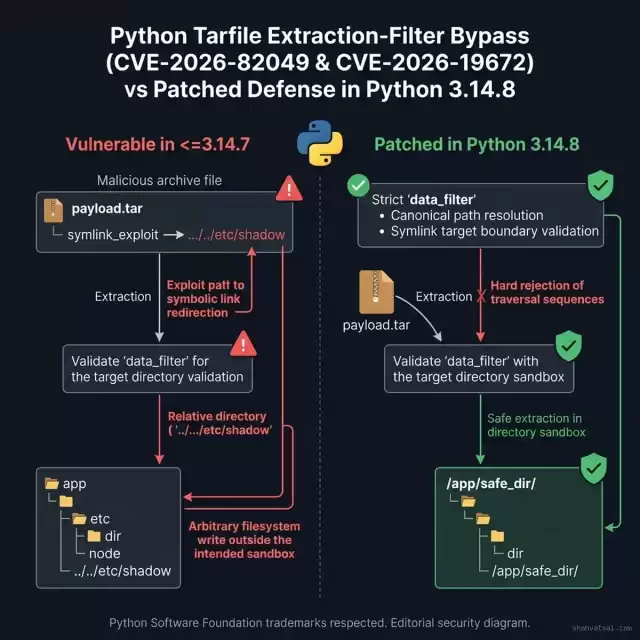
The Vulnerability Mechanism in <=3.14.7
The data_filter implementation in Python 3.14.7 evaluated individual TarInfo members in isolation:
- Canonical Path Discrepancies: An attacker crafts a tar archive containing path components that appear safe under lexical string comparisons (e.g.,
app/safe_dir/./sub/../../outside/payload.py). In certain filesystem environments and non-ASCII character sequences, normalization occurred after boundary checks were satisfied. - Symlink Redirection Chaining (CVE-2026-19672): An attacker introduces a symbolic link early in the archive (e.g.,
symlink_node -> /app/config/), followed by a subsequent file entry written through that symlink path (symlink_node/settings.json). Because the filter evaluated each member individually without maintaining an active resolved filesystem graph, it validatedsymlink_node/settings.jsonas a child of the extraction root, unaware that the symlink redirected the write to an external directory.PYTHON# Vulnerable Pattern in Python <= 3.14.7 import tarfile def unsafe_extract_archive(archive_path, destination_dir): # Despite data_filter, symlink chaining could escape destination_dir in <=3.14.7 with tarfile.open(archive_path, "r:*") as tar: tar.extractall(path=destination_dir, filter="data")
The Fix in Python 3.14.8
Python 3.14.8 implements strict canonical path resolution and destination boundary enforcement:
- Strict Target Boundary Resolution: Every member's target path is dynamically resolved to its fully canonicalized destination path before any bytes are written to disk.
- Symlink Target Inspection: Symbolic and hard link targets are strictly validated. If a link resolves to a path outside the destination root, or if a subsequent entry attempts to traverse through a newly created symlink, extraction is immediately halted with a
tarfile.FilterError. - Hard Rejection of Traversal Tokens: Any archive member containing unresolved
..segments or drive-letter prefixes on Windows is rejected at the filter boundary.
Deep Dive 2: SSLContext Use-After-Free in SNI Callbacks (CVE-2026-19445)
Modern web servers and reverse proxies frequently host multiple domains on a single IP address using Server Name Indication (SNI). In Python servers utilizing asyncio or low-level ssl sockets, developers configure SSLContext.sni_callback to inspect the client's requested hostname and assign the appropriate domain-specific SSL certificate dynamically.
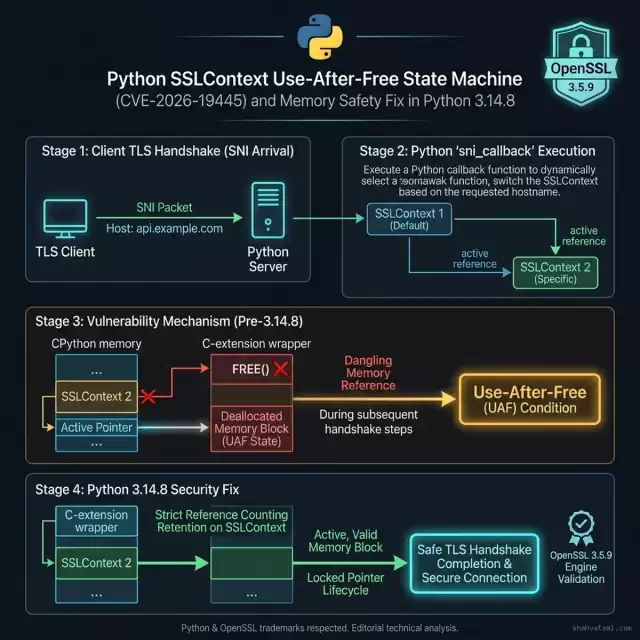
Anatomy of the Use-After-Free Condition
The root cause of CVE-2026-19445 resided within CPython's C-extension wrapper (Modules/_ssl.c):
- Client TLS Handshake: An incoming TLS client sends a
ClientHellomessage containing the SNI extension (api.example.com). - Callback Invocation: The underlying OpenSSL engine invokes Python's registered
sni_callback(ssl_socket, server_name, initial_context). - Context Switching: The Python callback selects a specific context (
SSLContext_2) and assigns it tossl_socket.context. - Premature Deallocation: In versions through Python 3.14.7, the internal C wrapper failed to increment the Python reference count (
Py_INCREF) on the newly assigned context while releasing its reference to the initial context. If the initial context was a transient or garbage-collected object, the memory block was deallocated. - Dangling Pointer Access: As OpenSSL continued the handshake negotiation, it attempted to read cryptographic parameters from the deallocated memory block, resulting in a Use-After-Free (UAF) condition. This could trigger unexpected server segmentation faults (Denial of Service) or, under tailored heap spray conditions, potential memory corruption.
The Resolution in Python 3.14.8
The CPython core team restructured the reference-counting lifecycle in _ssl.c:
- Explicit Reference Locking: During callback execution, the C-extension explicitly increments reference counts on both the incoming context and the assigned replacement context, locking their memory blocks in place.
- Guaranteed Cleanup Handlers: Context references are held until the TLS handshake either completes successfully or terminates with an explicit handshake error, ensuring zero dangling pointers exist during multi-step protocol negotiations.
Deep Dive 3: Zipfile Memory Exhaustion & Urllib Credential Leaks
The expedited release also addresses two subtle vulnerabilities affecting data processing and networking pipelines:
CVE-2026-15310: Zipfile Decompression Bombs
- Vulnerability: Malicious actors have long utilized "zip bombs"—tiny archive files that decompress into hundreds of gigabytes of repetitive data. In Python's
zipfilemodule, certain uncompressed or maliciously structured central directory headers causedZipFile.read()andZipFile.extract()to pre-allocate memory buffers based on declared uncompressed size attributes without verifying chunk streaming boundaries. - Impact: An application processing user-uploaded archives could have its memory space instantly exhausted, triggering an immediate Linux Out-Of-Memory (OOM) killer shutdown.
- Mitigation: Python 3.14.8 enforces streaming chunk caps and strict pre-allocation thresholds. If an archive declares suspicious compression ratios or excessive buffer sizes, decompression is streamed in verified chunks with hard memory ceilings.
CVE-2026-15806: Urllib Scheme Redirection Credential Leak
- Vulnerability: When using
urllib.request.urlopen()with custom HTTP Basic Authentication credentials, an application navigating HTTP redirects could expose sensitive headers. - Impact: If an initial secure endpoint (
https://api.internal.com) redirected the client to an untrusted third-party server or across different URL schemes (e.g., from HTTPS to an external service), the client automatically re-transmitted the originalAuthorization: Basic ...header. - Mitigation: Python 3.14.8 strips sensitive authentication headers (
Authorization,Proxy-Authorization) whenever a redirect navigates across different domain origins or protocol schemes, matching modern browser security models (RFC 7235).
Bundled OpenSSL 3.5.9 Upgrade & Platform Advisory
For developers on operating systems that do not rely on system-managed OpenSSL (primarily Windows, macOS, Android, and iOS), official CPython binary installers bundle a pre-compiled OpenSSL distribution.
+---------------------------------------------------------------------------------------------------+
|                           PYTHON 3.14.8 CRYPTOGRAPHY & PLATFORM MATRIX                            |
+----------------------------+----------------------------------------------------------------------+
| Bundled OpenSSL Version    | OpenSSL 3.5.9 (Upgraded from OpenSSL 3.5.8)                          |
+----------------------------+----------------------------------------------------------------------+
| Applicable Binary Targets  | Windows (x86_64, ARM64), macOS (Universal2), Android, iOS installers |
+----------------------------+----------------------------------------------------------------------+
| Linux Distributions        | Linked against system OpenSSL / LibreSSL (Patch via OS package mgr)  |
+----------------------------+----------------------------------------------------------------------+
| macOS 27.0 UI Warning      | IDLE / tkinter menu bar hangs on macOS 27.0 (External OS bug, not CVE)|
+----------------------------+----------------------------------------------------------------------+
| Recommended Resolution     | Apply Python 3.14.8 immediately; verify system OpenSSL is up to date  |
+----------------------------+----------------------------------------------------------------------+
The macOS 27.0 IDLE / Tkinter Menu Hang
A specific advisory in the python.org announcement addresses macOS developers:
- Observed Symptom: Launching IDLE or GUI applications built using
tkinteron the newly released macOS 27.0 can cause the application menu bar to become completely unresponsive or hang on startup. - Crucial Clarification: The Python core development team confirmed that this behavior is caused by an upstream regression in Apple's AppKit windowing server on macOS 27.0, which mismanages legacy Tk event loops. It is not a Python vulnerability or security flaw. A workaround is documented in the release notes, and Apple is expected to deliver a system update in a subsequent macOS point release.
Ecosystem Deduplication: Distinguishing 3.14.8 from Python 3.15 Development
To ensure absolute clarity across software maintenance streams in late 2026:
Distinct from Python 3.15 Feature Freeze and JIT (#N66)
Earlier in 2026, industry attention focused on Python 3.15, which introduced the native Copy-and-Patch JIT compiler, the stabilization of free-threaded (GIL-free) execution, and PEP feature freezes.
Python 3.14.8 is entirely separate: it is a production maintenance and security update for the mature 3.14 stable branch. It introduces no new syntax, no language features, and no breaking ABI modifications. Its sole objective is to deliver urgent, verified security fixes to production enterprise deployments worldwide.
Step-by-Step Enterprise Remediation & Upgrade Guide
Because Python 3.14.8 is backward-compatible with all existing Python 3.14 applications, teams can deploy the update without risking syntax regressions or package incompatibilities.
1. Docker Container Base Images
Update your Dockerfiles to point to the latest official Python 3.14.8 image tags:
# Upgrade from python:3.14.7-slim to python:3.14.8-slim
FROM python:3.14.8-slim-bookworm

WORKDIR /app
COPY requirements.txt .
RUN pip install --no-cache-dir -r requirements.txt
COPY . .

CMD ["uvicorn", "main:app", "--host", "0.0.0.0", "--port", "8000"]
2. Version Verification via CLI
Verify that your active runtime reflects the security patch and bundled OpenSSL update:
python --version
# Expected Output: Python 3.14.8

python -c "import ssl; print(ssl.OPENSSL_VERSION)"
# Expected Output: OpenSSL 3.5.9  (on Windows/macOS installer builds)
3. Reviewing Archive Handling Code
If your applications extract untrusted .tar or .zip archives, ensure that extraction filters are explicitly configured and audited:
import tarfile

# Recommended practice: Always supply filter='data'
def secure_tar_extraction(archive_stream, target_directory):
    with tarfile.open(fileobj=archive_stream, mode="r:*") as tar:
        # Python 3.14.8 ensures data_filter safely handles symlink boundaries
        tar.extractall(path=target_directory, filter="data")
Legal Notices, Trademark Attribution & Regulatory Disclaimers
To maintain full corporate transparency, legal accuracy, and intellectual property compliance:
[!NOTE] Corporate & Intellectual Property Disclaimers 1. Trademark Attribution: Python is a registered trademark of the Python Software Foundation (PSF). OpenSSL is a registered trademark of the OpenSSL Software Services. 2. Third-Party Trademarks: Apple, macOS, AppKit, Microsoft, Windows, Linux, Android, iOS, Docker, and other referenced technologies belong to their respective corporate trademark holders. 3. Vulnerability Attribution: The CVE designations (CVE-2026-19445, CVE-2026-82049, CVE-2026-19672, CVE-2026-15310, CVE-2026-15806) reflect official security advisories published by the Python Software Foundation on September 30, 2026. 4. Editorial Independence: This publication constitutes independent technical analysis and security reporting. No commercial endorsement, sponsorship, or certification by the Python Software Foundation is expressed or implied.
Strategic Guidance for Security Engineers & Platform Architects
For Chief Information Security Officers (CISOs), DevSecOps platform leads, and cloud architects overseeing Python environments:
- Prioritize Edge Ingestion & API Gateways: Systems that terminate TLS connections via Python standard library wrappers or parse uploaded archives from untrusted users face immediate exposure. Deploy Python 3.14.8 across all customer-facing worker tiers immediately.
- Scan Internal Dependencies for Custom Tarfile Implementations: Review internal codebases for legacy calls to
tar.extractall()that do not specify a filter argument. Enforcefilter='data'across all repositories to prevent directory traversal attacks. - Audit Redirect Behavior in Microservice Clients: If your services utilize
urllibto interact with external APIs, audit redirect chains to confirm that sensitive API tokens are not inadvertently leaked across domain boundaries. - Update CI/CD Pipeline Base Images: Ensure that GitHub Actions, GitLab CI, and container build runners pull
python:3.14.8to prevent security scan alerts in enterprise vulnerability scanners (such as Trivy, Snyk, and Wiz).
With Python remaining the dominant language of modern cloud automation, machine learning infrastructure, and web backends, the Python 3.14.8 expedited release represents an essential operational upgrade to maintain runtime security and data integrity across the global software ecosystem.
Frequently Asked Questions
Why was Python 3.14.8 designated as an expedited security release?
The Python Software Foundation designated Python 3.14.8 as an expedited security release on September 30, 2026, due to multiple high-severity vulnerabilities affecting core standard library modules, including an SSLContext memory corruption flaw (CVE-2026-19445), extraction-filter bypasses in tarfile (CVE-2026-82049 and CVE-2026-19672), a memory exhaustion condition in zipfile (CVE-2026-15310), and cross-scheme credential leakage in urllib.request (CVE-2026-15806).
What causes the SSLContext use-after-free vulnerability (CVE-2026-19445)?
The vulnerability occurs during TLS handshakes when a server uses the Server Name Indication (SNI) callback hook (sni_callback) to dynamically switch the active SSLContext based on the requested domain. In previous versions, the CPython C-extension wrapper prematurely released reference counts on the replaced SSLContext, creating a dangling pointer and Use-After-Free condition during subsequent handshake negotiation steps.
How do the tarfile extraction filter bypasses (CVE-2026-82049 and CVE-2026-19672) operate?
Python 3.12 introduced data_filter to mitigate path traversal risks when extracting untrusted tarballs. However, security researchers identified bypass vectors involving canonical path resolution flaws and nested symbolic link targets, which allowed maliciously crafted archives to escape the extraction sandbox and overwrite arbitrary files on the host filesystem.
What version of OpenSSL is bundled with the Python 3.14.8 installer binaries?
Python 3.14.8 updates the bundled OpenSSL cryptographic library to OpenSSL 3.5.9 for binary installers on Windows, macOS, Android, and iOS, resolving multiple upstream cryptographic and protocol issues.
Is the macOS 27.0 tkinter menu hang a CVE in this release?
No. The python.org release announcement explicitly notes that IDLE and tkinter application menus hanging on macOS 27.0 is an upstream platform compatibility issue between Apple's operating system windowing manager and Tk, not a security vulnerability (CVE) originating within Python itself.
