AI SUMMARY
- Headline
- SAP Completes Dremio Acquisition: Lakehouse Fuel for Agentic Analytics
- Global impact
- Enterprise software giant SAP has officially finalized its acquisition of Dremio, the open-source data lakehouse pioneer, on July 6, 2026.
- India lens
- Assess DPDP, RBI, and GCC delivery exposure — India-scale teams often feel vendor shifts 2–4 weeks before US HQ.
- My take
- I would brief the architecture board this week with one owner, one metric, and one rollback plan.
STRATEGIC OVERVIEW
Enterprise software giant SAP has officially finalized its acquisition of Dremio, the open-source data lakehouse pioneer, on July 6, 2026.
Enterprise software giant SAP has officially finalized its acquisition of Dremio, the open-source data lakehouse pioneer, on July 6, 2026. Originally announced in early May, the transaction brings Dremio’s high-performance, Apache Iceberg-native SQL query engine and semantic data virtualization into the core architecture of the SAP Business Data Cloud. The consolidation enables enterprise customers to unify SAP transactional systems with non-SAP operational data stores without moving, copying, or translating the underlying files, establishing the data foundation required for agentic AI analytics.
The Challenge: The SAP Data Silo Problem
For decades, SAP has served as the operational system of record for the world's largest enterprises, housing critical resource planning, supply chain, financial, and customer data. However, extracting value from SAP databases (such as S/4HANA) has historically been slow and expensive.
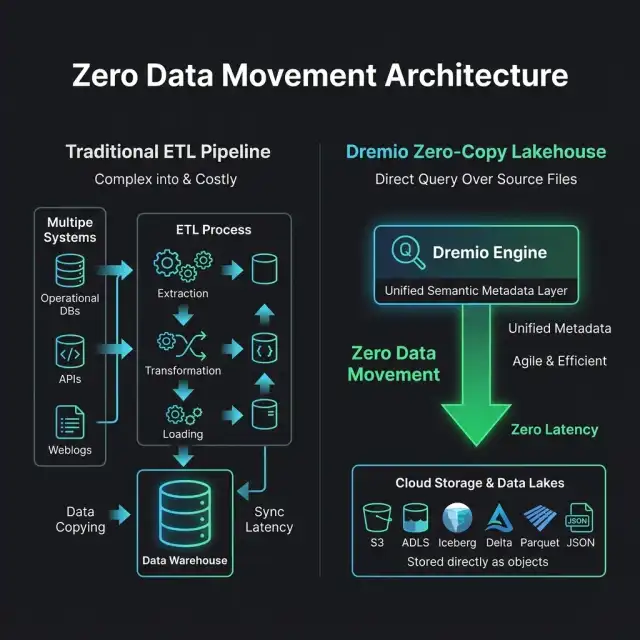
Traditional analytical pipelines required copying SAP tables into external data warehouses (such as Snowflake or Databricks) using complex extract, transform, load (ETL) routines. This architecture introduced three primary pain points:
- High Synchronization Latency: Transactional data was often hours or days out of sync by the time it reached the warehouse, preventing real-time forecasting.
- Storage and Compute Duplication: Copying terabytes of operational records to external warehouses doubled cloud storage bills and introduced high egress charges.
- Loss of Contextual Semantics: When SAP tables were exported, they lost the nested relationships, custom dimensions, and security roles defined in the SAP application layer, forcing developers to rebuild schemas from scratch.
This silo problem has become a major roadblock in the era of autonomous AI agents. If a company wants an AI agent to query live ERP data to run supply chain analysis, the agent must be able to access real-time transactional structures and non-SAP shipping logs simultaneously, without waiting for batch sync cycles.
The Solution: Dremio's Zero-Copy Semantic Lakehouse
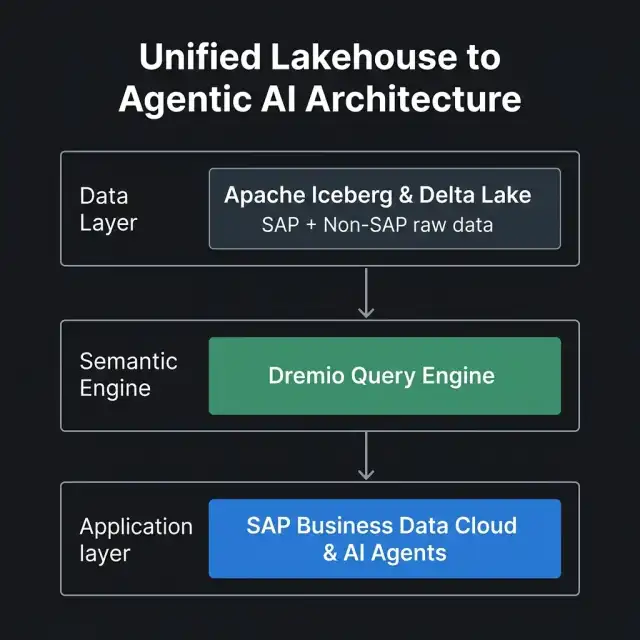
Integrating Dremio directly into the SAP Business Data Cloud solves the data movement bottleneck. Dremio operates as an open semantic lakehouse engine that queries data files directly where they live in object storage (such as Amazon S3, Google Cloud Storage, or Microsoft Azure Data Lake).
Under the hood, Dremio utilizes:
- Apache Iceberg: An open table format that allows multiple query engines to access large-scale tables concurrently with full ACID transactions.
- Apache Arrow: A columnar in-memory data layout that enables sub-second query execution times.
- Data Virtualization: A metadata semantic layer that maps physical files into virtual datasets, allowing developers to create unified views across distinct databases without copying the data.
With Dremio integrated, SAP’s Business Data Cloud can serve virtualized schemas that combine core ERP registers with non-SAP telemetry (such as IoT warehouse sensors or customer support logs) on the fly. The query engine accesses these disparate files directly, creating a unified data fabric.
Powering the Agentic AI Roadmap
The acquisition of Dremio provides the data infrastructure required to support SAP's "agentic AI" vision. By establishing a zero-copy semantic layer, SAP enables autonomous analytical agents to operate directly on raw datasets:
Semantic Grounding
To execute complex tasks (such as automated inventory replenishment), an AI agent needs more than access to database columns; it needs semantic context. Dremio’s semantic layer preserves SAP’s custom dimensions, business rules, and security policies, ensuring that agents query data safely and accurately. This aligns with other semantic mapping standards in the industry, such as Databricks Genie Agent semantic ontologies.
Eliminating Egress Latency
Because Dremio executes queries directly over storage tiers using Apache Arrow, AI agents receive real-time answers. An agent can detect a supply chain disruption on a non-SAP shipping dashboard, verify local warehouse balances in S/4HANA, and trigger a reorder request in under a second—a process that would take days under a traditional batch ETL pipeline.
Lowering AI Data Costs
Training and querying enterprise AI models is computationally expensive. By eliminating the need to copy and duplicate large datasets to external warehouse layers, the zero-copy architecture substantially reduces cloud compute costs, making high-frequency agentic queries economically viable.
Strategic Market Impact: The Battle for the Data Fabric
The acquisition completion intensifies the competition between enterprise application vendors and independent data warehouse providers:
- Bypassing the Warehouse: By integrating a high-performance query engine directly into its data cloud, SAP is encouraging customers to bypass Snowflake and Databricks. Enterprise teams can now run advanced analytics and AI queries directly on their cloud object storage, utilizing Iceberg as the common format.
- Hyperscaler Autonomy: Standardizing on open Iceberg and Arrow standards allows SAP to remain platform-agnostic, run virtualized queries across multi-cloud environments, and reduce dependencies on specific public cloud database tools.
- Enabling Local Sandboxes: The zero-copy model matches the decentralized developer practices seen in AI environments, where developers launch local sandboxes (such as Windsurf and Devin Desktop platforms) to query cloud-native APIs directly.
Deployment Timeline and Roadmap
Enterprise IT teams planning to leverage the integrated SAP-Dremio architecture should prepare for the following roadmap phases:
- Phase 1: Iceberg Migration: Ensure that non-SAP operational databases are migrated to open table formats, specifically Apache Iceberg. This allows Dremio to query them natively.
- Phase 2: Semantic Mapping: Map custom SAP ERP dimensions into Dremio’s virtual semantic catalog, establishing the metadata relationships that will guide AI agent query logic.
- Phase 3: Agent Integration: Connect AI agent frameworks to the Business Data Cloud API. Configure the agents to pull live tables via Dremio's serverless endpoints, utilizing stablecoin edge payments (such as AWS and Cloudflare x402 edge billing) for high-frequency external tools where applicable.
Sources: SAP News Center July 6, 2026 · Dremio Product Architecture Documentation
What did SAP announce on July 6, 2026?
SAP officially completed its acquisition of Dremio, an open data lakehouse platform, integrating its serverless query engine into the SAP Business Data Cloud.How does Dremio eliminate data movement?
Dremio uses data virtualization and the Apache Iceberg table format to query files directly in cloud object storage, allowing teams to analyze SAP and non-SAP data together without copying or running ETL scripts.Why is this acquisition important for agentic AI?
Autonomous AI agents need real-time data access with semantic context. Dremio’s semantic layer preserves SAP’s custom dimensions and security policies, enabling agents to query live ERP databases directly.What open source technologies does Dremio rely on?
Dremio relies on Apache Iceberg for table formatting and metadata management, and Apache Arrow for sub-second, columnar in-memory query execution.How does this acquisition affect traditional data warehouses?
By allowing direct queries over object storage, SAP and Dremio reduce the need to export and duplicate ERP tables into external databases like Snowflake or Databricks, lowering cloud costs.