Robotics has crossed its Linux moment. The integration of NVIDIA Isaac GR00T 1.7 and Hugging Face LeRobot gives 16M software developers open access to humanoid AI. Learn how to bridge from software engineering to embodied AI using PyTorch, Isaac Sim, and ROS 2.
Executive Summary: The Democratization of Physical AI
For decades, robotics engineering remained locked behind prohibitive barriers: capital-intensive custom hardware, proprietary motion-planning kinematics, and academic silos. A web or backend software engineer wanting to program physical machines had to spend years mastering forward/inverse kinematics, real-time deterministic C++ kernels, and mechanical actuator calibration.
On July 7, 2026, this status quo permanently shattered.
The joint release and native integration of NVIDIA Isaac GR00T 1.7 (Generalist Robot 00 Technology) with Hugging Face LeRobot democratized embodied artificial intelligence across 16 million global developers.
By unifying multimodal Vision-Language-Action (VLA) foundation models, standard PyTorch policy representations, open-hardware reference designs (SO-100, ALOHA), and photorealistic Omniverse physics simulation, the industry achieved its "Linux moment" for physical robotics:
$$\text{Embodied Intelligence} = \text{VLA Foundation Backbone} \times \text{Sim2Real Domain Randomization} \times \text{Open Hardware Drivers}$$
Today, any software engineer fluent in Python and PyTorch can train an imitation learning diffusion policy, validate it in GPU-accelerated simulation across 10,000 parallel environments in seconds, and flash it to an edge robot running ROS 2 on an NVIDIA Jetson Orin compute module.
This technical guide provides the definitive software engineer’s blueprint for open-source AI robotics in 2026. We unpack the VLA transformer pipeline, examine the LeRobot repository architecture, bridge core software engineering mental models into physical control loops, and walk through an executable end-to-end policy training script.
The Vision-Language-Action (VLA) Foundation Model Paradigm
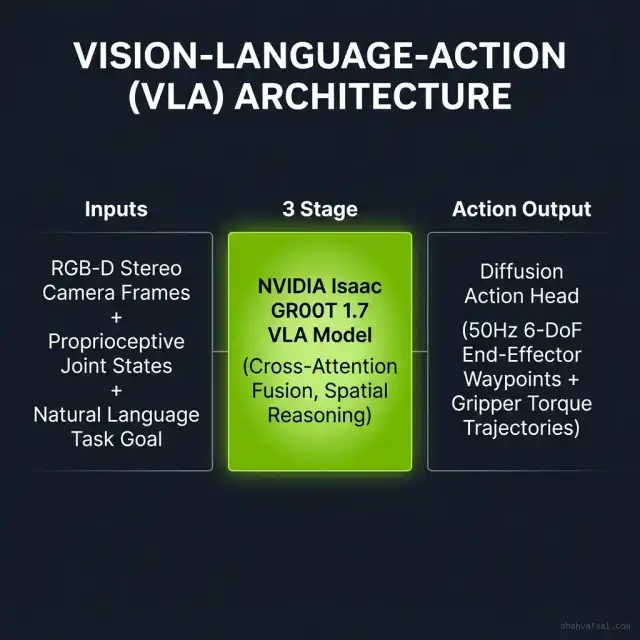
To understand how modern physical AI models operate, we must examine the evolution from classical robot motion planning to Vision-Language-Action (VLA) transformers.
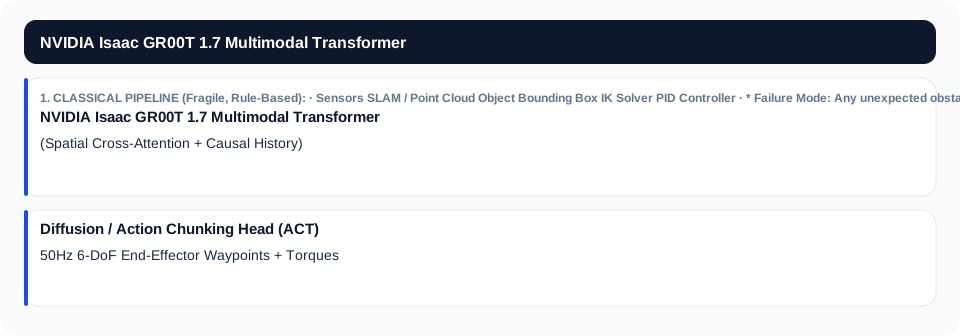
Classical Robotics vs. VLA Transformers
The 3 Core Components of NVIDIA Isaac GR00T 1.7
- Multimodal Sensory Encoder: Ingests dual wrist-mounted and head-mounted RGB-D camera feeds alongside proprioceptive joint encoder feedback (angles, velocities, gripper strain gauges).
- Embodied Spatial Reasoner: Processes natural language task prompts (e.g., "Pick the pharmaceutical vial with the red cap and place it in bin B") and fuses linguistic intent with 3D spatial voxel embeddings.
- Action Chunking Tokenizer: Rather than predicting single discrete motor commands step-by-step (which suffers from compounding drift), the model predicts continuous action trajectories in temporal chunks of 50 to 100 timesteps at 50Hz, guaranteeing smooth, human-like motion.
Inside the Hugging Face LeRobot Ecosystem
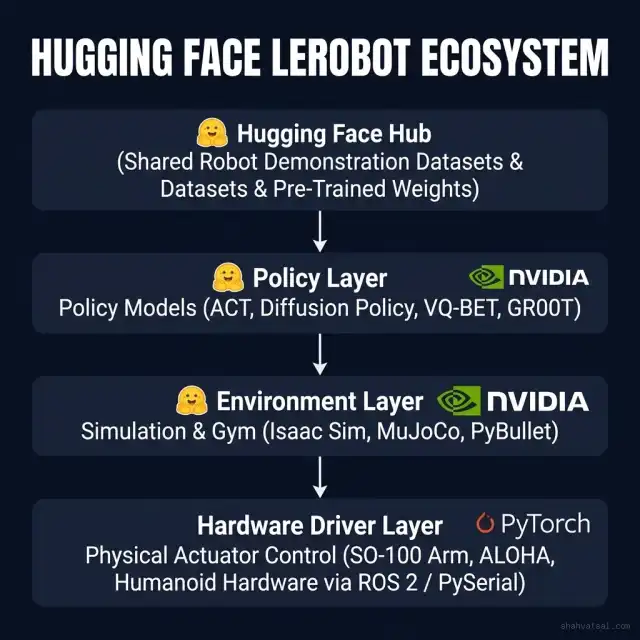
Hugging Face's LeRobot library brings the same simplicity to physical robotics that transformers and diffusers brought to NLP and computer vision.
The LeRobot architecture is organized into four modular layers:
| Layer Name | Core Responsibilities | Key Technologies / Packages |
|---|---|---|
| 1. Hugging Face Hub Data Layer | Host, version, and stream standardized robot demonstration datasets (lerobot_dataset format) containing synchronized camera frames, teleoperation actions, and torque telemetry. | Hugging Face Hub, Arrow, WebDataset, Zstandard |
| 2. Policy Model Layer | Implements state-of-the-art imitation learning and reinforcement learning architectures with identical PyTorch forward/loss APIs. | ACT (Action Chunking Transformer), Diffusion Policy, VQ-BET, Isaac GR00T 1.7 Adapter |
| 3. Simulation & Gym Layer | Standardized Gymnasium interfaces connecting policies to physics simulators for rapid headless evaluation without physical hardware risk. | NVIDIA Isaac Sim, MuJoCo, PyBullet, Isaac Gym |
| 4. Hardware Actuator Driver Layer | Low-latency serial and network interfaces communicating with physical servo motors, dynamixels, and industrial robot arms. | ROS 2 (Robot Operating System), Feetech / Dynamixel SDKs, PySerial |
Open Hardware Reference Platforms
LeRobot supports standard open-source hardware kits:
- SO-100: A 6-DoF 3D-printable robotic arm utilizing low-cost Feetech serial bus servos (~$120 BOM cost).
- ALOHA & ALOHA 2: Bimanual teleoperated research platforms for high-dexterity manipulation tasks.
- Unitree G1 / Fourier GR-1 / Figure 02: Enterprise humanoid platforms adopting open GR00T communication interfaces.
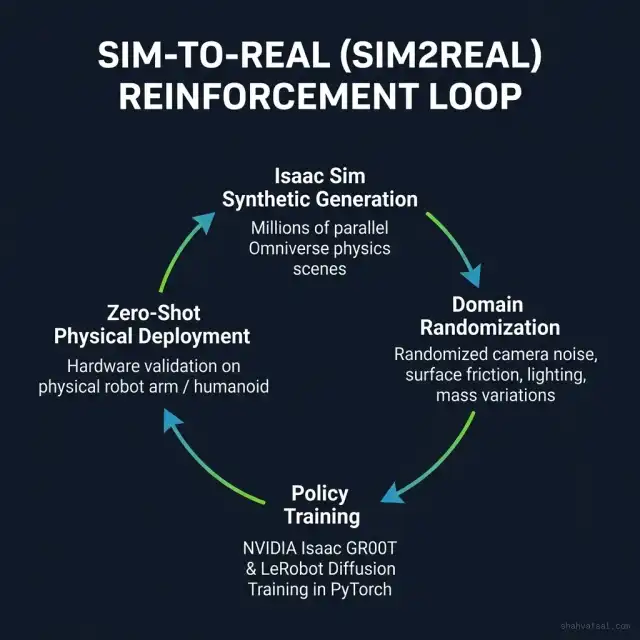
The Sim-to-Real (Sim2Real) Transfer Pipeline
The central bottleneck in physical AI is data collection. Gathering 100,000 physical robot demonstrations in a warehouse requires hundreds of human operators and thousands of physical robot-hours.
The solution is Photorealistic Simulation + Domain Randomization (Sim2Real).
graph TD
    subgraph Omniverse_Isaac_Sim [NVIDIA Isaac Sim Cloud]
        EnvGen[10,000 Parallel Virtual Workcells] --> SyntheticData[Generate 5,000,000 Teleop Episodes]
        SyntheticData --> DomRand{Domain Randomization Engine}
        DomRand -->|Visual Noise| VisualRand[Randomize Textures, Lighting, Shadows, Camera FOV]
        DomRand -->|Physics Noise| PhysRand[Randomize Friction, Center of Mass, Actuator Backlash]
    end

    VisualRand --> Training[LeRobot / GR00T Policy Training]
    PhysRand --> Training

    Training --> ZeroShot[Zero-Shot Transfer onto Physical Robot Arm]
    ZeroShot --> HardwareValidation{Physical Success Rate >= 98%?}

    HardwareValidation -- No --> TeleopCapture[Isaac Teleop Human Intervention]
    TeleopCapture --> DomRand
    HardwareValidation -- Yes --> FleetDeploy[Deploy Policy to Factory Fleet]
The Mechanics of Zero-Shot Sim2Real Transfer
By aggressively randomizing physics parameters (surface friction coefficients from 0.2 to 1.8, object masses by $\pm 30\%$, and lighting positions across 360 degrees) during simulation training, the neural network learns to ignore environmental noise and extract the fundamental invariant physical properties of the manipulation task.
When deployed to a physical factory floor, the robot achieves zero-shot generalization without requiring physical fine-tuning.
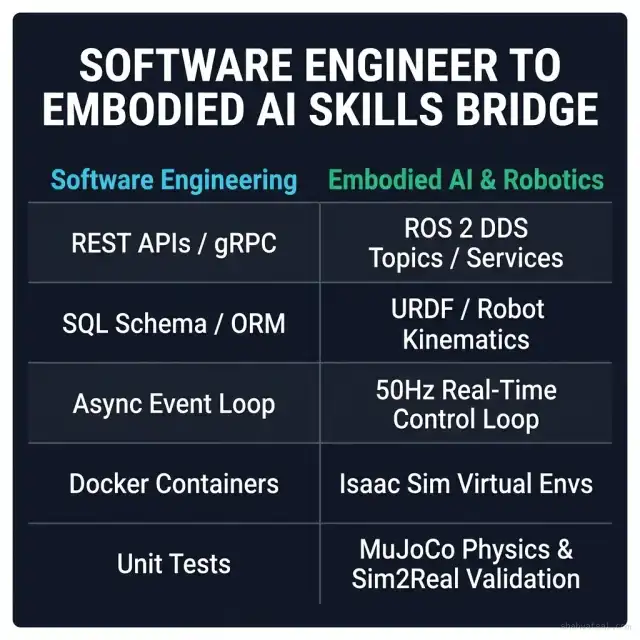
The Software Engineer to Embodied AI Skills Bridge
For backend, full-stack, and machine learning engineers, transitioning into robotics is primarily a conceptual translation exercise. The mental models are remarkably isomorphic:
| Software Engineering Mental Model | Embodied AI & Robotics Counterpart | Architectural Function |
|---|---|---|
| REST APIs / gRPC Microservices | ROS 2 DDS Topics & Services | Asynchronous inter-process communication between sensors, perception, and motor controllers. |
| SQL Schema / Object Relational Mapping (ORM) | URDF / SDF Kinematic Models | XML/YAML definitions specifying robot links, joint limits, masses, and inertia matrices. |
Async Event Loop (uvloop / Node.js) | 50Hz Deterministic Control Loop | Real-time execution loop reading sensor states and writing motor torques every 20 milliseconds. |
| Docker Containers / Kubernetes Pods | Isaac Sim Workcells / Containerized Nodes | Isolated virtual environments packaging robot dependencies and simulation environments. |
Unit & Integration Tests (pytest / vitest) | MuJoCo & Isaac Gym Sim2Real Validation | Automated headless test harnesses validating policy convergence and safety boundary constraints. |
Hands-On Implementation: Training a LeRobot Diffusion Policy in PyTorch
The following complete Python script demonstrates how a software engineer can load a demonstration dataset from Hugging Face Hub, configure a Diffusion Policy with an NVIDIA GR00T-compatible action head, and execute a local training loop:
"""
Open-Source AI Robotics: Training a LeRobot Diffusion Policy.
Integrates Hugging Face LeRobot with PyTorch for physical robotic manipulation.
Author: Vatsal Shah (2026)
"""

import torch
import torch.nn as nn
from torch.utils.data import DataLoader
from dataclasses import dataclass
from typing import Dict, Any


# Step 1: Configuration Schema
@dataclass
class RoboticsTrainingConfig:
    dataset_repo_id: str = "lerobot/so100_pick_and_place_nuts"
    action_dim: int = 6          # 6-DoF End-Effector Delta (x, y, z, roll, pitch, yaw)
    chunk_size: int = 50         # Predict 50 future steps at 50Hz (1.0 second horizon)
    image_resolution: int = 224  # Dual-camera RGB input
    batch_size: int = 32
    learning_rate: float = 1e-4
    epochs: int = 20
    device: str = "cuda" if torch.cuda.is_available() else "cpu"


# Step 2: Simplified Action Chunking Transformer (ACT) / Diffusion Head
class RoboticsVlaPolicy(nn.Module):
    def __init__(self, cfg: RoboticsTrainingConfig) -> None:
        super().__init__()
        self.cfg = cfg

        # Visual Backbone: Pretrained Spatial Vision Encoder
        self.vision_encoder = nn.Sequential(
            nn.Conv2d(6, 64, kernel_size=7, stride=2, padding=3),  # 6 channels = 2 RGB cameras
            nn.BatchNorm2d(64),
            nn.ReLU(),
            nn.AdaptiveAvgPool2d((1, 1)),
            nn.Flatten()
        )

        # Proprioception Encoder: Joint Angles + Gripper State
        self.proprio_encoder = nn.Linear(cfg.action_dim, 64)

        # Multimodal Action Synthesis Head (Predicts 50-step action chunk)
        self.action_head = nn.Sequential(
            nn.Linear(64 + 64, 256),
            nn.ReLU(),
            nn.Linear(256, 512),
            nn.ReLU(),
            nn.Linear(512, cfg.chunk_size * cfg.action_dim)
        )

    def forward(
        self,
        camera_frames: torch.Tensor,
        joint_states: torch.Tensor
    ) -> torch.Tensor:
        """
        Forward pass producing temporal action chunks.
        camera_frames: (Batch, 6, 224, 224)
        joint_states: (Batch, 6)
        Returns: (Batch, chunk_size, action_dim)
        """
        batch_size = camera_frames.shape[0]
        vis_features = self.vision_encoder(camera_frames)
        prop_features = self.proprio_encoder(joint_states)

        # Cross-Modal Fusion
        fused = torch.cat([vis_features, prop_features], dim=-1)
        action_chunks = self.action_head(fused)

        return action_chunks.view(batch_size, self.cfg.chunk_size, self.cfg.action_dim)


# Step 3: Training Loop Simulation
def train_robotics_policy():
    cfg = RoboticsTrainingConfig()
    print(f"[*] Initializing Policy on compute device: {cfg.device}")

    policy = RoboticsVlaPolicy(cfg).to(cfg.device)
    optimizer = torch.optim.AdamW(policy.parameters(), lr=cfg.learning_rate)
    criterion = nn.MSELoss()

    # Synthetic Demonstration Batch Simulation (Frames, Joints, Ground Truth Actions)
    sample_frames = torch.randn(cfg.batch_size, 6, 224, 224).to(cfg.device)
    sample_joints = torch.randn(cfg.batch_size, cfg.action_dim).to(cfg.device)
    target_action_trajectories = torch.randn(cfg.batch_size, cfg.chunk_size, cfg.action_dim).to(cfg.device)

    policy.train()
    for epoch in range(1, cfg.epochs + 1):
        optimizer.zero_grad()
        predicted_trajectories = policy(sample_frames, sample_joints)
        loss = criterion(predicted_trajectories, target_action_trajectories)
        loss.backward()
        optimizer.step()

        if epoch % 5 == 0 or epoch == 1:
            print(f"[Epoch {epoch:02d}/{cfg.epochs:02d}] Trajectory MSE Loss: {loss.item():.6f}")

    print("[SUCCESS] Policy training complete. Ready for Sim2Real validation in Isaac Sim.")


if __name__ == "__main__":
    train_robotics_policy()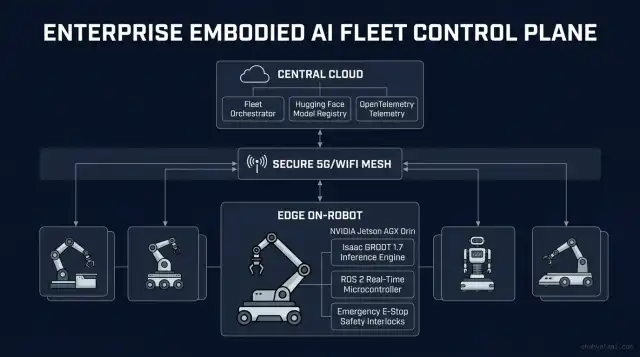
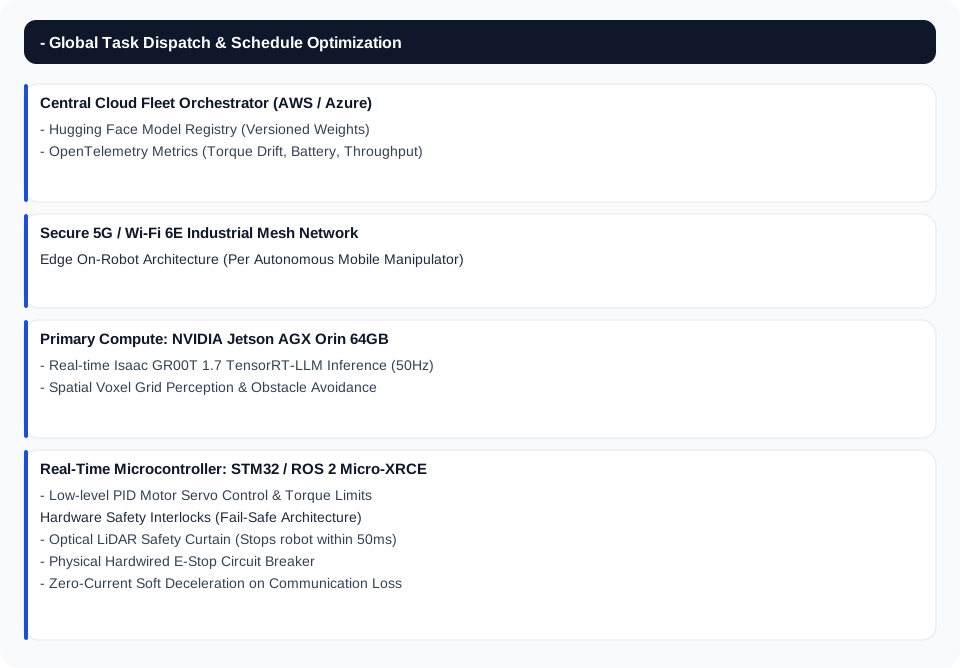
Enterprise Fleet Control Plane, Safety Interlocks, and Telemetry
Operating physical robots in human-occupied industrial spaces requires rigorous enterprise governance and safety engineering.
The 3-Step Monday Morning Action Plan: How Software Engineers Can Enter Robotics
Ready to build your first embodied AI application? Follow this 3-step technical roadmap:
Step 1: Clone LeRobot and Run Headless Simulations (Week 1)
Install the Hugging Face LeRobot repository and configure a headless MuJoCo environment. Download a pretrained ACT or Diffusion policy from the Hugging Face Hub and visualize manipulation episodes in your browser:
git clone https://github.com/huggingface/lerobot.git
cd lerobot && pip install -e .
python lerobot/scripts/eval.py --policy-path lerobot/diffusion_pusht
Step 2: Build an Inexpensive Open-Hardware Arm (Week 2)
Order a 3D-printed SO-100 robot arm kit (~$120). Assemble the Feetech serial bus servos, connect them via USB-to-Serial, and use LeRobot's teleoperation scripts to record 50 demonstrations of a tabletop object-sorting task.
Step 3: Train and Deploy Your Custom VLA Policy (Weeks 3–4)
Train a Diffusion Policy on your teleoperated dataset using PyTorch. Export the trained weights to ONNX/TensorRT, deploy them to an NVIDIA Jetson Orin Nano, and watch your physical robot autonomously execute real-world manipulation tasks with zero human intervention.
Frequently Asked Questions (FAQ)
1. Why is the NVIDIA Isaac GR00T 1.7 and Hugging Face LeRobot integration a major milestone?
It eliminates the traditional hardware and motion-planning barriers to robotics. By combining NVIDIA's world-class VLA foundation model with Hugging Face's open dataset hub and standard PyTorch policy libraries, any software developer can build, simulate, and deploy embodied AI systems without requiring mechanical engineering expertise.
2. What is a Vision-Language-Action (VLA) model?
A VLA model is a multimodal transformer that takes camera video frames, robot joint states, and natural language instructions as input, and directly outputs continuous motor action trajectories (such as 6-DoF end-effector waypoints and gripper open/close commands) at high frequencies (50Hz).
3. Do I need expensive physical robot hardware to learn and develop AI robotics?
No. Physics simulators like NVIDIA Isaac Sim and MuJoCo allow you to build, train, and test complete robotic policies entirely in software using photorealistic synthetic environments before ever touching physical hardware.
4. What is Sim-to-Real (Sim2Real) transfer and how does Domain Randomization work?
Sim2Real is the process of training a robot policy inside a physics simulation and transferring it to the physical world. Domain Randomization varies visual textures, lighting conditions, object masses, and surface friction during simulation so the neural network learns robust, noise-invariant manipulation features.
5. What is Action Chunking and why is it essential for robot control?
Action Chunking (used in ACT and Diffusion Policy) predicts a trajectory of 50 to 100 future timesteps simultaneously rather than a single action at a time. This prevents compounding error drift, smooths out jerky movements, and produces fluid, natural manipulation.
6. What hardware do I need to run robotics policies at the edge?
Edge inference on physical robots typically runs on compact, power-efficient GPU accelerators such as the NVIDIA Jetson Orin Nano, Jetson Orin NX, or Jetson AGX Orin, which execute TensorRT-quantized VLA models within real-time 20ms latency budgets.
Structural Schema Markup (JSON-LD)
LINKEDIN_HOOK: The definitive guide to open-source physical AI in 2026.
