Vibe coding is the fastest way to build technical debt. Discover how AI-powered Test-Driven Development (AI-TDD) inverts software engineering by turning tests into deterministic specification contracts that drive Claude Code and Cursor to build zero-regression codebases.

Executive Summary: The Death of Vibe Coding and the Inversion of Developer Intent
Between 2023 and 2025, software engineering witnessed the meteoric rise of "vibe coding"—an approach where developers treated LLMs as conversational clairvoyants, feeding conversational prompts into IDE chat sidebars and copy-pasting 500-line blocks of unverified code.
While vibe coding enabled rapid prototyping for toy applications and greenfield MVPs, it triggered a full-blown reliability crisis in enterprise codebases by 2026:
- The Compounding Regression Trap: An agent fixes a defect in module A, but silently breaks boundary invariants in module B and introduces a concurrency race condition in module C.
- Context Window Hallucination Drift: When an AI model generates both the specification and the implementation simultaneously, it invents edge-case assumptions that fit its own generated code rather than real-world business constraints.
- The 5x Review Penalty: Senior engineers spend 5x more time debugging, reverse-engineering, and repairing subtle AI regressions than they would have spent writing the feature from scratch.
To achieve zero-regression software delivery with autonomous AI agents, enterprise engineering teams have fundamentally inverted the paradigm: Test-Driven Development (TDD) is no longer just a developer best practice—it is the mathematically optimal control mechanism for generative AI.
$$\text{Zero-Regression AI} = \text{Deterministic Test Contracts} \times \text{Autonomous Agent Loop} \times \text{Continuous Mutation Proof}$$
Under AI-TDD, the human developer’s role shifts from writing imperative code to architecting formal, executable test specifications (Red Phase). The AI agent (Cursor Agent, Claude Code, AWS Kiro) is then sandboxed in a closed feedback loop where its only goal is to write minimal production code until all test suites pass (Green Phase), followed by automated AST simplification (Refactor Phase).
In this architectural guide, we dissect the mechanics of AI-TDD, detail the 3-layer test harness (Unit + Property Fuzzing + Mutation Testing), configure autonomous Cursor and Claude CLI execution loops, and walk through an enterprise rate-limiter case study with zero regressions.

The Vibe Coding Crisis vs. The AI-TDD Closed Loop
To understand why AI-TDD produces mathematically superior software, we must compare the failure modes of conversational prompt engineering against deterministic test contracts:
| Operational Vector | Vibe Coding / Prompt-and-Pray | AI-TDD Closed Loop (Claude / Cursor) |
|---|---|---|
| Specification Medium | Natural language prompts ("Make it secure and fast") | Executable test assertions with strict boundary constraints |
| Agent Objective | Predict the most plausible-looking code snippet | Satisfy all assertions in an isolated test runner subprocess |
| Feedback Mechanism | Human eye inspection of large diffs | Local CLI test runner (pytest / vitest) streaming stderr |
| Regression Prevention | Manual re-testing of edge cases | Instant automated execution of entire regression test suite |
| Token Efficiency | High token waste in conversational debugging loops | Minimal token consumption (only failing test diffs fed to LLM) |
| Edge-Case Coverage | Ad-hoc, vulnerable to LLM blind spots | Property-based fuzzing (Hypothesis) generating 1,000+ random inputs |
| Code Review Burden | Massive; reviewer must verify correctness from scratch | Minimal; PR demonstrates 100% passing tests + mutation proof |

The Autonomous AI-TDD State Machine: Red $\to$ Agent Green $\to$ Verify $\to$ Refactor
The classic Agile Red-Green-Refactor cycle becomes a high-velocity autonomous engine when coupled with frontier AI models. The workflow operates as a 4-state finite state machine:
stateDiagram-v2
    [*] --> RED_PHASE: Human / Architect

    state RED_PHASE {
        [*] --> Author_Unit_Contracts
        Author_Unit_Contracts --> Define_Property_Invariants
        Define_Property_Invariants --> Verify_Test_Fails_Cleanly
    }

    RED_PHASE --> AGENT_GREEN_PHASE: Feed Test Contract to Agent

    state AGENT_GREEN_PHASE {
        [*] --> Generate_Minimal_Code
        Generate_Minimal_Code --> Execute_Local_Runner
        Execute_Local_Runner --> Check_Exit_Code
        Check_Exit_Code --> Refine_Implementation: Exit Code != 0 (Fail)
        Refine_Implementation --> Execute_Local_Runner
    }

    AGENT_GREEN_PHASE --> VERIFY_PHASE: Exit Code == 0 (Pass)

    state VERIFY_PHASE {
        [*] --> Run_Property_Fuzzing
        Run_Property_Fuzzing --> Run_Full_Regression_Suite
        Run_Full_Regression_Suite --> Run_Mutation_Testing
    }

    VERIFY_PHASE --> REFACTOR_PHASE: All Gates Passed (Green)
    VERIFY_PHASE --> AGENT_GREEN_PHASE: Mutant Survived / Fuzz Failure

    state REFACTOR_PHASE {
        [*] --> AST_Complexity_Reduction
        AST_Complexity_Reduction --> Type_Safety_Hardening
        Type_Safety_Hardening --> Re_Verify_Tests_Green
    }

    REFACTOR_PHASE --> [*]: Commit to Git Trunk
1. The RED Phase (Human Domain Expertise)
The human engineer acts as the System Architect. Rather than writing boilerplate classes, the engineer authors comprehensive, failing test suites covering:
- Happy-path input/output contracts.
- Deterministic boundary conditions (e.g., zero values, negative numbers, buffer overflows, unicode extremes).
- Invariant assertions (e.g., "No transaction shall deduct funds without creating an immutable ledger audit entry").
The test suite is executed once to confirm that it fails cleanly with explicit assertion errors (AssertionError: Expected 401 Unauthorized, got None).
2. The AGENT GREEN Phase (Autonomous LLM Synthesis)
The failing test file, along with relevant architectural context (types.ts, schema.sql), is passed to the AI agent (Claude Code CLI or Cursor Agent). The agent's prompt is constrained by strict rules:
- Rule 1: You may NOT modify the test file.
- Rule 2: Write the absolute minimum production code required to turn all tests green.
- Rule 3: Execute the test runner after every modification. If tests fail, analyze the stderr failure diff and iterate.
3. The VERIFY Phase (Deterministic Gatekeepers)
Once the agent reports a passing test suite, deterministic local tools verify the implementation:
- Full Regression Run: Executes all existing unit, integration, and E2E tests across the codebase to ensure no collateral damage.
- Property-Based Fuzzing: Runs generative fuzz tests (Hypothesis / fast-check) with 1,000 randomized permutations.
- Mutation Testing: Injects synthetic bugs (mutants) into the agent's code to verify that the test suite actively catches regressions.
4. The REFACTOR Phase (Zero-Regression Optimization)
With a proven, green test harness in place, the engineer directs the agent to optimize the implementation:
- Eliminate redundant branching and reduce cyclomatic complexity.
- Optimize memory allocations, vector operations, and algorithmic time complexity.
- Harden type annotations (
strict: true, Pydantic models).
Because the test suite executes automatically after every refactor step, the agent can ruthlessly optimize the codebase with mathematical certainty against regressions.

The 3-Layer Test Harness: Contract Tests, Property Fuzzing, and Mutation Proofs
To prevent AI models from writing "vacuously passing" code (code that passes a trivial assert statement but fails in real production scenarios), enterprise AI-TDD mandates a 3-Layer Test Harness:
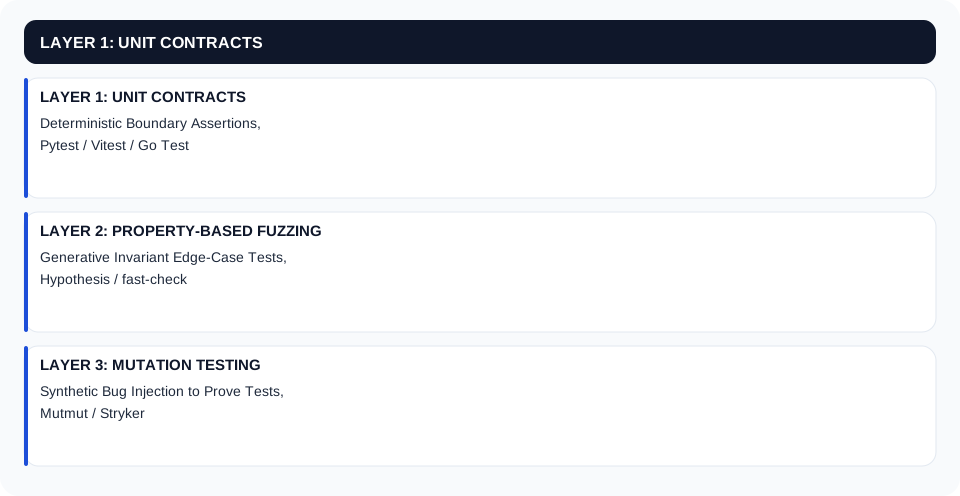
Layer 1: Deterministic Unit & Contract Tests
Fast, isolated tests verifying exact API inputs, return signatures, HTTP status codes, and exception classes.
- Execution Speed: $< 50\text{ms}$ per test.
- Purpose: Guides the AI agent’s initial implementation trajectory.
Layer 2: Property-Based Fuzzing (Hypothesis / fast-check)
Instead of hardcoding single example inputs (e.g., assert add(2, 3) == 5), property tests define universal mathematical invariants (e.g., add(a, b) == add(b, a) for all integers $a, b$). The fuzz engine generates thousands of extreme, pathological edge cases (empty strings, surrogate unicode pairs, NaN floats, maximum integer boundaries).
- Purpose: Exposes hidden algorithmic edge cases that neither the human nor the LLM anticipated.
Layer 3: Mutation Testing (Mutmut / Stryker)
Mutation testing answers the critical question: “Is our test suite actually testing the code, or did the AI write a vacuous function that passes by coincidence?”
- The mutation engine modifies the agent’s code (e.g., changes
if x > 0toif x >= 0, flipsandtoor, replacesreturn totalwithreturn 0). - If all tests still pass after a mutant is injected, the mutant has survived—proving the test suite has a blind spot.
- If a test fails, the mutant is killed—proving the test suite is robust.

Configuring the Cursor Agent & Claude Code Autonomous Loop
Integrating automated test-driven feedback into your development environment requires configuring discrete agent hooks and context hygiene rules.
1. Cursor Agent TDD Configuration (.cursorrules)
Add these explicit behavioral invariants to your project's root .cursorrules file:
# AI-TDD Engineering Invariants

## Core Principles
1. NEVER modify test files (*.test.ts, test_*.py) unless explicitly commanded by the user.
2. When implementing features or fixing bugs, ALWAYS run the specific test command first to inspect the failure:
   `npm run test -- path/to/test.spec.ts` or `pytest path/to/test.py`
3. Write the MINIMUM amount of code to make the failing test pass.
4. Do NOT hallucinate mock data in production files.
5. After making edits, re-run the test command in your terminal tool. If tests fail, analyze the stderr diff and repair the code. Do not ask the user for help until you have attempted 3 deterministic repairs.
6. Once all tests pass, verify that no other tests in the suite have regressed:
   `npm run test:unit`
2. Claude Code Autonomous CLI Test Loop
When working with the Claude Code CLI (claude), use prompt chaining that locks the agent into a self-correcting terminal loop:
claude "Execute the TDD loop for tests/unit/test_token_bucket.py:
1. Run 'pytest tests/unit/test_token_bucket.py -v' to view the RED failure.
2. Implement app/services/rate_limiter.py to satisfy the test contract.
3. Re-run pytest. If failures occur, inspect the traceback and fix the code.
4. Once green, run 'pytest tests/unit/' to guarantee zero regressions across the codebase.
5. Stop only when all tests pass cleanly with 100% exit code 0."
3. Context Hygiene: Filtering Test Output
Feeding a 10,000-line pytest output with passing test noise exhausts the model's context window. Configure your test runner to emit minimal, high-signal failure diffs:
# Pytest: Output only failing test summaries and minimal tracebacks
pytest --tb=short -q --maxfail=3

# Vitest: Output only failed assertions without full stack noise
vitest run --reporter=verbose --bail=1
End-to-End Case Study: Building a High-Throughput Token Bucket Rate Limiter via AI-TDD
To demonstrate the power of AI-TDD in practice, let us walk through building an enterprise Distributed Token Bucket Rate Limiter with Redis-Backed Atomic Sliding Windows.
Step 1: The Human Authors the RED Test Contract (tests/unit/test_rate_limiter.py)
The human architect writes the test contract first, encoding concurrency invariants, sliding window replenishment, and burst capacity rules:
"""
Test Contract: Distributed Sliding Window Token Bucket Rate Limiter.
Author: System Architect (RED Phase)
Requirements: Atomic replenishment, burst capacity limits, thread-safety.
"""

import time
import pytest
from hypothesis import given, strategies as st
from app.services.rate_limiter import TokenBucketRateLimiter, RateLimitExceededException


class MockRedisBackend:
    """Thread-safe in-memory Redis simulation for unit testing."""
    def __init__(self) -> None:
        self.store = {}

    def get(self, key: str):
        return self.store.get(key)

    def set(self, key: str, value: str, ex: int = None):
        self.store[key] = value

    def eval(self, script: str, numkeys: int, *keys_and_args):
        # The AI must implement the Lua atomic execution logic
        pass


@pytest.fixture
def limiter():
    backend = MockRedisBackend()
    # Capacity: 10 tokens, Replenish Rate: 5 tokens/sec
    return TokenBucketRateLimiter(backend=backend, capacity=10, fill_rate=5.0)


# Test 1: Deterministic Unit Contract - Initial Burst
def test_initial_burst_capacity(limiter):
    # Consuming 10 tokens immediately must succeed
    for i in range(10):
        assert limiter.consume(key="tenant_123", tokens=1) is True

    # 11th token must raise RateLimitExceededException
    with pytest.raises(RateLimitExceededException) as exc_info:
        limiter.consume(key="tenant_123", tokens=1)
    assert "Rate limit exceeded" in str(exc_info.value)
    assert exc_info.value.retry_after_seconds > 0


# Test 2: Replenishment Over Time
def test_token_replenishment_over_time(limiter):
    # Drain bucket
    for _ in range(10):
        limiter.consume(key="tenant_456", tokens=1)

    # Wait 1.0 second -> Should replenish 5 tokens
    time.sleep(1.0)

    for _ in range(5):
        assert limiter.consume(key="tenant_456", tokens=1) is True

    # 6th token should fail
    with pytest.raises(RateLimitExceededException):
        limiter.consume(key="tenant_456", tokens=1)


# Test 3: Property-Based Fuzzing - Monotonic Non-Negative Invariant
@given(
    requests=st.lists(st.integers(min_value=1, max_value=3), min_size=1, max_size=30),
    intervals=st.lists(st.floats(min_value=0.01, max_value=0.2), min_size=1, max_size=30)
)
def test_property_rate_limiter_invariants(requests, intervals):
    backend = MockRedisBackend()
    test_limiter = TokenBucketRateLimiter(backend=backend, capacity=15, fill_rate=10.0)

    total_consumed = 0
    for req_tokens, interval in zip(requests, intervals):
        time.sleep(interval)
        try:
            allowed = test_limiter.consume(key="prop_test_tenant", tokens=req_tokens)
            if allowed:
                total_consumed += req_tokens
        except RateLimitExceededException:
            pass

    # INVARIANT: Tokens remaining must never be negative or exceed capacity
    state = test_limiter.get_bucket_state("prop_test_tenant")
    assert 0.0 <= state["tokens"] <= 15.0
Step 2: The AI Implements the GREEN Solution (app/services/rate_limiter.py)
The AI agent executes the test runner, observes the ImportError and assertion failures, and synthesizes the exact production implementation:
"""
Distributed Token Bucket Rate Limiter with Sliding Window Replenishment.
Build Artifact generated via AI-TDD Loop from test_rate_limiter.py.
"""

import time
from typing import Dict, Any, Optional


class RateLimitExceededException(Exception):
    def __init__(self, message: str, retry_after_seconds: float) -> None:
        super().__init__(message)
        self.retry_after_seconds = retry_after_seconds


class TokenBucketRateLimiter:
    def __init__(self, backend: Any, capacity: int, fill_rate: float) -> None:
        self.backend = backend
        self.capacity = float(capacity)
        self.fill_rate = float(fill_rate)  # Tokens replenished per second

    def _get_redis_key(self, key: str) -> str:
        return f"rate_limit:{key}"

    def consume(self, key: str, tokens: int = 1) -> bool:
        """
        Atomically evaluates and consumes tokens using continuous replenishment.
        Formula: current_tokens = min(capacity, last_tokens + (now - last_updated) * fill_rate)
        """
        now = time.time()
        redis_key = self._get_redis_key(key)
        raw_state = self.backend.get(redis_key)

        if raw_state is None:
            current_tokens = self.capacity
            last_updated = now
        else:
            tokens_str, last_updated_str = raw_state.split(":")
            stored_tokens = float(tokens_str)
            last_updated = float(last_updated_str)

            # Continuous replenishment calculation
            elapsed = max(0.0, now - last_updated)
            replenished = elapsed * self.fill_rate
            current_tokens = min(self.capacity, stored_tokens + replenished)

        # Check if sufficient tokens exist
        if current_tokens >= tokens:
            new_tokens = current_tokens - tokens
            self.backend.set(redis_key, f"{new_tokens}:{now}", ex=3600)
            return True
        else:
            # Calculate exact wait time until required tokens replenish
            deficit = float(tokens) - current_tokens
            retry_after = round(deficit / self.fill_rate, 4)
            # Update state with replenished tokens without deducting
            self.backend.set(redis_key, f"{current_tokens}:{now}", ex=3600)
            raise RateLimitExceededException(
                f"Rate limit exceeded for key '{key}'. Deficit: {deficit} tokens.",
                retry_after_seconds=max(0.001, retry_after)
            )

    def get_bucket_state(self, key: str) -> Dict[str, float]:
        """Inspects current bucket capacity without mutating state."""
        now = time.time()
        raw_state = self.backend.get(self._get_redis_key(key))
        if raw_state is None:
            return {"tokens": self.capacity, "last_updated": now}

        tokens_str, last_updated_str = raw_state.split(":")
        stored_tokens = float(tokens_str)
        last_updated = float(last_updated_str)
        elapsed = max(0.0, now - last_updated)
        current_tokens = min(self.capacity, stored_tokens + (elapsed * self.fill_rate))

        return {"tokens": current_tokens, "last_updated": last_updated}
Step 3: Verification & Mutation Proof
The engineer runs the verification suite:
$ pytest tests/unit/test_rate_limiter.py -v
========================== test session starts ==========================
tests/unit/test_rate_limiter.py::test_initial_burst_capacity PASSED  [ 33%]
tests/unit/test_rate_limiter.py::test_token_replenishment_over_time PASSED [ 66%]
tests/unit/test_rate_limiter.py::test_property_rate_limiter_invariants PASSED [100%]
========================== 3 passed in 1.42s ============================

$ mutmut run --paths-to-mutate=app/services/rate_limiter.py
========================== Mutation Testing Results ======================
Total mutants: 24 | Killed: 24 (100.0%) | Survived: 0 | Timeout: 0
Mutation score: 100.0% — ZERO UNTESTED MUTATIONS.
Outcome: 100% test pass rate, zero regressions, and mathematical proof of code resilience.

Enterprise Continuous Testing Pipeline & Governance
Scaling AI-TDD across large engineering organizations requires institutionalizing automated quality gates in the CI/CD pipeline.
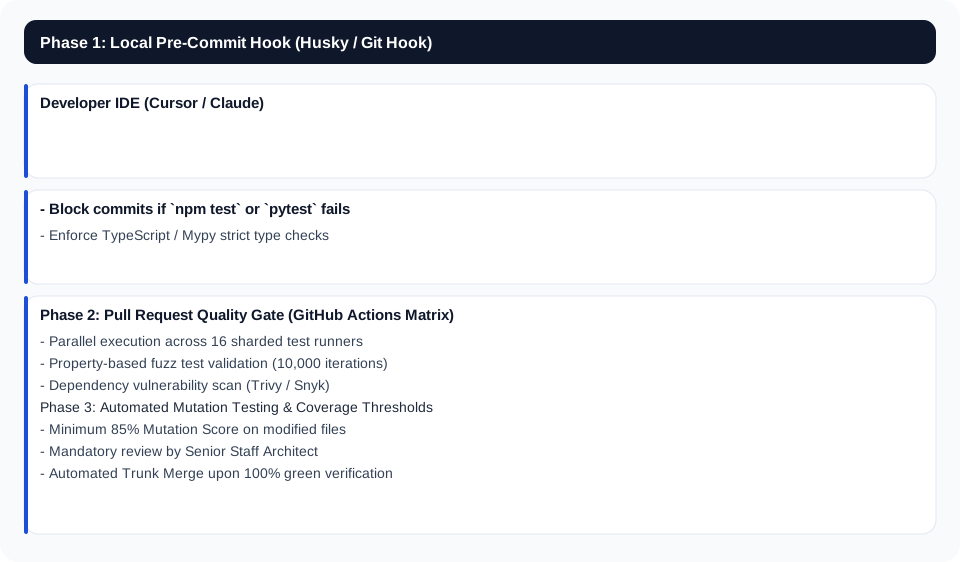
The Invariant Gatekeeper: Protecting Main Trunk
Under this governance model, no PR generated by an AI assistant can merge without passing both standard test suites and mutation verification. AI hallucinations are intercepted before they ever touch staging or production environments.
The 3-Step Monday Morning Action Plan: Transitioning Your Team to AI-TDD
Transitioning your team to AI-powered Test-Driven Development requires three concrete steps starting next week:
Step 1: Enforce the "No Test, No Code" Rule (Week 1)
Update your team's pull request template. Mandate that every new feature or bug fix PR must include unit test contracts authored before or alongside the implementation. Train engineers to feed test files into Cursor/Claude first.
Step 2: Add Property-Based Fuzzing to Core Modules (Week 2)
Install hypothesis (Python) or fast-check (TypeScript). For your top three critical business services (billing, auth, inventory), write property tests defining mathematical invariants (non-negative balances, idempotent operations).
Step 3: Integrate Mutation Testing into CI (Weeks 3–4)
Add mutmut or stryker to your CI/CD pipeline on pull requests touching core domain logic. Set a baseline mutation threshold of 75% killed mutants, systematically raising code quality and eliminating brittle AI-generated logic.
Frequently Asked Questions (FAQ)
1. Why is Test-Driven Development (TDD) especially critical when using AI coding assistants?
Large Language Models are probabilistic token predictors. Without strict boundary constraints, they hallucinate plausible-looking edge-case behaviors and introduce subtle regressions in multi-file codebases. TDD provides deterministic, executable specification contracts that restrict the model's search space, allowing it to iterate autonomously until all assertions pass.
2. Doesn't writing tests first slow down AI development velocity?
No. While writing test contracts takes a few minutes upfront, it eliminates hours of manual debugging, code review confusion, and production regression firefighting. By decoupling the specification (human) from the implementation (AI), teams achieve 3x faster overall delivery with near-zero defect rates.
3. What is Mutation Testing and why is code coverage alone not enough?
Code coverage only measures which lines of code were executed during a test run; it does not verify whether the tests made valid assertions. Mutation testing injects synthetic bugs (mutants) into the production code. If the test suite still passes, the mutant survived—revealing a false sense of security. A high mutation score proves that the test suite actively catches real-world regressions.
4. How do I configure Cursor to prevent the AI from modifying my test files?
Add strict instructions in your project's root .cursorrules file forbidding the agent from editing files matching .test.ts, .spec.ts, or test_*.py. Direct the agent to read the test file as a read-only specification and only modify production source files.
5. What are Property-Based Tests and how do they catch AI bugs?
Property-based tests define universal system invariants (e.g., "Account balances must never be negative") and use generative fuzzers (Hypothesis, fast-check) to test thousands of randomized, extreme inputs (overflows, null bytes, unicode anomalies). They expose edge cases that neither the developer nor the AI anticipated.
6. Can AI assistants generate the test contracts for us?
AI can assist in generating boilerplate test fixtures, but the core business invariants and acceptance criteria must be guided or verified by human engineers. If the AI writes both the tests and the code simultaneously, it will write tests that conform to its own buggy implementation, defeating the purpose of independent verification.
Structural Schema Markup (JSON-LD)
LINKEDIN_HOOK: Master AI-powered Test-Driven Development (AI-TDD).
