Nokia and Google Cloud Deploy Gemini-Powered Autonomous NetOps in Nokia Assurance Center
By Vatsal Shah | June 22, 2026 | 7 min read | Source: Google Cloud Press
TELECOM NETOPS INSIGHT
- Autonomous Troubleshooting:
- The system moves beyond traditional event logging, employing active diagnostic loops to run traces and correct router configurations autonomously.
- Glass Box Accountability:
- All agent decisions, execution paths, and configuration changes are recorded in transparent diagnostic logs, allowing human operators to audit and override actions.
- Multi-Agent Design:
- The architecture distributes tasks across specialized agents (e.g., Router Agent, Event Triager), preventing a single model from handling too many instructions.
Lead Paragraph
SUNNYVALE, California and ESPOO, Finland — In a major step toward self-driving telecommunications infrastructure, Nokia and Google Cloud have announced a partnership to deploy Gemini-powered autonomous agents within the Nokia Assurance Center. The collaboration integrates six specialized AI agents designed to handle real-time network operations (NetOps), including automated fault isolation, traffic optimization, and anomaly resolution. Built on the Google Cloud Gemini Enterprise Agent Platform, the system uses "glass box" explainable autonomy, allowing operators to audit agent reasoning and configuration changes in real time. Initial field trials indicate that the autonomous agents reduce network incident resolution times by 50% to 80%, with general availability on the Google Cloud Marketplace scheduled for September 2026.
What Happened
The integration of Gemini-powered agents into the Nokia Assurance Center introduces a specialized multi-agent workflow for telecommunications operators. Key features of the partnership include:
- The NetOps Agent Squad: Six specialized agents are deployed to handle specific parts of the incident lifecycle, such as the Router Agent, Event Triager, and Traffic Optimizer.
- Closed-Loop Diagnoses: The agents can run remote diagnostic commands, fetch router state configurations, and suggest routing changes without human intervention.
- Marketplace Availability: The solution will be offered as a SaaS product on the Google Cloud Marketplace starting in September 2026, allowing telecom operators to integrate the agents into existing systems.
                           AUTONOMOUS NETOPS FLOW
+--------------------------------------------------------------------------+
|  Nokia Assurance Center (Incoming Alert)                                 |
|         │                                                                |
|         ▼ (Event Triage & Routing)                                       |
|  [ Gemini Router Agent ] ──► [ Diagnostic Tracer ] ──► [ Conflict Check ]|
|         │                                                                |
|         ▼ (Verification & Deployment)                                    |
|  Automated Network Correction (Configuration Applied to Routers)          |
+--------------------------------------------------------------------------+
Why It Matters
For network engineers and IT leaders, managing modern telecom networks manually is increasingly difficult due to growing traffic volumes. Traditional monitoring systems alert operators to issues but require manual intervention to diagnose root causes, analyze logs, and execute commands. This manual process increases downtime and operational overhead.
By deploying autonomous agents, the Nokia Assurance Center automates the entire triage-to-resolution cycle. The agents identify anomalies, run diagnostics, and suggest corrections in seconds rather than hours. This speed is critical for maintaining service-level agreements (SLAs) in high-throughput enterprise environments.
Multi-Agent Architecture in NetOps
The core of the Nokia Assurance Center update is its multi-agent coordination system. Instead of relying on a single large language model to manage the entire network, Nokia and Google Cloud engineered a group of specialized agents.
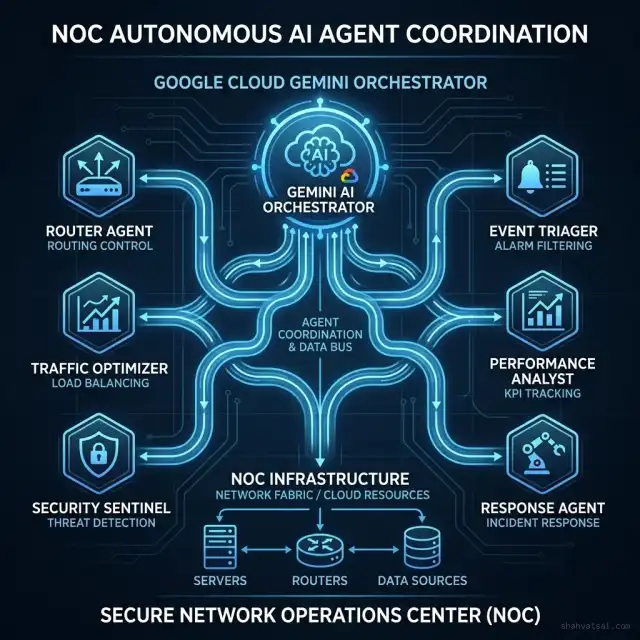
Each agent has a specific focus. For example, the Event Triager analyzes incoming alarms to filter out noise, while the Router Agent queries configuration states and logs to isolate hardware faults. This modular design prevents context overload, improves decision accuracy, and allows operators to scale specific agents independently. The orchestrator coordinates these tasks, passing structured data between agents to resolve incidents efficiently.
H2: The Event Triage and Resolution Loop
The autonomous loop begins when a network anomaly occurs. The system uses a structured sequence to verify and resolve the issue without manual intervention.
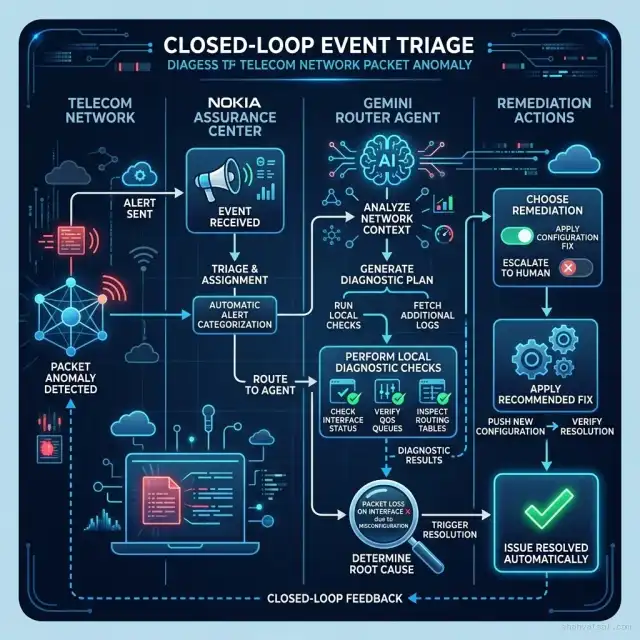
Once the Event Triager flags a critical alert, the Router Agent executes diagnostic commands to isolate the fault. If the issue is a software mismatch or a routing misconfiguration, the agent drafts a configuration patch. Before applying the patch, a separate safety engine verifies the changes against security policies to prevent network loops or access violations. After verification, the patch is applied, the routing state is checked, and a detailed incident report is generated for human audit.
Strategic Context: Orchestration & Sovereignty
This deployment highlights the growing importance of advanced agentic design patterns in enterprise production environments. As outlined in the guide on Multi-Agent Orchestration Layers, breaking down complex tasks into specialized, single-purpose agents is essential for building reliable, production-ready AI systems.
Furthermore, as telcos manage critical national infrastructure, data governance and security are paramount. Deploying these agents within a secure, compliant cloud architecture matches the requirements of Sovereign Architecture 2026. This setup ensures that data remains within defined geographic boundaries and complies with regional telecommunications regulations.
What to Watch Next
- Expanded Multi-Vendor Integrations: Watch for announcements regarding agent support for non-Nokia hardware to allow unified NetOps orchestration in hybrid environments.
- Real-time Billing Integration: Monitor if upcoming releases connect NetOps agents directly with billing platforms to adjust customer SLAs dynamically during outages.
- On-Device Edge Agents: Track the development of smaller, distilled models running directly on cellular base stations for localized edge troubleshooting.
Read the official partnership announcements on Google Cloud Press → Google Cloud Press Corner
Key Takeaways
- Strategic Partnership: Nokia and Google Cloud are deploying Gemini-powered autonomous agents within the Nokia Assurance Center.
- Explainable Autonomy: The system uses a "glass box" model, providing full audit trails of agent reasoning and configuration changes.
- Efficiency Gains: Field trials show a 50% to 80% reduction in network incident triage and resolution times.
- Specialized Multi-Agent Design: Workloads are distributed across six dedicated agents to optimize accuracy and performance.
- Marketplace Release: The solution will launch on the Google Cloud Marketplace as a SaaS product in September 2026.
FAQ
