STRATEGIC OVERVIEW
Model, score, and fix the human side of AI adoption — literacy, upskilling ROI, and culture — so Copilot and enterprise LLM licenses turn into 15–30% workforce productivity, not shelfware.
Why I Built This Framework
Most digital transformation playbooks treat Artificial Intelligence as a drop-in software upgrade. They assume that purchasing GitHub Copilot, ChatGPT Enterprise, or Claude Team licenses and distributing them to employees will automatically result in productivity gains. In reality, without a structured approach to upskilling, behavioral change, and cultural alignment, tool adoption stalls.
After auditing digital workflows across global software development offices, India delivery hubs, and product organizations, I built this framework to standardize the human side of AI integration. We need a mathematical model to calculate the financial ROI of upskilling alongside software licensing, combined with a capability matrix to identify cultural and policy bottlenecks.
The goal is simple: accelerate tooling adoption, build role-specific AI competencies, and unlock 15-30% in gross workforce productivity gains.
When to Use This Framework
You should run this capability assessment and deploy the matching ROI modeler in the following situations:
- Low Copilot Adoption: You have distributed generative AI developer tools or enterprise licenses, but actual weekly usage telemetry is flat or clustered among a few power users.
- The Upskilling Deficit: You need to transition developers and business operations teams from manual execution to intent-based engineering but lack role-specific training pathways.
- The Shadow AI Risk: Employees are actively using public model interfaces to assist with daily tasks, creating significant regulatory exposure for proprietary code or customer PII.
- ROI Justification: The finance committee or corporate board requires quantitative proof of AI tool productivity impact before approving next-year software licensing budgets.
The Maturity / Readiness Matrix
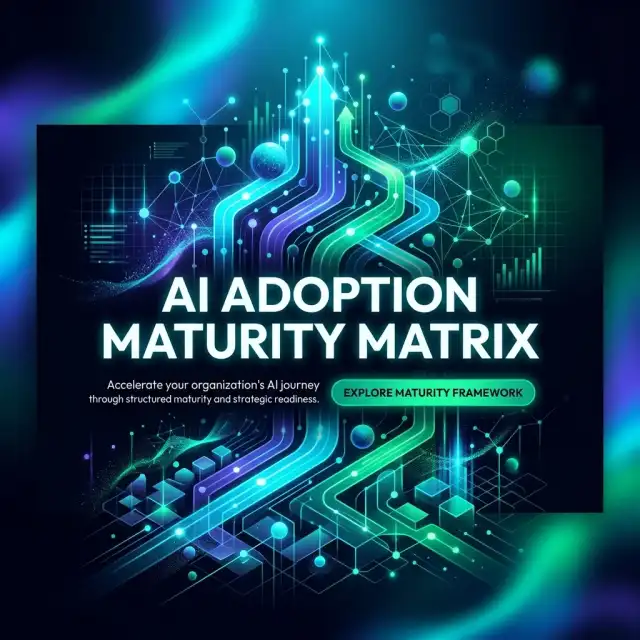
Before launching training programs, you must baseline your current capabilities. The matrix below defines the five core dimensions of enterprise AI adoption maturity.
| Dimension | Level 1 — Ad Hoc | Level 3 — Managed | Level 5 — Optimized |
|---|---|---|---|
| Strategy & Alignment | Isolated pilots running in department silos; no executive sponsor or structured KPI definitions. | Executive sponsor active; defined target adoption rates and initial pilot team benchmarks. | Unified AI Transformation Board; leadership incentive metrics linked to documented time savings. |
| Literacy & Training | No baseline literacy definitions; general training links shared without assessment. | Standardized upskilling tracks; role-specific prompt checklists provided to pilot groups. | Continuous learning platform; mandatory baseline literacy certifications and custom libraries. |
| Integration & Tooling | Employees copy/paste code to public endpoints; no private enterprise sandboxes. | Centralized corporate copilots active; initial private API gateways configured for security. | Custom workspace agent integrations; secure VPC gateways with custom-trained prompt guides. |
| Governance & Risk | Vague security policies; shadow tool usage unmonitored; no API input filtering. | Basic data privacy guidelines; manual audits of code repositories for key exposure. | Real-time compliance check gates; automated filters blocking leakage of proprietary assets. |
| Value Realization | Expenditures unmonitored; productivity claims rely on occasional user feedback. | Weekly tool consumption reviews; cost attribution mapped per department. | Unified value realization dashboards; continuous tracking of actual hourly task reduction. |
Dimension Scoring Guide
Dimension 1: AI Strategy & Leadership Alignment
Evaluate how effectively your leadership sponsors and tracks the transition to an AI-augmented operating model.
- Level 1 (Score: 1): Individual teams buy personal subscriptions. Management does not track tool budgets. There is no official AI committee.
- Level 3 (Score: 3): A formal steering committee exists. Target adoption rates (e.g. 50% usage within 60 days) are defined and monthly progress reports are sent.
- Level 5 (Score: 5): The AI Transformation Board has board-level representation. Executives are incentivized on meeting productivity targets and upskilling compliance.
Dimension 2: Workforce AI Literacy & Skill Training
Evaluate how systematically your organization baselines and improves AI operational competencies.
- Level 1 (Score: 1): Training is self-directed. Employees rely on public videos. There are no standardized competency definitions.
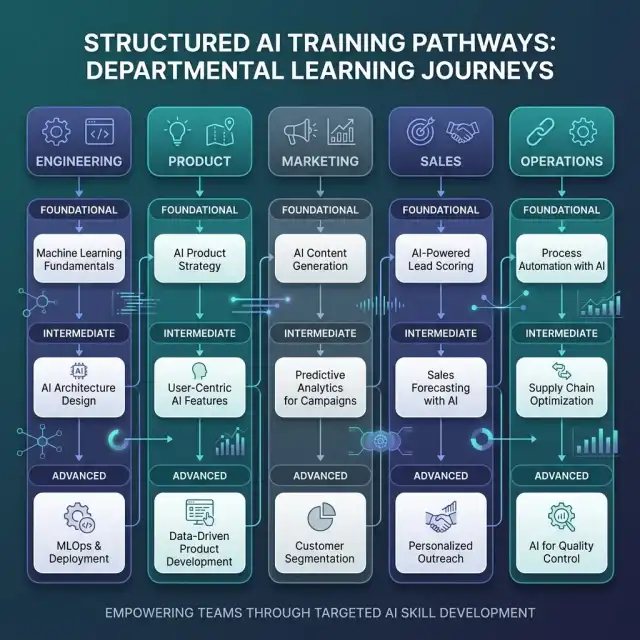
- Level 3 (Score: 3): Role-based pathways (e.g., Software Engineering, Product Management, Legal/Compliance) are mapped. Employees receive basic prompt templates.
- Level 5 (Score: 5): Baselines are established via mandatory literacy assessments. Prompts and custom agents are checked in as organizational assets.
Dimension 3: Tooling Integration & Copilots Deployment
Evaluate the depth and security of your deployed AI workspace applications.
- Level 1 (Score: 1): No corporate sandboxes exist. Employees copy/paste proprietary customer schemas directly into public interfaces.
- Level 3 (Score: 3): Secure private copilots (e.g., GitHub Copilot Enterprise or Azure OpenAI Chat) are deployed. Standard API keys are managed centrally.
- Level 5 (Score: 5): Private API gateways with secure VPC boundaries are active. Models are integrated into native developer and operations tools.
Dimension 4: Governance, Risk Management & Compliance
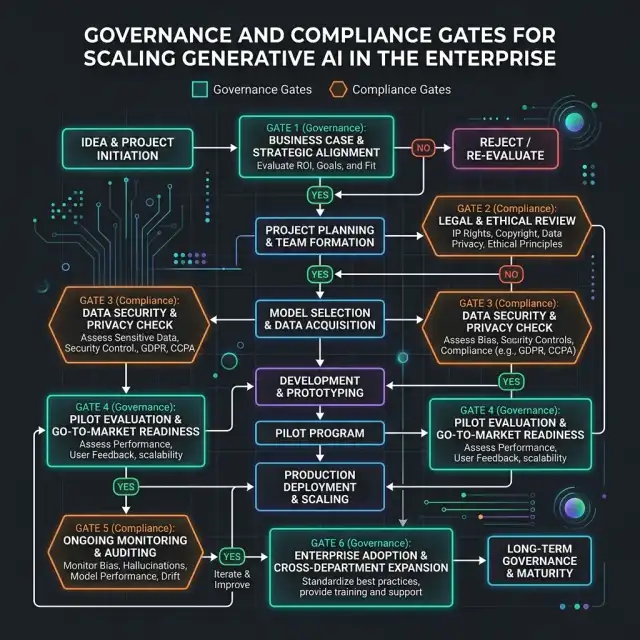
Evaluate your controls to prevent IP leakage, security breaches, and compliance failures.
- Level 1 (Score: 1): Rely on employee trust. No automated scanning is active. APIs are direct to public servers without oversight.
- Level 3 (Score: 3): General usage policies are updated. Security scans repository commits for API key exposure. Data sharing parameters are explicitly configured to 'no training'.
- Level 5 (Score: 5): Real-time compliance check gates analyze inputs at the API proxy layer. Automatic regex and semantic filters block PII leakage.
Dimension 5: Value Realization & Core Telemetry
Evaluate how rigorously you track cost expenditures and calculate business ROI.
- Level 1 (Score: 1): Software license costs are bundled into general software expense categories; no usage logs are available.
- Level 3 (Score: 3): Tool usage logs are reviewed weekly. Departments are billed back based on allocated seat licensing.
- Level 5 (Score: 5): Value telemetry maps actual hours active on tools (e.g. IDE cursor time, auto-triage volume) to calculate exact productivity ROI.
Self-Assessment Checklist
Ask your transformation team the following 12 checkpoint questions to identify capability gaps:
- Strategic Intent: Do we have a board-level sponsor directly responsible for generative AI deployment value metrics?
- KPI Mapping: Are our productivity goals defined in terms of specific task time reduction (e.g., MTTR, QA cycles) rather than general utility?
- Budgeting: Is training budget specifically allocated per employee alongside software license allocation?
- Competency Mapping: Have we defined what represents basic, intermediate, and advanced AI literacy for each core department?
- Prompt Libraries: Do we have a centralized repository where teams share, version control, and audit prompt templates?
- Workspace Access: Can our employees access private, secure model sandboxes that guarantee data is not stored or used for model training?
- IDE Integration: Are developers provided with integrated editor copilots configured with access to our internal repository context?
- Compliance Scanning: Do we automatically scan codebase repositories for exposed API credentials or private key commits?
- Data Leakage: Do we filter outgoing requests to public model endpoints for customer PII, internal project names, or proprietary code?
- Telemetry: Are we actively monitoring weekly active user (WAU) metrics for deployed AI tools?
- Attribution: Are model API costs attributed directly to the departments or teams consuming the tokens?
- Continuous Feedback: Do we run a monthly review to prune unused software licenses and reallocate them to high-performing teams?
90-Day Action Roadmap
To transition from ad-hoc exploration to optimized maturity, execute the following 90-day action roadmap:
| Timeline | Strategic Sprint Focus | Action Item Tasks | Expected Deliverable |
|---|---|---|---|
| Days 1 - 30 | Literacy Baseline & Audit | - Run baselining surveys across all departments. - Identify shadow AI tool usage. - Define core upskilling tracks. | - Baselining survey results published. - Initial capability scores mapped. |
| Days 31 - 60 | Tooling Rollout & Sprints | - Deploy secure workspace copilots and sandboxes. - Distribute shared prompt template libraries. - Execute role-specific training sprints. | - Corporate sandboxes operational. - Competency checklists distributed. |
| Days 61 - 90 | Governance & Telemetry | - Deploy API gateway compliance check gates. - Connect usage telemetry to cost attribution metrics. - Align incentive structures. | - Telemetry dashboard active. - Compliance gate filters operational. |
Common Anti-Patterns to Avoid
Even organizations with strong intent make systematic errors when deploying AI programs without a structured maturity framework. The following five anti-patterns account for over 80% of failed enterprise AI adoption initiatives:
Anti-Pattern 1: Licensing First, Training Never. The most common failure mode is distributing AI tool licenses to the entire workforce without first defining minimum literacy standards or role-specific training pathways. The result is an 8–12% active user rate after 90 days, wasted software budget, and a narrative that "AI doesn't work" rather than "AI was deployed without readiness."
Anti-Pattern 2: Treating Governance as a Legal Exercise. Organizations that delegate AI policy entirely to Legal produce documents that are technically compliant but operationally inert. Effective governance is a cross-functional discipline requiring HR (shadow AI behavior), IT (API control planes), Finance (cost attribution), and Engineering (input/output filtering) to operate together under a unified AI risk charter.
Anti-Pattern 3: Measuring Seat Count Instead of Active Value. Reporting license utilization as the primary AI adoption KPI is the equivalent of measuring gym membership to assess physical fitness. Level 5 organizations track prompt acceptance rates, co-pilot suggestion adoption, MTTR reduction, and sprint velocity change — all correlated to specific role-based upskilling milestones.
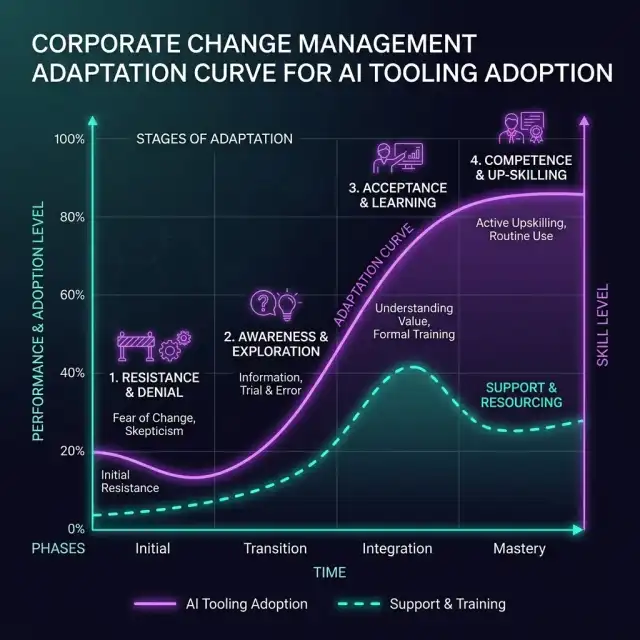
Anti-Pattern 4: Skipping the Change Management Layer. AI transformation produces behavioral anxiety at scale, particularly among knowledge workers who perceive automation as a threat to job security. Organizations that do not invest in a formal change management program — including AI champion networks, open feedback sessions, and transparent communication about how AI will augment rather than replace roles — face active resistance that stalls adoption regardless of tool quality.
Anti-Pattern 5: No Executive Accountability Loop. If AI transformation metrics are not included in executive performance reviews, they will not receive sustained leadership attention past the initial announcement phase. Level 5 organizations embed AI adoption rates, upskilling compliance scores, and Value Realization dashboard outputs directly into CEO, CHRO, and department head quarterly performance reviews.
Downloadable Toolkit
Access the full toolkit files below to facilitate your audit and model organizational ROI:
| Toolkit Asset | Format | Description |
|---|---|---|
| Workforce ROI Modeler | Excel (.xlsx) | Live TCO/ROI workbook containing workforce scale, licensing, and expected productivity curves. |
| Maturity Executive Briefing | PDF (.pdf) | 3-page stakeholder summary detailing maturity vectors, cultural curves, and recommendations. |
| Workshop Facilitator Guide | Word (.docx) | 90-minute workshop playbook, facilitator checklists, and department alignment worksheets. |
| Printable Scorecard Checklist | PDF (.pdf) | Clean, print-ready checklist containing maturity scoring indicators for auditing. |
Enterprise AI Adoption Maturity Scorecard
You read the story — now sign in to the full simulated console that mirrors what was delivered. Real screens, real workflows, fictional data only.
- Sign in with a one-click demo account or role
- Work a guided mission or explore freely
- Real validation, errors, and state changes — not a slideshow
Opens in a new tab. Simulation only — fictional data, no production systems connected.
If the new tab didn't open, copy this link:
https://demos.shahvatsal.com/frameworks/enterprise-ai-adoption-maturity-model-scorecard-2026/
