Meta Business Agent Goes Global: 1B+ Daily Business Threads on WhatsApp & Instagram
By Vatsal Shah | June 3, 2026 | 7 min read | Source: Meta Newsroom
Lead Paragraph
LONDON, United Kingdom — At its annual Conversations conference in London on June 3, 2026, Meta announced the global rollout of the Meta Business Agent, a unified conversational AI platform designed to automate customer support, lead qualification, and e-commerce transactions directly within Meta's messaging channels. Operating across WhatsApp, Instagram, and Messenger—surfaces that combined handle over 1 billion daily business threads—the Meta Business Agent Platform represents a massive shift in AI agent distribution. By offering out-of-the-box integrations with CRM giants like Zendesk and e-commerce platforms like Shopify, Meta is enabling millions of businesses to deploy action-taking agents without requiring dedicated engineering resources, while shifting WhatsApp Business pricing to an industry-standard token-based utility model.
What Happened
The global launch of the Meta Business Agent follows a highly successful multi-month preview program that onboarded over one million businesses. By opening the platform globally, Meta is targeting the massive mid-market and SMB segments that have traditionally been locked out of complex custom AI agent development due to integration and infrastructure costs.
Key details of the rollout include:
- Omnichannel Support: A single Meta Business Agent configuration can manage incoming customer queries across WhatsApp, Messenger, and Instagram DM interfaces simultaneously, translating and responding in local languages.
- Transition to Token-Based Pricing: To align with standard LLM compute patterns, Meta is shifting WhatsApp API pricing from flat conversation-based rates to a token-based structure. This model charges businesses based on raw input and output tokens consumed by the AI agent during interaction cycles.
- Out-of-the-Box Setup: Small and medium-sized businesses can activate the agent in minutes directly through the Meta Business Suite console, configuring behavior rules, personality traits, and catalog sync options.
Technical Architecture: Unified Messaging Layer
Architecturally, the Meta Business Agent Platform functions as a centralized middleware layer positioned between Meta's core communication APIs and third-party enterprise databases. Rather than building separate API handlers for WhatsApp, Instagram, and Messenger, developers interact with a unified schema that normalizes events, user contexts, and transaction logs.
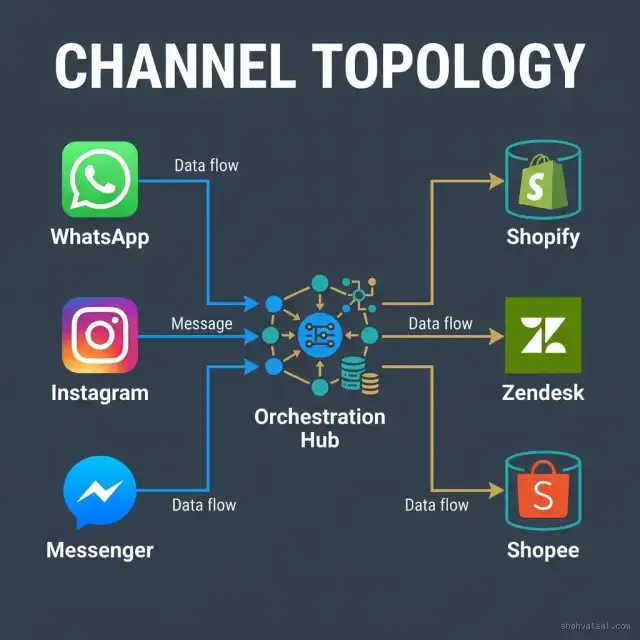
As shown in Figure 1, the platform architecture routes customer interactions through a shared orchestrator. This engine handles:
- State Management: Maintaining conversation history and session attributes across channels (e.g., if a user starts on Instagram and shifts to WhatsApp).
- Entity Extraction: Automatically identifying product IDs, tracking numbers, and customer emails from free-text messaging.
- Action Execution: Triggering external API calls to fulfill orders, check inventory levels, or log support tickets.
For developers seeking to integrate custom backends, the platform exposes webhooks that deliver normalized payloads:
{
  "object": "meta_business_agent",
  "entry": [
    {
      "id": "meta-agent-182937",
      "time": 1780512000,
      "messaging": [
        {
          "sender": { "id": "user-whatsapp-98213" },
          "recipient": { "id": "business-page-09283" },
          "message": {
            "text": "Can I return my order #98210? It arrived damaged.",
            "intent": "order_return",
            "entities": {
              "order_id": "98210",
              "reason": "damaged_on_arrival"
            }
          }
        }
      ]
    }
  ]
}
By standardizing these webhooks, Meta allows businesses to hook their agents directly into enterprise ticketing systems. For example, if a return request requires escalation, the agent can pass the structured payload directly to a support representative.
Why It Matters: The Distribution Moat and Pricing Shift
Meta's global launch is a distribution story rather than a pure model capability breakthrough. While other tech companies focus on building larger models or standalone web chat interfaces, Meta is building agent endpoints directly where consumers spend their time.
WhatsApp alone commands over two billion monthly active users, representing a massive conversational footprint. By enabling businesses to place deployable AI agents directly within these active threads, Meta is fundamentally changing the economics of customer service:
- Elimination of DIY Pipelines: Businesses no longer need to run complex API middleware or manage token limits themselves; the Meta Business Agent handles model hosting, prompt engineering, and security mapping natively.
- The Token Economy Shift: Moving to token-based pricing for WhatsApp interactions aligns Meta's monetization with raw infrastructure costs. This allows businesses to pay strictly for what they use, lowering the entry barrier for low-frequency users while scaling logically for high-throughput enterprises.
- Action-Oriented Conversational UI: Unlike older chatbots that simply answered FAQs, the Business Agent is action-oriented. It can check real-time stock levels, initiate refunds, and modify bookings by interacting directly with the e-commerce database.
This strategy matches the broader trend of embedding agentic capabilities directly into transactional pipelines. To see how these systems compare to traditional chatbots, read our comparative guide on Agentic AI vs Generative AI.
Additionally, as autonomous transaction handling becomes the norm across messaging platforms, understanding how systems orchestrate payments and checkout without human intervention is critical. For a look at the future of retail automation, explore our analysis of the Agentic Commerce Revolution.
Vatsal's Expert Take: Platform Lock-in and Vendor Strategy
titled "VATSAL'S EXPERT TAKE"
Meta has successfully leveraged its messaging monopoly to build a powerful agent distribution channel. For mid-market and SMB companies, the ability to deploy a multi-channel agent in minutes is highly compelling. However, enterprise tech leaders must approach this with caution. Building your customer engagement layer entirely on Meta's proprietary engine introduces significant platform risk.
If your agent logic, customer relationship mappings, and conversational state are locked inside Meta's ecosystem, you are vulnerable to future API pricing changes, policy updates, and service disruptions. The ideal enterprise strategy is to treat the Meta Business Agent as an edge execution channel, while maintaining core agent logic, system prompts, and memory structures within a vendor-neutral orchestrator.
What to Watch Next
- Token Pricing Specifics: Watch for the detailed pricing sheets for the new token-based model. If rates are set too high, it may push high-volume enterprises back toward custom-built Twilio or direct API solutions.
- Expanded CRM Integrations: While Shopify and Zendesk are supported at launch, expect partnerships with Salesforce, HubSpot, and SAP in the coming quarters to solidify Meta's enterprise presence.
- Sovereign Compliance Controls: With the EU AI Act enforcement fast approaching, Meta must implement localized data processing boundaries to guarantee that enterprise conversation logs do not run afoul of regional privacy mandates.
Read the official announcement on Meta Newsroom → Meta Newsroom
Key Takeaways
- Omnichannel Launch: Meta Business Agent is GA across WhatsApp, Messenger, and Instagram, simplifying customer support channels.
- Massive Scale: The platform operates on messaging surfaces handling over 1 billion daily business threads.
- Token-Based Billing: Meta is transitioning WhatsApp API usage to a token-per-interaction model, replacing flat conversation charges.
- Pre-built Integrations: Native connections are live for Shopify, Zendesk, and Shopee to enable transactional actions.
- Enterprise Platform Layer: The console includes unified logging, compliance controls, and agent behavior tuning.
FAQ
